
The 50/10 Focus Method: Why Longer Focus Beats Pomodoro

There’s a special kind of frustration reserved for people who’ve just hit their stride on a difficult problem, only to be told it’s time to stop. The ‘Pomodoro Technique’ (Italian for ‘tomato’, named after the tomato-shaped kitchen timer its inventor used) has helped millions of people focus. But it has also interrupted millions of potential breakthroughs when people use it in the wrong way. And are you one of them?
Why Focusing for 25 Minutes Isn’t Always Enough
When you’re doing deep work that requires prolonged concentration, the Pomodoro Technique sometimes interrupts you exactly when you shouldn’t be interrupted: twenty minutes into a complex problem, your brain finally understands the full scope. You see the connections. The solution starts emerging. Then the timer buzzes. Break time.
You’ve just been yanked out of a flow state—the state of peak mental performance you just spent the last 20 minutes building.
The 50/10 focus method solves this problem. Fifty minutes of focused work (the ‘sprint’) followed by 10 minutes of genuine rest. Same ratio as Pomodoro (both use 5:1 work-to-break), but doubled duration. This seemingly minor change produces dramatically different results.
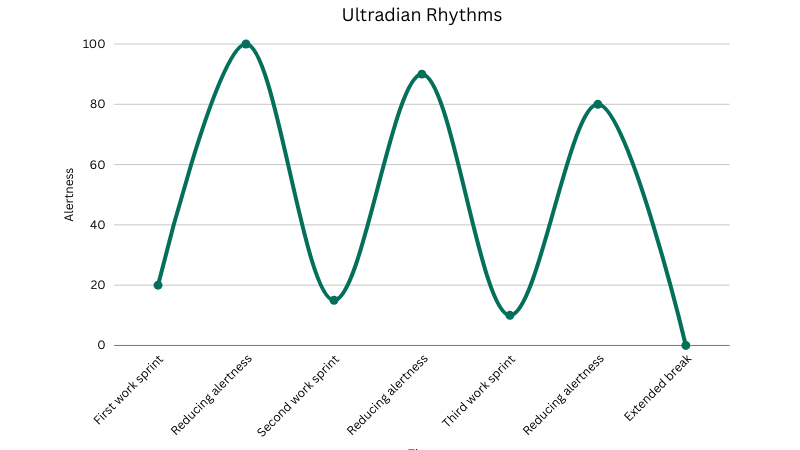
Research on ultradian rhythms shows our brains naturally cycle through periods of higher and lower alertness roughly (known as “brain-rest activity cycles”) every 90–120 minutes, and breaking this into shorter, focused blocks of around 50 minutes with regular rest periods works with, rather than against, these natural energy cycles.
The 50/10 method sits in this sweet spot: it gives your brain enough time to actually achieve something substantial whilst preventing the mental fatigue that tends to set in beyond this. Combined with techniques like environment design, it creates ideal conditions for sustained deep work.
How the 50/10 Method Works
The structure is simpler than most productivity systems:
Work sprint: 50 minutes of deep focus on a single task
Break: 10 minutes rest away from all work
Repeat: Maximum 2-3 consecutive cycles before you take an extended break
That’s it. No complex rules about long breaks every four cycles. No distinction between “pomodoros” and “long pomodoros.” Just alternating between focused work and genuine rest.
The method works because it respects three principles that Pomodoro overlooks:
1. Flow state duration: Your brain takes time to enter a state of deep focus. With 50-minute blocks, you get 30-35 minutes of actual flow work. With 25-minute Pomodoro, you get maybe 5-10 minutes before the timer interrupts.
2. Context switching cost: Every interruption—even planned ones—costs mental energy to resume. Fewer interruptions means less energy wasted on restarting.
3. Task completion satisfaction: Fifty minutes allows you to finish meaningful chunks of work. You close out entire sections, solve complete problems, draft whole documents. This completion triggers dopamine release that motivates the next sprint.

Setting Up Your First 50/10 Sprint
Before the Sprint
Start with preparation, not the timer. Choose one specific task. Not “work on project” but “complete the introduction for my report” or “analyse Q3 data for tomorrow’s meeting.” Vague tasks kill focus because your brain wastes energy deciding what to do next.
Clear your environment. Close unnecessary applications. Put your phone on Do Not Disturb. Tell colleagues you’re unavailable for 50 minutes. This prep takes 2-3 minutes but eliminates the interruptions that would otherwise fragment your focus.
Define your end state. What does “done” look like for this 50-minute sprint? Having a clear finish line keeps you moving forward rather than wandering.
During the Sprint
Start the timer and work. That’s it.
When distractions arise, jot them on paper without engaging. Just note it and return to work.
If you finish your planned task early, continue with the next logical step. Don’t artificially stretch work to fill time, but don’t break early either. The 50-minute container creates momentum.
Around minute 40-45, you might feel the urge to check how much time remains. Resist this. Clock-watching fragments focus. Trust that the timer will alert you when time’s up.
The Break
This is where most people fail at the 50/10 method. Ten minutes isn’t “quick email check” time. It’s genuine rest.
Ineffective breaks include: checking emails, social media or the news, having difficult conversations, planning your next sprint, or anything requiring intense mental effort.
Effective breaks include: walking outside, stretching, making tea, staring out the window, chatting with a colleague about non-work topics, eating a snack, or doing some breathing exercises.
The break serves one purpose: allowing your overheated brain to recover. Any activity requiring focus defeats this purpose.
When the 10 minutes end, decide whether you’re starting the next sprint or taking an extended break. Don’t ease back into work gradually. The sharp transition is intentional—it trains your brain to engage fully when the sprint begins.
QUICK WIN:
Right now, set a phone reminder for tomorrow morning: “50/10 sprint”. When it goes off, pick your single most important task, set a timer for 50 minutes, and close everything else. Just one sprint. That’s all. Notice how much you accomplish compared to a normal scattered hour.
The Science Behind 50-Minute Focus
The 50-minute work block isn’t an arbitrary number. It aligns with several well-established findings from cognitive and biological research.
Ultradian Rhythms and Natural Attention Cycles
Your brain doesn’t sustain attention in a flat line — it operates in waves. These are called ultradian rhythms: biological cycles that repeat multiple times throughout the day, typically lasting 90-120 minutes. Within each cycle, your brain moves through a period of high alertness followed by a natural dip where concentration drops and fatigue sets in.
The first 50-60 minutes of each cycle represent peak cognitive performance. After that, attention degrades noticeably. The 50/10 method works with this biology rather than against it — you’re capturing the productive peak of each ultradian cycle and resting before the dip sets in. Pomodoro’s 25-minute blocks, by contrast, cut you off mid-peak, whilst 90-minute deep work sessions push you into the fatigue zone.
The True Cost of Interruptions
In her 2008 study, “The Cost of Interrupted Work: More Speed and Stress.”Gloria Mark (professor of informatics at the University of California and author of Attention Span: Finding Focus for a Fulfilling Life) found that it takes an average of 23 minutes to regain full focus after an interruption. In a standard Pomodoro cycle of four 25-minute blocks, you experience four planned interruptions — that’s potentially 92 minutes of recovery time scattered across a morning. With the 50/10 method, the same three hours of work contains fewer interruptions, preserving significantly more mental energy for actual productive work.
This isn’t just about losing time. Each interruption forces your brain to dump its mental model of whatever problem you were solving and rebuild it from scratch. For complex tasks like writing, programming, or strategic analysis, this rebuilding process is where the real cost lies. The 50-minute block gives you enough unbroken time to build a rich mental model and then actually use it.
Flow State Research
Mihaly Csikszentmihalyi’s research on flow (see his book Flow: The Psychology of Optimal Experience)— the state of complete absorption where performance peaks and time seems to disappear — consistently shows that flow requires an extended ramp-up period. Most people need 15-20 minutes of uninterrupted focus before entering flow. In a 25-minute Pomodoro, that leaves just 5-10 minutes of actual flow work before the timer pulls you out. In a 50-minute sprint, you get 30-35 minutes of deep, productive flow — roughly five times more per session.
As a psychologist, this is what I find most compelling about the 50/10 structure. It’s not a productivity hack — it’s a method that’s genuinely aligned with how your brain is wired to focus. You’re not fighting your biology; you’re working in rhythm with it.
When 50/10 Outperforms Other Methods
The 50/10 method isn’t universally superior. It excels in specific situations:
Complex cognitive work: Creative work, complex problem-solving, and immersive tasks (think programming, writing, analysis, strategic planning, design work) all require sustained concentration. The 50/10 method provides enough time for you to reach and maintain that state. See our complete guide to focusing at work for more on this.
High-context tasks: Work requiring you to hold multiple variables in working memory simultaneously. The longer duration means less time spent rebuilding context after breaks.
Remote work situations: When working from home, the clear boundaries of 50/10 sprints prevent the drift into always-on, scattered work patterns.
50/10 vs 90-Minute Deep Work Blocks
In his book, Deep Work: Rules for Focused Success in a Distracted World, Cal Newport advocates for extended focus sessions of 90 minutes or more. The logic is sound — longer sessions mean more time in flow and fewer interruptions. But in practice, 90-minute blocks create problems that the 50/10 method avoids.
First, 90 minutes pushes past the productive peak of most ultradian cycles. Around the 60-minute mark, cognitive fatigue begins setting in for most people, and the final 30 minutes often produce noticeably lower quality work. You feel like you’ve been productive because you worked for a long time, but the output doesn’t always reflect the effort.
Second, 90-minute blocks are harder to schedule. Most professionals have meetings, calls, and commitments that fragment their day. Finding a clear 90-minute window can feel impossible, which means deep work simply doesn’t happen. A 50-minute sprint fits between meetings. It’s realistic in a way that 90 minutes often isn’t.
Third, the psychological barrier is lower. Committing to 50 minutes feels manageable; committing to 90 minutes can trigger procrastination, particularly on tasks you’re already resisting. The 50/10 method gives you most of the depth benefits of extended focus sessions with significantly less resistance and fatigue.
That said, if you’re someone who routinely enters deep flow and can sustain genuine focus for 90 minutes, there’s no reason to shorten your sessions. The 50/10 method is most valuable for people who find 90 minutes unrealistic or unsustainable — which, in my experience, is the majority of working professionals.

When to Use Pomodoro Instead
Fifty-minute sprints aren’t always appropriate:
Use 25-minute Pomodoro for administrative tasks—emails, scheduling, quick decisions, routine work. These don’t require deep focus, and shorter cycles keep energy high.
Choose Pomodoro when you’re easily distracted or building focus habits. If 50 minutes feels impossible, start with 25 and gradually extend as your concentration improves.
Pomodoro works better for ADHD or attention difficulties where maintaining focus for 50 minutes isn’t realistic. The frequent breaks in Pomodoro provide more regular dopamine hits and reduce overwhelm.
For mixed task lists combining admin and deep work, use the 1-3-5 rule to identify which tasks deserve 50-minute sprints versus 25-minute intervals.
Common Mistakes That Kill the Method
Running Too Many Consecutive Sprints
Two 50-minute sprints (100 minutes total work) is sustainable. Three sprints pushes limits. Four or more guarantees diminishing returns.
Your brain requires metabolic resources for sustained focus. These deplete regardless of break frequency. After 2-3 hours of intensive focus, you need an extended break (20-30 minutes) or a shift to lighter work.
Pushing beyond this doesn’t produce proportionally more output. It produces exhausted, low-quality work.
Flexible Sprint Duration
“I’ll just work until I finish this section” defeats the entire purpose. The timer creates urgency. Remove the timer, and you lose the psychological benefit of working against a deadline.
Stick to 50 minutes even when you haven’t finished. Note where you stopped, take your break, then resume. This trains your brain to work efficiently within time constraints.
Pseudo-Breaks
Checking Slack “just quickly” isn’t a break. Neither is reading work emails, browsing LinkedIn, or planning tomorrow’s schedule. These activities require prefrontal cortex engagement—the exact resource you’re trying to restore.
Ten minutes of actual rest beats 20 minutes of “semi-break” activity. Commit fully to breaks or don’t take them at all.
No Break Between Sprints
The break isn’t optional. It’s not a reward for finishing—it’s a requirement for starting the next sprint effectively.
Skip breaks and watch your focus deteriorate. The second sprint will be noticeably worse than the first. The third will be terrible. The break isn’t wasted time; it’s the foundation for sustained productivity.
QUICK WIN:
Write a “break menu” — a short list of 5-6 things you’ll actually do during your 10-minute breaks (walk to the kitchen, stretch, step outside, make a drink). Stick it next to your screen. When the timer goes off, pick one from the list instead of defaulting to email or social media. Having a plan for breaks is just as important as having a plan for the sprint.
Adapting 50/10 to Your Schedule
Real workdays rarely align perfectly with productivity methods. Here’s how to adapt:
Morning routine: Two 50-minute sprints before lunch. This captures your peak cognitive hours for demanding work. Use morning sprints for tasks requiring maximum mental clarity.
Meeting-heavy days: Single 50-minute sprint between meetings for critical work. Better to complete one meaningful task than scatter attention across multiple half-finished items.
Afternoon energy dip: Consider shorter focus blocks (30-40 minutes) post-lunch when alertness naturally drops. Forcing 50-minute sprints when energy is low produces poor results.
Flexible ending time: If you must finish in 90 minutes, do one 50-minute sprint, break, then 30 minutes of focused work. Adapt the system to reality whilst maintaining the focused work pattern.
Similar to how friction logging reveals obstacles in your workflow, tracking when 50/10 works versus struggles helps you optimize timing.
Your Implementation Plan
Start small. One 50-minute sprint tomorrow morning for your most important task. Don’t restructure your entire workday around 50/10 immediately.
Track what you accomplish in that single sprint versus an equivalent hour of normal work. The comparison reveals whether this method suits your work style.
If the first sprint works well, add a second sprint the following day. Try habit stacking to make it consistent — “After I sit down at my desk with coffee, I will start my first 50/10 sprint.” Gradually expand as you build the focus muscle and understand your limits.
Within two weeks, you’ll know whether 50/10 fits your work. If it does, you’ve found a sustainable focus system. If it doesn’t, you’ve only invested minimal time discovering this.
The goal isn’t adopting another productivity technique. It’s finding the focus structure that lets you do your best work consistently.
Frequently Asked Questions
Is the 50/10 method better than Pomodoro?
It depends on the task. For complex, cognitively demanding work — writing, programming, analysis, design — 50/10 consistently outperforms Pomodoro because it gives your brain enough time to reach and sustain deep focus. For quick administrative tasks, routine work, or when you’re struggling to concentrate at all, Pomodoro’s shorter intervals are often more effective. Many people use both: 50/10 for their most important deep work and Pomodoro for lighter tasks.
What should I do during the 10-minute break?
Anything that doesn’t require cognitive effort. Walk, stretch, make a drink, look out of the window, chat about non-work topics, eat a snack, or do a few minutes of breathing exercises. The key rule: avoid anything that engages your prefrontal cortex — so no emails, social media, news, or work planning. Your brain needs those 10 minutes to genuinely recover, not switch to a different type of concentration.
How many 50/10 sprints can you do in a day?
Most people can sustain 4-6 quality sprints per day, though not all consecutively. After 2-3 back-to-back sprints, you’ll need an extended break of 20-30 minutes. Realistically, with meetings, admin, and other commitments, 3-4 focused sprints represents an exceptionally productive day. That’s 2.5-3.5 hours of genuinely deep work — more than most professionals achieve in an eight-hour day of unfocused effort.
Can I adjust the timing to 45/15 or 60/10?
Yes — the 50/10 split is a starting point, not a rigid rule. Some people find 45 minutes more sustainable; others prefer 60. The important principles are: keep your work block long enough to reach flow (at least 40 minutes), take a genuine break (at least 10 minutes), and be consistent with whatever ratio you choose. Avoid constantly adjusting the timing, though — the predictability of a fixed rhythm is part of what makes the method effective.
RESOURCES:
I only recommend resources that I either use personally or have researched and feel are genuinely helpful for my readers. Resources sometimes contain affiliate links; if you purchase through these, I may earn a small commission at no extra cost to you.
Recommended Reading
Deep Work by Cal Newport — The case for extended, distraction-free focus. Paperback | Kindle | Audible
Flow by Mihaly Csikszentmihalyi — The original research on flow states Paperback | Audible
Timer Apps:
Focus Keeper and Pomofocus — clean timer apps that lets you customise work and break durations (set to 50/10)
Related Articles from the Marginal Gains Blog:
How to Focus Better at Work — Deep work strategies for sustained concentration
The 1-3-5 Rule — Prioritise which tasks deserve a 50/10 sprint
Friction Logging — Identify what’s disrupting your focus sessions
The Two-Minute Rule for Habits — Build the daily habit of doing your first sprint
I'm Simon Shaw, a Chartered Occupational Psychologist with over 20 years of experience in workplace psychology, learning and development, coaching, and teaching. I write about applying psychological research to everyday challenges - from habits and productivity to memory and mental performance. The articles on this blog draw from established research in psychology and behavioural science, taking a marginal gains approach to help you make small, evidence-based changes that compound over time, allowing you to make meaningful progress in the areas you care about most.