
How to Focus Better at Work: The Complete Deep Work Guide

Here’s a scenario you’ll probably recognise. You sit down with big plans to nail that important project — a tricky report, a creative brief, or some strategic thinking that actually matters. Ten minutes later, you’ve checked your email twice, peeked at social media, and somehow ended up down a rabbit hole reading about something completely unrelated. An hour has passed, but the actual work? Still sitting there, untouched.
And here’s the thing — this isn’t you being lazy or easily distracted. You’re experiencing a massive clash between how your brain is wired and how modern workplaces expect you to operate. Cal Newport coined the term “deep work” in his book Deep Work: Rules for Focused Success in a Distracted World to describe the kind of focused, brain-intensive work that actually moves the needle. The problem? Most workplaces are set up for the exact opposite — what he calls “shallow work.” All those emails, quick chats, and low-level administrative tasks.
Learning how to focus better at work isn’t just a bit harder than it used to be. For most of us, it’s become nearly impossible without a proper plan. One study by Gloria Mark found that the average office worker switches tasks every few minutes. Meanwhile, the work that genuinely matters — writing, analysis, solving problems, strategic thinking — needs hours of uninterrupted focus, not minutes.
But before you start fantasising about quitting your job and moving to a cabin in the woods, here’s the good news: you don’t need to go full hermit mode. You need a practical system for protecting your focus within the chaos. That’s exactly what this article gives you — strategies for how to focus better at work in real workplaces, not idealised fantasy ones.
Why Learning to Focus Better at Work Actually Matters
Your Brain, Distracted
When you jump from Task A to Task B, your brain doesn’t instantly follow along. There’s something called “attention residue”, a concept identified by psychologist Sophie Leroy — part of your mental focus stays stuck on the previous task even after you’ve moved on. Once you’ve become distracted, this residue can hang around for over 20 minutes. Research shows that after being interrupted, it can take 10-25 minutes to fully return to your original task and regain deep focus.
The Career Case for Focus
Here’s the business case for learning how to focus better at work: it’s where real value gets created. All that shallow work — the emails, the meetings about meetings, the admin busywork — is necessary, sure. But it’s maintenance. It doesn’t typically lead to breakthroughs, promotions, or game-changing results.
Think about what actually moved your career forward this past year. Probably not the 4,000 emails you sent. More likely it was that analysis that changed company strategy, the presentation that won the big client, the code that finally solved that stubborn problem. All of that? Deep work requiring proper focus.
QUICK WIN:
Think about the single piece of work you completed in the last month that you’re most proud of. How long did it actually take? Now think about how long it took because of interruptions. That gap — between how long good work takes and how long it actually took — is the cost of not knowing how to focus better at work. Write down that number.
Why “Just Concentrate Harder” Doesn’t Work
Understanding why focus is so hard is crucial, because generic advice like “eliminate distractions” completely misses the point. You can’t eliminate distractions in most modern workplaces — you can only get strategic about managing them.

The Three Big Things Working Against You
1. Your Workplace Culture: Many workplaces have accidentally created cultures where being constantly available equals being professional. These aren’t just annoying individual habits — they’re systematic expectations that actively punish attempts to protect your focus. Learning how to politely refuse workplace requests can be a huge help here.
2. How Tech is Designed: Your tools are literally engineered to fragment your attention. Notification systems, those anxiety-inducing red badges, infinite scrolling — these features exist because keeping you engaged makes money for the platforms. It’s not a conspiracy; it’s just business. But it doesn’t help you work better. Breaking free from constant digital interruption requires a systematic approach — our digital detox guide provides a structured framework for reclaiming your attention.
3. Your Brain Gets Trained Wrong: The more fragmented your attention becomes, the harder it gets to focus. Your brain adapts to constant stimulation and develops a “novelty bias” — you start to feel genuinely uncomfortable with sustained attention on a single task. Distraction breeds more distraction. Your brain literally rewires itself to crave interruption.
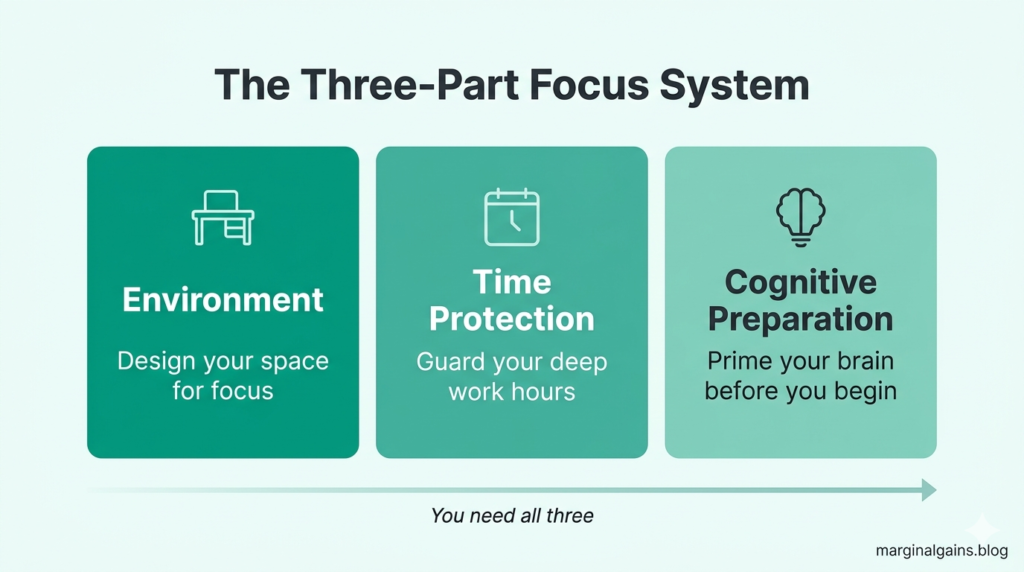
How to Focus Better at Work: A Simple Three-Part System
Here’s what actually works. The system has three parts: fixing your environment, protecting your time, and preparing your brain. You need all three. Trying to force focus through sheer willpower alone is like trying to sleep with strobe lights flashing in your face — technically possible, but why make it harder than it needs to be?
Part 1: Sort Out Your Environment (15 Minutes)
Your Physical Space
- Close your office door or put on headphones as a visual “leave me alone” signal. In an open office, face away from walkways if you can — it reduces interruption by about 40%.
- Clear your desk except for what’s directly relevant to your current task. Visual clutter genuinely increases stress hormones and reduces working memory. See our guide on how to set up your home office for better focus.
- If you can, change location entirely. A library, conference room, or a different room at home — anywhere that doesn’t have your usual “shallow work” associations. The environmental change acts as a mental trigger.
Your Digital Setup
- Phone on airplane mode, ideally in a drawer. Physical distance matters — even knowing your phone is within reach reduces cognitive performance on complex tasks.
- Close every application except what you actually need. Properly quit Slack or Teams, close email, shut down social media. Use browser extensions like StayFocusd to block distracting websites. Keep browser tabs to a minimum.
- Set an email autoresponder: “I’m working on a deadline until [time] and checking emails periodically. I’ll get back to you by [time]. For anything urgent, ring me.” This manages expectations and stops you feeling guilty about not being constantly available.
QUICK WIN:
Right now, before your next piece of focused work, put your phone in a drawer — not face-down on your desk, in a drawer. Close every app except the one you need. Set a 60-minute timer. This single environmental change is the fastest way to learn how to focus better at work, and you can test it in the next hour.
Part 2: Protect Your Time (Weekly Planning Required)
The biggest mistake people make when trying to focus better at work is “hopeful scheduling” — thinking “I’ll do focused work when I find time.” Spoiler: you won’t find time. You have to actively create it and defend it.
Split your day into deep and shallow blocks. For example: 9am to midday for focused work, 1pm to 5pm for meetings, email, and admin. This acknowledges that most jobs genuinely require shallow work — you’re not trying to eliminate it, just keeping it contained to specific times.
Start with this bare minimum focus schedule:
- Monday, Wednesday, Friday: 2-hour morning blocks for focused work
- Tuesday, Thursday: meetings and collaborative work only
- Actually put these blocks in your calendar as “Focus Time” and mark yourself as busy
That’s six hours of proper focused work per week — enough to make real progress on complex projects whilst still being available when people need you. One absolutely critical rule: protect the first 90 minutes of your workday whenever you can. Starting your day with email or meetings is like using your best energy on your least important work.
Part 3: Prepare Your Brain (5-Minute Daily Ritual)
Your brain needs a transition ritual to switch from “scattered and reactive” mode to “focused and productive” mode. Without it, you’ll waste the first 30 minutes of your focus time just warming up.
- Write down exactly what you’ll accomplish in this session. Be specific: “Draft sections 2-4 of the report” not “Work on report.” Vague goals lead to vague work.
- Gather everything you need — research, notes, references — so you won’t break focus hunting for things later.
- Take three proper deep breaths. Sounds simple, but it genuinely helps you shift physiologically from stressed to calm.
- Set a visible timer for your focus duration. This creates helpful psychological pressure and stops you constantly checking the clock.
QUICK WIN:
Open your calendar right now and block three 90-minute slots next week labelled “Focus Time — do not book.” Monday, Wednesday and Friday mornings if possible. Mark yourself as busy. That’s it. You’ve just created more protected focus time than most knowledge workers get in a month.
When Things Go Wrong (And They Will)
The Quick Recovery Method
When you get interrupted during focused work:
- Immediately jot down your current thought before dealing with the interruption. This externalises where your head was so you can get back there faster.
- Handle the interruption as briefly as possible without being rude.
- Before diving back in, spend 90 seconds reviewing what you wrote down and rebuilding your mental context. This dramatically cuts the attention residue problem.
- Reset your timer for whatever focus time remains.
When Your Mind Wanders
Your mind will wander, especially in week one. This is completely normal — your brain is habituated to frequent stimulation. When you catch your attention drifting, don’t beat yourself up. Simply notice the drift and gently redirect back to your work. If the same distraction keeps surfacing (like remembering an email you need to send), write it on a “deal with later” list and return to focus. Deep work requires a clear mental runway before you begin. Mental clutter clearing is another good strategy for offloading background tasks so focused attention becomes possible.
Think of this like fitness training. Initially, you might only manage genuine focus for 15-20 minutes before drifting. With practice over 2-3 weeks, this naturally extends to 60-90 minutes. Techniques like mindfulness can also help here — the same attention-training principles apply directly to how to focus better at work.
When You Start to Procrastinate
When you feel yourself procrastinating rather than focusing on your priorities, consciously unblock your resistance to getting things done. The 2-minute rule for procrastination is a technique that stops small tasks from accumulating on your to-do list and distracting you from your main focus. Apply it to quickly clear minor tasks that fragment your attention. For additional inspiration, see our list of 50 2-minute tasks to overcome procrastination.
Advanced Focus Techniques (Once You’ve Got the Basics)
The “Grand Gesture” (For Important Projects)
For exceptionally important work, create what Newport calls a “grand gesture” — a significant change in environment that signals to your brain this work is unusually important. Cal Newport writes his books in rented cabins. J.K. Rowling famously booked a hotel suite to finish Harry Potter. Bill Gates takes annual “Think Weeks” in a cottage.
Your version doesn’t need to cost a fortune — working in a library, or simply working from home in a room you’ve never worked in before. The psychological boost from the environmental change can genuinely enhance your focus on high-stakes work.
The Shutdown Ritual (End Your Day Properly)
How you finish your workday affects both your recovery and tomorrow’s ability to focus. A five-minute shutdown ritual:
- Quickly review everything that came in today to ensure nothing urgent got missed.
- Update your task list with anything that needs handling tomorrow.
- Check tomorrow’s calendar and confirm you’ve protected focus time.
- Say out loud: “Shutdown complete.”
The verbal declaration isn’t daft — it’s a psychological anchor that helps your brain properly release work concerns. Without it, you’ll experience the work rumination that prevents proper recovery and makes tomorrow’s focus harder.
Batch Your Shallow Work
Rather than scattering admin tasks throughout the day, batch them into dedicated blocks. Learn how to batch emails in two 30-minute sessions (say, 11am and 4pm) rather than constantly checking. This eliminates attention residue from constant task-switching, makes you faster at admin work, and creates clear boundaries that protect your focus time.
Common Mistakes When Trying to Focus Better at Work
Starting Too Ambitious: Don’t try for four-hour focus sessions straight away. Start with 60-90 minutes. Your attention capacity is like fitness — it develops gradually. Push too hard too fast and you’ll burn out and quit the whole thing.
The All-or-Nothing Trap: If you block out focus time and then get dragged into an urgent meeting, that doesn’t mean the day’s ruined. Thirty minutes of proper focus beats zero. Don’t let perfection be the enemy of the good.
Forgetting to Actually Rest: Focused work is mentally exhausting. Research suggests 3-4 hours daily is the sustainable maximum for most people. Schedule proper rest — walks, exercise, genuine social connection — not just more shallow work. Quality sleep is the ultimate cognitive reset — discover how to improve sleep quality to ensure your brain recovers fully between focus sessions.
Ignoring Workplace Reality: In some workplaces, blocking daily focus time genuinely isn’t possible without permission. Have an honest conversation with your manager: “I’d like to protect 9-11am three days weekly for focused project work. I’ll be fully responsive outside those windows. Can we trial this for a month?” Most managers will support this if you frame it around productivity.
How to Tell If Your Focus Is Improving
Track your focus hours weekly. Use a simple spreadsheet or notebook noting: date and time of your focus session, actual duration of genuine focus, what you accomplished, and how difficult maintaining focus felt (1-10 scale).
After a month, you’ll spot clear patterns: certain times of day work better, specific environments boost your focus, particular tasks need different session lengths. A realistic target for most knowledge workers: 8-12 hours of focused work weekly. That sounds modest, but it’s probably 4-8 times more than you’re currently achieving.
QUICK WIN:
At the end of today, write down how many minutes of genuinely focused work you completed — no interruptions, no task-switching. Be honest. That number is your baseline. Track it daily for one week. You cannot improve what you don’t measure, and most people are shocked how low the real figure is.
The Bottom Line on How to Focus Better at Work
Learning how to focus better at work isn’t some optional productivity hack. In an economy where value increasingly comes from complex problem-solving, strategic thinking, and creative work, the ability to focus intensely is fundamental infrastructure. It’s what exceptional work gets built on.
Try logging your friction points at work, then systematically eliminate them. The ability to focus deeply isn’t just about getting more done — it’s also the foundation for learning effectively. The same cognitive conditions that enable deep work determine how well new information is encoded and retained. If you want to take that further, our guide on how to learn faster covers the memory science behind this in detail.
Here’s the genuinely good news: unlike raw talent or fancy credentials, focused attention is trainable. You can genuinely improve your capacity for concentrated work through deliberate practice. The person who can reliably produce four hours of focused work daily has an enormous competitive advantage over equally talented peers who can’t.
Your brain is capable of remarkable things. You just need to give it the space to actually do them. Start this week. Pick three morning blocks. Clear 90 minutes. Follow the three-part system, and track what happens.
RESOURCES:
I only recommend resources that I either use personally or have researched and feel are genuinely helpful for my readers. Resources sometimes contain affiliate links; if you purchase through these, I may earn a small commission at no extra cost to you.
Recommended Reading:
Deep Work: Rules for Focused Success in a Distracted World by Cal Newport — The foundational text on deep work that introduced the concepts underpinning this article. Paperback | Kindle | Audible
Attention Span: Finding Focus for a Fulfilling Life by Gloria Mark — Research-backed insights from the leading expert on workplace interruptions and task-switching. Paperback | Kindle | Audible
The Distracted Mind: Ancient Brains in a High-Tech World by Adam Gazzaley — Neuroscience perspective on why modern technology fragments attention and how to counter it. Paperback | Kindle
Indistractable: How to Control Your Attention and Choose Your Life by Nir Eyal — Practical framework for managing internal triggers and external distractions at work. Paperback | Kindle | Audible
Useful Tools:
Freedom and StayFocusd — Cross-device and browser-based website blockers for scheduled focus blocks
Brain.fm — Neuroscience-based focus music designed to enhance concentration
Toggl Track or Clockify — Free time-tracking apps for monitoring actual focus hours
Related Articles from Marginal Gains:
How to Batch Emails — Implement the batching strategy for handling shallow work so it stops bleeding into focus time.
The 2-Minute Rule — Clear minor tasks that fragment attention before deep work sessions.
How to Do a Digital Detox — Systematic approach to breaking the digital distraction patterns that undermine focus.
Mindfulness for Focus — Train your attention capacity through meditation practices that directly complement the techniques in this article.
Home Office Setup for Productivity — Design your physical environment for better focus.
I'm Simon Shaw, a Chartered Occupational Psychologist with over 20 years of experience in workplace psychology, learning and development, coaching, and teaching. I write about applying psychological research to everyday challenges - from habits and productivity to memory and mental performance. The articles on this blog draw from established research in psychology and behavioural science, taking a marginal gains approach to help you make small, evidence-based changes that compound over time, allowing you to make meaningful progress in the areas you care about most.