
Mindfulness for Focus: Stop Your Mind Racing

Your mind wanders about 47% of the time you’re awake, according to research by Harvard psychologists Killingsworth and Gilbert — who tracked 250,000 real-time data points from 2,250 people going about their daily lives. You can download the tracking app used in this study for free. Nearly half your day spent mentally somewhere else — replaying yesterday’s conversation, planning tonight’s dinner, worrying about next week’s deadline. You’re sitting in a meeting but mentally planning your shopping list. Reading an email but thinking about an argument from this morning. Sometimes, it feels like your attention has more tabs open than your browser. Mindfulness for focus offers a practical, research-backed solution to this constant mental drift.
This constant mental drift isn’t just annoying — it measurably impairs your cognitive performance. When your attention wanders, you miss information, make more mistakes, and need longer to complete tasks. Your working memory gets cluttered with irrelevant thoughts, leaving less capacity for the task at hand.
Mindfulness training offers a practical solution. By systematically practising sustained attention, you strengthen the brain networks that control focus. This isn’t mystical — it’s straightforward cognitive training backed by over 100 controlled studies. People who practise mindfulness show measurably better focus, stronger working memory, and improved ability to ignore distractions.
The techniques here draw from psychological research applied to everyday mental performance. You’ll learn what mindfulness actually does to your attention systems and how to use these practices strategically for better focus.
What Mindfulness for Focus Actually Means: Beyond the Buzzword
Mindfulness gets thrown around as a vague wellness concept, but psychologically it has a specific meaning: paying attention to present-moment experience with an open, non-judgmental attitude. That simple definition contains three practical components that explain why it improves focus.
- Intentional attention control. Mindfulness requires deliberately choosing where your attention goes — usually your breathing, bodily sensations, or what you’re sensing right now. This isn’t passive daydreaming but active focus management. Every time you notice your mind has wandered and bring it back, you’re exercising the same mental muscle you use for any focused work.
- Staying in the present. Mindfulness trains you to focus on what’s happening now rather than rehashing the past or planning the future. This matters because ruminating about yesterday or worrying about tomorrow both consume working memory — the mental space you need for current tasks. Research shows mind wandering predicts mistakes, slower reactions, and poor comprehension. Mindfulness trains the opposite habit. Mindfulness also helps you show up more fully in conversation — and social connection is one of the most underrated tools for brain health available to you.
- Non-judgmental observation. Rather than constantly evaluating whether experiences are good or bad, mindfulness encourages simply noticing what’s there. This acceptance reduces the mental effort of continuous judgment and emotional reaction, preserving cognitive resources for your actual work. Studies show this non-judgmental stance reduces the psychological distress that typically disrupts concentration.
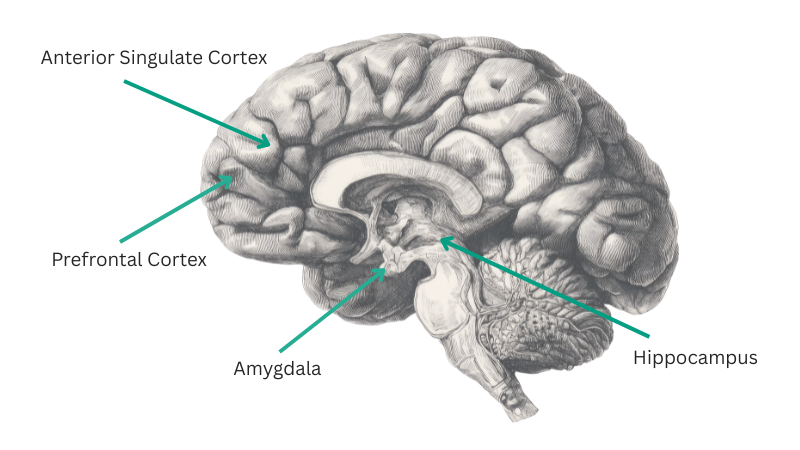
As a psychologist, I find the neuroscience here genuinely compelling. Mindfulness practice consistently strengthens four interconnected brain regions: the prefrontal cortex, which exercises top-down cognitive control, maintaining chosen focus and suppressing irrelevant thoughts; the anterior cingulate cortex, which acts as an executive attention monitor — detecting when focus has drifted and signalling the need to redirect; the amygdala, which regulates emotional reactivity and stress responses, reducing the psychological arousal that so often disrupts concentration; and the hippocampus, which supports memory consolidation and is particularly vulnerable to chronic stress. Research shows that regular mindfulness practice produces measurable changes in all four regions — including increased grey matter density and stronger connectivity between them. When you return your attention to your breath for the hundredth time in a single session, you’re not failing — you’re doing exactly the training these networks need.
QUICK WIN:
Next time you sit down to work, spend just two minutes focusing on your breathing before you start. Don’t control it — simply notice it. When your mind wanders (it will), return your attention to the breath. That’s the entire practice. Do it again tomorrow.
Practical Implementation: Starting a Mindfulness for Focus Practice
Use guided instruction initially. Whilst experienced practitioners may meditate without guidance, beginners benefit from structured instruction. Numerous apps provide guided meditations with clear directions. Research on structured programmes like Mindfulness-Based Stress Reduction suggests they produce larger benefits than self-directed practice, likely because proper instruction prevents common mistakes that undermine effectiveness.
Expect mind wandering — it’s not failure but the training itself. The common misconception that meditation requires an empty mind causes unnecessary frustration. Mind wandering will occur constantly, especially initially. Each time you notice wandering and redirect attention, you’re successfully practising the skill that transfers to improved focus elsewhere. Studies show even expert meditators experience mind wandering; they simply detect and redirect it more efficiently.
Begin with focused attention on breathing. Sit comfortably with eyes closed or gaze lowered. Direct attention to breathing sensations — wherever you notice them most clearly (nostrils, chest, abdomen). Don’t control the breath; simply observe it. When you notice attention has wandered (to thoughts, sounds, sensations), acknowledge this without judgment and return focus to breathing. That’s the complete basic technique — deceptively simple but genuinely challenging.
Track both formal practice and informal mindfulness. Formal practice means dedicated meditation sessions. Informal practice involves bringing mindful awareness to routine activities: eating, walking, washing up. Research suggests informal practice complements formal meditation by extending attentional training throughout daily life. However, studies show formal practice produces larger cognitive effects, suggesting dedicated sessions remain essential.
Body scan meditation represents a further useful practice. This involves systematically directing attention through different body regions, noticing sensations without judgment. Whilst primarily developed for stress reduction and body awareness, body scan also trains sustained attention and may improve your ability to disengage from repetitive thinking by redirecting focus to physical sensations.
Addressing Common Obstacles to Mindfulness for Focus
Mindfulness practice encounters predictable obstacles. Understanding these in advance prevents them from derailing your practice.
The “I can’t clear my mind” misconception is nearly universal. This fundamentally misunderstands meditation’s purpose. You’re not attempting to stop thoughts — that’s neurologically impossible without serious brain damage. You’re training awareness of thoughts and ability to disengage from them. Thinking isn’t failure; remaining unaware of thinking or being unable to redirect attention represents the challenge meditation addresses. Reframing this expectation prevents the discouragement that causes many beginners to quit.
Boredom and restlessness emerge frequently, particularly in early practice. Sitting quietly with breathing feels tedious compared to normal stimulation. This reflects habitual patterns: your nervous system expects constant novelty. The initial discomfort demonstrates precisely why training sustained attention on non-stimulating objects proves valuable — it develops tolerance for the boring-but-important tasks that knowledge work demands. Research shows boredom during meditation decreases with practice as your control over your attention develops.

Physical discomfort can sabotage practice. Whilst traditional meditation often emphasises specific postures, research suggests posture matters less than sustained attention. If sitting causes pain that dominates awareness, try different positions: chair rather than floor, lying down (though drowsiness increases), walking meditation. The goal involves finding a position sustainable for your practice duration whilst maintaining alertness.
Expectations of immediate dramatic results lead to disappointment. Unlike medications producing rapid effects, mindfulness operates through gradual skill development. Cognitive benefits emerge progressively over weeks and months, not during individual sessions. Research shows measurable improvements typically require 20–40 hours of cumulative practice — roughly 6–12 weeks at 20 minutes daily. Setting appropriate timelines prevents premature abandonment before benefits manifest.
QUICK WIN:
Set a seven-day experiment: ten minutes of breathing meditation each morning before checking your phone. Keep a simple note each evening rating your focus that day from 1–10. After seven days, review whether your scores changed. The data from your own experience is more persuasive than any research study.
How Mindfulness Works with Other Focus Strategies
Mindfulness for focus isn’t a replacement for other ways to improve your focus — it works alongside them. Understanding how these approaches fit together helps you combine them effectively rather than treating mindfulness as a standalone solution.
Mindfulness and regular breaks make a powerful combination. Research on mental recovery shows that a brief mindfulness practice during your break helps you recharge better than just sitting there scrolling your phone. A 5-minute mindfulness session mid-afternoon gives you double benefits: you’re training your attention whilst also giving your brain the rest it needs. Studies show these mindful breaks reduce afternoon concentration problems more effectively than coffee breaks.
Sleep and mindfulness help each other. Mindfulness practice improves your sleep quality, probably because it reduces the ruminating thoughts and emotional stress that keep people awake. Better sleep, in turn, makes it easier to focus and remember things — exactly what mindfulness training aims to improve. Research shows mindfulness-based approaches effectively treat insomnia, with people sleeping better and thinking more clearly during the day.
Cutting down on digital distractions and practising mindfulness tackle the same problem from different angles. For example, reducing visual clutter in your workspace changes your environment to make focus easier. Mindfulness builds your internal ability to stay focused even when distractions are present. Together, they give you both a better setup and better skills for maintaining concentration.
Mindfulness is also one of the most effective tools for managing overthinking — the tendency to get stuck in repetitive, unhelpful thought loops. See our guide on stopping overthinking for practical techniques that complement mindfulness practice. It also pairs nicely with practical systems for managing mental load. Mental clutter clearing addresses the structural side of an overloaded mind — the tasks and decisions that meditation alone won’t resolve.
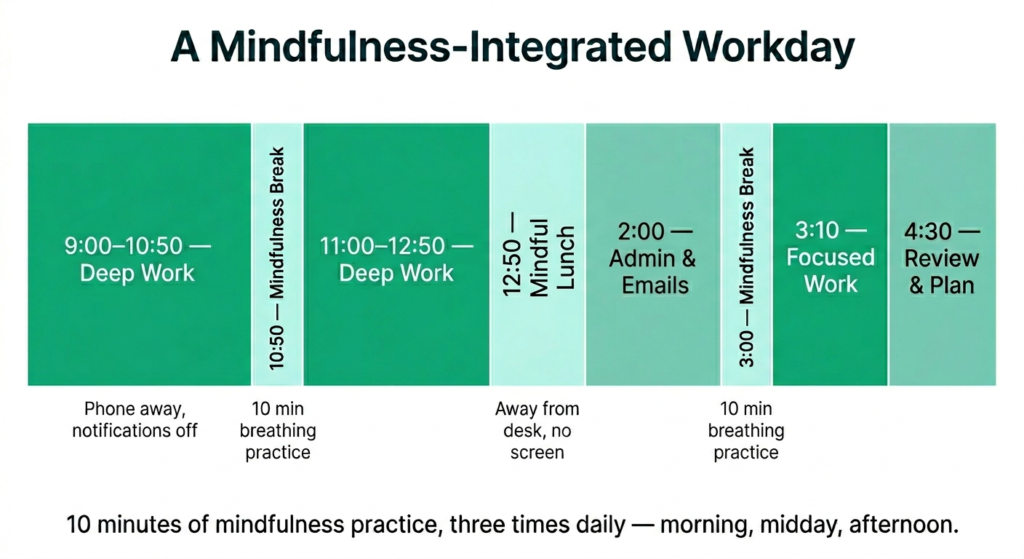
Task management systems work better when you’re more self-aware. The awareness you develop through mindfulness helps you notice when you’re getting mentally overwhelmed, when your concentration is fading, or when you’re switching between tasks too much. This noticing lets you adjust how you’re working in real-time based on how you’re actually feeling, rather than just sticking to a rigid schedule.
Special Populations and Considerations
Whilst mindfulness shows broad applicability, certain groups demonstrate particular vulnerabilities or benefits requiring adapted approaches.
Individuals with attention deficit disorders show mixed but generally positive responses to mindfulness training. Reviews suggest mindfulness interventions produce small to moderate improvements in attention symptoms. However, traditional sitting meditation proves challenging for people with severe attention difficulties. Adapted approaches — shorter initial sessions, more active practices like walking meditation, stronger external structure — often work better. Research suggests mindfulness may be most effective as complementary to other interventions rather than standalone treatment for clinical attention disorders.
Older adults demonstrate particularly strong cognitive benefits from mindfulness practice. Studies show that mindfulness interventions may help prevent or slow age-related cognitive decline, with effects comparable to cognitive training programmes. The mechanism may involve mindfulness’s effects on executive function — cognitive abilities that typically decline with age. Research also suggests mindfulness reduces age-related increases in mind wandering, helping maintain task engagement.
Individuals experiencing high chronic stress benefit substantially from mindfulness’s dual effects on attention and stress regulation. Research demonstrates that stress impairs executive function and working memory — precisely the cognitive capacities mindfulness enhances. By reducing both stress levels and stress’s cognitive impacts, mindfulness may prove particularly valuable for people in chronically demanding circumstances. Mindfulness is particularly valuable during burnout recovery — not as a cure, but as a way of restoring the attentional capacity that chronic stress depletes. See our full guide on recovering from mental burnout
People with trauma histories require careful approach to mindfulness practice. Whilst mindfulness-based interventions can help trauma symptoms, the internal focus can sometimes trigger traumatic memories or dissociation. Trauma-informed mindfulness adaptations — emphasising external sensory awareness over internal focus, maintaining eyes open, using movement practices — reduce these risks whilst preserving cognitive benefits.
Measuring Progress: How to Know If Mindfulness for Focus Is Working
Unlike physical training where progress appears obviously in increased strength or endurance, mindfulness development proves subtler. Systematic tracking helps recognise improvements that might otherwise remain unnoticed.
Track mind wandering frequency during meditation. In early practice, you might recognise mind wandering only after several minutes lost in thought. With practice, the lag between wandering onset and recognition shrinks. Eventually, you notice attention beginning to drift before full distraction occurs. This faster recognition represents substantial progress even though meditation still feels difficult. Research shows expert meditators detect mind wandering approximately twice as quickly as beginners.
Monitor performance on sustained attention tasks. If your work involves extended focus (writing, coding, data analysis), note whether you can maintain concentration for progressively longer periods. Do you complete focused work sessions with less frequent distraction? Can you resist checking phone or email during dedicated work time more easily? These functional improvements often precede subjective feelings of enhanced focus.
Assess working memory informally. Notice whether you’re retaining information better during conversations, remembering task details without notes more readily, or following complex instructions more accurately. Research suggests mindfulness-related working memory improvements transfer to daily cognitive demands, not just artificial laboratory tasks.
Notice when you catch yourself drifting. Are you spotting your wandering mind more often during everyday activities — not just during meditation? Can you tell when your concentration is slipping during work and actually do something about it? This ability to notice what’s happening in your own head is one of mindfulness’s most valuable benefits, even though it’s not as obvious as “better focus.” When you can recognise that your attention is fading or your mind is cluttered, you can make real-time adjustments to how you’re working. Without that self-awareness, you’d just keep pushing through ineffectively.
Consider using simple online tests. Free reaction time tests (like those at Human Benchmark) provide objective measures of your attention. Test your reaction time and working memory before starting mindfulness practice, then retest after 8–12 weeks to see concrete improvements. Research uses these types of tasks because they’re sensitive to mindfulness effects whilst being simple enough that anyone can do them.
QUICK WIN:
Go to Human Benchmark now and run the reaction time test. Record your score. Repeat after four weeks of daily mindfulness practice. The difference — or lack of it — will tell you more about your attention than any questionnaire.
Common Questions About Mindfulness for Focus
Several questions arise repeatedly about mindfulness practice. Research provides clearer answers than most popular writing suggests.
How long until benefits appear? Reviews suggest measurable cognitive improvements typically emerge after 20–40 hours of cumulative practice. At 20 minutes daily, this represents 6–12 weeks. However, individual studies report effects as early as four days of practice, whilst others show continued improvements beyond six months. The honest answer: benefits likely begin within weeks but continue developing with sustained practice.
Does session length matter? Research comparing different durations suggests 10–30 minutes produces similar per-session effects, though longer sessions accumulate practice hours faster. Studies show 10 minutes daily produces measurable benefits, making session length less critical than consistency. If you can only sustain 10 minutes, that’s vastly superior to attempting 30 minutes sporadically.
Is app-guided meditation as effective as in-person instruction? Limited research comparing these formats suggests app-based mindfulness produces cognitive benefits comparable to in-person programmes, though dropout rates may be higher. Headspace (which I’ve subscribed to for a couple of years and highly recommend) provides accessibility and flexibility advantages, whilst in-person instruction offers accountability and personalised guidance. Either approach works if practised consistently.
Can you meditate too much? Whilst most Western practitioners never approach concerning practice volumes, research on intensive retreat meditation (8+ hours daily for weeks) occasionally reports adverse psychological effects in vulnerable individuals. However, the 10–30 minutes daily most people practise shows remarkably few negative effects in research. The practical answer: standard practice durations appear very safe for most people.
The Bottom Line: Attention as a Trainable Skill
Here’s the big takeaway from mindfulness research: your attention isn’t fixed — it’s trainable. Your ability to stay focused, catch yourself when your mind wanders, and remember what you’re working on all improve with practice. Think of it like going to the gym, but for your concentration.
This is both good news and challenging news. Good news because if you struggle with focus, it might not be a permanent flaw — you might just be out of practice. Challenging news because there’s no shortcut. Unlike taking a pill or downloading an app, mindfulness for focus requires you to actually sit down and do it, repeatedly, for weeks and months.
The evidence suggests this effort produces genuine returns. Small to moderate improvements in executive attention, working memory, and sustained focus translate to meaningful real-world benefits: fewer errors in detailed work, better retention of complex information, and enhanced ability to maintain concentration despite distractions. These improvements won’t transform you into a superhuman thinker, but they can help you function closer to your natural cognitive capacity without attention-related impairments.
Implementation requires neither perfection nor massive time investment. Ten minutes daily of focused attention on breathing, sustained consistently for weeks, produces measurable cognitive enhancement. The practice feels simple — deceptively so. The challenge lies not in complexity but in consistency: showing up daily to train attention even when it feels tedious, difficult, or apparently pointless.
Begin today. Set a timer for 10 minutes. Sit comfortably, close your eyes, and direct your attention to the location, sounds and feeling of your breathing. When you notice attention has wandered — and it will, constantly — simply return your focus to your breath. That’s the complete practice. Repeat tomorrow. And the day after. The cognitive benefits emerge not from dramatic experiences during meditation but from the accumulated training effect of repeated attentional exercise. Your focus is trainable. The question is whether you’ll invest the modest but consistent effort required to train it.
Mindfulness is one of ten mental performance pillars assessed in the Mental Performance Checklist — it provides a quick snapshot of how you’re doing and provides inspiration for areas to improve.
RESOURCES:
I only recommend resources that I either use personally or have researched and feel are genuinely helpful for my readers. Resources sometimes contain affiliate links; if you purchase through these, I may earn a small commission at no extra cost to you.
Recommended reading
The Headspace Guide to Mindfulness and Meditation — Andy Puddicombe. The practical complement to mindfulness — while meditation trains your internal attention, this book gives you the framework to manage external triggers and design your environment for focus. Paperback | Kindle | Audible
The Miracle of Mindfulness — Thich Nhat Hanh. The accessible classic that introduced mindfulness to a Western audience without mysticism or jargon. Short, practical, and grounded — a natural starting point for anyone wanting to understand what the practice actually involves. Paperback | Kindle | Audible
Wherever You Go, There You Are — Jon Kabat-Zinn. From the founder of Mindfulness-Based Stress Reduction, the programme cited throughout the research in this article. Practical and science-grounded without sacrificing the humanity of the practice. Paperback | Kindle | Audible
Indistractable: How to Control Your Attention and Choose Your Life — Nir Eyal. The practical complement to mindfulness — while meditation trains your internal attention, this book gives you the framework to manage external triggers and design your environment for focus. Paperback | Kindle | Audible
Recommended tool
Headspace — The app I use personally and have subscribed to for several years. Structured guided meditations, sleep tools, and focus sessions — all built on the same attentional training principles covered in this article. The beginner course is an excellent starting point. Visit Headspace
Related Articles
How to Improve Mental Performance — The complete framework for optimising your cognitive output.
Maintain Mental Energy — How to sustain focus and cognitive performance across a full working day.
How to Stop Overthinking — Practical techniques for breaking repetitive thought loops that drain attention.
Mental Clutter Clearing — Reduce the open loops and background noise that make focus harder.
Stress Management for Mental Performance — How chronic stress impairs the same attention systems mindfulness strengthens.
I'm Simon Shaw, a Chartered Occupational Psychologist with over 20 years of experience in workplace psychology, learning and development, coaching, and teaching. I write about applying psychological research to everyday challenges - from habits and productivity to memory and mental performance. The articles on this blog draw from established research in psychology and behavioural science, taking a marginal gains approach to help you make small, evidence-based changes that compound over time, allowing you to make meaningful progress in the areas you care about most.