
Best Exercise for Brain Health: Which Types Work Best?

Your brain consumes roughly 20% of your body’s energy despite representing only 2% of body weight. This makes it particularly responsive to the changes that happen when you exercise. When you move your body, you’re not just strengthening muscles and improving fitness — you’re fundamentally changing how your brain works. Choosing the best exercise for brain health means understanding which types of physical activity produce the strongest cognitive benefits, and why.
Research consistently shows that exercise produces measurable improvements in memory, attention, processing speed, and decision-making — benefits that apply regardless of your current fitness level or age.
This guide examines how exercise enhances brain health, identifies which exercise types produce the strongest cognitive benefits, and provides evidence-based approaches for improving mental performance through physical activity. Understanding these relationships allows you to design exercise routines that target specific outcomes whilst supporting overall brain health.
How the Best Exercise for Brain Health Changes Your Brain
Exercise changes your brain through multiple connected pathways. The most direct mechanism involves increased blood flow. During physical activity, your heart pumps more oxygenated blood to your brain, delivering glucose and oxygen whilst removing waste products more efficiently.
Research using brain scanning consistently shows that regular aerobic exercise increases blood flow to the hippocampus and prefrontal cortex — brain regions vital for memory formation and executive function. Studies show these improvements emerge after as little as eight weeks of consistent training, with effects strongest in previously sedentary adults.
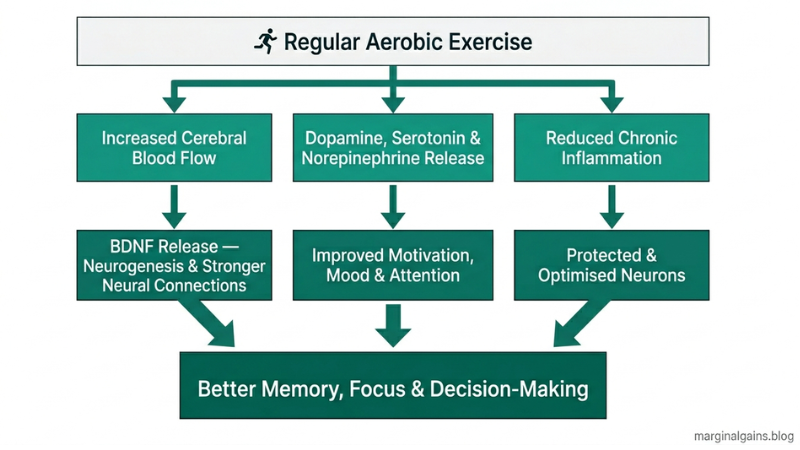
Beyond blood flow, exercise triggers the release of brain-derived neurotrophic factor (BDNF), often described as “Miracle-Gro for the brain.” BDNF promotes the creation of new neurons — particularly in the hippocampus — and strengthens connections between existing neurons.
Animal studies show dramatic effects: mice that exercise show doubled rates of new neuron creation compared to inactive controls. Human research reveals similar patterns. A landmark study found that one year of moderate aerobic exercise increased hippocampal volume by 2% in older adults — effectively reversing age-related shrinkage by one to two years.
Exercise also affects neurotransmitter systems. Physical activity increases dopamine, serotonin, and norepinephrine — brain chemicals vital for motivation, mood, and attention. These changes occur both during exercise and produce long-term improvements in how these systems function.
The inflammatory response provides another mechanism. Chronic low-grade inflammation impairs thinking and accelerates brain ageing. Exercise produces anti-inflammatory effects, reducing inflammatory markers whilst increasing anti-inflammatory compounds. This shift protects neurons from damage and supports optimal cognitive function.
Physical exercise improves the brain conditions needed for learning — pair it with the evidence-based techniques in our guide on how to learn faster and you’re giving your brain every advantage.
QUICK WIN:
This week, schedule a 20-minute brisk walk immediately before a task that requires clear thinking — a work meeting, a problem you need to solve, or focused reading. Notice whether your concentration feels sharper afterwards. This is BDNF in action.
Aerobic Exercise: The Best Exercise for Brain Health Overall
Aerobic exercise — activity that elevates heart rate sustainably — produces the most robust and well-documented cognitive benefits, making it the strongest candidate for best exercise for brain health. Walking, running, cycling, swimming, and similar activities all qualify when performed at appropriate intensity.
A large research review examining 133 studies found that aerobic exercise produces moderate improvements in attention, processing speed, executive function, and memory across all age groups. The effects appear strongest for executive functions — the high-level thinking processes involved in planning, decision-making, and mental flexibility.
The intensity matters significantly. Research shows that moderate-to-vigorous intensity aerobic exercise produces larger cognitive benefits than gentle activity. Moderate intensity means working at a level where you can speak in sentences but not hold an extended conversation. Vigorous intensity (breathing hard, can only speak a few words at a time) produces even stronger immediate effects on some thinking measures.
Duration follows a dose-response relationship: more exercise generally produces greater benefits, though returns diminish beyond certain thresholds. Studies show measurable cognitive improvements from as little as 20–30 minutes of aerobic exercise. However, the strongest long-term benefits emerge from 150–300 minutes weekly — the range recommended for general health.

The timing of cognitive effects varies by outcome. Immediate effects — improvements measurable right after exercise — appear most reliably for attention and processing speed. Long-term effects — changes emerging after weeks or months of regular exercise — show strongest impacts on memory and executive function.
For practical implementation, aim for at least 30 minutes of moderate-intensity aerobic exercise on most days. If you’re not currently exercising, begin with 10–15 minutes and gradually increase duration and intensity. The mental performance benefits accumulate gradually, with measurable improvements typically appearing after 8–12 weeks of consistent training.
Other Exercise Types: Alternatives and Complements to Aerobic Training
Resistance Training: Strength for Brain and Body
Resistance training — exercises using weights, resistance bands, or body weight to build strength — produces cognitive benefits through partially different mechanisms from aerobic exercise. Whilst there is less research compared to aerobic training, evidence increasingly supports resistance exercise as a valuable cognitive intervention and a strong contender for best exercise for brain health alongside aerobic work.
A large research review published in the British Journal of Sports Medicine found that resistance training significantly improved executive function, memory, and overall cognitive function in adults. Effects were comparable in size to aerobic exercise for some outcomes, suggesting resistance training as a viable alternative or complement to aerobic activity.
The mechanisms likely involve both overlapping and unique pathways. Like aerobic exercise, resistance training increases BDNF and insulin-like growth factor-1 (IGF-1) — another brain-supporting compound. However, resistance training may produce stronger effects on certain hormones, including testosterone and growth hormone, which influence brain function.
Resistance training also improves how your body uses insulin and processes glucose more effectively than aerobic exercise alone. Since the brain depends heavily on glucose for fuel, improved metabolic health translates directly to better cognitive function.
Practical resistance training for cognitive benefit should target major muscle groups with moderate loads performed for 8–12 repetitions per set. Two to three sessions weekly produces measurable benefits without requiring excessive time commitment.
High-Intensity Interval Training: Maximum Benefits in Minimal Time
High-intensity interval training (HIIT) alternates brief periods of intense effort with recovery intervals. A typical HIIT session might involve 30 seconds of hard effort followed by 60–90 seconds of active recovery, repeated for 15–20 minutes total.
HIIT produces remarkably strong cognitive effects given its time efficiency. Research shows that HIIT sessions as short as 10–15 minutes can produce cognitive improvements comparable to longer moderate-intensity sessions. A study in Medicine & Science in Sports & Exercise found that just four weeks of HIIT (three sessions weekly) improved executive function and processing speed in young adults.
The mechanisms behind HIIT’s effectiveness likely involve greater metabolic stress and hormonal responses compared to steady-state exercise. The intense intervals create larger spikes in lactate, stress hormones, and growth factors. These metabolic disturbances appear to trigger stronger adaptive responses in both muscle and brain tissue.
However, HIIT’s intensity creates greater physical and mental demands. The effort required can reduce adherence for some people, and the high intensity increases injury risk without proper preparation. HIIT works best as one component of a varied exercise programme rather than as the sole training method.
Mind-Body Exercise: Integrating Movement and Thinking
Mind-body exercises like yoga, tai chi, and Pilates combine physical movement with focused attention, breathing control, and often meditation components. These practices produce cognitive benefits through mechanisms that partially overlap with conventional exercise whilst adding unique elements related to attention control and mind-body integration.
Research on tai chi demonstrates particularly impressive cognitive effects. A large research review examining 20 studies found that tai chi improved global cognitive function, executive function, memory, and processing speed in older adults. Interestingly, effects were comparable to or exceeded those from conventional aerobic exercise in some studies, despite tai chi’s lower cardiovascular intensity.
The cognitive demands built into mind-body practices may explain their effectiveness. Learning and remembering movement sequences, maintaining balance, coordinating breathing with movement, and sustaining focused attention all challenge thinking systems in ways that complement the physical benefits of activity.

Mind-body exercises offer particular advantages for people unable to perform high-intensity exercise due to age, injury, or chronic conditions. The gentler physical demands make these practices more accessible whilst still providing meaningful cognitive benefits.
QUICK WIN:
If you currently do only one type of exercise, add a ten-minute session of a different type this week — if you run, try a bodyweight circuit; if you lift weights, add a ten-minute yoga sequence. Variety in exercise type produces broader cognitive benefits than repeating the same activity.
Optimising Your Approach: Timing, Dose, and Age Considerations
When to Exercise for Maximum Cognitive Benefit
Exercise timing influences both immediate cognitive effects and the sustainability of exercise habits. Research examining time-of-day effects reveals complex patterns that depend on the specific cognitive outcomes of interest and whether you’re naturally a morning or evening person.
For immediate cognitive enhancement — quick improvements in focus and mental clarity — morning exercise appears optimal for most people. Studies show that morning exercise produces larger improvements in attention and processing speed throughout the day compared to afternoon or evening sessions. The mechanism likely involves circadian alignment: exercise in the morning reinforces the body’s natural wake-up processes, enhancing alertness.
However, for long-term cognitive health, consistency matters more than specific timing. Choose whatever time you’re most likely to maintain regularly. A study examining exercise adherence found that morning exercisers showed higher long-term consistency than those who scheduled afternoon or evening sessions. The best exercise for brain health is ultimately the one you’ll actually do.
Finding the Optimal Exercise Dose
Determining optimal exercise dose requires balancing maximum cognitive benefit against sustainability and recovery capacity. A comprehensive review found that cognitive benefits increase with exercise volume up to approximately 150–180 minutes weekly of moderate-intensity aerobic exercise. Beyond this threshold, additional volume produces progressively smaller incremental benefits.
However, intensity can partially compensate for volume. Studies show that 75–90 minutes weekly of vigorous-intensity exercise produces cognitive benefits comparable to 150–180 minutes of moderate-intensity activity. This suggests that HIIT and other high-intensity approaches offer time-efficient alternatives.
The minimum effective dose appears to be approximately 30–45 minutes weekly of moderate-to-vigorous exercise — substantially less than typically recommended for general health. Even this modest volume produces measurable cognitive improvements in people who weren’t previously exercising. This is encouraging: you don’t need to overhaul your life to get meaningful brain benefits from physical activity.
Exercise Across the Lifespan: Age-Specific Considerations
Exercise benefits brain health across all ages, though specific effects and optimal approaches vary with developmental stage. In children and adolescents, exercise supports normal brain development whilst enhancing academic performance. Research consistently shows that physically active children demonstrate better attention, faster processing speed, and superior academic achievement.
For young and middle-aged adults, exercise maintains cognitive function whilst building cognitive reserve — the brain’s resilience against future challenges. Studies show that higher fitness in midlife predicts better cognitive function decades later, suggesting that exercise during these years provides long-term protection.
In older adults, identifying the best exercise for brain health takes on additional importance for preventing cognitive decline. Research shows that regular exercise reduces dementia risk by 30–40% compared to inactive ageing. Even among people already experiencing mild cognitive impairment, exercise interventions slow progression and may improve some cognitive functions.
The mechanisms in older adults include enhanced brain plasticity, increased brain volume in regions vulnerable to age-related shrinkage, improved blood vessel health, and reduced inflammation. Exercise essentially acts as a multi-targeted protective intervention addressing multiple pathways of age-related brain deterioration simultaneously.
Maximising Cognitive Benefits: Environment and Integration Strategies
Indoor Versus Outdoor Exercise
Where you exercise influences cognitive outcomes through mechanisms independent of the physical activity itself. Outdoor exercise — particularly in natural environments — produces larger improvements in mood, stress reduction, and certain cognitive functions compared to equivalent indoor activity.
Research published in Scientific Reports found that a 15-minute walk in a natural outdoor setting produced greater improvements in attention and working memory than the same walk indoors. The mechanisms likely involve attention restoration theory: natural environments allow focused attention to rest whilst engaging effortless attention to pleasant stimuli.
However, indoor exercise offers advantages for consistency and control. Weather, temperature, and safety concerns all influence exercise adherence. A balanced approach combines both environments: outdoor exercise when conditions permit, supplemented by indoor exercise to maintain consistency throughout the year.
Integrating Exercise with Other Cognitive Interventions
Exercise produces additive or synergistic benefits when combined with other evidence-based cognitive interventions. Exercise and sleep quality work together: exercise improves sleep quality, whilst good sleep enhances recovery and adaptation from exercise. This creates a virtuous cycle where each reinforces the other.
Exercise combined with cognitive training produces larger cognitive improvements than either intervention alone. Studies show enhanced executive function and memory from combined physical and cognitive training. The mechanism appears to involve complementary effects: exercise creates a biologically primed state whilst cognitive training provides specific skill development. This is why pairing exercise with activities like reading, learning, or problem-solving is particularly effective.
Nutrition and exercise interact to support brain health. Exercise increases metabolic demands, making adequate nutrition essential for optimal adaptations. Protein supports recovery, carbohydrates fuel high-intensity exercise, and omega-3 fatty acids may enhance exercise-induced brain plasticity. Staying well hydrated is equally important — our guide on dehydration and brain function explains why even mild dehydration impairs cognition during and after exercise.
Group exercise combines two of the most powerful brain health interventions simultaneously — movement and meaningful social interaction. For more on the second half of that equation, see our guide on social connection and brain health.
Building a Brain-Healthy Exercise Programme
Translating research into sustainable practice requires systematic planning that balances optimal approaches with individual constraints, preferences, and adherence factors.
As a Chartered Occupational Psychologist who has studied performance optimisation for over two decades, I’ve observed that the most effective programmes share common features: they start modestly, progress gradually, include variety, and most critically, they align with individual preferences and constraints. This last point is particularly important when choosing the best exercise for brain health — the evidence clearly shows that adherence matters more than any specific exercise type.
Begin with an honest assessment of current fitness, time availability, and constraints. If you’re not currently exercising, starting with 150 minutes weekly of vigorous exercise creates overwhelming demands that predict failure. Instead, begin with 10–15 minutes daily of moderate walking and progressively increase duration and intensity over weeks and months.

Structure your weekly programme to include variety: aerobic exercise for cardiovascular fitness and blood flow, resistance training for strength and metabolic health, and potentially mind-body practices for stress management. A sample week might include three 30–40 minute aerobic sessions, two resistance training sessions, and one yoga or tai chi session.
Use implementation intentions to strengthen adherence. Research shows that people who create specific plans (“I will exercise Monday, Wednesday, and Friday at 7:00 AM at the park near my house”) maintain consistency far better than those with general intentions. The specificity removes the need to make a decision in the moment — which is precisely when motivation tends to waver. This principle connects directly to how habit formation works: anchoring a new behaviour to a specific cue and time is what turns a good intention into an automatic routine.
Track progress objectively. Beyond subjective feelings, measure objective indicators like resting heart rate, workout performance, and cognitive function. Seeing measurable improvements reinforces motivation and confirms that your programme is producing intended effects.
Adjust based on response. If you’re not seeing cognitive improvements after 8–12 weeks of consistent exercise, consider increasing intensity, duration, or frequency. Conversely, if you experience excessive fatigue, you may need additional recovery or reduced training volume. One useful signal: many people notice improvements in mental energy before they notice other cognitive benefits — a useful early indicator that your programme is working.
QUICK WIN:
Block three specific 30-minute time slots in your calendar this week for exercise. Write down the exact time, location, and activity for each. Treat these as non-negotiable as any work meeting. Specificity dramatically improves follow-through compared to vague intentions.
The Long-Term Perspective: Exercise as Cognitive Insurance
The most compelling case for identifying the best exercise for brain health comes from long-term research examining lifelong physical activity patterns and late-life cognitive function. These studies reveal that exercise throughout life provides cumulative protection against cognitive decline and dementia.
Research tracking individuals for 20–30 years shows that those who maintain regular exercise demonstrate substantially lower dementia risk and better cognitive preservation compared to inactive counterparts. The protection appears dose-dependent: more exercise throughout life produces greater late-life benefits. A 2025 review published in The Lancet concluded that regular physical activity is one of the most important modifiable factors for healthy brain ageing — placing it alongside sleep, social connection, and managing cardiovascular risk factors.
Importantly, it is never too late to start. Studies show that older adults who weren’t previously exercising but begin an exercise programme experience cognitive improvements and reduced decline rates even when starting in their 60s, 70s, or 80s. Whilst earlier intervention provides maximum benefit, exercise produces meaningful cognitive protection regardless of when you begin. Combining regular physical activity with good sleep and cognitive function practices creates a particularly powerful foundation for brain health across life.
This long-term perspective reframes exercise from an optional enhancement to essential maintenance. Your brain depends on the metabolic, chemical, and structural changes produced by regular physical activity. Without exercise, the brain operates in a chronically sub-optimal state, vulnerable to accelerated decline and dysfunction.
Start today. Whether it’s a 10-minute walk, a resistance training session, or a yoga class, each bout of exercise produces immediate cognitive benefits whilst contributing to long-term brain health. The cumulative effect of consistent physical activity represents one of the most powerful interventions available for optimising and protecting cognitive function throughout your lifespan.
RESOURCES:
I only recommend resources that I either use personally or have researched and feel are genuinely helpful for my readers. Resources sometimes contain affiliate links; if you purchase through these, I may earn a small commission at no extra cost to you.
Further Reading on Exercise and Brain Health:
Spark: The Revolutionary New Science of Exercise and the Brain by John J. Ratey — The definitive book on how physical activity transforms brain function, mood, and cognition. Highly recommended for anyone wanting to understand the neuroscience in depth. Paperback | Kindle
Healthy Brain, Happy Life by Wendy Suzuki — A neuroscientist’s accessible exploration of how exercise transforms memory, mood and cognitive function. Written from both research and personal experience. Paperback
Atomic Habits by James Clear — Building the exercise habit itself is often the biggest challenge. This is the most practical guide to making new behaviours stick. Paperback | Kindle | Audible
Related Articles from Marginal Gains:
How to Improve Mental Performance: 10 Science-Backed Strategies
Sleep and Cognitive Function: The Complete Guide
How to Maintain Mental Energy: Stop the 3pm Crash
Dehydration and Brain Function: Why Your Brain Needs Water
Stress Management Techniques for Mental Performance
I'm Simon Shaw, a Chartered Occupational Psychologist with over 20 years of experience in workplace psychology, learning and development, coaching, and teaching. I write about applying psychological research to everyday challenges - from habits and productivity to memory and mental performance. The articles on this blog draw from established research in psychology and behavioural science, taking a marginal gains approach to help you make small, evidence-based changes that compound over time, allowing you to make meaningful progress in the areas you care about most.