
Sleep and Cognitive Function: The Complete Guide

We spend roughly one-third of our lives asleep, yet most people treat sleep as the first thing to sacrifice when life gets busy. Few decisions cost more cognitively. Sleep and cognitive function are inseparably linked — sleep isn’t downtime for your brain but an active state during which essential maintenance work determines how well you think, focus, and make decisions the following day.
The effects of insufficient sleep on cognitive function run considerably deeper than feeling groggy. After a single poor night, attention lapses, working memory shrinks, and decision-making becomes less reliable. After several consecutive nights of restricted sleep, the deficits accumulate into something closer to significant cognitive impairment — and most people don’t notice how compromised they’ve become.
This guide covers the neuroscience behind sleep’s cognitive benefits, what sleep deprivation actually does to performance, and practical strategies for protecting your brain through better sleep.
What Sleep and Cognitive Function Have in Common: Active Brain Maintenance
Sleep isn’t passive. Your brain cycles through distinct stages roughly every 90 minutes throughout the night, each serving specific functions. Non-REM (NREM) sleep — particularly its deepest stage, slow-wave sleep — dominates the first half of the night and is when your brain clears metabolic waste, consolidates newly learned information, and restores the neural resources that support next-day performance. REM sleep, which dominates the latter half, supports emotional regulation, creative thinking, and the integration of new information with existing knowledge.
This architecture matters practically. Cutting your sleep short by even an hour or two disproportionately reduces REM sleep, which clusters in the final sleep cycles. Early wake-ups for work or obligations don’t just shorten sleep — they selectively remove the stage most associated with flexible thinking and emotional regulation.
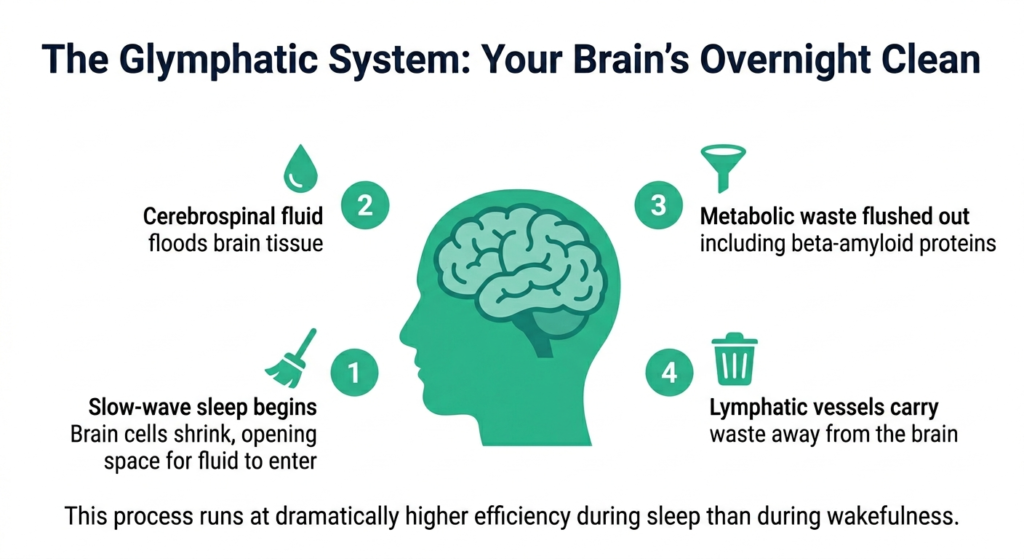
The glymphatic system: your brain’s overnight clean
One of the most significant recent discoveries in sleep neuroscience concerns waste clearance. During slow-wave sleep, the space between brain cells expands by approximately 60%, allowing cerebrospinal fluid to flush metabolic waste products — including beta-amyloid and tau proteins associated with Alzheimer’s disease — from brain tissue. This glymphatic system operates at dramatically higher efficiency during sleep than during wakefulness.
Even a single night of sleep deprivation measurably increases brain levels of beta-amyloid. This provides a mechanistic explanation for why chronic poor sleep in midlife correlates with increased dementia risk decades later. Your brain quite literally needs to be offline to clean itself — and that cleaning cannot be deferred indefinitely without consequences.
How Sleep Deprivation Impairs Sleep and Cognitive Function
The cognitive costs of sleep loss are well-quantified, and they’re larger than most people expect.
Attention and sustained focus
Sustained attention — the ability to maintain focus over extended periods — is among the first capacities to deteriorate with sleep loss, and the most dramatically. After 24 hours of continuous wakefulness, cognitive performance declines to a level equivalent to a blood alcohol concentration of 0.10% — above the legal limit for driving in most countries. Reaction times slow by 20–30%, and attention lapses begin occurring unpredictably.
More relevant for most people is the cumulative effect of chronic partial restriction. Restricting sleep to six hours per night for two weeks produces impairments equivalent to two consecutive all-nighters — yet participants in these studies consistently underestimated how impaired they were. Subjective sleepiness plateaus after a few days while objective performance continues to deteriorate. People feel adapted to mild sleep deprivation while remaining genuinely impaired.
This disconnect is one of the most practically important findings in sleep research. If you’re running on six hours and feel fine, that feeling is not a reliable indicator of how well you’re actually functioning.
Working memory and executive function
Working memory — the cognitive system that holds and manipulates information in real time — shows measurable deficits even after modest sleep restriction. This affects everything from following a complex argument to planning a multi-step task to resisting distraction while working on something that requires sustained concentration. The strategies covered in our guide to improving working memory become harder to apply when the underlying system has been depleted by poor sleep.
Decision-making under uncertainty is also significantly affected. Sleep-deprived individuals show altered risk assessment — a tendency toward both riskier choices and decision avoidance — and reduced capacity for strategic planning. Financial traders making decisions after poor sleep demonstrate measurably less effective risk management. Surgical residents working extended shifts show increased error rates. These aren’t edge cases; they reflect the normal consequences of operating a complex cognitive system on insufficient maintenance.
The prefrontal cortex connection
Neuroimaging helps explain why these impairments occur. During sleep deprivation, the prefrontal cortex — responsible for high-level cognitive control, inhibiting impulses, and directing attention — shows reduced activation during demanding tasks. The brain attempts to compensate by recruiting additional regions, essentially working harder to maintain performance. This compensation has limits, and once they’re reached, performance degrades regardless of effort or motivation.
This is the subjective experience of cognitive fatigue: having to concentrate much harder than usual to accomplish tasks that would normally require little effort. The strategies for maintaining mental energy that work well when rested become considerably less effective when the underlying neural capacity for sustained attention has been compromised by insufficient sleep.
QUICK WIN:
Track your sleep duration for one week without trying to change anything. Most people who do this discover they’re averaging less than they thought — often 45–60 minutes less. Knowing your actual baseline is the starting point for making meaningful changes. A simple note on your phone is enough; no app required.
How Much Sleep Do You Actually Need for Optimal Cognitive Function?
Research reveals a remarkably consistent answer across large-scale studies. Data from the UK Biobank study, examining nearly 480,000 individuals, identified seven hours as the sleep duration associated with the highest cognitive performance. Performance decreased for every hour above or below this target, creating a U-shaped curve. Brain imaging data corroborated this: individuals sleeping six to eight hours showed significantly greater grey matter volume in 46 brain regions critical for memory, decision-making, and cognitive control.
The consensus recommendation from sleep medicine organisations suggests seven to nine hours for adults. Individual variation exists — some people genuinely function well at the lower end — but “I’m fine on five hours” is a claim that warrants scepticism. The research on subjective versus objective impairment suggests that people who believe they’ve adapted to short sleep have usually just adapted to feeling somewhat tired, not to performing well.
Changes in habitual sleep duration matter as much as absolute amounts. Research from the Whitehall II study found that adverse changes — either decreasing below or increasing above the seven-to-eight-hour range — were associated with cognitive performance equivalent to four to seven years of accelerated cognitive ageing. Consistency counts: dramatic fluctuations in sleep duration from night to night appear as problematic as chronically insufficient sleep.
Sleep, Stress, and Cognitive Function
The relationship between sleep and cognitive performance isn’t one-directional. Poor sleep elevates cortisol and activates stress responses that further impair prefrontal function — creating a feedback loop where stress disrupts sleep and sleep deprivation amplifies stress reactivity. This is one reason why managing stress effectively and protecting sleep quality are mutually reinforcing rather than separate goals. The same prefrontal impairment pattern also appears in clinical burnout — and poor sleep is both a symptom and an accelerant. See our guide on recovering from mental burnout for how sleep fits into the rehabilitation process.
Emotional regulation is particularly affected. The amygdala — which processes emotional responses — shows heightened reactivity after sleep deprivation, while the prefrontal regions that normally moderate it become less effective. Sleep-deprived individuals are more emotionally reactive, less able to exercise perspective, and more susceptible to cognitive biases under stress. This matters at work: the quality of your judgement in high-pressure situations is significantly influenced by whether you slept well the night before.
Optimising Sleep and Cognitive Function: Practical Strategies
Understanding why sleep matters is only useful if it changes behaviour. These are the practical principles that emerge most consistently from the research.
Protect your sleep window
Calculate backwards from your required wake time to establish a consistent bedtime that gives you seven to eight hours. Then protect that bedtime with the same priority you’d give to an important meeting. The cumulative return on cognitive investment from consistent adequate sleep likely exceeds that from most other performance interventions.
Maintain consistent sleep and wake times including weekends. Large variations between weekday and weekend schedules create “social jetlag” — a perpetual cycle of adjustment that prevents your circadian system from settling into efficient, restorative patterns.
Manage light exposure
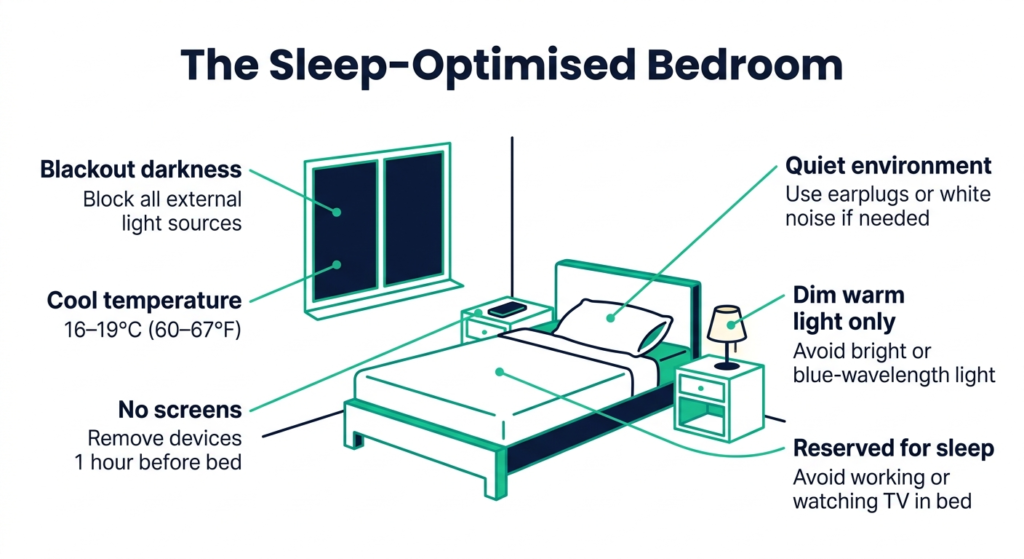
Light is the primary input to your circadian clock. Bright light exposure in the morning — ideally natural sunlight — anchors your rhythm and promotes daytime alertness. Reducing light exposure in the evening, particularly blue-wavelength light from screens, supports natural melatonin production and sleep onset. If evening screen use is unavoidable, use night mode settings and reduce brightness substantially at least an hour before bed.
Optimise your sleep environment
Core body temperature must drop for sleep to initiate and deepen. Keep your bedroom cool: 16–19°C (60–67°F) is the research-supported range. A warm bath or shower 60–90 minutes before bed facilitates this — the subsequent temperature drop as your body cools signals sleepiness. Darkness matters too: even small amounts of light from devices or street lighting can fragment sleep and reduce slow-wave depth.
Be honest about stimulants and alcohol
Caffeine has a half-life of approximately five to six hours. A coffee at 3pm still has half its caffeine active at 8–9pm, delaying sleep onset and reducing slow-wave sleep even when you don’t feel particularly alert. Alcohol presents the opposite illusion: it may accelerate sleep onset but suppresses REM sleep and fragments the second half of the night, reducing overall cognitive restoration. Both substances interfere with sleep quality in ways that aren’t always subjectively obvious.
Strategic napping
When nocturnal sleep has been compromised, a brief nap (10–20 minutes) can partially restore alertness and attention for several hours. Longer naps of 60–90 minutes that include slow-wave sleep provide more substantial restoration and support complex cognitive functions, though they carry some risk of sleep inertia (grogginess on waking). Timing matters: early afternoon (1–3pm) aligns with a natural circadian dip and is least likely to interfere with nighttime sleep.
Address sleep disorders
If you consistently sleep seven to nine hours but remain cognitively impaired during the day, consider whether a sleep disorder might be compromising quality rather than duration. Obstructive sleep apnoea — characterised by repeated breathing interruptions that fragment sleep — is significantly under-diagnosed and produces substantial cognitive deficits in attention, memory, and executive function even when total sleep duration appears adequate. Loud snoring, witnessed breathing pauses, waking gasping, or persistent daytime sleepiness despite adequate time in bed all warrant professional evaluation.
QUICK WIN:
Choose one change from the strategies above and apply it this week rather than attempting to overhaul everything at once. The highest-leverage starting point for most people is a consistent wake time — even on weekends. Set it, protect it for seven days, and notice the difference in how rested you feel by the end of the week.
Sleep and Cognitive Function: Long-Term Brain Health
The cognitive costs of poor sleep aren’t only immediate. Longitudinal research increasingly suggests that sleep quality across midlife is a modifiable risk factor for later cognitive decline. The Whitehall II cohort study found that consistently sleeping six hours or fewer at age 50 was associated with a 30% higher risk of dementia compared to those sleeping seven hours, independent of other health and behavioural factors.
This matters because sleep is one of the few dementia risk factors that is genuinely actionable. Unlike genetics or early-life history, sleep habits can be changed at any age. The glymphatic waste clearance mechanism — described above — offers a plausible biological explanation for why this relationship exists, and it suggests that the long-term cognitive argument for prioritising sleep is as strong as the immediate performance argument.
Social withdrawal is one of the earliest signs of inadequate rest — and one of the most cognitively costly. Read more about how social connection and brain health interact with your sleep quality.
Regular exercise supports both sleep quality and long-term brain health through overlapping mechanisms: improved cardiovascular function, reduced inflammation, and enhanced slow-wave sleep depth. The two behaviours reinforce each other in ways that compound over time.
QUICK WIN:
Calculate your ideal bedtime tonight. Take your required wake time and count back seven and a half hours — that’s your target. Set a phone reminder 30 minutes before that time as a wind-down prompt. Do it for one week and track how your focus feels by day five compared to day one.
The Bottom Line on Sleep and Cognitive Function
Sleep isn’t a productivity sacrifice — it’s the foundation that determines how much of your cognitive capacity is actually available. The person who sleeps seven to eight hours and works effectively for sixteen hours typically outperforms the person who sleeps five to six hours and muddles through eighteen with impaired attention, slower processing, and reduced decision quality.
The choice isn’t between sleep and performance. Adequate sleep is what makes sustained high performance possible. And unlike many interventions in the mental performance space, the evidence here is unusually consistent: protect your sleep, and you protect your cognitive function. If you’re interested in the specific mechanisms by which sleep supports learning and memory formation — as distinct from general cognitive performance — that’s covered in more depth in our companion article on how sleep affects memory.
Key Takeaways
Sleep is active brain maintenance, not passive downtime. Slow-wave sleep clears metabolic waste, restores neural resources, and prepares cognitive capacity for the following day. The glymphatic system — which flushes brain waste including Alzheimer’s-associated proteins — operates primarily during slow-wave sleep, and even one night of deprivation produces measurable increases in beta-amyloid.
After 24 hours without sleep, cognitive performance is equivalent to being over the legal alcohol limit for driving. Chronic restriction to six hours per night accumulates to similar impairment within two weeks — yet people feel more adapted than they are. Seven hours is the most consistently research-supported target for adults, with both less and more sleep being associated with reduced cognitive performance and brain volume.
Sustained attention and prefrontal executive function are most vulnerable to sleep loss. Decision-making quality and emotional regulation are significantly affected. Consistent sleep and wake times — including weekends — are as important as total duration, and social jetlag from variable schedules undermines sleep quality even when total hours are adequate.
Long-term, sleep quality in midlife is a modifiable risk factor for cognitive decline and dementia. The argument for protecting sleep and cognitive function is not only about tomorrow’s performance — it’s about the brain you’ll have in twenty years.
Try our Mental Performance Checklist to reflect on how you’re doing in relation to your sleep and other areas of mental performance.
RESOURCES:
I only recommend resources that I either use personally or have researched and feel are genuinely helpful for my readers. Resources sometimes contain affiliate links; if you purchase through these, I may earn a small commission at no extra cost to you.
Recommended reading
Why We Sleep: The New Science of Sleep and Dreams — Matthew Walker. The most comprehensive and accessible account of what sleep science actually shows — covering cognitive performance, memory, mental health, and long-term brain health. Essential reading for anyone who has ever justified cutting sleep short. Paperback | Kindle | Audible
The Organized Mind: Thinking Straight in the Age of Information Overload — Daniel Levitin. A neuroscientist’s guide to how the brain manages cognitive load, with a strong chapter on sleep’s role in mental clarity and decision-making. Paperback | Kindle
Related Articles
How to Improve Sleep Quality — Practical evidence-based strategies for improving both sleep duration and depth.
How Does Sleep Affect Memory? — A deeper look at the specific mechanisms by which sleep supports learning and memory consolidation.
How to Maintain Mental Energy — Sleep is the foundation; this covers the strategies that build on it throughout the day.
Best Exercise for Brain Health — Exercise and sleep reinforce each other as the two highest-leverage behaviours for long-term cognitive health.
Stress Management for Mental Performance — How chronic stress disrupts sleep and amplifies the cognitive costs of poor rest.
I'm Simon Shaw, a Chartered Occupational Psychologist with over 20 years of experience in workplace psychology, learning and development, coaching, and teaching. I write about applying psychological research to everyday challenges - from habits and productivity to memory and mental performance. The articles on this blog draw from established research in psychology and behavioural science, taking a marginal gains approach to help you make small, evidence-based changes that compound over time, allowing you to make meaningful progress in the areas you care about most.