
Mental Clutter Clearing: The 5-Item Method for Clearer Thinking

It’s 2am. You’re exhausted. But your mind won’t stop.
Did I send that email? What if the presentation goes badly? I should exercise more. Why did I say that thing three years ago? Don’t forget milk. Check the door. Is that noise normal?
Mental clutter clearing isn’t just a productivity technique — it’s a necessary response to how modern life actually works. Research using brain imaging has found we experience around 6,000 distinct thoughts every day — and for many people, a significant proportion are repetitive, unproductive loops that crowd out what actually matters.
The result? Decision fatigue. Difficulty focusing. That foggy feeling where simple tasks feel overwhelming.
Traditional advice says “clear your mind” through meditation or “just relax.” But when your brain is genuinely overloaded with legitimate concerns, empty platitudes don’t help.
You need a systematic method for reducing mental load — not by ignoring tasks, but by organising them so your brain can stop juggling and start thinking. The 5-Item Method does exactly that.
What Is Mental Clutter?
Mental clutter is the accumulation of unprocessed thoughts, unmade decisions, and unfinished tasks that occupy your working memory.
Your brain has limited processing capacity — think of it as RAM in a computer. When too many applications run simultaneously, everything slows down. Mental clutter is those unnecessary background applications eating your cognitive resources.
Common sources include open loops — tasks you’ve started but not finished, which your brain constantly monitors even when you’re not actively working on them. Unmade decisions occupy mental space too: should I change jobs? What’s for dinner? Where should I go on holiday? Unprocessed emotions, information overload from email, social media and open browser tabs, and future planning obligations all contribute to the accumulation.

The psychological cost is significant. Research shows mental clutter increases anxiety, reduces cognitive function, disrupts sleep, and impairs decision-making. Your brain wasn’t designed to hold everything. It needs external systems.
QUICK WIN:
Right now, before reading further, grab a piece of paper and set a timer for 10 minutes. Write down every single thing currently on your mind — tasks, worries, ideas, decisions. Don’t organise, just dump. That single action is the first step in mental clutter clearing.
The 5-Item Method for Mental Clutter Clearing
The 5-Item Method is a mental clutter clearing system that limits your active attention to five items at any given time.
Not five today. Five total. Five things your brain is actively tracking.
Everything else gets externalised into a trusted system so your brain can stop monitoring and start thinking.
The structure is straightforward. Your Current Focus is the single thing you’re working on right now. Your 2 Active Projects are significant ongoing efforts requiring regular attention but not urgent today. Your 2 Upcoming Items are things scheduled for soon that need mental preparation. Everything else lives in an external system you trust, reviewed regularly, but not occupying mental space. Total active mental load: five items. Your brain can actually handle that.
Why Five Items?
Cognitive psychology research on working memory suggests humans can reliably hold 4–7 items in active consciousness. Five sits comfortably in that range.
More importantly, the number isn’t arbitrary — it forces prioritisation. If everything feels important, nothing actually is. Limiting to five makes you decide what truly deserves your mental energy. Similar to how the 1-3-5 rule structures daily tasks, the 5-Item Method structures your entire mental load.
Implementing Mental Clutter Clearing: Step-by-Step
Step 1: Complete Brain Dump
You can’t organise what you can’t see. First, externalise everything.
Set a timer for 15 minutes. Write down every task, worry, idea, decision, and commitment currently in your head. Don’t organise, don’t judge, don’t prioritise — just empty your brain onto paper. Include work projects, personal responsibilities, things you’ve been meaning to do, decisions you need to make, conversations you need to have, ideas you don’t want to forget, and worries keeping you up at night.
Most people end up with 30–50 items. Some reach 100+. That’s normal — your brain has been functioning as a poorly organised filing cabinet. Seeing it all written down is simultaneously overwhelming and relieving. Overwhelming because “how will I ever do all this?” Relieving because your brain can finally stop trying to remember it all.
For a simpler start, just list everything on paper with no organisation needed yet. If you want more structure, create columns — Work, Personal, Ideas, Decisions — and sort as you go. For a thorough approach, keep adding to your list for seven days to catch recurring mental loops.
Step 2: Identify Your Five
Now comes the hard part of mental clutter clearing: choosing five items from your list to hold in active mental space.
Your Current Focus is what you’re literally working on today — not what you should work on or want to work on, but what actually needs your attention right now. Your Active Projects are the two significant efforts requiring regular attention this week or month. Your Upcoming Items are the two things scheduled soon enough that you need to be mentally preparing — a presentation next week, a difficult conversation coming up, a deadline approaching.
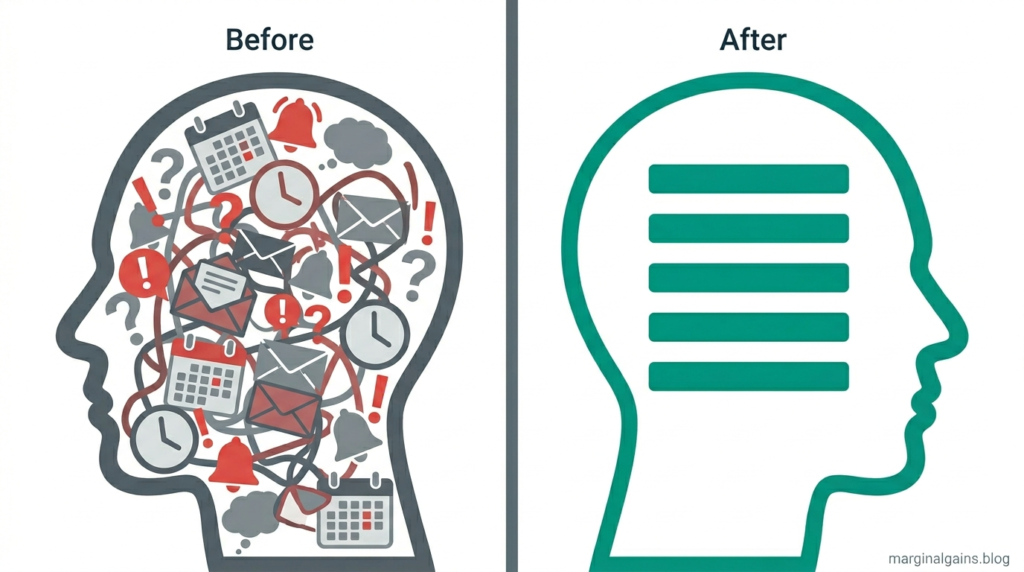
Everything else on your list goes into your external system. This feels brutal. Your brain will protest: “But this is important! And this!” True — they’re all important. But they can’t all occupy mental space simultaneously. The 5-Item Method isn’t about ignoring things — it’s about strategically allocating your finite mental resources.
Step 3: Create Your External System
This is essential to mental clutter clearing. Your brain will only release mental load if it trusts something else is tracking everything.
Your external system doesn’t need to be fancy — it needs to be trusted and consistently reviewed. A physical notebook works well: one page for your current five, separate pages for different categories of everything else. A digital notes app with your five at the top and categorised lists below is equally effective. A task management app where your five get priority flags and everything else lives in organised projects is another solid option.
The key is having one place where everything lives. If tasks scatter across multiple systems, your brain doesn’t trust any system and tries to remember everything itself. Review your external system daily — even five minutes builds the trust that nothing will fall through the cracks. When you know you’ll see that “book dentist appointment” task tomorrow during your review, your brain stops nagging you about it today.
Step 4: Implement Daily Review
Mental clutter clearing requires maintenance — not much, but consistent.
A daily check-in of five minutes is enough: what’s your current focus for today? Are your two active projects still the right two? Do your two upcoming items need adjustment? Has anything changed requiring a swap? This isn’t adding tasks or planning — it’s simply confirming your five items still make sense.
A weekly review of around 20 minutes is more thorough. Look at your entire external system, process new items from your brain dump, update project lists, move completed items out, and adjust priorities based on what actually happened that week. Similar to how friction logging reveals productivity blockers, regular review reveals what’s actually occupying mental space versus what you thought would. If you want to prevent mental clutter from accumulating again, see our list of 50 2-minute tasks to reduce procrastination.
The discipline isn’t in perfect execution — it’s in regular review. When you trust your system, your brain releases its mental grip.
QUICK WIN:
Schedule a five-minute review into your calendar for tomorrow morning — call it “Mental Clutter Check”. During it, write down your five items: one current focus, two active projects, two upcoming items. That’s your first daily review done.
Common Mental Clutter Clearing Challenges
Challenge 1: “Everything Feels Urgent”
When everything screams for attention, nothing gets it effectively. Ask yourself: “What happens if this doesn’t get done this week?” Often, nothing catastrophic. True urgency is rarer than it feels — most “urgent” things are actually “preferred soon.” Also question who made it urgent. External urgency (someone else’s deadline) doesn’t automatically deserve your mental space.
Challenge 2: “I Don’t Trust My System”
Your brain won’t release control unless it believes something else is reliable. Start small — choose three items to externalise completely this week. When your system proves reliable for three things, your brain gradually trusts it with more. Make your system visible too: an open notebook on your desk, an app always pinned. The more accessible it is, the more your brain trusts it.
Challenge 3: “New Things Keep Appearing”
Life happens — new requests, problems, and ideas arrive constantly. The solution is a capture inbox: new items don’t go directly into your five or even your organised system, but into an inbox you process during daily or weekly review. This prevents reactive addition to mental load. You acknowledge the item exists without immediately granting it mental space.
Challenge 4: “I Feel Guilty About What I’m Not Doing”
The unchosen items feel neglected — but reframe this. Those items aren’t being ignored; they’re being responsibly deferred. By focusing on five, you actually complete things rather than making minimal progress on everything. Progress on five beats stagnation on fifty.
What Happens After Mental Clutter Clearing
The effects of consistent mental clutter clearing are noticeable within days. A cluttered mind struggles to encode new information effectively — clearing mental noise is one of the preconditions for the learning strategies covered in our guide on how to learn faster.
Focus improves significantly — when your brain isn’t juggling thirty items, it can concentrate on the task in front of you. Deep work becomes possible again. Decision-making improves too, because mental clutter drains the cognitive energy needed to think clearly about important choices.
Anxiety reduces noticeably — much of it stems from unmanaged mental load. When items live in a trusted system, that background worry dissipates. Sleep improves for the same reason: your brain knows the system is tracking everything, so the 2am racing thoughts decrease dramatically.
Paradoxically, limiting your focus to five items results in finishing more things. Shallow progress on everything becomes meaningful completion of something. If you find that mental load is also affecting your energy levels, the strategies in our guide on maintaining mental energy work well alongside the 5-Item Method.
QUICK WIN:
After your next task is complete, pause before starting the next one. Ask: “Is this one of my five?” If not, add it to your external system and return to your five. That pause is where mental clutter clearing actually happens — in the moment of choosing.
Your Next Steps for a Clearer Mind
Mental clutter doesn’t clear itself — it accumulates until you actively intervene.
Tonight, spend 15 minutes with pen and paper. Write down everything in your head — every task, worry, idea, commitment. Tomorrow morning, review your list and circle five items: your current focus, two active projects, two upcoming items. Write those five on a fresh page. Everything else goes into whatever system you trust — notebook, app, whatever. The key is one place, reviewed regularly.
That’s mental clutter clearing in practice. Not complicated. Not easy either, because it requires choosing. But the relief of reducing 50 mental tabs to five is worth the discomfort of deciding. Your brain was designed to think, not to be a filing cabinet. Give it back its actual job.
RESOURCES:
I only recommend resources that I either use personally or have researched and feel are genuinely helpful for my readers. Resources sometimes contain affiliate links; if you purchase through these, I may earn a small commission at no extra cost to you.
Further Reading on Mental Clarity and Productivity:
Getting Things Done by David Allen — The foundational system for externalising mental load into trusted systems. The principles behind the 5-Item Method owe much to Allen’s work. Paperback | Kindle | Audible
The Organized Mind by Daniel Levitin — A neuroscientist’s guide to how the brain handles information overload and how to work with it rather than against it. Paperback | Kindle
Related Articles from Marginal Gains:
How to Improve Mental Performance: 10 Science-Backed Strategies
How to Focus Better at Work: The Complete Deep Work Guide
How to Maintain Mental Energy: Stop the 3pm Crash
The 1-3-5 Rule: A Simple Framework for Daily Productivity
Friction Logging: Find and Fix Productivity Roadblocks
I'm Simon Shaw, a Chartered Occupational Psychologist with over 20 years of experience in workplace psychology, learning and development, coaching, and teaching. I write about applying psychological research to everyday challenges - from habits and productivity to memory and mental performance. The articles on this blog draw from established research in psychology and behavioural science, taking a marginal gains approach to help you make small, evidence-based changes that compound over time, allowing you to make meaningful progress in the areas you care about most.