
Willpower and Habit Formation: Why Discipline Isn’t Enough

If you’ve ever failed to maintain a new habit despite your best intentions, you’ve probably blamed your lack of willpower. Perhaps you told yourself you simply need more discipline, more self-control, more mental toughness. This diagnosis feels intuitive — but it fundamentally misunderstands the relationship between willpower and habit formation, and worse, it sets you up for repeated failure.
The science of willpower and habit formation is far more complex and nuanced than popular psychology suggests. Understanding what research actually reveals about self-control, ego depletion, and automaticity changes not just how you approach building habits, but whether those habits survive beyond the initial enthusiasm.
As a Chartered Occupational Psychologist who’s worked for over two decades with individuals attempting behaviour change, there’s a consistent pattern: people who succeed at building lasting habits don’t have superior willpower. They’ve simply learned to build systems that require minimal willpower to maintain. The science supports this observation in fascinating ways.
What Is Willpower? A Starting Point for Habit Formation
Willpower is your ability to override an immediate impulse — the urge to check your phone, skip the gym, or reach for the biscuits — in favour of a longer-term goal. Most people think of it as a character trait: you either have it or you don’t. The science tells a more interesting story.
The Resource Model of Self-Control
Psychologist Roy Baumeister proposed that willpower works like a muscle. Use it repeatedly throughout the day and it gradually weakens — meaning the decisions you make at 9pm are likely to be worse than the ones you made at 9am. This idea spawned a whole genre of productivity advice: make important decisions in the morning, reduce trivial choices, and protect your self-control reserves for when they matter most.
It’s a compelling model. It’s also, as later research revealed, considerably more complicated.
Ego Depletion
The technical term for willpower fatigue is “ego depletion” — and for years it was one of psychology’s most celebrated findings. Hundreds of studies seemed to confirm it: exert self-control on one task, and you’ll perform worse on the next unrelated one. Resist the biscuits in round one, give up faster on the puzzle in round two.
Then came the replication crisis. When researchers tried to reproduce these findings using larger groups and more rigorous methods, the effect largely disappeared. A major study in 2016 involving 23 laboratories and over 2,000 participants found no reliable evidence for ego depletion at all.
The honest scientific position now is: we’re not entirely sure. What does seem clear is that willpower is influenced by belief, motivation, and context — not just a fixed biological resource that runs down like a battery. But here’s what matters practically: whether ego depletion is real or not, systems built on willpower alone fail consistently. The mechanism is less important than the outcome.
QUICK WIN:
Test your own relationship with willpower depletion. For one week, schedule your single most important habit immediately after waking — before any decisions, emails, or demands accumulate. Notice whether completion rates improve compared to attempting the same habit in the evening. Most people find a significant difference, regardless of whether true ego depletion exists.
Why Willpower and Habit Formation Make an Unreliable Pair
Even if we set aside the ego depletion controversy, multiple lines of research demonstrate why willpower makes a poor foundation for habit formation.
The Finite Resource Problem
Whether or not willpower depletes in the way Baumeister originally suggested, it clearly isn’t infinite. You can maintain high self-control for hours in specific situations, but not indefinitely across all domains simultaneously. Attempting to rely on constant vigilance and self-control across multiple habit changes creates unsustainable cognitive load.
I’ve observed this repeatedly in workplace coaching. Professionals who attempt simultaneous changes — better eating, regular exercise, improved sleep, reduced procrastination, enhanced focus — whilst maintaining demanding work schedules inevitably abandon some or all of these changes. The cumulative willpower demand exceeds what anyone can sustain.

Decision Fatigue
Separate from ego depletion theory, decision fatigue represents a well-documented phenomenon. As you make more decisions throughout the day, the quality of your decisions deteriorates. You become more impulsive, more likely to choose default options, and more prone to decision avoidance.
Every time you need to decide whether to perform your habit — to exercise or not, to check your phone or not, to eat the biscuit or not — you’re expending decision-making capacity. Habits that require dozens of daily decisions (“should I do this now?”) create substantial decision fatigue over time.
This explains why willpower often seems to fail in the evening. It’s not necessarily that your willpower has depleted, but that you’ve made hundreds of decisions throughout the day and your brain gravitates toward default options that require minimal cognitive effort.
Environmental Factors
Willpower exists in constant competition with your environment, and your environment usually wins. When you rely on willpower to override environmental cues, you’re fighting a battle dozens or hundreds of times daily. Your phone sits on your desk whilst you try to focus. Biscuits sit in your cupboard whilst you try to eat healthily. The sofa faces the television whilst you try to read more.
Each environmental cue triggers an impulse that must be consciously overridden. This creates continuous low-level cognitive load that accumulates throughout the day. Eventually, your willpower weakens and the environmental cue wins — not because you’re weak, but because fighting your environment is fundamentally exhausting.
The research on environment design for habits demonstrates that changing environmental cues produces more reliable behaviour change than attempting to override environmental influences through willpower. When you remove the cue, you eliminate the need for willpower entirely.
Individual Variability
People vary substantially in their baseline capacity for self-control, and this capacity fluctuates based on stress, sleep quality, health status, and numerous other factors. Relying on willpower means your habit success becomes dependent on variables largely outside your control.
Had poor sleep last night or fighting off a cold? Your willpower is compromised. Experiencing unusually high stress or working in an environment that conflicts with your core values? Your willpower is compromised. Your willpower is compromised. A willpower-dependent habit becomes unreliable precisely when you most need consistent behaviours to manage difficult periods.
Three Things that Work Better Than Willpower for Habit Formation
The limitations of willpower point toward more reliable approaches. These strategies minimise the need for ongoing self-control rather than depending on it.
1. Systems Over Goals
Goals define what you want to achieve; systems define how you’ll operate regardless of motivation or willpower levels. A goal is “exercise three times per week”. A system is “gym clothes in my bag, Monday/Wednesday/Friday blocked in my calendar, accountability partner confirmed”.
The system approach removes dozens of micro-decisions. You don’t decide whether to exercise — the system decides when and where exercise happens, and you simply follow the system. This dramatically reduces willpower demands because you’re not constantly negotiating with yourself about whether to act.
James Clear’s work in Atomic Habits emphasises this distinction. People who achieve consistent results don’t have superior willpower; they have superior systems. The system does the work that willpower can’t sustain long-term.
2. Implementation Intentions
Research by Peter Gollwitzer demonstrates that implementation intentions — specific if-then plans — dramatically improve goal achievement compared to general goal-setting. Rather than intending to “exercise more”, you create a specific plan: “If it’s 6:30am on a weekday, then I will put on my running shoes and go for a run”.
Implementation intentions work by pre-deciding behaviour, removing the need for in-the-moment willpower. When 6:30am arrives, you’re not deciding whether to run. You’ve already decided. You’re simply executing the predetermined plan. This automation of decision-making preserves willpower for genuinely novel or complex situations.
The research shows that implementation intentions approximately double the success rate for goal achievement across diverse domains — not because they increase willpower, but because they eliminate the need for willpower at the moment of action.
3. Automaticity
The ultimate goal of habit formation is automaticity — behaviour that occurs without conscious deliberation. Truly automatic habits require no willpower because they’re not consciously controlled. You don’t use willpower to brush your teeth; you simply brush your teeth because that’s what you do after waking.
Research by Wendy Wood demonstrates that habits become automatic through consistent repetition in stable contexts. The more consistently you perform a behaviour in response to a specific cue, the more automatic it becomes. Eventually, the cue triggers the behaviour directly, bypassing conscious decision-making entirely.
This process takes longer than popular myths suggest — research shows an average of 66 days for a behaviour to become automatic, with substantial variation based on complexity. But once automaticity develops, the behaviour persists with minimal willpower requirement.
QUICK WIN:
Write one implementation intention for a habit you’ve been struggling to maintain. Use the exact format: “If [specific time or situation], then I will [specific behaviour] at [specific location].” Pin it somewhere visible. The specificity is what makes it work — vague plans still require in-the-moment willpower decisions.
Building Self-Control Capacity to Support Habit Formation
Whilst willpower shouldn’t be your primary strategy for habit formation, certain factors do influence your baseline capacity for self-control. Optimising these factors makes the limited willpower you do require more reliable.
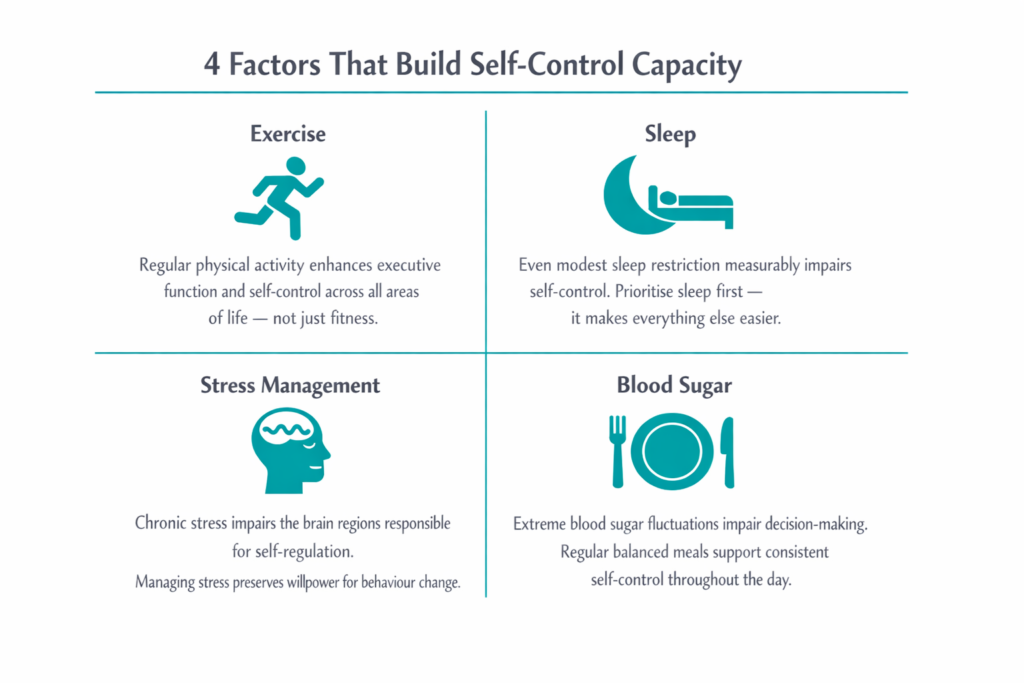
Exercise and Physical Health
Regular physical activity improves self-control across multiple domains. Exercise doesn’t just strengthen your muscles; it enhances executive function more broadly. Research shows that people who exercise regularly perform better on tasks requiring self-control, even when the tasks are completely unrelated to physical activity.
This creates a powerful argument for prioritising exercise as a foundational habit. Not because exercise requires superior willpower, but because establishing exercise enhances the self-control capacity available for other behaviours.
Sleep and Recovery
Sleep deprivation dramatically impairs self-control. Research consistently shows that people who are sleep-deprived make worse decisions, have more difficulty regulating emotions, and show reduced capacity to resist temptations. Even modest sleep restriction — going from eight hours to six — produces measurable deficits in self-control tasks.
Prioritising sleep therefore functions as a keystone habit — improving sleep enhances self-control, which makes other positive behaviours easier to maintain. In my practice, I consistently observe that addressing sleep issues first creates better conditions for all subsequent behaviour change attempts.
Stress Management
Chronic stress depletes the cognitive resources required for self-control. When your stress response system is constantly activated, the brain regions responsible for deliberate self-regulation function less effectively. You become more reactive, more impulsive, and less capable of inhibiting unwanted behaviours.
Stress management isn’t just about feeling better — it’s about preserving the cognitive capacity required for behaviour change. Effective stress management through exercise, meditation, social connection, or therapy creates better conditions for willpower and habit formation to work together.
Blood Sugar Regulation
Extreme blood sugar fluctuations impair decision-making and self-regulation. Regular balanced meals and avoiding long gaps without food helps maintain consistent cognitive performance — particularly relevant for habits you’re attempting in the afternoon or evening when energy tends to dip.
When Willpower Actually Helps Habit Formation
Despite its limitations, willpower does serve important functions in willpower and habit formation. Understanding where it’s useful helps you deploy it strategically rather than depleting it on tasks better handled by other strategies.
Initial Habit Establishment
The early stages of habit formation, before automaticity develops, require some willpower. You need to override existing patterns, remember new behaviours, and push through the awkwardness of unfamiliar actions. This is expected and manageable because it’s temporary.
The key is recognising this as a short-term investment. You’re using willpower to build systems and establish routines that will eventually require minimal willpower to maintain. Using strategies like the two-minute rule reduces the willpower required during this establishment phase, but some conscious effort remains necessary.
Dealing with Disruptions
Even well-established habits face disruptions: holidays, illness, schedule changes, life transitions. These disruptions temporarily break the cue-routine-reward association that makes habits automatic. Reestablishing the habit after disruption requires willpower because you’ve lost the automaticity.
This is where having preserved willpower through systemisation pays dividends. Because your regular routine doesn’t constantly drain willpower, you have capacity available for managing disruptions. The research on why habits fail shows that many habits collapse during disruptions precisely because people lack the willpower reserves to reestablish them.
Rather than trying to muscle through disruptions with willpower, you can also use evidence-based planning techniques like WOOP goal setting, which helps you identify obstacles in advance and create if-then plans that bypass the need for in-the-moment willpower entirely.
Making Decisions About Habits
Willpower serves genuine utility for meta-decisions about your habits: choosing which habits to pursue, evaluating whether habits serve your goals, deciding when to modify or abandon habits. These deliberative processes benefit from the self-regulation that willpower provides.
The distinction is between using willpower for ongoing behaviour execution versus using it for periodic planning and evaluation. The former is unsustainable; the latter is appropriate and valuable. Schedule regular reviews when you’re well-rested and not stressed, using your available willpower for thoughtful consideration rather than forcing daily behaviours.
Practical Applications for Willpower and Habit Formation
Understanding the relationship between willpower and habit formation translates into specific strategies you can implement immediately.
Conserving Willpower
Reduce unnecessary decisions throughout your day. Steve Jobs famously wore the same outfit daily, eliminating clothing decisions. Whilst you needn’t go that far, identifying and automating trivial decisions preserves willpower for genuinely important choices.
Plan meals in advance rather than deciding what to eat when hungry. Create morning and evening routines that flow automatically rather than requiring dozens of micro-decisions. Use implementation intentions for recurring situations. Each automated decision is willpower you’ve preserved for when it’s actually needed.
Timing Habit Attempts
Start new habits when life is relatively stable, not during periods of high stress or major transitions. Beginning a challenging habit whilst changing jobs, moving house, or managing a family crisis stacks too many willpower demands simultaneously.
Similarly, time your most willpower-demanding tasks for when your capacity is highest — typically morning for most people, before accumulating decision fatigue. If you’re attempting a difficult habit that hasn’t yet become automatic, schedule it early in your day rather than evening when willpower is lowest.
Reducing Daily Decisions
Transform recurring decisions into systems and rules. “I exercise Monday, Wednesday, Friday at 6:30am” eliminates the daily decision about whether to exercise today. “I check email at 10am and 3pm” eliminates dozens of decisions about checking email throughout the day.
This works because systems remove decision points. You’re not constantly negotiating with yourself about whether to act. The system defines when action occurs, and you simply follow it — fundamentally different from relying on willpower to override impulses.
QUICK WIN:
Audit your day for unnecessary decisions. Write down five recurring choices you make daily that could be converted into automatic rules — meal choices, when to check your phone, morning routine order. Convert each into a fixed rule this week. You’ll notice within a few days that your evenings feel less depleted, because you’ve preserved willpower throughout the day rather than spending it on trivial decisions.
The Path Forward
The relationship between willpower and habit formation is neither as simple as “just be more disciplined” nor as deterministic as “willpower is useless”. The nuanced reality is that willpower has genuine utility for specific purposes, but building sustainable habits requires minimising your dependence on it.
After two decades working with behaviour change, I’ve observed consistent patterns. People who succeed long-term don’t have extraordinary willpower. They’ve built systems, created supportive environments, developed implementation intentions, and pursued automaticity. They use willpower strategically for initial establishment and disruption management, but they don’t depend on it for ongoing execution.
Willpower is real but limited. Ego depletion may or may not be real, but either way, constant self-control is unsustainable. Environment, systems, and automaticity produce more reliable results than depending on discipline alone.
This isn’t permission to abandon self-control entirely. It’s recognition that your cognitive resources are precious and finite, and you should deploy them strategically. When you can remove temptation through environmental design, do that instead of resisting temptation through willpower. When you can automate behaviour through consistent routines, do that instead of deciding whether to act each time.
Your willpower is valuable precisely because it’s limited. Save it for the situations that genuinely require conscious self-regulation: establishing new patterns, managing disruptions, making important decisions about your behaviour. For everything else, build systems that work regardless of how motivated you feel.
The goal isn’t becoming someone with limitless self-control. The goal is becoming someone who rarely needs it.
RESOURCES:
I only recommend resources that I either use personally or have researched and feel are genuinely helpful for my readers. Resources sometimes contain affiliate links; if you purchase through these, I may earn a small commission at no extra cost to you.
Recommended Reading
Atomic Habits — James Clear. The definitive guide to building habits through systems rather than willpower. Essential reading for anyone serious about lasting behaviour change. Paperback | Kindle | Audible
Willpower — Roy Baumeister. Explores the role of glucose levels, healthy eating and sleep in maintaining the willpower to achieve personal goals. Paperback | Kindle | Audible
The Power of Habit — Charles Duhigg. Explores the science of habit loops and how automaticity works — directly relevant to understanding why willpower alone isn’t enough. Paperback | Kindle | Audible
Good Habits, Bad Habits — Wendy Wood. Written by the leading researcher on automaticity and habit formation, this is the most research-grounded book on how habits actually work. Paperback | Kindle | Audible
Related Articles
Habit Formation Guide — The complete evidence-based framework for building habits that last.
Why Habits Fail — The most common reasons habits don’t stick and how to address them.
The Two-Minute Rule — How to reduce the willpower required to start new habits.
Environment Design for Habits — How to remove the need for willpower by redesigning your surroundings.
Keystone Habits — The foundational habits that make all other behaviour change easier.
I'm Simon Shaw, a Chartered Occupational Psychologist with over 20 years of experience in workplace psychology, learning and development, coaching, and teaching. I write about applying psychological research to everyday challenges - from habits and productivity to memory and mental performance. The articles on this blog draw from established research in psychology and behavioural science, taking a marginal gains approach to help you make small, evidence-based changes that compound over time, allowing you to make meaningful progress in the areas you care about most.