How Long to Form a Habit? The Real Answer

If you’ve ever searched for information about building habits, you’ve probably encountered the claim that it takes 21 days to form a new habit. It’s repeated so often that it’s become accepted wisdom, appearing in self-help books, motivational speeches, and countless blog posts. So how long does it take to form a habit, really? The answer, based on rigorous psychological research, is both more complex and more useful than the simplified version you’ve probably heard.
As a Chartered Occupational Psychologist who works extensively with behaviour change, I’ve seen the damage this myth can cause. People attempt to build habits with unrealistic expectations, feel like failures when habits aren’t automatic after three weeks, and abandon worthwhile pursuits because they believe something’s wrong with them when actually, they simply needed more time.
In this article, I’ll walk you through what the science actually tells us about habit formation timelines, what factors affect how quickly habits develop, and how you can use this knowledge to set yourself up for success.
The Landmark Research on How Long It Takes to Form a Habit
The most comprehensive research on how long it takes to form a habit comes from a 2010 study by health psychology researcher Phillippa Lally and her colleagues at University College London. This study has become the definitive reference point for understanding habit formation timelines, yet it’s widely misunderstood and misrepresented.
Phillippa Lally’s UCL Study
Lally’s team recruited 96 volunteers who each chose a new health behaviour they wanted to turn into a habit. These ranged from simple behaviours like drinking a glass of water at breakfast to more complex ones like running for 15 minutes before dinner. Participants reported daily on whether they performed the behaviour and how automatic it felt.
The study ran for 84 days (12 weeks), during which researchers tracked not just whether people completed their chosen behaviour, but crucially, how automatic it became. This focus on automaticity — the sense of performing a behaviour without conscious thought or effort — is what makes this research particularly valuable. The British Psychological Society has a clear research digest summary of the Lally study if you’d like to read more about the methodology.
Study Methodology
What made Lally’s research particularly robust was its measurement approach. Rather than simply asking people if they’d formed a habit, researchers used the Self-Report Habit Index (SRHI), a validated psychological measure that assesses various dimensions of automaticity: how often people do the behaviour without thinking about it, whether it feels like “me,” and how much effort it requires.
Participants completed this measure daily, creating a detailed picture of how automaticity developed over time. The researchers then plotted automaticity curves for each participant, showing the trajectory from initial effort to eventual automaticity. This granular data revealed patterns that simple yes/no measures would have missed entirely.
I’ve created useable versions of the Self-Report Habit Index (good for in-depth habit assessment) and the shorter Self-Report Behavioural Automaticity Index (for tracking how automatic your habits are over time), which you can download here for free.
Key Findings: Average 66 Days, Range 18–254 Days
Here’s what the research actually found: on average, it took 66 days for a behaviour to become automatic. But that average conceals enormous variation. The range extended from just 18 days for the simplest habits to 254 days for the most complex ones. Some participants hadn’t reached full automaticity even by the end of the 84-day study period.
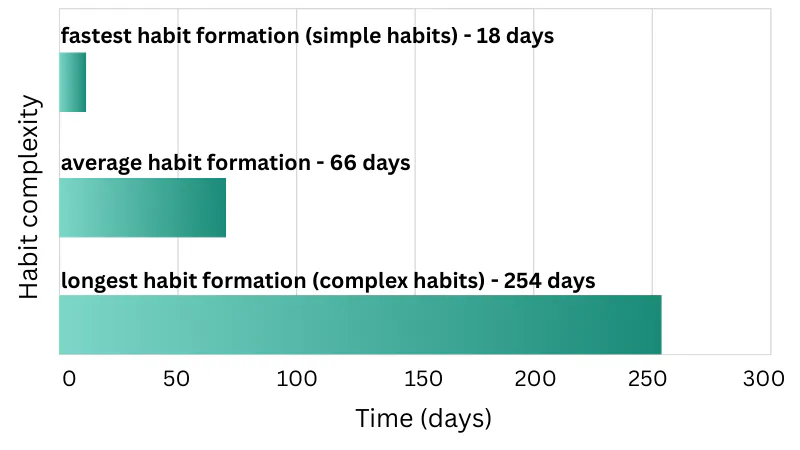
This variation isn’t noise in the data — it’s signal. Different behaviours take different amounts of time to become habitual, and different people will take different amounts of time to automate the same behaviour. The 66-day average is useful as a general guideline for how long to form a habit, but it’s just that: an average, not a prescription.
Critically, the research also found that missing a single day didn’t significantly impact habit formation. The automaticity curve showed some flexibility — people could skip occasionally without derailing the process entirely. This finding contradicts the perfectionist assumption that you must perform a habit every single day without exception.
QUICK WIN:
Look up the last habit you tried to build and gave up on. Ask yourself honestly: how many days did you stick with it before stopping? Chances are it was fewer than 66. Write down one habit you want to build and commit to a realistic 10-week minimum before judging whether it’s working.
Factors That Affect How Long It Takes to Form a Habit
Understanding why habit formation timelines vary so dramatically helps you set realistic expectations and choose habits strategically.
Habit Complexity
This is perhaps the most significant factor affecting formation time. Drinking a glass of water when you wake up is a simple behaviour with minimal steps. Running for 15 minutes requires changing clothes, going outside, actually running, then showering and changing back. The more complex the behaviour, the more cognitive processing it requires, and the longer it takes to become automatic.
In Lally’s study, participants who chose simple behaviours like drinking water or eating fruit reached automaticity much faster than those who chose exercise-based habits. This makes intuitive sense — simpler behaviours have fewer steps to automate and fewer potential friction points.
This doesn’t mean you should avoid complex habits. It simply means you should plan for a longer formation period and perhaps start with a simplified version that you can build up gradually.
Frequency (Daily vs Occasional)
How often you perform a behaviour dramatically affects how quickly it becomes habitual. Daily behaviours develop into habits faster than weekly ones, which in turn develop faster than monthly ones. This makes sense from a neurological perspective — habit formation relies on strengthening neural pathways through repetition, and more frequent repetition creates stronger pathways faster.
If you’re trying to build a habit of weekly meal preparation, you’ll need more calendar time to reach automaticity than if you’re building a daily meditation practice, even if the actual time spent on each behaviour is similar. You’re simply getting fewer repetitions in the same period.
This is why habit formation advice typically focuses on daily habits. They’re easier to track, provide more opportunities for practice, and automate more quickly. If you’re building a less-than-daily habit, multiply your expected timeline accordingly.
The same principles that govern habit formation — spaced repetition, consistent practice, consolidation over time — are central to the learning strategies covered in our guide on how to learn faster.
Individual Differences
People vary in how quickly they form habits, and this variation appears to be partly temperamental. Some people are naturally more routine-oriented and find it easier to stick to structured behaviours. Others are more spontaneous and find rigid routines constraining.
Your prior experience with habit formation also matters. If you’ve successfully built habits before, you’ve developed metacognitive skills — awareness of what works for you, strategies for overcoming obstacles, realistic expectations — that make subsequent habits easier to establish. This suggests that habit formation is itself a skill that improves with practice.
Personality traits like conscientiousness correlate with habit formation success. However, even if you’re not naturally conscientious, you can compensate through environmental design and external accountability systems.
Environmental Support
The environment in which you’re trying to build a habit significantly affects formation time. When your environment supports the habit — when healthy food is readily available, your running shoes are by the door, your meditation cushion is in a quiet space — the behaviour requires less willpower and becomes automatic more quickly.
Conversely, when you’re fighting against your environment — trying to eat healthily when your kitchen is full of processed snacks, attempting to exercise when you first have to find your trainers buried in the wardrobe — each performance of the behaviour requires conscious effort and decision-making, slowing automaticity development.
This is why environment design is such a powerful complement to habit formation. By making the desired behaviour the path of least resistance, you accelerate the transition to automaticity.
Motivation and Identity Alignment
Habits that align with your sense of identity and core values tend to form more quickly and persistently than those that feel imposed or disconnected from who you are. If you see yourself as “a healthy person” or “someone who values learning,” behaviours consistent with that identity feel more natural and automate more readily.
Initial motivation matters too, though its role diminishes over time. High motivation can carry you through the early weeks when the behaviour still requires effort and conscious decision-making. As automaticity develops, you need less motivation because the behaviour becomes increasingly effortless. This is why understanding that you need to persist beyond the initial motivation period is so important.
QUICK WIN:
Pick one habit you want to build and spend two minutes redesigning your environment to make it easier. Put your running shoes by the front door. Move the fruit bowl to the kitchen counter. Put your journal on your pillow. One small environmental change now can cut weeks off how long it takes to form a habit.
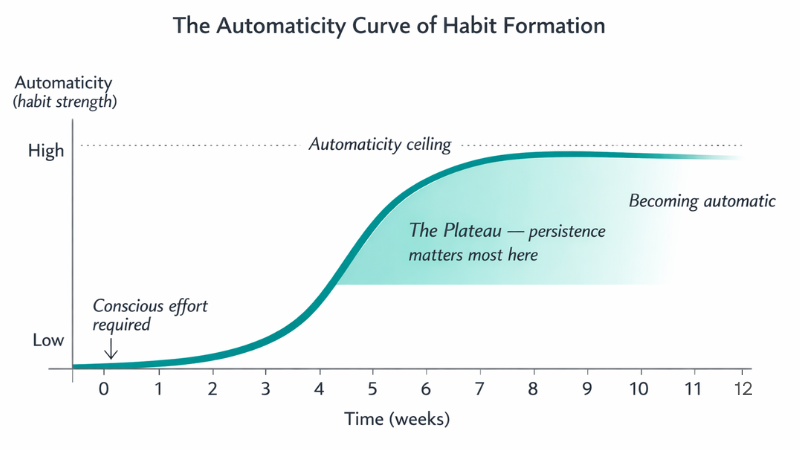
The Automaticity Curve
One of the most valuable insights from Lally’s research is the shape of the automaticity curve — how habits develop over time.
What Automaticity Means
Automaticity is the psychological term for performing a behaviour without conscious thought or decision-making. When a habit is fully automatic, you do it without deliberating, often without even noticing you’re doing it. You don’t decide to brush your teeth at night; you just find yourself doing it.
Automaticity exists on a continuum rather than as a binary state. A behaviour can be partially automatic — easier than it used to be, requiring less conscious effort, but not yet completely effortless. This is an important distinction because it helps you recognise progress even before a habit is fully formed.
How Habits Become Automatic
Neurologically, habit formation involves transferring control from the prefrontal cortex (responsible for conscious decision-making) to the basal ganglia (which handles routine, automatic behaviours). This transfer happens gradually through repetition in consistent contexts.
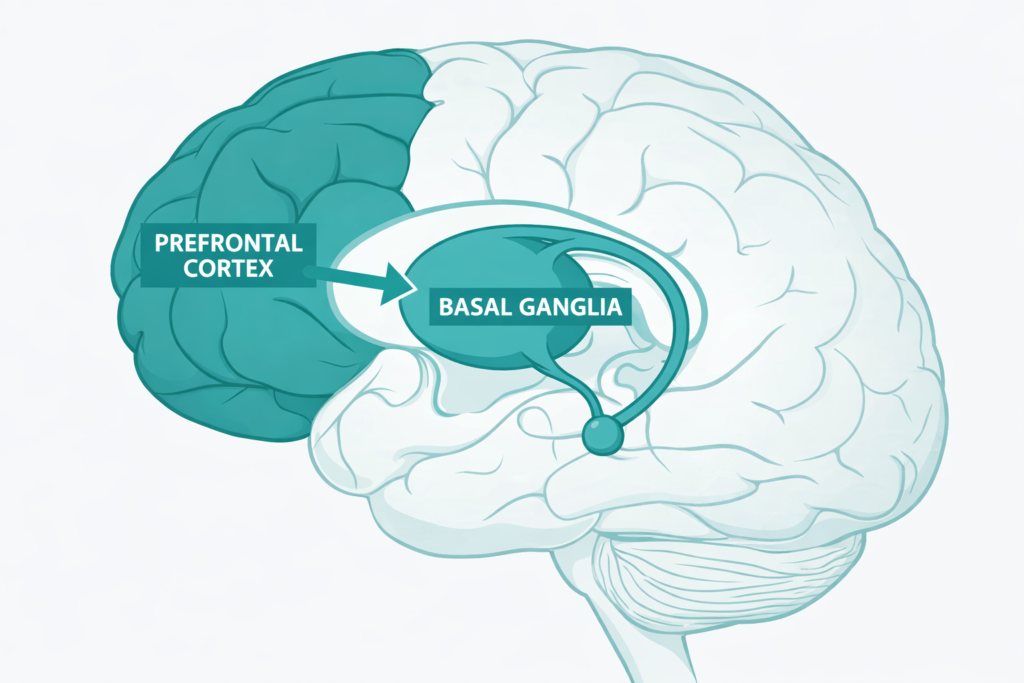
Each time you perform a behaviour in response to a consistent cue, you strengthen the association between that cue and the behaviour. Over time, the cue itself begins to trigger the behaviour automatically, bypassing conscious deliberation. This is why identifying and using effective habit triggers is so crucial for habit formation.
Measuring Automaticity
Whilst you probably won’t use formal psychological instruments like the SRHI, you can gauge your own automaticity by noticing how much effort the behaviour requires, whether you have to remind yourself to do it, how often you perform it without conscious decision, whether it feels like “just what you do,” and how uncomfortable it feels to skip it.
As automaticity increases, you’ll notice these shifts. The behaviour that once required a reminder and deliberate effort becomes something you just do, and eventually something that feels strange not to do.
Different Habits, Different Timelines
Based on Lally’s research and subsequent studies, we can categorise habits into rough timeline categories. These are guidelines, not guarantees, but they help set realistic expectations for how long to form a habit in each category.
Simple Habits (18–30 Days)
Simple habits are single-step behaviours that require minimal time or cognitive load. Examples include drinking a glass of water first thing in the morning, taking vitamins with breakfast, putting your keys in a designated spot when you arrive home, laying out tomorrow’s clothes before bed, and flossing your teeth.
These habits can become relatively automatic within three to four weeks because there’s simply not much to automate. They slot easily into existing routines and create minimal friction.
Moderate Habits (40–80 Days)
Moderate habits involve multiple steps or require more time and effort. They’re more substantial than simple behaviours but not overwhelmingly complex. Examples include morning meditation practice (10-15 minutes), evening journaling, daily language learning with an app, packing lunch the night before, and reading for 20 minutes before bed.
These habits typically reach substantial automaticity within six to twelve weeks. They require enough repetition that the entire sequence becomes fluid, but they’re not so complex that every component needs separate automation.
Complex Habits (100+ Days)
Complex habits involve multiple steps, significant time investment, or substantial behaviour change. Examples include regular exercise routines (getting dressed, travelling to gym, exercising, showering, changing), morning routines with multiple components, and weekly meal preparation.
These habits may take three to six months or longer to become truly automatic. Each component of the sequence needs to become habitual, and the entire chain needs to become smooth and effortless. Don’t be discouraged if these habits still require conscious effort after a couple of months — that’s entirely normal.
The Same Habit, Different Timelines
It’s worth noting that the same basic behaviour can fall into different categories depending on how you implement it. “Exercise” could be a simple habit if it means doing ten press-ups in your living room first thing in the morning, or a complex habit if it means driving to a gym, completing a full workout, showering, and returning home.
This is why starting with minimal versions of habits can be so effective. You can automate the simple version relatively quickly, then gradually increase complexity from a foundation of established automaticity.
What the Research Means Practically
Understanding the research on how long to form a habit has several practical implications for how you approach building new habits.
Setting Realistic Expectations
First and most importantly: stop expecting habits to form in 21 days. Unless you’re building an extremely simple habit, three weeks isn’t enough time to develop genuine automaticity. Setting yourself up with a more realistic timeline — expecting two to three months for most substantial habits — dramatically increases your likelihood of success.
When you know that feeling like the habit still requires effort at day 30 is completely normal, you won’t interpret that as failure. You’ll recognise it as an expected part of the process and continue rather than giving up.
Planning for the Plateau
The automaticity curve shows rapid initial progress, then a plateau where automaticity develops more slowly. This plateau is where many people give up, mistakenly believing the habit “isn’t sticking.” In reality, this slower progress phase is when the deeper neural pathways are being reinforced.
Plan for this plateau. Expect that the habit will feel harder around weeks four to eight than it did initially. This is normal. The excitement and novelty have worn off, but full automaticity hasn’t yet developed. This is when your commitment to the process matters most.
When You Can Expect to Feel Automatic
Based on Lally’s research, you can expect to feel substantial automaticity — where the behaviour feels more automatic than effortful — somewhere between 40 and 100 days for most habits. This doesn’t mean you’ll never think about the behaviour again, but it means it will require significantly less willpower and conscious decision-making.
Full automaticity, where you perform the behaviour almost without awareness, typically takes longer. But you don’t need to wait for full automaticity to benefit from a habit. Even partial automaticity makes consistent performance much easier.
Myths About Habit Formation Time
Let’s address some common misconceptions that undermine people’s habit-building efforts.
The 21-Day Myth
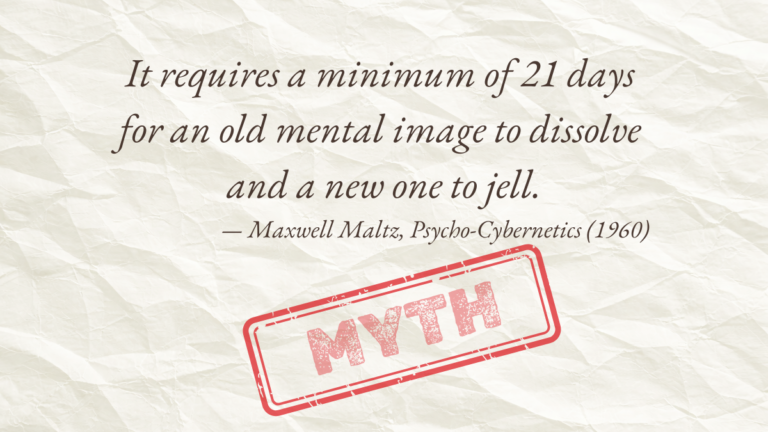
The 21-day myth originates from Dr Maxwell Maltz’s 1960 book “Psycho-Cybernetics.” Maltz, a plastic surgeon, noticed that patients took about 21 days to adjust to their new appearance after surgery. He observed that it took himself about 21 days to form a new habit. This observation — based on a small sample and a specific context — somehow transformed into a universal rule.
As we’ve seen from Lally’s research, 21 days is on the very short end of how long to form a habit, applicable only to the simplest behaviours. Yet this myth persists because it’s appealing: three weeks sounds manageable, specific, and achievable. Unfortunately, it’s also misleading for most habit-building attempts.
The 30-Day Challenge Myth
Similarly, the popular “30-day challenge” format, whilst valuable for building momentum and testing behaviours, rarely results in fully automatic habits. Thirty days is better than twenty-one, but it’s still shorter than most habits need to reach substantial automaticity.
This doesn’t mean 30-day challenges are worthless — they can be excellent for exploring new behaviours and building initial consistency. Just don’t expect the habit to be fully formed when the 30 days end. You’re typically somewhere in the middle of the formation process, not at the finish line.
“It Gets Easier After X Days” Myths
You’ll often see claims that habits “get easier” after specific time points — day 7, day 14, day 21. Whilst habits generally do become progressively easier over time, the process isn’t characterised by sudden shifts at predictable intervals. It’s more gradual and individual than these claims suggest.
The automaticity curve is relatively smooth, not step-like. You’ll likely notice gradual progress — the behaviour requires slightly less effort this week than last week — rather than waking up on day 22 to find the habit suddenly easy.
Using This Research to Build Habits That Stick
Armed with realistic information about how long to form a habit, you can make strategic choices that dramatically increase your success rate.
Choose Habit Complexity Strategically
If you’re new to deliberate habit building or have struggled with consistency in the past, start with simpler habits. Success breeds success — establishing a simple habit quickly builds confidence and teaches you about your own habit formation process. You can then tackle more complex habits from a foundation of demonstrated capability. Try our keystone habit tool if you’re ready to build your first keystone habit.
Alternatively, if you want to build a complex habit, break it into components and automate them sequentially. Instead of trying to establish a complete morning routine all at once, start with one element, automate it, add another, and so on. This staged approach results in more reliable automation than attempting everything simultaneously.
Track Automaticity, Not Just Completion
Most habit tracking focuses on whether you completed the behaviour: yes or no, done or not done. This is useful, but it misses the more important question: is this becoming automatic?
Consider adding a simple automaticity rating to your tracking. On a scale of 1-5, how automatic did the behaviour feel today? This gives you valuable feedback about whether you’re progressing toward genuine habit formation or just grinding through with willpower. If your automaticity ratings aren’t gradually increasing, something needs to change — perhaps you need better environmental design, a simpler version of the behaviour, or more consistent cues.
Don’t Give Up Too Early
Perhaps the most important practical implication: persist longer than you think you need to. If you’re attempting a moderately complex habit, commit to at least 10-12 weeks before evaluating whether it’s “working.” This commitment acknowledges the reality that substantial automaticity takes time.
Many people abandon promising habit-building attempts prematurely, right at the point where persistence would pay off. They interpret the continued need for conscious effort at week four as evidence that “this isn’t working for me,” when actually they’re progressing normally and just need more time.
This doesn’t mean persisting indefinitely with a habit that genuinely doesn’t suit you. But it does mean distinguishing between “this habit isn’t right for me” and “this habit hasn’t become automatic yet.” The former is a valid reason to stop; the latter isn’t.
QUICK WIN:
Add a simple automaticity rating to your current habit tracking. After completing your habit today, rate how automatic it felt on a scale of 1 (required a lot of effort) to 5 (did it without thinking). Track this weekly — a slowly rising number is evidence that it’s working, even when it doesn’t feel like it.
The Reality of Habit Formation
The research on how long to form a habit is both more demanding and more reassuring than popular myths suggest. It’s more demanding because genuine automaticity typically takes longer than the quick-fix promises of 21-day programmes. But it’s more reassuring because it shows that what feels difficult to most people actually is difficult — you’re not failing if a new behaviour still requires effort after a few weeks.
The 66-day average from Lally’s research gives us a useful benchmark, but the 18-254 day range is equally important. It reminds us that there’s no single timeline that applies to everyone for everything. Your timeline depends on the habit you’re building, your personal characteristics, your environment, and your consistency.
This variability might seem frustrating initially, but it’s actually liberating. It means you can stop comparing your progress to arbitrary standards and instead focus on your own automaticity development. Are your habits becoming progressively easier? Are you performing them more consistently without conscious decision-making? That’s progress, regardless of whether it matches someone else’s timeline.
Understanding how long habit formation really takes allows you to approach the process with appropriate patience and realistic planning. When you know that the behaviour still requiring effort at week six is completely normal, you won’t interpret that as failure. When you know that complex habits may take several months to automate, you can plan accordingly rather than giving up prematurely.
The science of habit formation isn’t just academically interesting — it’s eminently practical. By grounding your expectations in evidence rather than myth, choosing habits strategically based on complexity, and persisting through the predictable plateau period, you dramatically increase your likelihood of success.
So the next time someone tells you it takes 21 days to form a habit, you can politely correct them. And more importantly, when you’re building your own habits, you can give yourself the time you actually need rather than the time some myth suggests you should need. Your habits — and your long-term consistency — will be far stronger for it.
RESOURCES:
I only recommend resources that I either use personally or have researched and feel are genuinely helpful for my readers. Resources sometimes contain affiliate links; if you purchase through these, I may earn a small commission at no extra cost to you.
Recommended Reading:
Atomic Habits by James Clear — The clearest practical guide to building habits that stick, grounded in the same behaviour change science covered in this article. Paperback | Kindle | Audible
Good Habits, Bad Habits by Wendy Wood — Written by one of the world’s leading habit researchers, this is the most rigorous and accessible account of the science behind how habits actually form and change. Paperback | Kindle | Audible
The Power of Habit by Charles Duhigg — A compelling exploration of how habits work in individuals, organisations, and society. The habit loop framework introduced here has influenced millions of readers. Paperback | Kindle | Audible
Related Articles from Marginal Gains:
Habit Stacking — How to attach new habits to existing ones to dramatically reduce the time it takes to form them
The Habit Loop — Understanding cue, routine and reward: the neurological foundation of every habit
Environment Design for Habits — How to reshape your surroundings so habits form faster
How to Break Bad Habits — The same science applied in reverse
The Two-Minute Rule — Why starting absurdly small accelerates habit formation
I'm Simon Shaw, a Chartered Occupational Psychologist with over 20 years of experience in workplace psychology, learning and development, coaching, and teaching. I write about applying psychological research to everyday challenges - from habits and productivity to memory and mental performance. The articles on this blog draw from established research in psychology and behavioural science, taking a marginal gains approach to help you make small, evidence-based changes that compound over time, allowing you to make meaningful progress in the areas you care about most.