
Active Recall vs Passive Reading: What Works Better?

You’ve spent two hours reading through your notes. The material feels familiar. You recognise the concepts when you see them. Surely you’ve learned it? Then the exam arrives, or you need to apply the knowledge, and suddenly you can’t retrieve what felt so familiar just yesterday. The information was in your head—you know it was—but it won’t surface when needed.
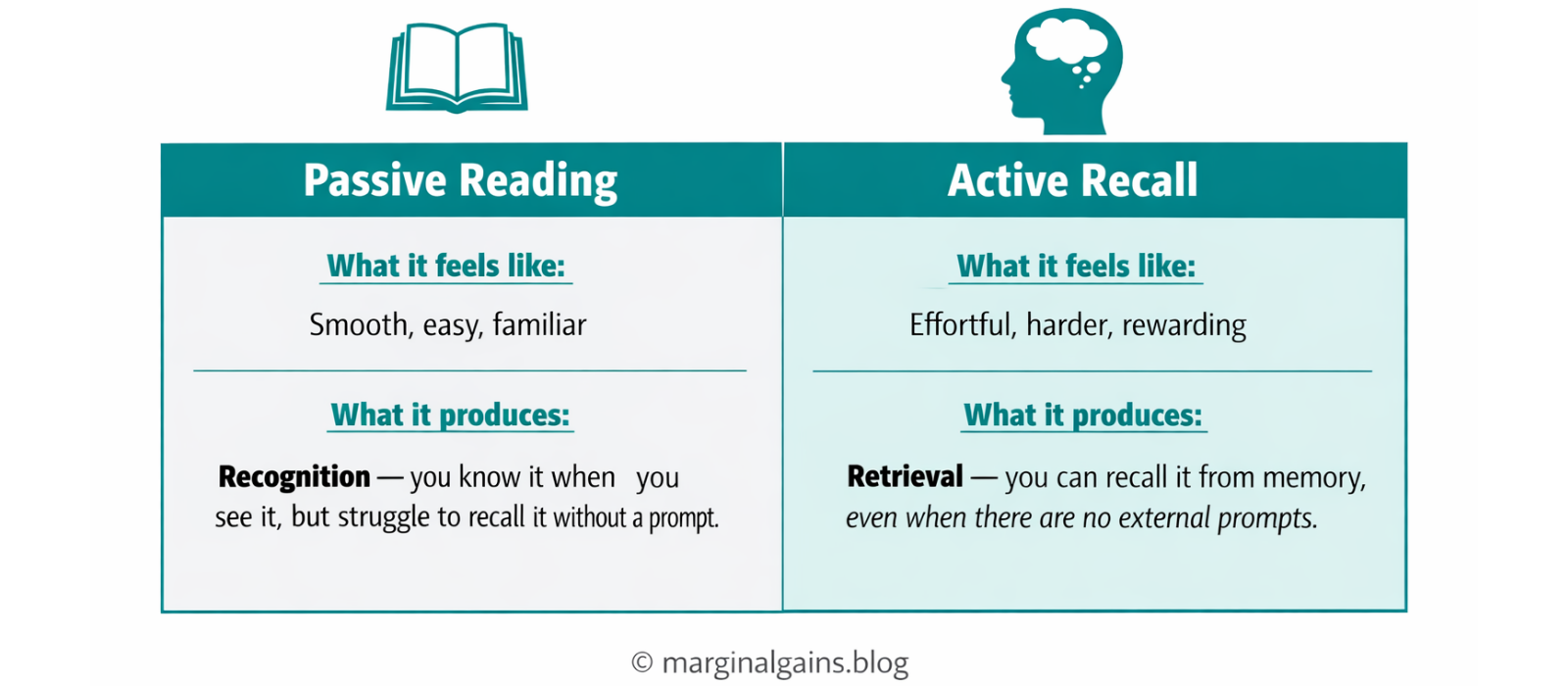
This frustrating experience reveals the core difference in the active recall vs passive reading debate. Recognising information when you see it (passive reading) is completely different from retrieving it from memory when needed (active recall). Most people default to passive reading because it feels productive and requires less mental effort. But research consistently shows that active recall produces dramatically better learning for the same time invested.
Understanding why this difference matters—and how to shift from passive to active strategies—transforms learning efficiency. You’ll learn more in less time, and crucially, what you learn will actually be available when you need it.
Understanding Passive Reading
Passive reading means consuming information without actively testing yourself on it. You read notes, textbooks, or articles. Perhaps you highlight or underline key passages. The information flows into your awareness, you process it to some degree, then move on to the next section.
This approach dominates because it feels productive. Pages turn, material gets covered, time passes. There’s a satisfying sense of progress as you work through content. And initially, passive reading does help—first exposure to material creates some learning even through passive methods.
But passive reading creates a dangerous illusion: the illusion of knowledge. Because material feels increasingly familiar as you review it, you conclude you’ve learned it. This familiarity isn’t lying exactly—you do know the material better than before reading. But familiarity with information when it’s in front of you doesn’t predict whether you can retrieve that information when it’s not.
Why Rereading Feels Productive But Isn’t
Rereading is particularly seductive because each pass through material feels easier than the last. This fluency—the ease with which information flows through your awareness—feels like learning progress. And in a narrow sense, it is: you’re getting better at reading that specific material.
But research shows that rereading produces minimal benefit for long-term retention beyond the first pass. The second reading helps somewhat. The third adds very little. By the fourth pass, you’re experiencing fluency without meaningful additional learning. You’re practising reading, not practising retrieval.
Active recall works particularly well when combined with visual note-taking — our guide on how to remember what you read covers the dual coding method that makes visual notes so much more effective than highlighted text.
The time invested in that third and fourth reading would produce far better results spent on active recall. This isn’t about working harder—it’s about working differently. The same minutes allocated to retrieval practice rather than rereading produces measurably superior retention.
The Illusion of Fluency
Cognitive psychologists have extensively studied why fluency misleads learners. When information processes easily—when reading feels smooth and comprehension feels effortless—your brain interprets this as evidence of learning. “This material makes sense easily, therefore I know it.”
This inference is backward. Fluency during study predicts how well you’ll recognise material when you see it again. It barely predicts how well you’ll retrieve that material independently. And retrieval—not recognition—is what learning actually requires.
The illusion becomes particularly strong when studying material you created yourself. Your own notes, by definition, use your language and organisation. They’ll always feel more fluent than original sources. This fluency makes you confident you’ve learned the material, when you’ve actually just learned your own notes’ structure.
Breaking free from fluency’s illusion requires deliberately choosing study methods that feel less fluent. Active recall feels harder because it is harder—and that difficulty is exactly what drives learning.
What Is Active Recall?
Active recall means deliberately retrieving information from memory without looking at your notes or materials. You’re testing yourself—forcing your brain to generate information rather than simply recognise it when presented.
This retrieval can take many forms: answering questions from memory, writing summaries without reference materials, explaining concepts to someone else, or attempting practice problems before checking solutions. The common element is generation from memory rather than recognition of presented information.
Active recall feels more difficult than passive reading because it is more difficult. This difficulty isn’t a design flaw—it’s the mechanism that produces superior learning. Your brain strengthens whatever neural pathways you actually use. Passive reading uses recognition pathways; active recall uses retrieval pathways. You’re practising exactly the skill you need.
The Testing Effect: Why Active Recall vs Passive Reading Isn’t Close
The testing effect—sometimes called the retrieval practice effect—describes a robust research finding: testing yourself on material produces better long-term retention than studying the material for an equivalent time.
This seems counterintuitive. Shouldn’t more study time produce more learning? But dozens of studies across different materials, age groups, and contexts consistently show the testing effect. A typical study might have participants spend 10 minutes studying material, then either restudy for another 5 minutes or take a 5-minute test. The tested group substantially outperforms the restudied group on later retention tests.
The effect isn’t about the stress of testing or memorising answers to specific test questions. It’s about the act of retrieval itself. Self-testing with questions you create produces the same benefit. The mechanism is the retrieval practice, not the formal test format.
This has enormous implications for study strategy. Time spent testing yourself isn’t time away from learning—it’s the most effective form of learning available. The test isn’t checking what you’ve learned; the test is the learning.
Retrieval Practice Explained
Why does retrieving information strengthen memory more than reviewing it? Multiple mechanisms contribute to the testing effect.
First, retrieval strengthens memory traces through use. Neural pathways that successfully retrieve information become stronger, making future retrieval easier. This is direct practice of the cognitive skill you need—getting information out of your head when required.
Second, retrieval effort matters. The harder you work to retrieve information (within reason—completely failing to retrieve doesn’t help), the more that successful retrieval strengthens the memory. Easy retrieval of recently-reviewed material provides minimal benefit; effortful retrieval of partially-forgotten material produces substantial benefit.
Third, retrieval practice reveals gaps precisely. When you fail to retrieve information, you’ve identified exactly what you don’t know. Passive reading might leave you thinking you know material when you don’t; active recall vs passive reading makes this gap immediately visible.
Finally, retrieval requires elaboration. To generate information from memory, you typically need to think through connections, reasons, or contexts. This elaborative processing strengthens understanding beyond simple memorisation.
These same principles apply directly when you’re trying to learn any skill fast — deliberate, retrieval-based practice consistently outperforms passive repetition.
The Research on Active Recall vs Passive Reading
While individual studies provide valuable evidence, the cumulative research across decades paints a clear picture of relative effectiveness. Roediger and Karpicke’s landmark 2006 work demonstrated that retrieval practice produced significantly better long-term retention than repeated study — a finding replicated across dozens of subsequent studies.
The Evidence for Active Recall
Rowland’s 2014 meta-analysis — one of the most comprehensive reviews of the field, covering 159 studies — found that retrieval practice outperformed repeated studying in 81% of comparisons. Crucially, the advantage grows with time: Roediger and Karpicke’s original experiments showed that restudying actually beat retrieval practice on an immediate test, but retrieval practice substantially outperformed restudying when tested two days and one week later. The longer the delay, the more passive review lets you down.
The benefit holds across different types of material. Foreign language vocabulary, scientific concepts, historical facts, mathematical procedures, and professional knowledge all show the testing effect. The specific retention percentages vary, but the advantage of active recall persists.
Long-Term Memory Formation
The advantage of active recall becomes more pronounced over time. Initial learning through any method produces some short-term retention. But as time passes, information learned through passive methods fades faster than information learned through active recall.
This pattern makes sense given what we understand about memory consolidation. Active recall engages deeper processing and creates stronger initial encoding. It also provides repeated consolidation opportunities—each retrieval strengthens the memory trace through reconsolidation.
For professional knowledge or academic learning intended to last years rather than days, this long-term difference is crucial. Passive review might suffice for passing tomorrow’s test, but active recall builds knowledge that remains accessible months or years later.
How to Implement Active Recall
Understanding that active recall vs passive reading favours active recall matters little without practical implementation strategies. Here’s how to actually do it.
The Blank Page Method
The simplest active recall technique requires only blank paper. After reading a section of material, close your book or notes. Take a blank page and write down everything you remember about what you just read.
Don’t aim for perfect reproduction—aim for genuine recall. Write main concepts, supporting details, examples, anything that surfaces from memory. When you can’t remember more, check your materials to see what you missed. Then close them again and try adding the missed information from memory.
This method reveals your actual knowledge state accurately. Material you thought you knew but can’t write down isn’t actually learned. Material you can generate from memory is genuinely encoded. The gaps between what you thought you knew and what you can actually retrieve are precisely what needs more work.
The blank page method scales to any content length. After a lecture, take 10 minutes to write everything you remember before moving on. After reading a chapter, spend 15 minutes generating a summary from memory. The time invested in retrieval practice produces better returns than equivalent time spent reviewing.
QUICK WIN:
After your next study session, set a timer for 5 minutes. Close everything and write down every key point you remember. Don’t aim for perfection — aim for honest recall. The gaps you find are exactly what needs more work. This single habit change produces better results than doubling your passive reading time.
Self-Generated Questions
Rather than waiting for instructors or textbooks to provide questions, create your own. As you study material, generate questions that material should answer. Then close your notes and answer your questions from memory.
Good self-generated questions target understanding rather than simple recall. Don’t just ask “What is X?”—ask “How does X work?”, “Why is X important?”, “How would X apply to situation Y?”, or “What’s the difference between X and Z?”
The act of generating questions forces you to think about material structure and relationships. What are the key concepts? What’s worth remembering? How do pieces connect? This question-generation itself is valuable learning, separate from the benefit of answering questions later.
Keep a question bank as you study. Periodically test yourself on accumulated questions. As material becomes more familiar, questions requiring integration across topics become possible: “How do concept A and concept B relate?” or “What happens when principle X conflicts with principle Y?”
QUICK WIN:
Before reading a new section, write three questions you expect it to answer based on the heading alone. Then read to find the answers — and generate them from memory immediately after. This primes retrieval from the start rather than bolting it on at the end.
Flashcards Done Right
Flashcards are popular for good reason—they enable efficient active recall practice. But many people use them ineffectively, treating them as passive review tools rather than retrieval practice.
Effective flashcard use requires genuinely trying to retrieve answers before flipping cards. This seems obvious, but watch people using flashcards and you’ll often see them quickly flipping without serious retrieval attempts. That’s passive recognition, not active recall.
Force yourself to generate an answer—even a guess—before checking. The retrieval attempt matters even when wrong. Failed retrieval followed by seeing the correct answer often produces stronger learning than immediate passive review.
Create cards that require generation, not just recognition. Rather than “Term: [front] / Definition: [back]”, use “When would you use this concept?” or “Explain this in your own words.” These prompts force elaborative retrieval rather than simple matching.
Space your flashcard review using principles from spaced repetition — our guide on how to use spaced repetition explains how to combine active recall with optimal spacing for maximum retention. Cards answered correctly can be reviewed less frequently; difficult cards need more frequent practice. This combination is particularly powerful.
Combining Both Approaches Strategically
Understanding that active recall vs passive reading favours active methods doesn’t mean abandoning passive reading entirely. Each approach has appropriate uses when strategically combined.
When to Use Passive Reading
Passive reading serves important purposes in learning. First exposure to new material benefits from passive consumption—you need basic familiarity before effective retrieval practice becomes possible.
When material is genuinely complex or unfamiliar, forcing immediate active recall can be counterproductive. You’re not yet at the point where you can retrieve anything meaningful. Initial reading builds basic understanding that enables later retrieval practice.
Passive reading also works for getting oriented to material structure, finding specific information, or deciding what deserves deep learning versus skimming. These purposes don’t require memorisation, making passive reading appropriate.
The key is recognising passive reading’s role: it’s for familiarisation and orientation, not for building lasting memory. It’s a first pass that enables later active recall, not a substitute for it.
The Two-Pass System
An effective synthesis uses passive reading for initial exposure and active recall for actual learning. The first pass is passive: read material, take notes, build basic understanding. This pass doesn’t try to memorise anything—it aims for comprehension and note-taking.
The second pass is active: close materials, retrieve from memory, check accuracy, identify gaps. This pass transforms familiarity into retrievable knowledge.
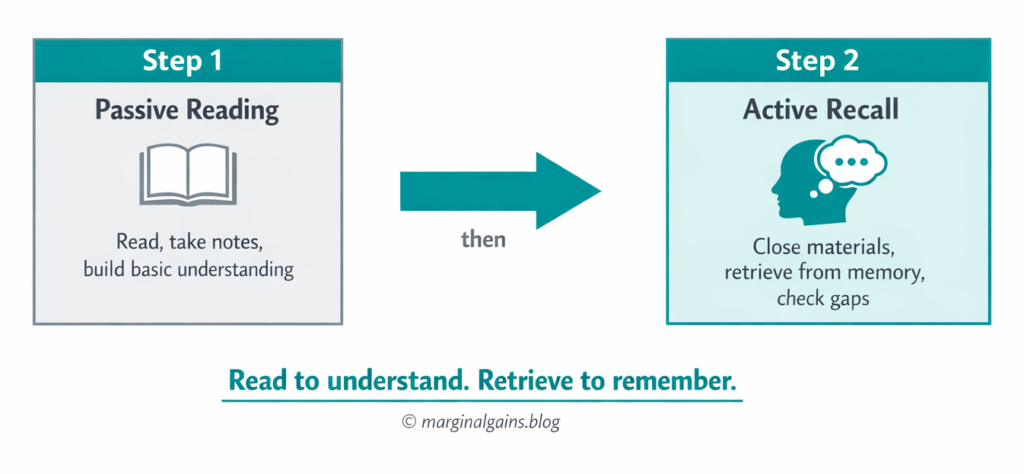
This two-pass approach respects that active recall requires something to retrieve. The passive first pass provides that foundation. But it doesn’t mistake the foundation for the structure—the active second pass does the work of building lasting memory.
Timing between passes matters. Allowing some forgetting between passive reading and active recall increases retrieval difficulty, which strengthens the testing effect. Reading then immediately testing provides some benefit, but testing after a day or two provides more, as retrieval becomes more effortful.
QUICK WIN:
Don’t test yourself immediately after reading — schedule your active recall session for the following day. Even a 24-hour gap dramatically increases retrieval difficulty, which strengthens memory consolidation. Study Monday evening, test yourself Tuesday morning. This simple timing shift produces noticeably better retention with zero extra study time.
Active Recall for Different Learning Goals
The general principle—retrieval practice beats passive review—applies broadly, but implementation varies based on what you’re learning.
Factual Knowledge
For straightforward facts, terms, or definitions, active recall is relatively straightforward. Create questions or flashcards requiring retrieval of specific information. Test yourself regularly, spacing reviews based on success. Active recall combines particularly well with mnemonic devices — using a mnemonic to encode information initially, then retrieving it through active recall to cement it in long-term memory.
The challenge with purely factual learning is maintaining meaningful understanding alongside memorisation. Actively recalling isolated facts without understanding context or applications produces brittle knowledge. Combine factual recall with elaborative questions: “Why does this fact matter?” or “When would you use this information?”
Conceptual Understanding
For complex concepts, active recall targets explanation and application rather than definition recitation. Test yourself with questions like “Explain this concept in your own words” or “How would this principle apply to a new situation?”
The Feynman Technique exemplifies active recall for conceptual material. Close your notes and explain the concept as if teaching someone with no background. Your explanation will reveal gaps in understanding that passive reading might miss. Those gaps identify exactly what needs more study.
For interconnected concepts, test yourself on relationships: “What’s the difference between concept A and B?” or “How do these three concepts fit together?” This forces retrieval of not just individual ideas but their structure and connections.
Procedural Skills
For procedures or step-by-step processes—including learning any skill fast—active recall means attempting the procedure from memory. For mathematical problems, try solving from scratch before checking solutions. For programming, write code before reviewing examples. For practical skills, perform the procedure before consulting references.
This often reveals that you can follow a procedure when watching someone else or reading steps, but can’t generate it independently. That gap is crucial—your actual competence is your ability to generate the procedure, not your ability to recognise it when presented.
After attempting procedures from memory, compare your attempt to correct versions. This comparison—seeing where you went wrong or what you missed—is itself valuable learning that passive review doesn’t provide.
Overcoming Resistance to Active Recall
Despite clear evidence of superiority, many learners resist switching from passive to active methods. Understanding this resistance helps overcome it.
Why Active Recall Feels Harder
Active recall requires more mental effort than passive reading. Generating information from memory is cognitively demanding. Failed retrieval feels frustrating. The difficulty makes active recall feel less productive than passive reading, even though the opposite is true.
This perception stems from confusing immediate fluency with learning effectiveness. Passive reading feels smoother and more pleasant. Active recall feels choppy and effortful. But difficulty during learning often predicts better long-term retention—the “desirable difficulty” effect.
Recognise that the discomfort is the point. You’re not supposed to find active recall as smooth as passive reading. The difficulty signals your brain is doing work that produces lasting learning. Easy studying produces minimal retention; effortful studying produces strong retention.
Building Active Recall Habits
Transitioning from passive reading to active recall requires breaking ingrained passive study habits. Start small rather than trying to transform all studying immediately. After your next reading session, take just five minutes to write everything you remember before moving on.
Notice the gap between what felt familiar while reading and what you can actually retrieve. This gap, uncomfortable as it is, provides valuable feedback that passive reading conceals. The discomfort of discovering you know less than you thought is far better than discovering it later when it matters.
Build up gradually. Five minutes of active recall per study session becomes ten minutes, then fifteen. As active recall becomes habitual, you’ll naturally allocate more time to it because you’ll notice the superior results.
Track retention explicitly. Keep notes on what you learned each week, then test yourself a week later. Compare retention between material learned passively versus actively. This personal data often convinces more powerfully than abstract research findings.
Common Mistakes with Active Recall
Even when people adopt active recall, implementation mistakes can limit benefits. Avoiding these problems improves results substantially.
Testing Too Soon After Study
Immediately testing yourself after study provides some benefit, but less than testing after a delay. When material is still fresh in working memory, retrieval is too easy to provide maximal benefit.
Allow some forgetting before testing. Study material today, test yourself tomorrow rather than immediately. This spacing increases retrieval difficulty, producing stronger memory consolidation. The testing effect grows stronger as retrieval becomes more effortful (up to the point where retrieval becomes impossible).
Giving Up Too Quickly on Retrieval
When information doesn’t surface immediately during active recall, many people quickly give up and check their notes. But struggling to retrieve—spending 30-60 seconds actively trying before checking—produces better learning than immediate surrender.
The retrieval attempt matters even when unsuccessful. Your brain identifying that it can’t retrieve something, then seeing the correct answer, creates stronger encoding than passively reviewing the answer without an attempted retrieval.
Force yourself to try harder before checking. Write down partial information you can remember. Make educated guesses. Only after genuine effort should you check materials. This pattern maximises the testing effect’s benefits.
Using Only Recognition-Based Tests
Multiple choice tests, true/false questions, or matching exercises test recognition more than retrieval. While better than pure passive reading, they don’t provide the full benefit of generation from memory.
Prioritise formats requiring generation: short answer questions, essay questions, explaining concepts aloud, or the blank page method. These formats force actual retrieval rather than recognising correct answers among options.
If using multiple choice for convenience, try this modification: before looking at options, generate your own answer. Write down what you think the correct answer is. Then check against the options provided. This adds a generation component that pure multiple choice lacks.
Active Recall in Professional and Academic Contexts
The benefits of active recall vs passive reading extend beyond individual study sessions into broader learning contexts.
Redesigning Study Sessions
Traditional study sessions follow a passive pattern: read material, review notes, perhaps reread difficult sections. An active recall approach restructures this fundamentally.
Begin with retrieval practice on previously-studied material before consuming new information. This warm-up strengthens existing knowledge while preparing your brain for learning. Spend 10-15 minutes testing yourself on last week’s material before this week’s reading.
During learning, pause every 10-15 minutes to retrieve what you’ve just covered. Close materials briefly and summarise in writing or aloud. This forces consolidation of material while it’s recent, dramatically improving retention compared to straight-through passive reading.
End study sessions with retrieval rather than review. Your final 10-15 minutes should test yourself on the session’s material from memory. This closing retrieval practice consolidates learning far better than final passive review.
QUICK WIN:
Restructure your next study session so it starts with retrieval, not reading. Spend the first 10 minutes writing down everything you remember from last time before opening any notes. This single change — retrieval before review — consistently produces better long-term retention than any amount of additional reading time.
Exam Preparation Transformation
Most exam preparation focuses on passive review: rereading notes, reviewing slides, studying summaries. An active approach treats preparation as intensive retrieval practice.
Collect or create practice problems, past exam questions, or self-generated questions covering material. Spend preparation time answering these from memory, checking accuracy, and retrying missed items. This approach often covers less material than passive review but produces superior exam performance.
Study groups become more effective when structured around active recall. Rather than reviewing material together, group members test each other, explain concepts aloud, or solve problems independently before comparing approaches. The social support helps maintain effort during difficult retrieval practice.
Conclusion: Choosing Difficulty Over Comfort
The evidence is overwhelming: active recall vs passive reading isn’t a close contest. Active recall produces substantially better learning for equivalent time invested — and the advantage grows the longer the delay between studying and being tested. For anyone serious about learning effectively, active recall should become the default study method.
The challenge isn’t understanding this intellectually—most people accept the research once they see it. The challenge is consistently choosing the harder path. Active recall feels more difficult, less fluent, and often less satisfying during study. Passive reading feels productive even when it’s not.
Start gradually. Add active recall elements to your study without abandoning familiar methods immediately. After reading sections, take five minutes to write what you remember. Create questions and test yourself. Use the blank page method once per study session.
As you notice the benefits—information that actually surfaces when needed rather than feeling frustratingly familiar but unretrievable—the motivation to continue grows. Active recall becomes less foreign, and the improved results make the additional effort worthwhile. Active recall is also a technique that helps to keep your memory sharp as you age.
The fundamental insight is simple but transformative: learning happens through retrieval, not through review. Every moment spent testing yourself is a moment spent learning. Every moment spent passively reading is a moment spent feeling like you’re learning. Choose the reality over the feeling, and your learning transforms.
Recommended Resources
RESOURCES:
I only recommend resources that I either use personally or have researched and feel are genuinely helpful for my readers. Resources sometimes contain affiliate links; if you purchase through these, I may earn a small commission at no extra cost to you.
Recommended Reading
Make It Stick — Brown, Roediger & McDaniel. The definitive evidence-based guide to effective learning. Retrieval practice is central to every chapter. Paperback
A Mind for Numbers — Barbara Oakley. Practical strategies for learning difficult material, with strong emphasis on active recall and spaced practice. Paperback | Kindle | Audible
Moonwalking with Einstein — Joshua Foer. A fascinating exploration of memory and how retrieval-based techniques can transform what you’re capable of remembering. Paperback | Kindle | Audible
I'm Simon Shaw, a Chartered Occupational Psychologist with over 20 years of experience in workplace psychology, learning and development, coaching, and teaching. I write about applying psychological research to everyday challenges - from habits and productivity to memory and mental performance. The articles on this blog draw from established research in psychology and behavioural science, taking a marginal gains approach to help you make small, evidence-based changes that compound over time, allowing you to make meaningful progress in the areas you care about most.