
How to Build a Memory Palace: The Complete Step-by-Step Guide
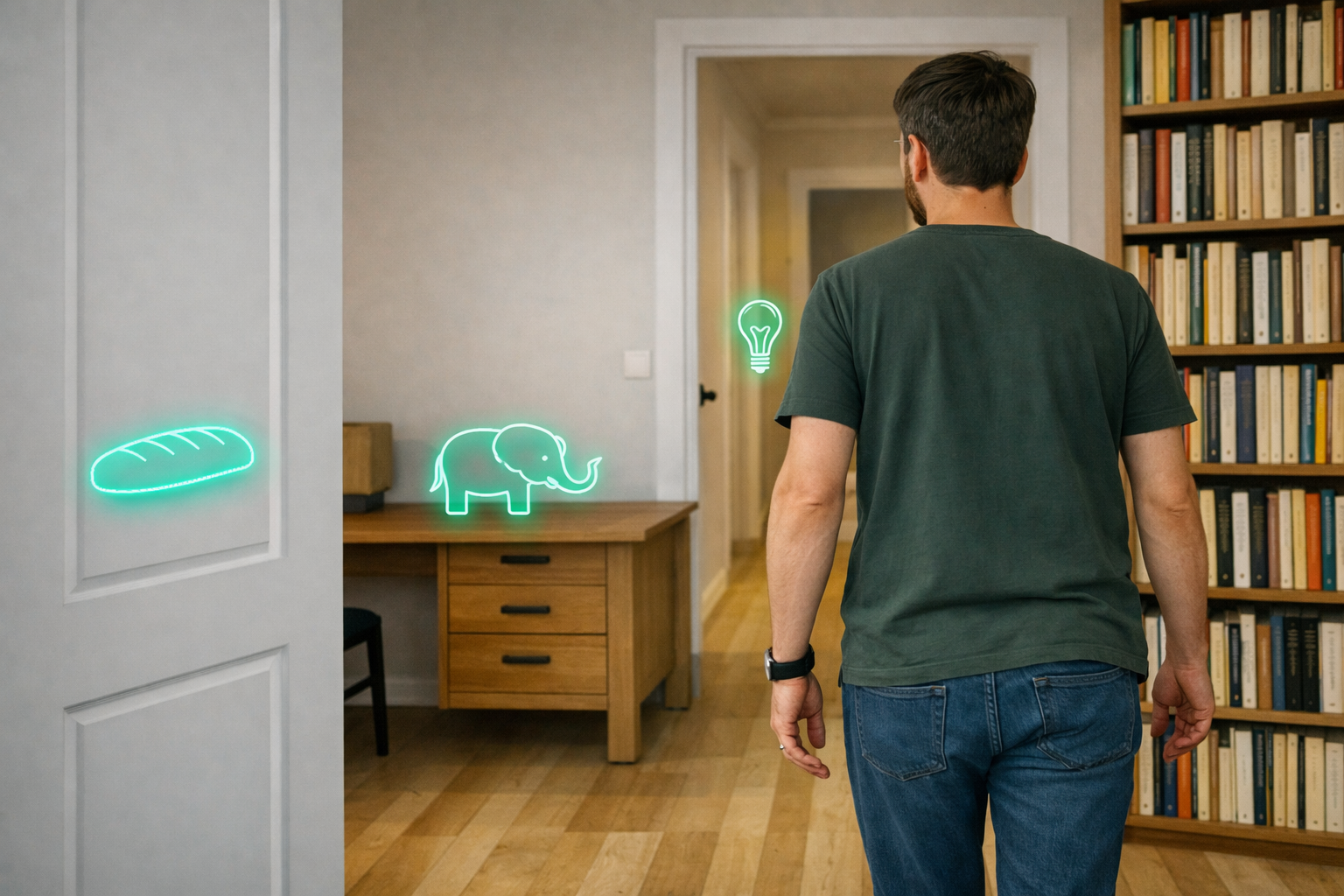
You walk into your childhood bedroom and immediately see a giant elephant wearing a top hat, juggling three flaming torches. At your desk, Albert Einstein is solving equations whilst eating a slice of pizza. In the corner, a medieval knight is having a sword fight with a rubber duck.
This isn’t a fever dream. It’s the memory palace technique in action — and learning how to build a memory palace might be the most powerful learning tool you’ve never used.
The memory palace technique transforms locations you know well into mental filing systems where information sticks. Ancient Greek and Roman orators used it to deliver hours of speeches without notes. Modern memory champions use it to memorise thousands of digits. And you can use it to remember anything from exam content to shopping lists.
This guide shows you exactly how to build a memory palace in the next 20 minutes, starting with the basics and building to practical applications you can use immediately.
The memory palace is also a powerful tool within a broader skill acquisition toolkit — see our guide on how to learn any skill fast for how it fits alongside deliberate practice and spaced repetition.
What Is the Memory Palace Technique?
The memory palace technique (also called the method of loci) is a memory strategy that stores information by placing mental images in specific locations within an imagined space. You create a mental journey through a familiar place, position vivid images representing what you want to remember at specific points along that journey, and later recall the information by mentally retracing your steps.
The technique works because your brain naturally excels at remembering spatial information and visual imagery. When you combine something abstract you need to learn with a concrete location you know well, you create a powerful mental association that’s far easier to retrieve than trying to memorise information in isolation.
The memory palace is one of the most powerful mnemonic devices available, with centuries of use behind it. It harnesses the same visual processing system that makes dual coding so effective for reading (our guide on how to remember what you read explores this visual-verbal connection in the context of everyday reading retention).
The Ancient Origins
According to legend, the Greek poet Simonides of Ceos discovered this technique around 500 BCE after surviving a building collapse at a banquet. When called upon to identify fellow guests, he realised he could remember exactly who had been sitting where by mentally reconstructing the seating arrangement. This spatial memory proved more reliable than trying to recall faces alone.
Roman orators like Cicero refined the technique, using it to memorise lengthy speeches by mentally walking through buildings and associating different parts of their oration with specific architectural features. The method remained a cornerstone of rhetoric and education for centuries.
Why It Works: The Science
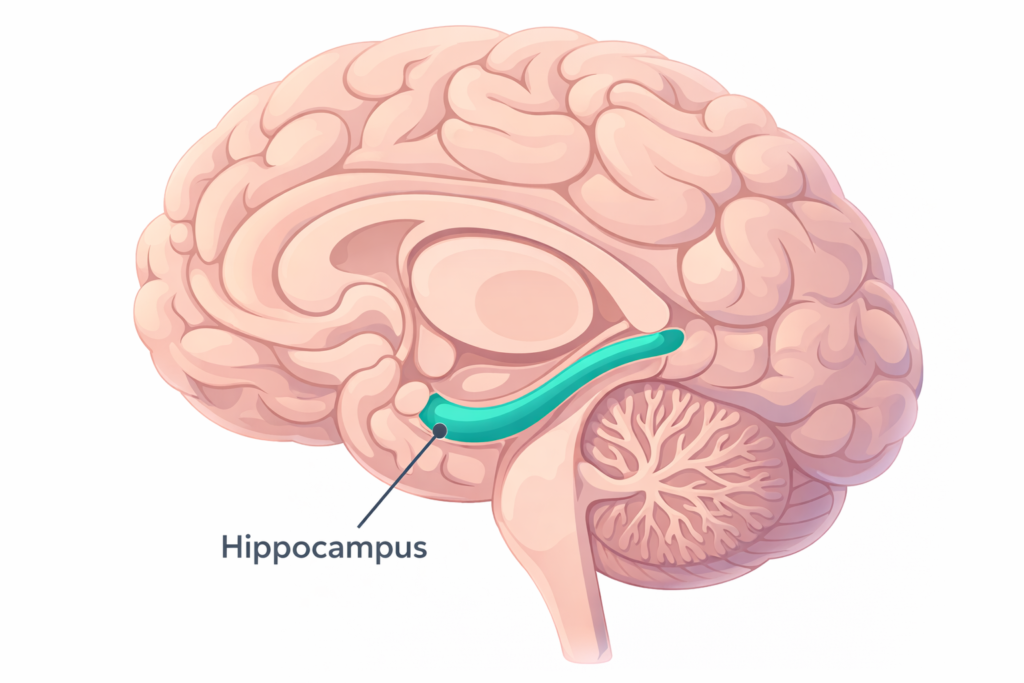
Your brain’s hippocampus specialises in spatial navigation and consolidating memories. Research shows it activates strongly when processing location-based information. Memory champions who use the memory palace technique don’t have superhuman brains — a 2003 brain imaging study found that superior memory performance was not driven by structural brain differences, but by more effective engagement of spatial memory regions, including the hippocampus.
A 2017 study found that mnemonic training reshapes brain networks to support superior memory: after just six weeks of memory palace training, ordinary people showed brain activity patterns similar to elite memory athletes — and remembered an average of 62 words compared to 27 before training. The technique literally rewires how your brain processes and stores information.
How to Build a Memory Palace: Step-by-Step
Building a memory palace isn’t complicated, but it does require following specific steps. Here’s the exact process for how to build a memory palace that works — whether you’re memorising vocabulary, presentations, or exam content.
Step 1: Choose Your Location (2 Minutes)
Select a place you know intimately. Your home is ideal for beginners because you can visualise every detail without effort. Other good options include your workplace, a regular walking route, or even your childhood home if you remember it clearly.
The key criterion is familiarity. You should be able to mentally walk through this location with your eyes closed, knowing exactly what you’ll encounter at each point.
Start small. A single room is perfect for your first memory palace. You can expand to entire houses or buildings once you’ve mastered the basics.
Step 2: Define Your Mental Route (3 Minutes)
Plan a logical path through your chosen location. In a bedroom, you might enter through the door, move clockwise around the room, visiting the wardrobe, desk, bed, and window in order.
Your route must be consistent and unambiguous. You’ll always follow the same path, never crossing back on yourself or skipping locations. This consistency is crucial because it provides the structure that makes retrieval reliable.
Identify 5-10 distinct “stations” along your route — specific pieces of furniture, architectural features, or memorable spots where you’ll place mental images. Breaking information into manageable groups using the chunking method can help you organise what you’ll place at each station. In that bedroom example, your stations might be the door handle, wardrobe, desk, bookshelf, bed, window, and bedside table.
Step 3: Mentally Walk Your Route (5 Minutes)
Close your eyes and practise your mental journey several times. Start at your first station and move methodically to each subsequent point, noting the distinctive features of each location.
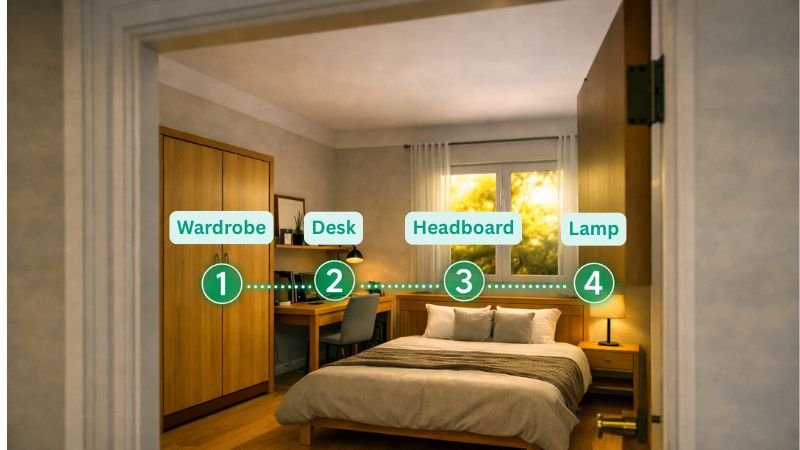
This rehearsal cements the route in your mind, making it automatic. When you later add information to these stations, you won’t waste mental energy trying to remember what comes next — your brain will know the path instinctively.
Walk your route forwards, then try it backwards. Both directions should feel natural before you proceed to adding information.
QUICK WIN:
Take a mental walk through one room of your home. Count the distinct objects or features you pass — door, wardrobe, desk, bed, window. That’s your first memory palace route. You’ve just completed Steps 1 to 3 in under two minutes. The next step is simply adding images.
Step 4: Convert Information into Memorable Images (5 Minutes)
This is where the memory palace technique transforms from simple to powerful. You need to convert abstract information into concrete, vivid mental imagery.
Let’s say you’re memorising a shopping list: bread, milk, tomatoes, cheese, and coffee. For each item, create an exaggerated, unusual mental image:
- Bread: A massive loaf, still steaming, three times larger than normal
- Milk: A milk bottle with arms and legs, dancing
- Tomatoes: Bright red tomatoes bouncing like tennis balls
- Cheese: A wheel of cheese rolling away like a tyre
- Coffee: A coffee cup overflowing, spilling everywhere
Make your images bizarre, exaggerated, or emotional. The stranger the image, the more memorable it becomes. Your brain pays attention to unusual things and tends to forget the mundane. For more on the processes underlying forgetting, see our article, Why do we forget?
Step 5: Place Images at Your Stations (5 Minutes)
Now connect each mental image to a specific station in your memory palace. The placement should involve interaction between the image and the location — the bread isn’t just near the door, it’s blocking it. The milk isn’t just on the wardrobe, it’s dancing on top of it. This interaction strengthens the association.
Using our bedroom example: the massive steaming loaf is wedged in the door blocking your entry; the dancing milk bottle performs on top of the wardrobe; bouncing tomatoes hit the desk like table tennis; the wheel of cheese rolls along the bookshelf knocking books over; coffee overflows from a cup soaking the bed sheets.
Recalling Information from Your Memory Palace
Retrieval is straightforward once you know how to build a memory palace and have placed your images. Simply take your mental walk again, visiting each station in order. As you arrive at each location, the image you placed there will spring to mind, and with it the information you encoded.
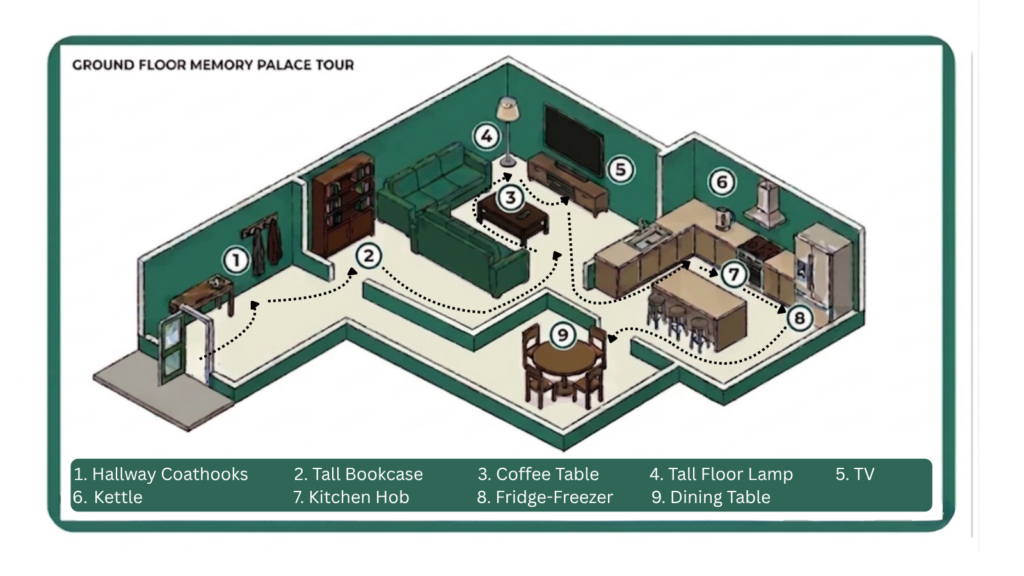
The spatial structure does the heavy lifting. You don’t need to consciously remember what comes next — your familiarity with the location handles that automatically. You simply need to decode the images back into the information they represent. This is active recall practice at work — mentally walking through your palace forces genuine retrieval rather than passive recognition.
Strengthening Recall Through Practice
For information you need to retain long-term, walk through your memory palace multiple times using spaced repetition schedules — immediately after creating it, one hour later, later that day, the next day, three days later, and one week later. Each mental walk strengthens the associations, moving information from short-term to long-term memory.
QUICK WIN:
Use your memory palace for your next shopping list. Before you leave the house, mentally walk your kitchen and place one vivid, bizarre image for each item at a different spot. No list needed. When you’re in the shop, close your eyes for five seconds and retrace the route. Everything will be there.
Making Images More Memorable
Not all mental images stick equally well. The most effective images share specific characteristics that make them unforgettable.
Exaggeration
Make things abnormally large or small. That loaf of bread isn’t normal-sized — it’s huge. The dancing milk bottle isn’t subtly swaying — it’s doing a full Broadway routine.
Movement
Static images are forgettable. Add motion to everything. The tomatoes bounce, the cheese rolls, the coffee flows. Action captures attention and aids memory.
Unusual Combinations
Pair things that don’t belong together. Milk bottles don’t normally dance on wardrobes. That incongruity makes the image stick.
Sensory Details
Engage multiple senses beyond just vision. Imagine the smell of the fresh bread, the coldness of the milk bottle, the squelch of the tomatoes, the waxy texture of the cheese, the bitter aroma of the coffee. The more sensory details you include, the richer and more memorable the association becomes.
Practical Applications
Once you know how to build a memory palace, it adapts to almost any memorisation challenge. Here’s how to apply it to common situations.
Learning Vocabulary
Convert foreign words into memorable images using sound-alike associations. The French word “chat” (cat) sounds like “shah” — place an image of a Persian shah petting a cat at your first station. The German word “Schmetterling” (butterfly) sounds like “shattering” — imagine a butterfly shattering into pieces like glass.
Remembering Presentations
Assign each main point of your presentation to a station. For a presentation on climate change with five key points, create five images representing these concepts and place them sequentially. During your talk, mentally walk your route — each station triggers your next point, keeping your presentation flowing naturally without notes.
Names and Faces
When meeting new people, create a quick mental image connecting their name to a distinctive physical feature, then place that image at a station. This combines particularly well with specific techniques for remembering people’s names at networking events.

Common Mistakes When Building a Memory Palace
Choosing Unfamiliar Locations
Using a location you don’t know well creates unnecessary cognitive load. Your brain spends energy trying to remember the location itself rather than the information you’ve stored there. Stick to places where you could walk around in pitch darkness without hesitation.
Creating Vague Images
Generic images don’t stick. “A cat” is forgettable. “Your neighbour’s ginger cat wearing a tiny crown, meowing the national anthem” is memorable. Specificity and absurdity win every time.
Rushing the Process
Building a memory palace properly takes time initially. Trying to memorise information before your route feels automatic undermines the entire technique. Invest the upfront time establishing your location and route, and the payoff comes in effortless recall later.
Reusing Locations Too Soon
Reusing memory palace locations is possible, but carries risks. Research shows that storing similar types of information at the same locations causes ‘retroactive interference’ — new memories disrupt old ones. However, reuse works reasonably well when the information belongs to clearly different topics, because the subject itself acts as an additional retrieval cue that separates the memories. The safest rule: use fresh locations for anything you need long-term, and reserve reuse for temporary information like shopping lists where interference doesn’t matter.
QUICK WIN:
List five locations you know so well you could describe every detail from memory — your bedroom, kitchen, childhood home, workplace, train stops or landmarks on your regular commute. Those are five ready-made memory palaces you can start using today. You don’t need to build anything from scratch — you already have the raw material.
Building Multiple Memory Palaces
One memory palace can hold significant information, but serious users develop networks of dozens or even hundreds of locations. Start simple with 5-10 memory palaces based on locations like your current home (different rooms can be separate palaces), your childhood home, your workplace, your regular commute route, a friend or family member’s house you know well, or a favourite café.
As you become comfortable with how to build a memory palace, you’ll spot potential locations everywhere. Any place you’ve visited repeatedly can become part of your network.
Who Benefits Most from Memory Palaces?
While anyone can learn how to build a memory palace and benefit from it, certain situations make it particularly valuable.
Students preparing for exams benefit enormously, especially when dealing with subjects requiring recall of specific facts, dates, or terminology. Medical students use memory palaces to learn anatomy, drug names, and diagnostic criteria. Law students memorise case law and legal principles.
Professionals who present regularly — teachers, speakers, consultants — use memory palaces to deliver talks confidently without notes, maintaining natural eye contact with audiences. See our guide to remembering presentations for more tips about this.
Language learners accelerate vocabulary acquisition by creating memorable associations between new words and mental images positioned in familiar locations. The memory palace integrates well with a range of other evidence-based learning strategies if you want to create a complete learning system.
Anyone studying later in life who finds traditional rote learning increasingly difficult discovers that the memory palace technique works with, not against, how mature brains naturally operate. The spatial component plays to strengths that often remain robust even as other memory functions decline — our guide on keeping memory sharp with age explores this in more detail.
Take Your First Mental Walk
The memory palace technique isn’t magic — it’s a structured method for leveraging your brain’s existing strengths. You already remember locations effortlessly. Learning how to build a memory palace simply converts that spatial ability into a general-purpose learning tool.
Right now, you could build your first memory palace in 20 minutes. Choose a familiar room, define a simple route with 5-7 stations, and try memorising a short list. The immediate results will surprise you.
With practice, the process becomes faster and more natural. What takes 20 minutes initially soon takes 5 minutes, then 2 minutes. The technique that ancient orators spent years perfecting becomes a reliable tool you can deploy whenever memorisation challenges arise.
Your first memory palace awaits. The door is open — step inside.
RESOURCES:
I only recommend resources that I either use personally or have researched and feel are genuinely helpful for my readers. Resources sometimes contain affiliate links; if you purchase through these, I may earn a small commission at no extra cost to you.
Recommended Reading
Moonwalking with Einstein — Joshua Foer. A journalist’s account of training for the US Memory Championship using the memory palace technique. The most readable and compelling introduction to how memory champions actually think. Paperback | Kindle | Audible
Make It Stick — Brown, Roediger & McDaniel. The evidence-based guide to effective learning. Covers how memory palaces fit within a broader system of retrieval practice and spaced repetition. Paperback
Related Articles from the Marginal Gains Blog:
Do Mnemonic Devices Work? — How the memory palace fits within the broader family of mnemonic techniques, and which methods work best for different types of information.
How to Use Spaced Repetition — Combine your memory palace with spaced review schedules to move information into long-term memory permanently.
Active Recall vs Passive Reading — Why mentally walking your memory palace counts as retrieval practice, and how to make it even more effective.
I'm Simon Shaw, a Chartered Occupational Psychologist with over 20 years of experience in workplace psychology, learning and development, coaching, and teaching. I write about applying psychological research to everyday challenges - from habits and productivity to memory and mental performance. The articles on this blog draw from established research in psychology and behavioural science, taking a marginal gains approach to help you make small, evidence-based changes that compound over time, allowing you to make meaningful progress in the areas you care about most.