
How to Learn Faster and Make It Stick

If you want to learn faster and retain information more reliably, the answer almost certainly isn’t to study harder or longer. Many people spend hours reading and re-reading material that simply won’t stick, or struggle through learning that takes far longer than necessary. The frustration is real: presentations you can’t recall without notes, skills that refuse to cement into place, information that takes weeks to learn when it should take days. This article walks you through a range of evidence-based techniques to show you how to learn faster and make it stick.
The good news? Both learning speed and memory retention can improve dramatically through specific, evidence-based techniques. Research shows that most people use inefficient learning strategies — not because they’re lazy, but because the most effective methods aren’t intuitive. Whether you’re developing professional skills, studying for exams, or simply wanting to learn more efficiently, understanding how your brain processes and stores information gives you practical tools to learn faster and remember longer.
This guide draws from cognitive psychology research and real-world applications to show you what actually works. No gimmicks, no pseudoscience — just proven strategies you can implement today.
Understanding How Memory Works
Before diving into techniques, it’s worth understanding the basic architecture of memory. This isn’t just academic — knowing how your memory operates helps you choose the right strategies for different situations.
The Three Stages of Memory Formation
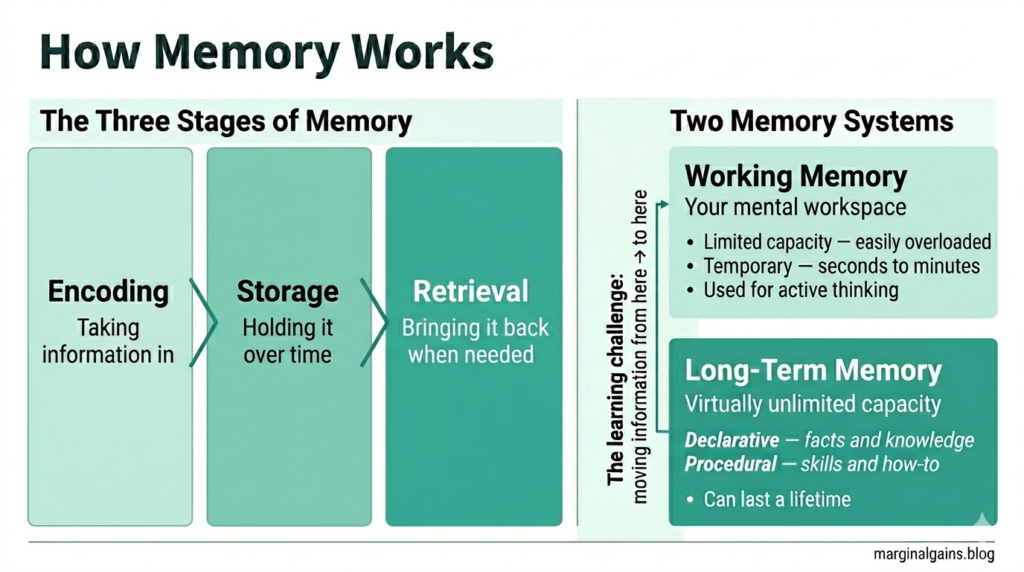
Every memory you form passes through three distinct stages: encoding, storage, and retrieval. Think of encoding as saving a file on your computer, storage as keeping it on your hard drive, and retrieval as opening it back up when needed.
The encoding stage is where most learning fails. Your brain receives thousands of pieces of information daily, but only a fraction gets encoded into memory. The techniques we’ll explore primarily target this encoding stage — they help your brain decide that information is worth keeping.
Storage happens largely without conscious effort, though sleep plays a crucial role in consolidating memories. The third stage — retrieval — is where many people discover their encoding wasn’t as solid as they thought. Information feels familiar but won’t surface when needed.
Working Memory vs. Long-Term Memory
Your brain uses two fundamentally different memory systems, and understanding the distinction matters for learning effectively.
Working memory is your mental workspace — it holds information temporarily while you use it. It’s remarkably limited, typically managing about four distinct pieces of information simultaneously. When you’re trying to follow complex instructions, remember a phone number long enough to dial it, or hold multiple thoughts in mind during a conversation, you’re using working memory.
Long-term memory, by contrast, has virtually unlimited capacity. Information stored here can last a lifetime. The challenge isn’t capacity — it’s getting information from working memory into long-term storage in a way that allows reliable retrieval later.
Most learning techniques work by either reducing the burden on working memory (through chunking or organisation) or strengthening the transfer from working to long-term memory (through repetition, elaboration, or association).
Evidence-Based Techniques to Learn Faster
Research consistently identifies certain techniques as significantly more effective than others. These aren’t the methods most people instinctively use — which explains why learning often feels harder than it should.
Active Recall and Retrieval Practice
Active recall is the single most powerful learning technique supported by research. Rather than reviewing information passively, you actively try to retrieve it from memory without looking at your notes.
This feels harder than rereading, which is precisely why it works. The effort of retrieval strengthens memory traces. Each time you successfully pull information from memory, you make it easier to retrieve next time. When you fail to retrieve something, you identify exactly what you haven’t learned properly. Our full guide to active recall vs passive reading explores the research behind this in more depth.
Practical implementation is straightforward: after reading a section of material, close your notes and write down everything you remember. Use flashcards where you test yourself rather than simply reviewing. When learning a skill, test your ability to perform it rather than just watching demonstrations.
The discomfort is the point. If active recall feels easy, your brain isn’t doing the work that builds lasting memory.
Spaced Repetition: The Fastest Way to Learn Faster and Retain Information
The forgetting curve — discovered by Hermann Ebbinghaus in 1885 — shows that we forget most new information rapidly within the first 24 hours, then more gradually over time. Spaced repetition exploits this pattern by reviewing information just as you’re about to forget it.
The optimal spacing isn’t intuitive. You might review material after one day, then three days, then a week, then three weeks, then several months. Each successful retrieval pushes the next review further into the future. Information reviewed too frequently wastes time; reviewed too infrequently, and you’ve already forgotten it.
This spacing effect is remarkably powerful. Research shows that distributed practice produces substantially better long-term retention than massed practice (cramming), even when total study time is identical. Your brain needs time between exposures to consolidate information properly. Our guide to spaced repetition covers the practical implementation in detail.
Digital tools like Anki automate the scheduling, but you can implement spaced repetition manually with a simple calendar system. The key is resisting the urge to review material when it still feels fresh — that’s when your time is least effective.
QUICK WIN:
Pick one thing you’ve recently read or listened to — a podcast episode, article, or meeting discussion. Right now, without looking at any notes, write down the three most important points you can recall. Whatever you can’t remember is what you actually need to go back and re-read. That’s active recall in action, and it takes under two minutes.
Elaborative Rehearsal
Elaborative rehearsal means processing information deeply by connecting it to existing knowledge, asking questions about it, and thinking through its implications. It’s the opposite of mindless repetition.
When you encounter new information, ask yourself: How does this relate to what I already know? Why does this work this way? What are the practical implications? Can I think of an example from my own experience? These questions force deeper processing that creates stronger, more retrievable memories.
The self-reference effect demonstrates this powerfully. Information becomes more memorable when you relate it to yourself. A fact about human behaviour is more memorable when you consider whether it applies to your own life. A business concept sticks better when you think through how you’d apply it in your work. The self-reference effect demonstrates this powerfully. Information becomes more memorable when you relate it to yourself. A fact about human behaviour is more memorable when you consider whether it applies to your own life. A business concept sticks better when you think through how you’d apply it in your work. This is elaborative rehearsal in action — and the levels-of-processing research that underpins it has been foundational in cognitive psychology since Craik and Lockhart’s landmark 1972 paper. I used to teach this back in the 2000s and it’s still as relevant today.
This takes more time initially but dramatically reduces the total time needed to learn something well. Shallow processing requires endless repetition; deep processing often requires just one or two exposures.
Dual Coding Theory
Your brain processes visual and verbal information through different pathways. Dual coding theory, developed by Allan Paivio, shows that information encoded both visually and verbally is more memorable than information encoded in only one way.
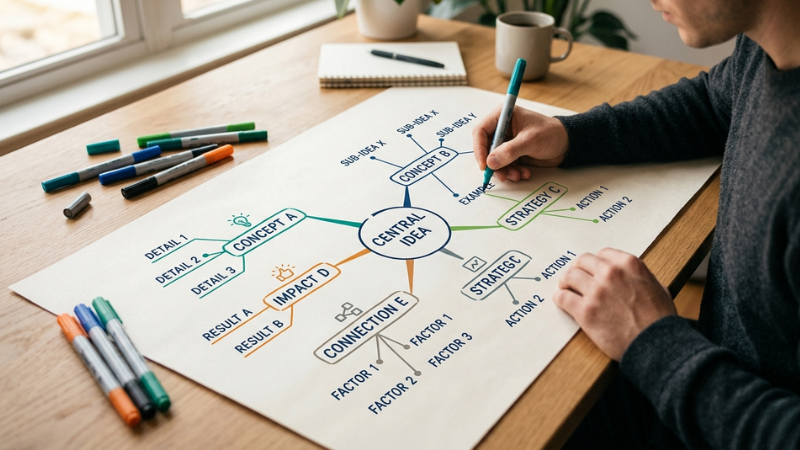
This explains why diagrams, sketches, and mind maps enhance learning — not because they look nice, but because they give your brain an additional retrieval path. When you can’t quite recall the verbal explanation, the visual representation might trigger the memory, and vice versa.
When applied specifically to reading, dual coding becomes particularly powerful — our guide on how to remember what you read shows you exactly how to combine visual and verbal processing to dramatically improve reading retention.
Practical application doesn’t require artistic skill. Simple sketches, basic diagrams, or even just spatial organisation of information on a page engages visual processing. The act of converting verbal information into visual form also forces deeper thinking about the material.
Efficient Strategies to Learn Faster Without Sacrificing Depth
Memory techniques help you retain what you’ve learned, but learning speed depends on how efficiently you process information in the first place. These strategies help you learn faster without sacrificing depth or retention.
Identifying High-Value Information
One of the biggest time-wasters in learning is treating all information as equally important. Textbooks contain core concepts, supporting details, examples, and filler. Lectures include key principles alongside tangential discussions. Not everything deserves equal attention.
Develop the skill of distinguishing signal from noise. Look for information that appears repeatedly — authors and instructors emphasise what matters by returning to it. Notice structural cues: section headings, summary boxes, “importantly” or “the key point is…” markers. Pay attention to what’s tested or applied practically.
When reading, scan the chapter structure before diving in. Read the introduction and conclusion first — they typically highlight core concepts. Then decide which sections warrant deep reading versus quick skimming. This strategic approach saves hours compared to treating every paragraph identically.
In professional learning, ask explicitly: “What’s the 20% that produces 80% of the results?” What information will you actually use? What knowledge enables everything else? Focus your deep processing there, and give lighter attention to supporting details you can reference later if needed.
The Feynman Technique: Learn Faster by Teaching Simply
Named after physicist Richard Feynman, this technique forces genuine understanding rather than superficial familiarity. The process is straightforward: take a concept you’re learning and explain it in simple language as if teaching someone with no background knowledge.
The magic happens when you get stuck. If you can’t explain something simply, you don’t understand it properly — you’ve just memorised jargon. The gaps in your explanation reveal exactly what you haven’t grasped. You then return to source material specifically targeting those gaps.
This technique prevents the illusion of knowledge — that feeling of understanding something when reading about it, only to discover you can’t actually explain or apply it. By forcing explanation in your own words, you identify these gaps immediately rather than discovering them later when it matters.
The technique works particularly well for complex or technical material. Rather than reading and rereading until material “feels” familiar, read once, then immediately try explaining it. Your failed explanation tells you exactly what to focus on next. This targeted approach helps you learn faster than passive repetition.
QUICK WIN:
Pick something you’ve learned recently — a concept from a meeting, a book chapter, or a course module. Open a blank document and explain it as if you’re writing a short email to a smart friend who knows nothing about the topic. Where you get stuck or vague is exactly what you need to go back and study. Five minutes of this reveals more gaps than an hour of rereading.
Progressive Summarisation
Progressive summarisation, developed by Tiago Forte, compresses information through successive passes, each time extracting only what’s most important. This creates efficient learning and excellent reference material.
The first pass captures information comprehensively — detailed notes or highlights from source material. The second pass bolds or highlights the most important points within your notes — perhaps 20% of the content. A third pass might bold the most critical insights within your already-highlighted material.
Each pass forces you to process information more deeply: “What’s truly essential here?” This progressive compression serves two purposes. First, the act of summarising builds understanding through elaborative processing. Second, you create layered notes where the most important information is immediately visible, but supporting details remain accessible.
This particularly suits professional learning where you’re building knowledge bases for long-term reference. Your notes become increasingly valuable over time as progressive summarisation reveals core principles whilst maintaining detailed support when needed.
Strategic Reading: When to Skim vs. Deep Dive
Reading everything at the same pace wastes enormous time. Different material demands different reading strategies, and efficiency comes from matching strategy to content and purpose.
Skim when you’re surveying a field, looking for specific information, or dealing with low-value content. Skimming isn’t lazy reading — it’s strategic reading. Your eyes move quickly, catching keywords, headings, topic sentences, and conclusions. You’re building a mental map of content location rather than absorbing details.
Deep reading applies when you’ve identified high-value content, when material is genuinely difficult, or when you need thorough understanding for application. Here, you slow down, reread difficult passages, take notes, and actively process meaning. Deep reading after strategic skimming is far more efficient than deep reading everything indiscriminately.
For books, read the introduction and conclusion first, then skim chapter beginnings and endings. This reveals structure and main ideas. Then decide which chapters deserve deep reading, which merit skimming, and which you can skip entirely. You might deeply read 30% of a book and still extract 80% of the value.
Learning Speed Multipliers
Beyond general strategies, specific practices dramatically accelerate learning when implemented consistently. These are force multipliers that compound over time.
Effective Note-Taking Methods
How you take notes during learning significantly affects both immediate comprehension and later retention. Most people’s instinct — transcribing information verbatim — is actually counterproductive.
Effective note-taking requires processing information actively rather than passively recording it. The Cornell method divides pages into sections: main notes, cues/questions in the margin, and summary at the bottom. During learning, you take normal notes. Afterwards, you generate questions or keywords in the margin that would cue those notes. Finally, you write a brief summary from memory.
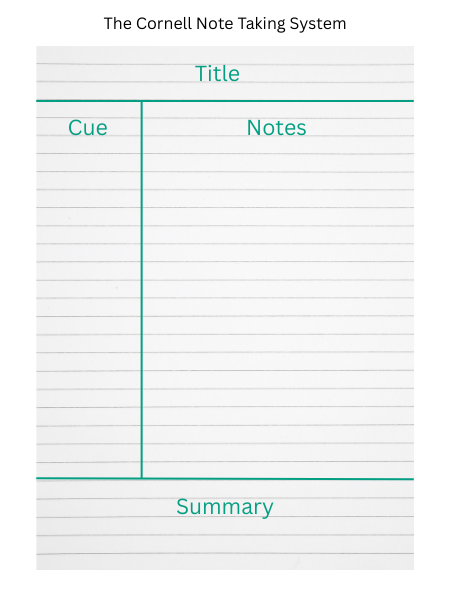
This structure forces active processing three times: during initial encoding, when creating cues, and when summarising. Each processing pass strengthens understanding and retention more effectively than passive review ever could.
Mind mapping works brilliantly for interconnected information. Rather than linear notes, you create visual networks showing relationships between concepts. The spatial organisation aids memory through dual coding, whilst the act of deciding how concepts relate builds deeper understanding.
Digital note-taking enables linking between notes, creating a personal knowledge web. Apps like Obsidian or Notion let you connect related concepts across different learning sessions, building an external thinking environment that supplements your memory.
Reducing Cognitive Load
Your working memory has limited capacity. You may have heard of Miller’s “magic number” — his 1956 research suggested we can hold around seven items (plus or minus two) in working memory at once. More recent work by psychologist Nelson Cowan, however, suggests the true limit is closer to four — but four chunks, not four individual items. Miller’s seven items were already grouped into meaningful units; Cowan’s research revealed the underlying limit before that grouping happens. The practical implication is the same either way: when learning pushes beyond this capacity, comprehension collapses. Reducing cognitive load lets you learn faster by keeping information processing within that limit.
Chunking is the fundamental technique. Rather than remembering seven individual items, group them into two or three meaningful chunks. We do this instinctively with phone numbers — breaking them into smaller groups makes them memorable in a way that a continuous string of digits simply isn’t. The same digits become more manageable when chunked appropriately.
External storage prevents working memory overload. When learning complex material, use paper or a whiteboard to hold information you’re working with. Writing down intermediate steps in calculations, key points from earlier in a lecture, or frameworks you’re applying frees working memory for actual processing rather than storage.
Reduce unnecessary cognitive load by eliminating distractions. Background music with lyrics, nearby conversations, or visible notifications all consume working memory capacity needed for learning. Create an environment where your limited cognitive resources can focus entirely on the learning task.
Pattern Recognition and Mental Models
Expert learners learn faster because they recognise patterns quickly. Novices see isolated facts; experts see relationships, principles, and structures. Developing pattern recognition and mental models accelerates all future learning in that domain.
Mental models are frameworks for understanding how things work. In business, you might have models for market dynamics, organisational behaviour, or decision-making. In psychology, models for memory, motivation, or behaviour change. These models let you quickly assimilate new information by fitting it into existing frameworks.
Build mental models deliberately. When learning something new, explicitly ask: “What’s the underlying structure here? What’s the general principle? How is this similar to something I already understand?” These questions help you extract transferable patterns rather than isolated facts.
Optimal Conditions for Faster Learning
When you learn matters almost as much as how you learn. Your brain’s capacity for encoding new information varies significantly based on physiological and environmental factors.
Your ‘chronotype’ (when you’re naturally most alert in the day) affects optimal learning times. If you’re a morning person, tackle difficult conceptual learning early. If you’re an evening person, don’t force intensive learning at 8am — you’re fighting biology. Match learning demands to your natural energy and focus patterns.
Physical state dramatically impacts learning capacity. Hunger, dehydration, or physical discomfort all impair cognitive function. Ensure basic physiological needs are met before demanding intensive learning from your brain. A 15-minute walk before learning often improves subsequent performance through increased blood flow and alertness.
The most underrated learning optimiser is taking actual breaks. The Pomodoro Technique (25 minutes focused work, 5-minute break) works because your brain needs recovery time. Trying to maintain focus for hours without breaks produces steadily declining returns. Better to work intensively for shorter periods with genuine breaks between.
QUICK WIN:
Before your next learning session, do a quick audit of your environment: silence your phone notifications, close unnecessary browser tabs, and put anything visually distracting out of sight. Then set a timer for 25 minutes and commit to single-task learning only. Notice how much more you absorb compared to a typical distracted session — the difference is your working memory being fully available for learning rather than split across competing demands.
Memory Techniques for Specific Situations
General principles are useful, but specific situations often demand specialised approaches. Here’s how to apply memory science to common challenges.
Remembering Names and Faces
Name recall fails for a specific psychological reason: names are arbitrary labels with no inherent meaning. Your brain evolved to remember meaningful information, not random associations between faces and sounds.
The most effective technique creates artificial meaning through association. When you meet someone named Martin, you might visualise them in a martial arts uniform (if that creates a memorable image for you). The associations needn’t be sophisticated — just distinctive and personally meaningful. Our full guide to remembering names and faces walks through several techniques in detail.
Repetition matters too, but not mindless repetition. Use the person’s name naturally in conversation within the first few minutes. The immediate rehearsal strengthens initial encoding when forgetting is most rapid.
Memorising Presentations
Professional presentations require a different approach than word-for-word memorisation. Attempting to memorise every word creates a fragile memory that falls apart if you lose your place. Instead, you want to remember key points and natural transitions.
Chunking works brilliantly here. Break your presentation into 3–5 main sections, each containing 3–4 key points. This hierarchical structure matches how your brain naturally organises information. You remember the structure, and the structure cues the details.
The journey method — a variation of the memory palace technique — lets you anchor presentation sections to familiar locations. During delivery, mentally retracing this path cues each section naturally. Our full guide to memorising a presentation covers this approach step by step.
Learning New Skills Faster
Skill acquisition follows different rules than fact memorisation. Motor skills and procedures require building automatic responses, not just storing information.
Deliberate practice — coined by Anders Ericsson — forms the foundation. This means practising at the edge of your current ability, getting immediate feedback, and focusing on your weakest areas. Comfortable practice maintains existing skill but doesn’t build new capability. Our guide on how to learn any skill fast covers the deliberate practice framework in detail, including how to structure your sessions for maximum improvement.
Mental practice supplements physical practice surprisingly effectively. Research with musicians, athletes, and surgeons shows that visualising performance activates similar neural pathways as actual performance. When you can’t physically practise, mentally rehearsing the skill maintains and even improves capability. For factual information without inherent structure, mnemonic devices can dramatically accelerate initial encoding — particularly the keyword method and method of loci.
The Science Behind How to Learn Faster: Sleep and Memory
Understanding why techniques work helps you adapt them to your specific needs and maintain motivation when initial progress feels slow.
Sleep and Memory Consolidation
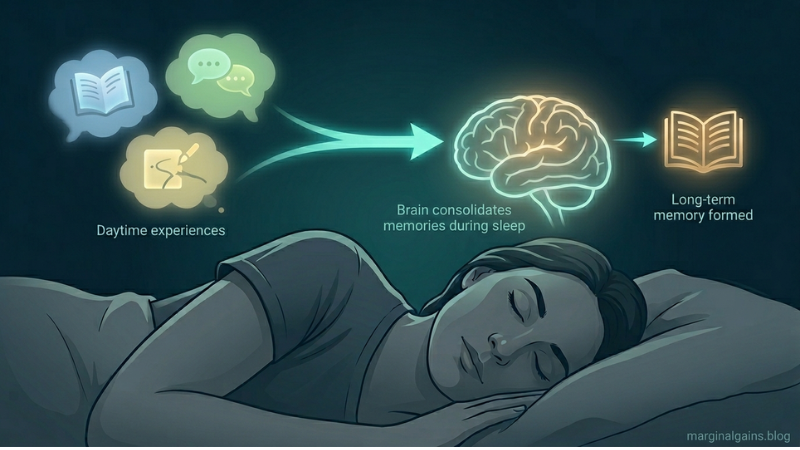
Sleep isn’t just rest — it’s when your brain actively processes and integrates new information. During deep sleep, your brain replays experiences from the day, transferring information from temporary storage into long-term memory.
Research shows that learning material before sleep leads to better retention than learning it earlier in the day. Different sleep stages consolidate different types of memory. REM sleep (when dreaming occurs) primarily consolidates procedural memories — skills and motor sequences. Deep sleep consolidates declarative memories — facts and concepts. This is one reason why sleep deprivation so dramatically impairs learning.
Strategic napping can enhance learning too, particularly naps containing deep sleep (90+ minutes) or short naps (10–20 minutes) that don’t leave you groggy. The key is timing: napping after intensive learning enhances consolidation, whilst napping before learning refreshes working memory capacity.
Why We Forget (and How to Prevent It)
Forgetting isn’t a failure of memory — it’s a feature. Your brain actively discards information that seems unimportant. Understanding why forgetting occurs helps you fight it effectively.
Decay theory suggests memories simply fade over time without use, like muscles weakening without exercise. But retrieval practice keeps them accessible. The occasional review maintains long-term retention far more efficiently than continued intensive study.
Interference causes more forgetting than simple decay. New learning interferes with old (retroactive interference), and old learning interferes with new (proactive interference). This is why similar topics are particularly hard to keep straight — they compete for the same retrieval cues.
Combat interference by making memories distinctive. Rather than learning similar concepts back-to-back, space them out. Explicitly note differences between easily confused items. Use different study environments or times of day to provide distinct contextual cues.
Building Your Personal System to Learn Faster
Knowing techniques is useless without implementing them. Here’s how to build an effective personal learning system.
Starting Simple
Pick one or two techniques that address your biggest challenge. Trying to implement everything simultaneously guarantees implementation failure.
If retention (making it stick) is your main problem, begin with active recall. After any learning session, close your materials and write down everything you remember. This single change produces dramatic results.
If you forget material within days or weeks, implement spaced repetition. Create a simple review schedule: review new material after one day, three days, one week, two weeks, one month. Adjust based on your results.
For complex material that won’t stick, use elaborative rehearsal. For every new concept, write down: how it connects to what you already know, why it matters, and one example from your own experience.
Common Mistakes That Slow Learning Down
The biggest mistake is confusing familiarity with learning. Rereading notes until material feels familiar doesn’t mean you’ve learned it — it means you’re good at recognising it. Test yourself instead. If you can’t generate information without prompts, you haven’t learned it yet.
Cramming persists despite overwhelming evidence it doesn’t work for long-term retention. You might pass tomorrow’s test through intensive last-minute study, but you won’t remember the material next month. If your goal is genuine learning rather than short-term performance, spacing is non-negotiable.
Multitasking during learning sessions seems efficient but fragments attention. Your brain can’t encode information effectively whilst monitoring email, texts, or background videos. Learning requires focused attention. Save multitasking for tasks that don’t require encoding new information.
How to Learn Faster and Make it Stick: Putting It All Together
Effective learning isn’t about being born with natural talent or grinding through endless hours of study. It’s about understanding how your brain processes information and using strategies that align with cognitive architecture.
Learning speed comes from efficient information processing: identifying what matters, using the Feynman method to build genuine understanding, reducing cognitive load, and creating optimal conditions for focus. The ability to learn faster and retain information comes from proper encoding strategies — active recall, spaced repetition, elaborative rehearsal, and dual coding.
These aren’t separate skills. Learning faster means nothing if you forget everything immediately. Strong memory is wasted if learning takes far longer than necessary. The techniques in this guide work together — efficient learning creates better initial encoding, making memory techniques more effective.
Start with one or two strategies that address your biggest challenge. Build competency in foundational techniques before adding others. The improvement won’t be instant — learning techniques work through cumulative effect — but you’ll notice differences within days of proper implementation.
Your brain is more capable than you think. Give it the right conditions — efficient processing strategies, proper encoding techniques, spaced practice, adequate sleep — and you’ll be surprised what you can learn and retain. The investment in understanding how to learn faster pays dividends across every area that requires acquiring and applying knowledge, which is to say, across your entire life.
RESOURCES:
I only recommend resources that I either use personally or have researched and feel are genuinely helpful for my readers. Resources sometimes contain affiliate links; if you purchase through these, I may earn a small commission at no extra cost to you.
Recommended Reading:
Make It Stick: The Science of Successful Learning by Peter Brown — The most accessible summary of what the research actually says about learning. Covers retrieval practice, spaced repetition, and interleaving with clear real-world examples. Paperback
A Mind for Numbers: How to Excel at Maths and Science by Barbara Oakley — Despite the title, this is fundamentally about how to learn anything effectively. Particularly strong on chunking, procrastination, and switching between focused and diffuse thinking modes. Paperback | Kindle | Audible
Moonwalking with Einstein: The Art and Science of Remembering Everything by Joshua Foer — A journalist’s account of training for the USA Memory Championship. Makes the science of memory genuinely compelling. Paperback | Kindle | Audible
Peak: Secrets from the New Science of Expertise by Anders Ericsson — The definitive book on deliberate practice from the researcher who coined the term. Essential reading for skill acquisition. Paperback | Audible
How to Take Smart Notes by Sönke Ahrens — The practical guide to building a knowledge system that compounds over time. Based on the Zettelkasten method. Paperback
Related Articles from Marginal Gains:
Active Recall vs Passive Reading — Why testing yourself consistently beats re-reading
How to Use Spaced Repetition — The complete guide to implementing the most powerful retention tool available
The Memory Palace Technique — How to use spatial memory to recall almost anything
How to Learn Any Skill Fast — Applying these principles specifically to skill acquisition
How to Memorise a Presentation — Practical techniques for confident, notes-free delivery
I'm Simon Shaw, a Chartered Occupational Psychologist with over 20 years of experience in workplace psychology, learning and development, coaching, and teaching. I write about applying psychological research to everyday challenges - from habits and productivity to memory and mental performance. The articles on this blog draw from established research in psychology and behavioural science, taking a marginal gains approach to help you make small, evidence-based changes that compound over time, allowing you to make meaningful progress in the areas you care about most.