
How to Take Better Notes (and Remember What You Learn)

Most people’s notes are like a junk drawer — everything goes in, nothing useful comes out.
Pages of scribbled bullet points, half-finished sentences, and things that seemed important at the time but are completely baffling three days later. Notebooks full of information that was never reviewed, never used, and never retained.
Here’s the uncomfortable truth: writing something down doesn’t mean you’ll remember it. If you’re just transcribing — copying what you hear or read without engaging with it — you might as well not bother. Studies consistently show that passive note-taking produces surprisingly little long-term retention. Learning how to take better notes is less about the system you use and more about how actively your brain engages with the material.
The good news is that a few straightforward changes to how you take notes can make an enormous difference — not just what you remember, but how deeply you understand it in the first place. These aren’t complex systems that require expensive apps or an hour of setup. They’re practical adjustments you can make today.
Why Most Note-Taking Doesn’t Work
Before looking at what works, it helps to understand why most note-taking fails. The core problem is that people mistake recording for learning.
When you transcribe a lecture or copy out passages from a book, you’re essentially acting as a human photocopier. Your brain is focused on the mechanical task of getting words onto paper, not on processing what those words mean. Research by Pam Mueller and Daniel Oppenheimer suggested that students who typed notes verbatim during lectures scored lower on conceptual understanding tests than those who wrote by hand — not because typing is bad, but because typing is faster, which makes verbatim transcription tempting and comprehension optional.
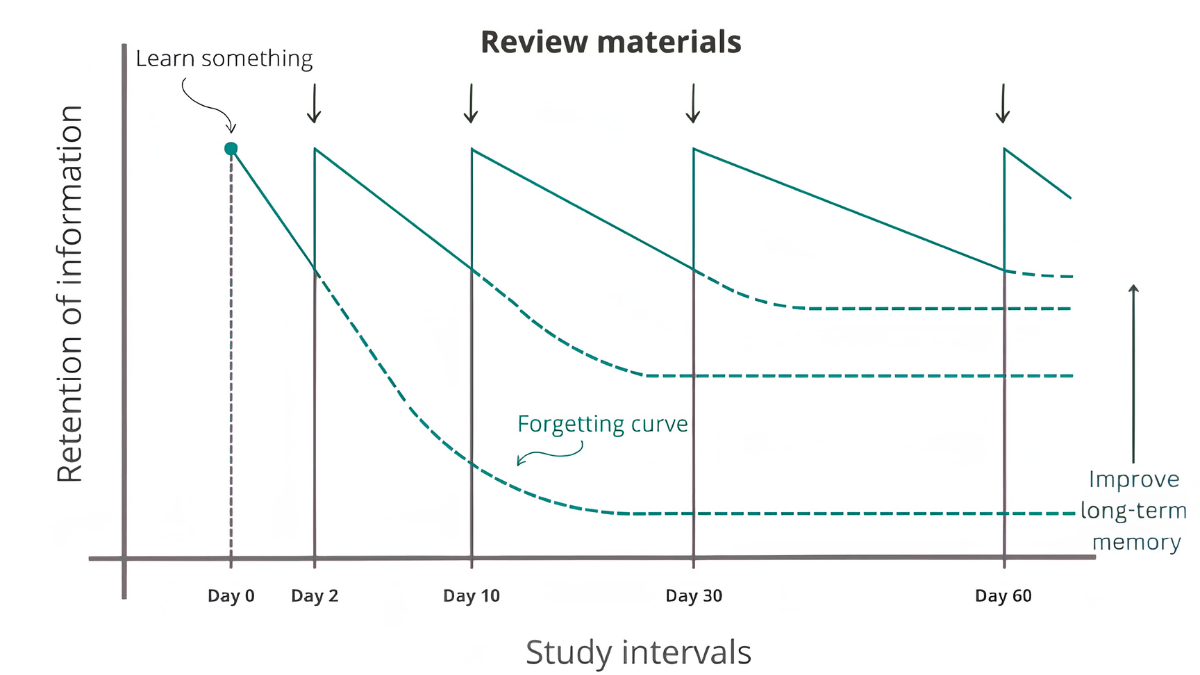
The second problem is the review gap. Most people take notes, close the notebook, and never look at it again. Hermann Ebbinghaus’s research on the forgetting curve — still one of the most replicated findings in psychology — shows that without review, people forget roughly two-thirds of new information within 24 hours. Your notes can’t help you if you never go back to them.
The third problem is isolation. Notes taken as a list of disconnected facts are much harder to retain than notes that connect new information to what you already know. Your brain stores and retrieves information through associations, not through sequential lists.
Fix these three problems — passive recording, no review, and no connection to existing knowledge — and your note-taking will improve dramatically.
The Principles That Make Notes Stick
Before diving into specific methods, it’s worth understanding the underlying principles. These are what make any note-taking approach work — and what will help you adapt whichever method you choose to your own situation. If you want to know how to take better notes, mastering these principles matters more than picking the right system.
Write in Your Own Words
This single change will improve your retention more than any app, notebook, or system. When you restate something in your own words, your brain has to actually process the idea — you can’t copy out a sentence without understanding it. This is called elaborative encoding, and it’s one of the most consistent findings in memory research.
It also makes your notes more useful when you come back to them. Your own phrasing is easier to decode than someone else’s, and it tends to capture the specific aspect of an idea that you found meaningful, rather than the version the author or lecturer thought was important.
QUICK WIN:
Next time you read something worth noting, close the book or tab first. Then write what you remember in your own words. It feels uncomfortable — that’s the learning happening.
Connect New Information to What You Already Know
Your brain is not a hard drive. It doesn’t store information in neat, isolated files. It stores it in networks — new ideas get anchored to existing ones, and the more connections you create, the easier a memory is to retrieve.
When you take a note, ask yourself: what does this remind me of? How does this relate to something I already understand? Where does this fit with things I already believe? Even jotting a quick connection — “this is similar to X” or “this contradicts what Y said about Z” — dramatically increases the chance you’ll be able to retrieve the information later.
Review Soon and Repeatedly
The forgetting curve is steep immediately after learning — which means that reviewing your notes within 24 hours is far more effective than reviewing them a week later. That first review while the material is still fresh reinforces the memory traces before they fade.
After that first review, spaced repetition — reviewing at increasing intervals — is the most effective approach to long-term retention. You don’t need an app to do this; even a rough schedule of reviewing after one day, one week, and one month will dramatically outperform the single read-through most people do. Our guide to spaced repetition explains the mechanics in full if you want to go deeper.
Four Methods for How to Take Better Notes
There’s no universally best note-taking method — the right one depends on what you’re learning, why, and how your mind works. But understanding the four approaches below will give you a toolkit to draw from rather than defaulting to the unstructured list that most people end up with.
1. The Cornell Method
Developed at Cornell University in the 1950s, this method divides your page into three sections: a narrow column on the left, a wider column on the right, and a summary box at the bottom.
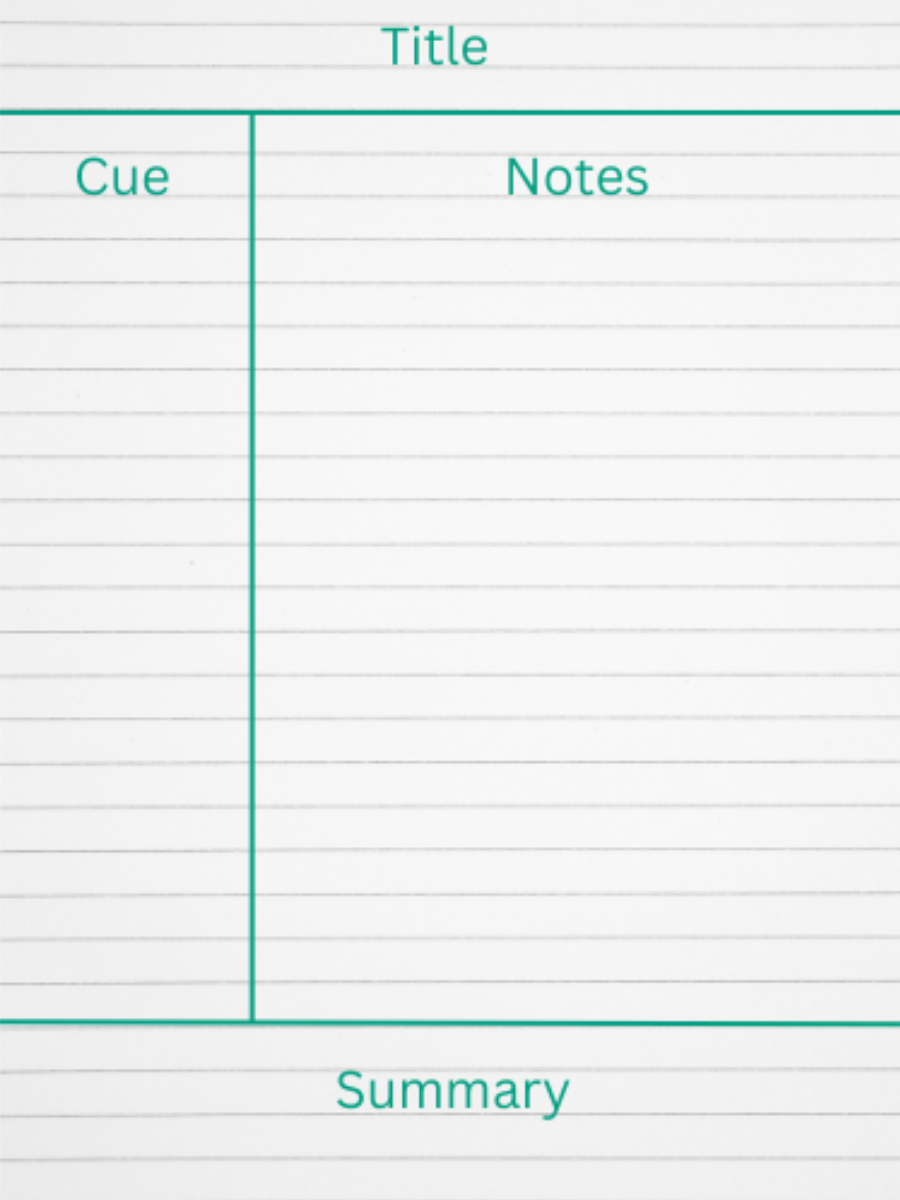
During a lecture or while reading, you take notes in the right-hand column as normal. Afterwards — ideally within 24 hours — you use the left-hand column to write questions or keywords that the notes answer. The bottom section is for a brief summary in your own words.
The result is a note that’s also a self-testing tool. Cover the right column, look at your questions on the left, and try to answer from memory. This forces retrieval practice — one of the most effective learning techniques known to cognitive science. See our article on active recall vs passive reading for more on this.
Best for: Lectures, structured learning, studying for exams, anything where you need to be able to recall specific information later.
QUICK WIN:
Next time you’re taking notes, draw a narrow column on the left, a wide column on the right, and a box across the bottom. Notes go right, questions go left, summary goes at the bottom — written in your own words within 24 hours.
2. The Outline Method
The most familiar method, and the one most likely to be done badly. The outline method organises information hierarchically — main topics at the top level, supporting points indented beneath, details indented further still.
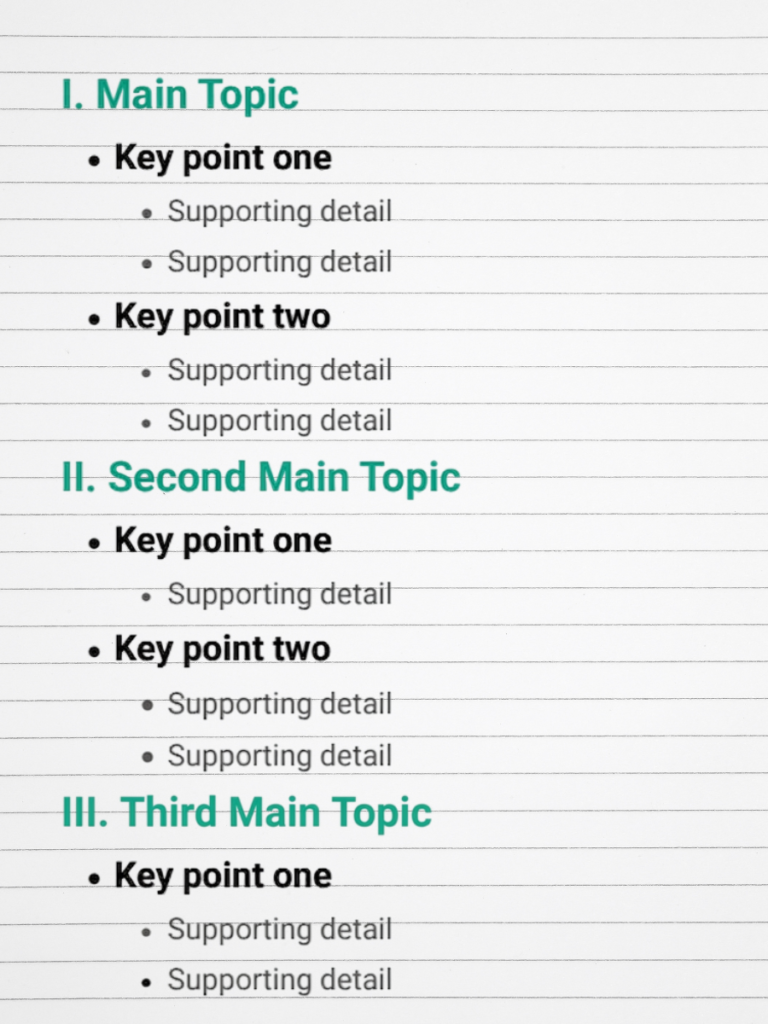
Done well, it produces clear, scannable notes that show you how ideas relate to each other. Done badly, it degenerates into a flat list of bullet points where everything has equal weight and nothing has context.
The key is being selective. You don’t need to capture everything — you need to capture the structure. Ask yourself: what are the two or three main ideas here? What supports each of them? What’s the detail that actually matters?
Best for: Content with a clear structure (textbooks, reports, well-organised presentations), when you need to review quickly, when you’re not sure which method to use.
3. Mind Mapping
A mind map starts with a central concept and branches outward, with related ideas connected by lines rather than nested by indentation. The visual, non-linear structure mirrors how your brain actually stores information — in networks rather than lists.
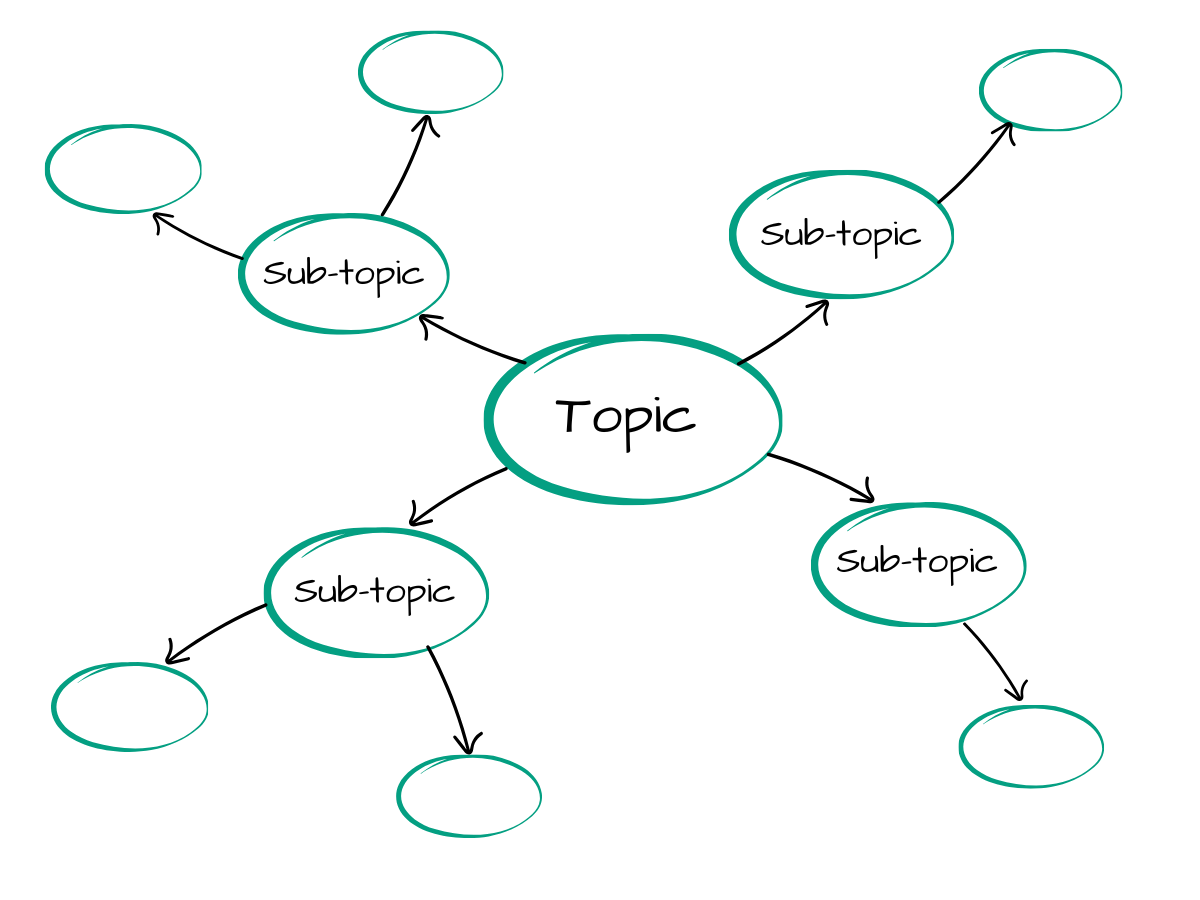
Mind maps are particularly good at showing relationships between ideas that a hierarchical outline would hide. They’re also easier to add to as you learn more — you can attach a new branch anywhere without restructuring the whole thing.
The main limitation is that they don’t scale well for capturing detail. A mind map of a 300-page book tends to become either unreadably dense or frustratingly superficial. They work best as planning or overview tools, or for capturing the big picture of a complex topic before you dive into the detail.
Best for: Brainstorming, planning, getting an overview of a complex topic, visual thinkers who find lists constraining.
4. The Zettelkasten Method
This one is more involved, but worth knowing about if you read a lot and want your notes to actually build into something useful over time.
Zettelkasten is German for “slip-box” — the system was developed by sociologist Niklas Luhmann, who used it to write more than 70 books and 400 academic articles. The idea is simple: each note captures a single idea, written in your own words, with explicit links to related notes. Over time, you build a personal knowledge base where ideas connect and interact in ways that generate new insights.
The difference from a regular notes folder is the linking. When you write a note, you actively ask: what other notes does this connect to? That process of searching for connections forces you to engage with your existing knowledge, which both reinforces it and helps you spot patterns you might otherwise miss.
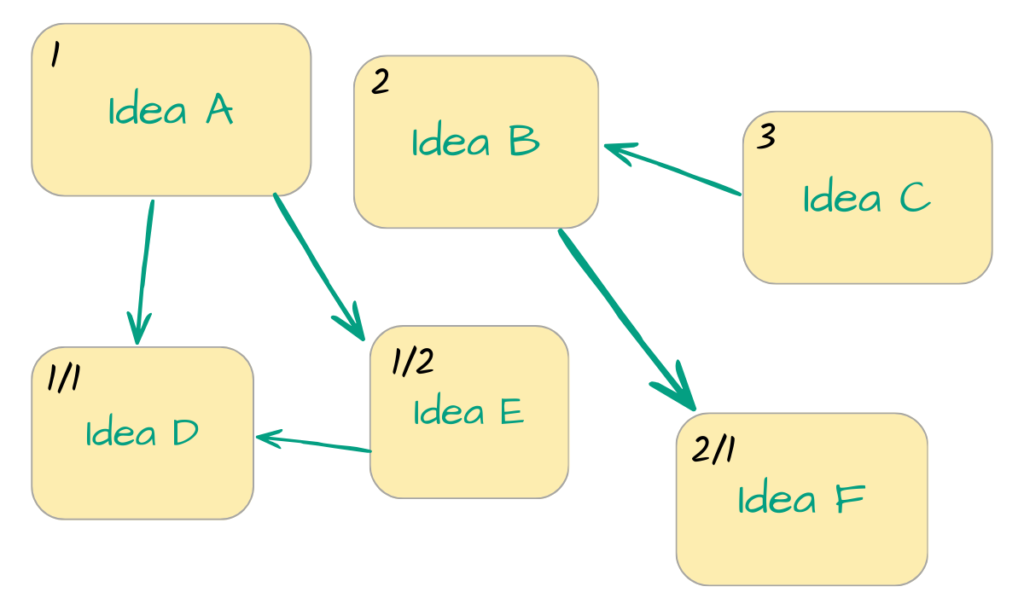
Each card has a unique ID. Sub-notes branch from parent notes — 1/1 and 1/2 are both children of note 1 — but cards also link across the system regardless of hierarchy. Note 1/2 links back to 1/1, and note 3 links to a completely separate branch. This creates a web of connected ideas rather than a rigid top-down structure.
Sönke Ahrens’s book How to Take Smart Notes is the most accessible guide to this approach, and well worth reading if you’re interested in taking it further. The tool Obsidian is purpose-built for Zettelkasten-style note-taking if you prefer digital.
Best for: Non-fiction readers who want to build knowledge over time, writers and researchers, anyone who thinks in ideas rather than tasks.
Handwriting vs. Typing: What the Research Actually Says
This debate comes up constantly, and the answer is more nuanced than most people expect. Understanding it is useful if you want to know how to take better notes across different situations.
The research does generally favour handwriting for conceptual understanding. Because writing by hand is slower, it forces you to process and summarise — you simply can’t transcribe verbatim, so your brain has to do the work of deciding what matters. That processing is where a lot of the learning happens.
However, the research on typing vs. handwriting mostly compares verbatim typing with handwriting. When people are taught to take non-verbatim, processed digital notes — using their own words, making connections — the advantage of handwriting largely disappears. The method matters more than the medium.
There are also practical considerations that the research doesn’t capture. Digital notes are searchable, shareable, and impossible to leave on a train. They’re easier to link, tag, and organise into the kind of connected system the Zettelkasten method requires. For volume and flexibility, digital wins.
The honest answer: if you’re in a lecture or meeting and need to understand the material deeply, handwriting has a genuine edge. It’s particularly valuable when the content involves diagrams, spatial relationships, or mathematical equations — things that are slow and awkward to capture on a keyboard. Many students find that switching to pen and paper for these moments removes a layer of friction that digital note-taking simply can’t solve. If you’re building a long-term knowledge base and need to search and connect ideas across hundreds of notes, digital is more practical. Many people use both — handwriting in the moment, then typing up and processing later.
QUICK WIN:
If you normally type your notes, try handwriting your next reading session. If you normally handwrite, try the reverse. One session is enough to notice how differently your brain engages with each approach.
How to Take Better Notes: The Review Step Most People Skip
You can take the most beautifully structured notes in the world and still retain almost nothing if you never go back to them. Review is where notes pay off — and it’s the step most people skip when they’re trying to work out how to take better notes effectively.
The most effective review isn’t re-reading. It’s testing. Cover your notes and try to recall the key ideas from memory. Check what you got right and what you missed. This retrieval practice — the act of trying to remember — strengthens the memory trace far more than passive re-reading does. It’s uncomfortable, because you’ll discover how much you’ve already forgotten. That discomfort is the point.
A practical review rhythm that most people can sustain:
- Same day or next morning: Spend five minutes adding questions to your notes (the Cornell left column) and writing a three-sentence summary. This is fast and high-value.
- After one week: Cover your notes and test yourself on the key questions. Check what you missed and re-read only those sections.
- After one month: A final review. By now you should be able to recall most of it. Anything that still isn’t sticking probably needs to be turned into a flashcard or just accepted as something you don’t need to know in detail.
This rhythm works with any note-taking method. The specific schedule matters less than the principle: review while the memory is still recoverable, then space out the subsequent reviews. Our article on how to remember what you read covers this in more detail, including how to adapt it for books specifically.
QUICK WIN:
Find a set of notes you took in the last week. Without looking at them, write down everything you can remember. Then check. Whatever’s missing is exactly what you need to review — and the act of trying to recall it has already started the process.
Choosing the Right Method for the Situation
You don’t need to pick one method and stick to it forever. Different situations call for different approaches, and knowing when to use each is half the skill of learning how to take better notes effectively.
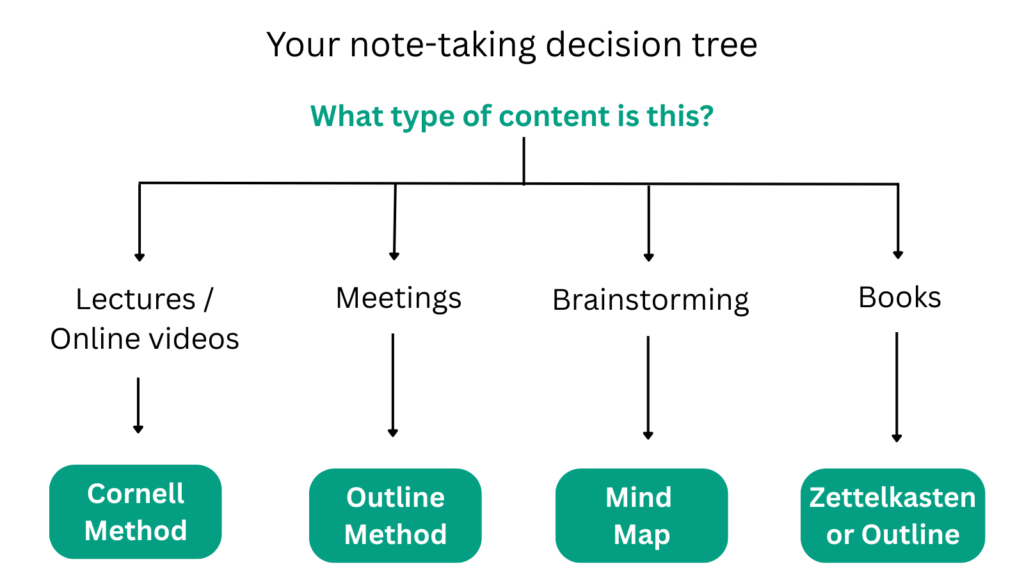
In lectures or structured presentations: The Cornell method. The two-column format forces you to process after the fact and turns your notes into a self-test tool.
Reading non-fiction books: Write in your own words in the margins (if it’s your copy), or keep a separate notebook where you summarise chapters before moving on. For serious readers building a knowledge base, the Zettelkasten approach is worth the setup time.
Work meetings: The outline method, used selectively. Capture decisions, actions, and key points — not everything said. Distinguish between information and actions with a simple system (asterisks, boxes, or initials next to action items).
Brainstorming or planning: Mind mapping. The non-linear structure is better for generating and connecting ideas than for capturing information you need to recall later.
Online courses and videos: Pause frequently and write from memory rather than transcribing in real time. Treat each section like a lecture — the Cornell method works well here, with notes during, questions and summary after.
How to Take Better Notes: A Simple System You Can Start Today
If the above feels like a lot to take in, here’s a stripped-back version that will improve your note-taking immediately, regardless of what you’re learning or what tools you use. This is the simplest answer to how to take better notes — five steps, no special equipment required.
- Before you start: Write one sentence about what you’re trying to learn or understand. This focuses your attention and gives you a filter for what’s worth noting.
- During: Write only in your own words. Nothing verbatim. Aim for key ideas, not comprehensive coverage.
- Immediately after: Write three to five questions that your notes answer, and a two or three sentence summary. This takes five minutes and is the single highest-value step most people skip.
- Tomorrow: Cover your notes. Try to answer the questions from memory. Check, then briefly re-read anything you couldn’t recall.
- Next week: One more retrieval practice session. By now, most of it should stick.
That’s it. No special app required. No system overhaul. Just a shift from passive recording to active processing, combined with two brief review sessions. Most people who try this are surprised by how much more they retain — and how much faster the reviews get once the material has been properly processed the first time.
I’m Simon Shaw, a Chartered Occupational Psychologist with over 20 years of experience in cognitive assessment and psychology-backed approaches to learning and memory. The strategies in this article are grounded in established cognitive psychology research — practical approaches that work consistently whether you’re studying, in meetings, or learning independently.
RESOURCES:
I only recommend resources that I either use personally or have researched and feel are genuinely helpful for my readers. Resources sometimes contain affiliate links; if you purchase through these, I may earn a small commission at no extra cost to you.
Essential Reading on Note-Taking and Learning:
How to Take Smart Notes by Sönke Ahrens — The definitive guide to the Zettelkasten method and building a note-taking system that actually develops your thinking over time. Paperback
Where Good Ideas Come From by Steven Johnson — Explores the conditions in which new ideas emerge and why connecting knowledge across domains produces better thinking. Paperback | Kindle | Audible
Related Articles from Marginal Gains:
How to Use Spaced Repetition
How to Remember What You Read
How to Learn Faster
Active Recall vs. Passive Reading
I'm Simon Shaw, a Chartered Occupational Psychologist with over 20 years of experience in workplace psychology, learning and development, coaching, and teaching. I write about applying psychological research to everyday challenges - from habits and productivity to memory and mental performance. The articles on this blog draw from established research in psychology and behavioural science, taking a marginal gains approach to help you make small, evidence-based changes that compound over time, allowing you to make meaningful progress in the areas you care about most.