
How to Memorise a Presentation Without Notes

Learning how to memorise a presentation is one of the most valuable skills a professional can develop — yet most people approach it the wrong way. You’ve created brilliant slides. You’ve researched your topic thoroughly. But when you imagine standing in front of that audience, panic sets in. What if you forget what to say? What if your mind goes blank halfway through?
The fear of forgetting is one of the most common sources of presentation anxiety. Many speakers resort to cramming their slides with bullet points or reading from notes, which undermines their credibility and disconnects them from their audience. The alternative — trying to memorise everything word-for-word — feels overwhelming and often backfires under pressure.
There’s a better approach. The most confident speakers don’t rely on rote memorisation. Instead, they use specific psychological techniques that make information stick without the stress of verbatim recall.
This article shows you exactly how to memorise a presentation using evidence-based methods that actually work — techniques from memory research that help you internalise your content, reduce anxiety, and deliver with genuine confidence.
The memory techniques that underpin great presentation recall draw from the same cognitive science covered in our broader guide on how to learn faster.
Why Traditional Memorisation Fails for Presentations
Most people approach the question of how to memorise a presentation the wrong way. They write out their entire speech, then try to learn it word-for-word through repetition. This rarely works, and here’s why.
When you attempt verbatim memorisation, you’re fighting against how memory actually functions. Your working memory — the mental space where you actively process information — can only hold about four chunks of information at once. Trying to recall exact phrasing for a 20-minute presentation creates massive cognitive load. One forgotten word can derail your entire train of thought.
Research on presentation anxiety shows that word-for-word memorisation actually increases stress. You’re not just delivering content — you’re constantly monitoring whether you’re saying the “right” words. This divided attention makes you sound robotic and prevents you from responding naturally to your audience.
The speakers who appear most natural aren’t reciting memorised scripts. They’ve internalised the structure and key ideas of their presentation, allowing them to communicate concepts rather than recite words. This approach works with your memory system rather than against it.
QUICK WIN:
Write down your next presentation’s core message in one sentence. Not the topic — the single thing you want your audience to walk away believing or doing. If you can’t write it in one sentence, your structure isn’t clear enough yet. Clarifying this now will make every memorisation technique below significantly easier to apply.
How to Memorise a Presentation: The Memory Palace Technique
One of the most powerful methods for memorising a presentation is the Memory Palace technique, also called the Method of Loci. This ancient strategy has been used for thousands of years because it leverages your brain’s exceptional ability to remember spatial information.
Your brain evolved to remember locations and journeys. Think about how easily you can mentally walk through your childhood home or navigate your regular commute. The Memory Palace technique harnesses this natural strength by linking your presentation points to specific locations in a familiar space.
Here’s how to build a Memory Palace for your presentation. First, choose a location you know extremely well — your home, your route to work, or a favourite walking path. The key is intimate familiarity with every detail. Next, identify distinct stops along a clear path through this space — five to seven stops for a 15-minute presentation with five main sections typically suffice.
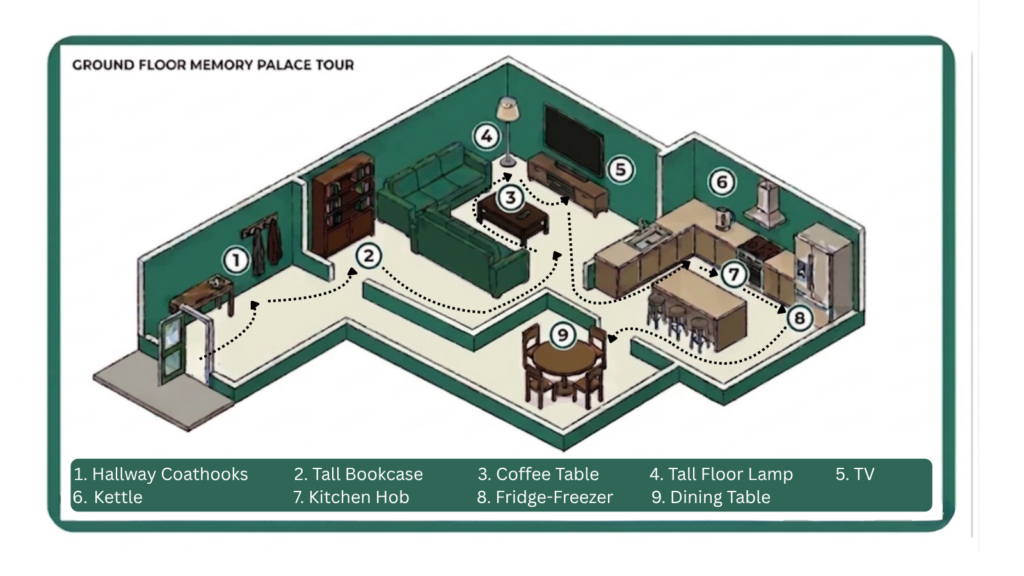
Now comes the crucial part: creating vivid mental associations between each location and your presentation content. If your first point discusses market growth, you might imagine your front door exploding outward with plants bursting through in exaggerated growth. The more unusual and vivid the image, the more memorable it becomes.
When delivering your presentation, you mentally walk through your chosen space. Each location triggers the associated content. This method works because you’re retrieving information through a familiar spatial journey rather than forcing linear recall of abstract concepts.
One client memorised a 30-minute technical presentation by placing each section in rooms of his childhood home. During delivery, he simply “walked through” the house in his mind. The technique reduced his anxiety substantially because he had multiple retrieval cues rather than depending on remembering exact wording.
Chunking: Break Your Presentation Into Memorable Sections
Another highly effective strategy for memorising a presentation draws from research on chunking — the psychological principle that we remember information better when it’s grouped into meaningful units.
Rather than viewing your presentation as one long stream of information, divide it into clear, logical chunks. Most presentations naturally break into an introduction, three to five main points, and a conclusion. This structure mirrors how our brains prefer to organise and retrieve information.
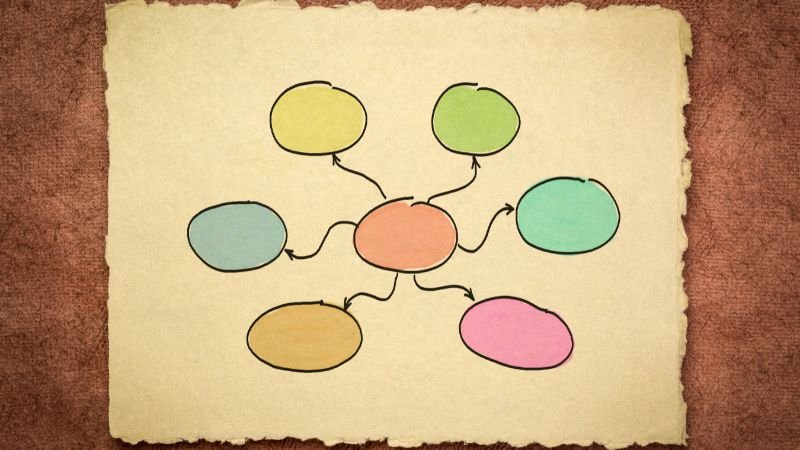
For each chunk, identify the core message you need to convey — a single sentence that captures the essence of that section. Everything else in that section supports or illustrates this central idea. When you’ve internalised these core messages, the supporting details flow more naturally.
Create “anchor phrases” for each section — short, memorable phrases that encapsulate the main point. These aren’t meant to be spoken verbatim; they’re mental hooks that keep you oriented. If your section discusses customer retention strategies, your anchor might be “keep customers coming back.” This phrase triggers the specific strategies you’ll discuss without requiring word-for-word recall.
QUICK WIN:
Take your next presentation and write one anchor phrase for each main section — a short phrase that captures the essence of that section in 4-6 words. Put these on a single index card. These anchors are all you need to navigate your way through the presentation. Test yourself by covering the card and reciting each section from the anchor alone.
Spaced Practice: The Most Effective Way to Memorise a Presentation
How you practise matters as much as what you practise. The most common mistake is leaving all rehearsal until the night before, then running through your presentation repeatedly in a marathon session. This feels productive but produces poor long-term retention.
Memory research consistently shows that spaced practice — distributing your practice over time — creates much stronger and more durable memories than massed practice. When you rehearse your presentation over several days or weeks, you’re allowing time for memory consolidation between sessions.
Here’s an effective practice schedule. On day one, go through your presentation two or three times, focusing on the overall structure and main points. Don’t worry about perfect delivery. On day two, practise again but start testing yourself — can you deliver each section without looking at your notes? On day three, deliver the entire presentation straight through.
Continue over the following days, gradually increasing the difficulty. Try presenting while walking around, or in front of a mirror. The gaps between practice sessions are crucial — during these breaks, your brain consolidates the memories, making retrieval easier each time you return to the material.
For high-stakes presentations, begin serious rehearsal at least two weeks before your presentation date. Practise every other day for the first week, then daily for the final week. This spacing gives your memory system time to solidify while keeping the content fresh.
The deliberate practice principles that underpin great presentation delivery are the same ones covered in our guide on how to learn any skill fast — structured repetition and targeted feedback are key.
Creating Visual Cues and Memory Anchors
Professional speakers rarely memorise presentations in isolation from their visual aids. Instead, they create strategic memory anchors — visual or structural elements that automatically trigger the next section of content.
If you’re using slides, each slide becomes a memory anchor. A single powerful image or a clear, simple chart provides a much stronger retrieval cue than cluttered slides filled with bullet points — which give you too many anchors and none that stand out.
Physical movement can also serve as a memory anchor. Some speakers associate different presentation sections with different areas of the stage or room — moving to a new position signals both to you and your audience that you’re transitioning to a new topic. Gestures work similarly: if you naturally gesture when discussing growth, that physical movement becomes associated with that content in your memory.
QUICK WIN:
Look at your slide deck right now. Does each slide have one dominant visual element that immediately tells you what that section is about? If not, identify one slide that’s too cluttered and reduce it to a single image or headline. That slide will now function as a reliable memory anchor rather than a confusing prompt.
The Power of Storytelling for Memorability
Human brains are hardwired for narrative. We remember stories far more easily than we remember lists of facts or abstract concepts. If you structure your presentation as a story — or embed stories within it — you dramatically improve your ability to memorise and deliver it naturally.
Stories have built-in memory aids. They follow a predictable structure: situation, complication, resolution. This gives you a mental framework that guides you through the content — you’re not trying to remember isolated pieces of information, you’re recalling a narrative arc that pulls you forward.
For a business presentation about quarterly results, the story might be: we faced this challenge, we took these actions, here’s what happened. For a research presentation: we noticed this puzzle, we investigated it this way, here’s what we discovered. Stories also make your presentation more engaging — when people follow a narrative, they become more forgiving of minor delivery imperfections and more likely to remember your key messages.
Practical Rehearsal Strategies That Work
Effective practice goes beyond simply reading through your presentation repeatedly. Different rehearsal methods strengthen different aspects of your memory and delivery.
Start by practising in sections rather than always running through the entire presentation. Master your introduction first — this is where nerves typically peak, and where strong delivery builds confidence. Once the introduction feels solid, move to the conclusion. Beginning and ending strongly matters more than perfect middle sections.
Record yourself presenting. Listening back reinforces your memory through auditory repetition, you identify awkward phrasing that needs adjustment, and you become more comfortable with your own voice — reducing self-consciousness on the day.
Vary your practice conditions. Present standing up and sitting down. Present in quiet and with background noise. Present while tired and while alert. This variation makes your memory more robust because you’re not dependent on ideal conditions. When something unexpected happens on the day — a noisy room, an unfamiliar setup — you’ll still retrieve your content reliably.

Practise retrieving your content without looking at notes. This active recall strengthens memory far more than passive review. Set your notes aside and see how much you can deliver from memory. When you get stuck, check your notes, then put them away and try that section again. Each successful retrieval makes the next one easier — exactly the same principle that makes studying without re-reading so much more effective.
Managing Presentation Anxiety Through Preparation
The relationship between memorisation and anxiety runs both ways. Anxiety makes memorisation harder, but solid memorisation reduces anxiety. Understanding this connection helps you prepare more effectively.
Presentation anxiety often stems from uncertainty. When you’re confident you know your material, you can focus on connecting with your audience rather than worrying about forgetting. The techniques covered here — Memory Palace, chunking, spaced practice — all reduce uncertainty by giving you multiple ways to retrieve information.
It’s also important to prepare for the possibility of forgetting. Even the best-prepared speakers occasionally lose their place. Have a recovery strategy: a brief pause, a drink of water, or a transition phrase like “The key point here is…” that gives you a moment to reorient. Knowing you have a plan for managing forgotten content actually makes forgetting less likely — you’re not consumed by fear of it happening.
Research on public speaking anxiety consistently shows that thorough preparation is the single most effective way to reduce it. Once you’ve practised adequately, trust your preparation. Your brain continues consolidating the memory overnight — but only if you allow it to rest.
When to Memorise Word-for-Word (And When Not To)
Some presentation elements benefit from precise memorisation, while others work better with flexible recall. Knowing the difference helps you allocate your preparation time effectively.
Your opening and closing statements often deserve word-for-word memorisation. A strong, practised opening establishes credibility and confidence immediately. A memorable conclusion ensures your key message sticks. Memorising these sections also helps because they occur when anxiety typically peaks (the beginning) and when fatigue might affect recall (the end).
Key statistics, quotes, or technical terms may also warrant exact memorisation. If you’re citing specific research findings or quoting an authority, precision matters. Work these into your Memory Palace as particularly vivid images, or write them on small cards you review frequently.
The middle sections, however, usually work better with conceptual memorisation. Know your main points thoroughly, but allow flexibility in how you express them. This sounds more natural and lets you adjust your language based on audience response.
QUICK WIN:
Write out your opening two sentences and your closing two sentences word-for-word right now. Memorise these verbatim — they’re short enough to do in five minutes. Everything else can be flexible, but walking in knowing exactly how you’ll open and close dramatically reduces anxiety and gives your delivery a polished frame.
Building Long-Term Presentation Skills
The techniques in this article will help you memorise a presentation today, but they also build transferable skills that make future presentations easier. Each presentation you memorise using these methods strengthens your overall memory capacity and reduces the time needed for subsequent preparation.
Many speakers report that after using the Memory Palace technique for several presentations, they begin to do it almost automatically. The mental process of creating spatial associations becomes second nature. Similarly, chunking information becomes a natural way of organising thoughts — not just for presentations but for all types of communication.
Consider keeping a presentation journal where you note which techniques worked best for each talk. Over time, you’ll discover your optimal preparation approach. Some people respond particularly well to visual memory anchors; others find narrative structure most helpful. There’s no single right method — the goal is finding what works reliably for you.
Putting It All Together
Knowing how to memorise a presentation effectively isn’t about forcing information into your brain through repetition. It’s about working with your memory’s natural strengths — spatial recall, pattern recognition, narrative structure, and distributed practice.
Start early enough to allow spaced practice over at least a week, ideally two. Break your presentation into logical chunks and identify the core message of each section. Use the Memory Palace technique to create a mental journey through your content. Embed stories where possible to create natural narrative flow. Practise actively, testing your ability to retrieve content without notes. Focus on memorising your opening and closing word-for-word, but allow flexibility in the middle.
Above all, remember that these techniques become more effective with practice. Your first presentation using the Memory Palace might feel unfamiliar — by your third or fourth, it will feel natural. Confident presentation delivery without reliance on notes isn’t a gift some people have and others lack. It’s a skill you develop through evidence-based preparation.
RESOURCES:
I only recommend resources that I either use personally or have researched and feel are genuinely helpful for my readers. Resources sometimes contain affiliate links; if you purchase through these, I may earn a small commission at no extra cost to you.
Recommended Reading:
Moonwalking with Einstein: The Art and Science of Remembering Everything by Joshua Foer — The definitive accessible guide to memory techniques including the Memory Palace method covered in this article. Essential reading if you want to go deeper. Paperback | Kindle | Audible
A Mind for Numbers: How to Excel at Maths and Science by Barbara Oakley — Packed with practical techniques on chunking, spaced practice and retrieval — all directly applicable to presentation memorisation. Paperback | Kindle | Audible
Related Articles from Marginal Gains:
The Memory Palace Technique — A full step-by-step guide to building and using a Memory Palace for any type of memorisation task.
How to Use Spaced Repetition — The science behind the spaced practice schedule recommended in this article, with practical implementation guidance.
Active Recall vs Passive Reading — Why testing yourself beats re-reading every time, and how to apply this to presentation rehearsal.
How to Remember What You Study — Broader memory techniques that complement the presentation-specific strategies here.
The Chunking Method — A deeper dive into the chunking principle referenced throughout this article.
I'm Simon Shaw, a Chartered Occupational Psychologist with over 20 years of experience in workplace psychology, learning and development, coaching, and teaching. I write about applying psychological research to everyday challenges - from habits and productivity to memory and mental performance. The articles on this blog draw from established research in psychology and behavioural science, taking a marginal gains approach to help you make small, evidence-based changes that compound over time, allowing you to make meaningful progress in the areas you care about most.