
How to Remember What You Study (Without Cramming)
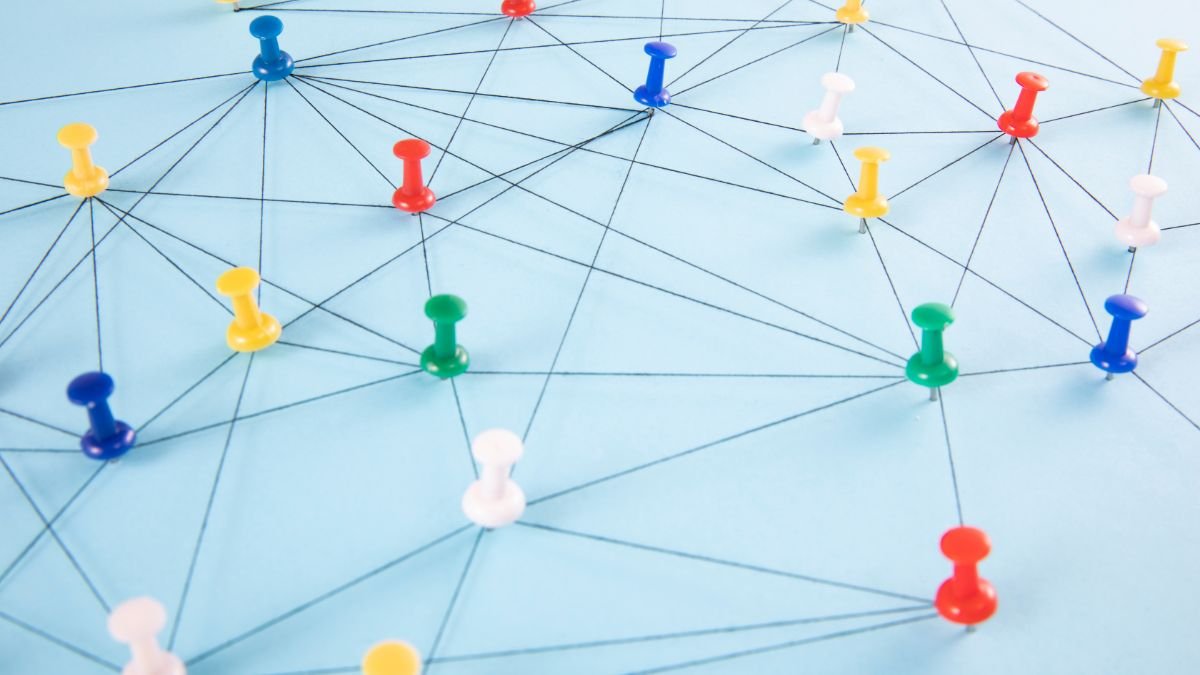
If you want to know how to remember what you study — not just for tomorrow’s test, but for months afterwards — the answer lies in a single principle: connection. You spend three hours studying for an exam. You quiz yourself and everything seems to stick. The next morning, you sit down to write and half of it has vanished. Two weeks later, you’d struggle to recall even the basics.
This isn’t because you have a poor memory. It’s because you’re using surface-level study techniques that create temporary retention rather than lasting understanding. The information goes in, but it never properly connects to anything already in your head, so it slides out again almost as quickly.
The difference between remembering something for a test and actually learning it comes down to one crucial process: connecting new information to what you already know. This technique, called elaborative rehearsal in psychology, transforms isolated facts into integrated knowledge. Instead of trying to force-feed your brain disconnected information, you create meaningful links that make retrieval automatic.
This article shows you exactly how to remember what you study — not just for the exam, but for months or years afterwards.
Why Cramming Fails (and What Actually Works)
Cramming feels productive. You’re reading, highlighting, re-reading notes, making flashcards. You’re putting in the hours. But here’s the uncomfortable truth: most cramming activities create fluency illusion — the feeling that you know something when you actually don’t.
When you re-read your notes for the third time, the material feels familiar. Your eyes glide over the words. Nothing feels difficult. Your brain interprets this ease as understanding, even though you couldn’t explain the concepts without looking at the page.
Psychologists Fergus Craik and Robert Lockhart identified this problem in their 1972 research on levels of processing. They found that deep processing — thinking about meaning, making connections, relating ideas to existing knowledge — creates dramatically stronger memories than shallow processing like simple repetition. Simply Psychology’s overview of the levels-of-processing model explains the research clearly if you’d like to explore the evidence further.
Surface-level techniques include re-reading, highlighting, and copying out notes. These activities engage your eyes and hands but barely touch your brain. They’re passive. Deep processing techniques, by contrast, force you to think actively about what you’re learning, why it matters, and how it connects to things you already understand.
The most powerful deep processing technique is connecting new information to your existing knowledge. Your brain isn’t a blank storage device waiting to be filled with isolated facts. It’s a web of interconnected concepts, and new information sticks best when you deliberately hook it onto that web.
The Connection Principle: How to Remember What You Study Long-Term
Imagine trying to remember a string of eleven digits — something like a phone number you’ve never seen before. Eleven random characters are nearly impossible to hold in mind. But what if you could break them into three meaningful chunks, each linked to something you already know? Suddenly those eleven “random” characters become three memorable units connected to things already in your head.
This is how memory works at every level. Information that connects to existing knowledge transfers to long-term memory. Information that sits in isolation fades within hours.
Your brain stores knowledge in networks — interconnected webs of related concepts. When you learn “photosynthesis,” that word doesn’t exist in isolation. It connects to “plants,” which connects to “chlorophyll,” “sunlight,” “carbon dioxide,” “oxygen,” “food chain,” and dozens of other concepts. Each connection makes the central concept more retrievable.
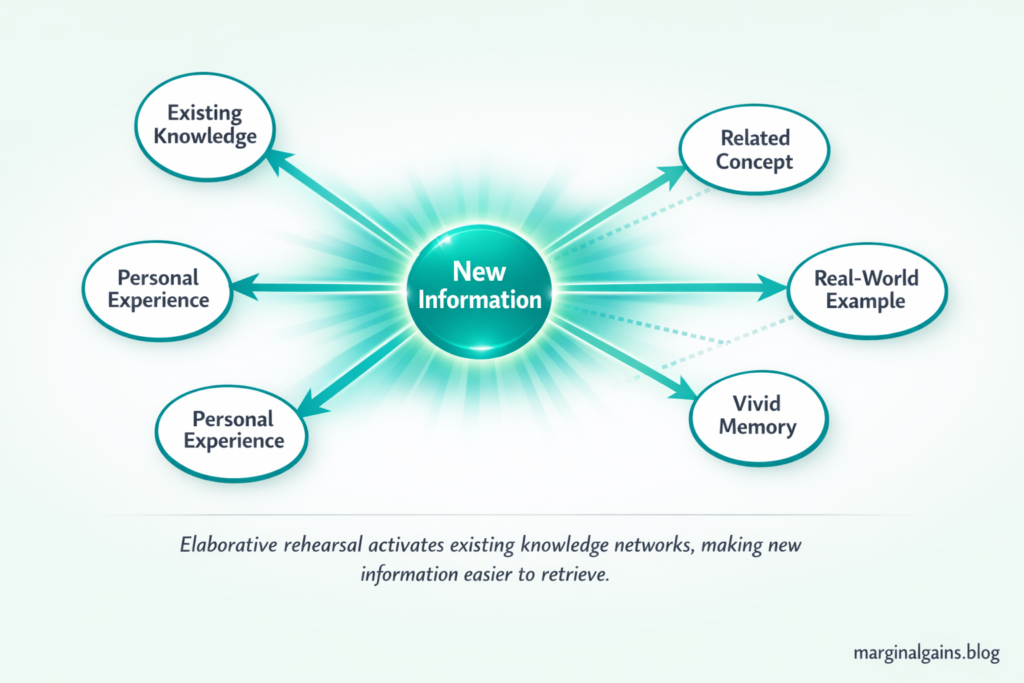
Students who connect new material to their existing knowledge consistently outperform those who try to memorise in isolation. The connections don’t have to be profound or complex. Even simple links — “this reminds me of,” “this contradicts,” “this is similar to” — dramatically improve retention.
As a psychologist who’s worked in learning and development for over 20 years, I’ve seen this principle transform struggling students into confident learners. The difference isn’t innate ability. It’s knowing how to leverage the brain’s natural connection-making machinery.
Practical Technique 1: The “Relate It” Method
Every time you encounter a new concept, force yourself to answer three questions before moving on. Don’t skip this step. The act of pausing and connecting is what creates the memory.
First: “What does this remind me of?” Look for any similarity to something you already understand. When learning about supply and demand in economics, you might think: “This is like when concert tickets sell out — prices go up when everyone wants them.” The analogy doesn’t need to be perfect. It just needs to be meaningful to you.
Second: “How does this contradict or differ from what I thought?” Noticing differences is as valuable as spotting similarities. If you thought plant roots only absorbed water but learn they also exchange nutrients with soil fungi, that surprise creates a memorable connection. Your brain pays special attention to information that updates or contradicts existing beliefs.
Third: “Where have I seen this in real life?” Personal connections are the stickiest kind. If you’re studying cognitive dissonance, think about that time you bought an expensive gadget and then immediately started finding reasons to justify the purchase. Linking abstract concepts to your own experiences makes them unforgettable.
Try this right now with something you’re currently studying. Pick one concept and answer all three questions. Write the answers down. That act of written elaboration strengthens the connections you’re creating.
QUICK WIN:
Pick one concept you’re currently studying — anything at all. Before reading on, write down three genuine connections: something it reminds you of, something it contradicts or surprises you about, and one example from your own life or experience. Don’t move on until you’ve answered all three. That two-minute pause creates more lasting memory than another hour of re-reading.
Practical Technique 2: The Explanation Test
After reading a section of your textbook or notes, close them. Then explain what you just read as if teaching it to someone who knows nothing about the topic. Say it out loud or write it in your own words.
This simple act reveals what you actually understand versus what merely looked familiar on the page. When you try to explain, gaps in your understanding become immediately obvious. You’ll stumble over certain parts, realise you can’t quite articulate how two concepts connect, or notice you’ve forgotten a crucial detail.
These gaps are good news. They show you exactly what needs more attention. Go back, re-engage with the difficult bits using active recall techniques, and try explaining again. Each time you reconstruct the explanation, you’re strengthening the connections between concepts.
The explanation doesn’t necessarily need an audience (although if you have a trusted friend to hand, this works well, too). Some students find talking to themselves awkward, but it works. If you prefer, imagine explaining to a friend, a younger sibling, or even a rubber duck (programmers actually use this technique for debugging code). The process of converting your understanding into clear explanation forces deep processing.

This technique works particularly well when combined with spaced repetition schedules — return to the material after increasing intervals and attempt to explain it again from memory. Each successful retrieval strengthens your long-term storage.
Practical Technique 3: Build a Concept Map
Concept mapping is the visual equivalent of making connections. Take a blank page and write your central topic in the middle. Then branch out, connecting related ideas with lines. Add notes on the connections explaining why two concepts relate.
This isn’t just about making pretty diagrams. The act of deciding which concepts connect and how creates the deep processing that makes information stick. You can’t draw connections between ideas you don’t understand, so the process forces genuine engagement.
Visual note-taking is one of the most powerful applications of the dual coding method (our dedicated guide on how to remember what you read covers this method in depth, including how to apply it across different types of reading material).
Start with a simple example. If studying the French Revolution, put “French Revolution” in the centre. Branch out to “Causes” (financial crisis, inequality, Enlightenment ideas), “Key Events” (Bastille, Reign of Terror, Napoleon’s rise), and “Consequences” (spread of nationalism, end of absolute monarchy). Then draw connections between branches. How did financial crisis lead to the storming of the Bastille? How did Enlightenment ideas influence revolutionary goals?
The visual format has another advantage: it matches how your brain actually stores information. Knowledge doesn’t live in neat linear lists. It exists in networks. Creating a concept map externalises your internal knowledge structure, making gaps and weak connections visible. This also works brilliantly for memorising presentations.
Combining concept mapping with chunking strategies creates an even more powerful study system — you organise information into meaningful groups and visualise how those groups interconnect.
QUICK WIN:
Take a blank page and write the main topic you’re currently studying in the centre. Set a timer for five minutes and branch out as many connections as you can — related ideas, causes, consequences, examples, contradictions. Don’t worry about neatness. When the timer goes off, look at the gaps in your map: those are the areas where your understanding is weakest and where your next study session should focus.
Practical Technique 4: The Question-First Approach
Before you read a new chapter or section, generate questions about what you expect to learn. Skim the headings and subheadings. What questions does this structure suggest? What do you already know that might relate?
This pre-loading activates your existing knowledge networks. Your brain starts scanning for relevant connections before you even begin reading. When you then encounter the new information, your mind is primed to integrate it with what you already know.
For example, before reading a chapter on climate change, you might ask: What’s the difference between weather and climate? How do we know temperatures are rising? What causes it? What are the consequences? Some answers you might already know partially. Others will be completely new. Either way, the questions create a framework for understanding.
As you read, actively seek answers to your questions. When you find relevant information, explicitly note which question it addresses. This creates clear connections between the new content and your existing curiosity or knowledge.
Research on reading comprehension consistently shows that students who generate questions before reading understand and retain significantly more than those who passively start reading. The question-asking primes your brain to notice relevance and make connections.
Practical Technique 5: Connect Across Subjects to Remember What You Study More Deeply
One of the most underused study strategies is looking for connections between different subjects. The same concepts appear in multiple domains, but students often keep their learning compartmentalised.
When studying probability in mathematics, you might notice it connects to risk assessment in economics, experimental design in psychology, and evolutionary biology. Making these cross-subject connections not only strengthens your understanding of probability but also enriches your grasp of all the connected fields.
This doesn’t mean you need to be studying multiple subjects simultaneously. Even historical connections work. If you’re learning about coding algorithms now and studied chemistry last term, can you spot similarities between chemical reactions and computational processes? Both involve inputs, transformations, and outputs. Both follow rules and produce predictable results.
Cross-domain connections are particularly powerful because they’re unexpected. Your brain pays extra attention to surprising links, which makes them more memorable than obvious connections within a single subject.
QUICK WIN:
Think of something you studied last week — in any subject. Now ask: where else have I encountered this idea, even in a completely different context? Look for the underlying principle rather than the surface topic. A concept from biology might mirror something from economics; a historical pattern might echo a current event. Write down one cross-subject connection you haven’t noticed before. Unexpected links are the ones your brain remembers best.
Practical Technique 6: Use Analogies and Metaphors
When you encounter something truly unfamiliar, create an analogy to something you already understand well. Analogies are connection-making tools that link the unknown to the known.
Trying to understand how neurons transmit signals? Think of it like passing a message along a line of people — each person receives it, processes it briefly, and passes it to the next person. The analogy isn’t perfect (neurons are more complex than people), but it gives you an initial framework for understanding signal transmission.
Learning about market bubbles in economics? They’re like that friend who gets extremely enthusiastic about a new hobby, convinces everyone else it’s amazing, you all invest time and money into it, and then everyone suddenly loses interest and moves on to something else. The value was never as real as the enthusiasm suggested.
The best analogies come from your own life and interests. If you’re into football, use football analogies. If you cook, use cooking analogies. The personal relevance of the comparison strengthens the connection.
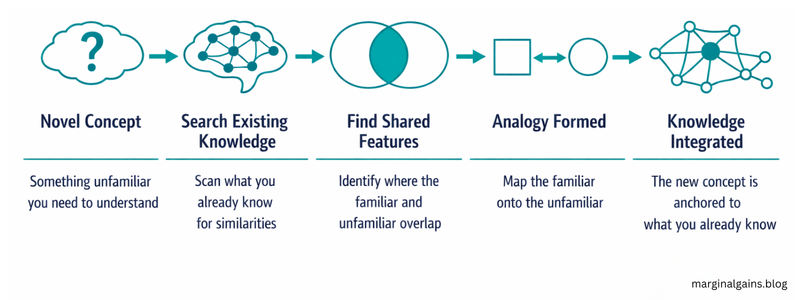
Be careful with one thing: after using an analogy to initially understand a concept, verify where the analogy breaks down. All analogies have limits. Neurons don’t get tired like people passing messages. Recognising where an analogy fails is part of deepening your understanding.
Common Mistakes That Stop You Remembering What You Study
The biggest mistake students make is confusing familiarity with understanding. Just because something looks familiar when you re-read it doesn’t mean you’ve learned it — it means you’re good at recognising it. Test your actual understanding by trying to recall and explain without looking.
Another error is making superficial connections. “This reminds me of that other thing” isn’t enough unless you can articulate why and how they relate. Vague associations don’t create the deep processing necessary for retention. Force yourself to be specific about the nature of the connection.
Some students also fall into the trap of over-organising. Spending two hours creating beautiful colour-coded notes and diagrams might feel productive, but if you’re not actively thinking about the meaning and connections, you’re not learning. Organisation is valuable only when it reflects genuine understanding. See our guide on how to take better notes for more on this.
Finally, don’t abandon other techniques entirely. Connection-making works best alongside other effective strategies. Continue using evidence-based learning techniques like testing yourself, spacing your practice, and varying your study locations. Connection-making is powerful, but it’s one tool among many.
Making It Habitual
Reading these techniques once won’t change how you remember what you study. You need to deliberately practise them until they become automatic. Start with just one approach — perhaps the “Relate It” method — and use it consistently for a week.
Initially, it will slow you down. Making connections requires pausing to think, and thinking feels slower than skimming through pages. This slowness is the point. You’re doing deep work instead of creating the illusion of progress through rapid, shallow reading.
After a week, add a second technique. Perhaps you start closing your notes and explaining concepts out loud. After another week, try concept mapping. Build your practice gradually rather than trying to do everything at once.
Within a month, you’ll notice you make connections automatically. When you encounter new information, your brain immediately starts searching for related concepts without conscious effort. The techniques become invisible — they’re just how you think.
The Long-Term Benefits
Students often think about memory techniques purely in terms of exam performance. But creating genuine understanding through connections pays dividends far beyond test scores.
Information you’ve properly connected and understood becomes part of your permanent knowledge base. Two years after studying, you’ll still be able to discuss the concepts because they’re woven into your understanding of the world. Compare this to crammed information, which evaporates within weeks.
Connected knowledge is also more transferable. When you understand ideas through their relationships to other concepts, you can apply them in new contexts. You’re not just memorising facts for tests — you’re building a framework for thinking that serves you throughout your career.
Perhaps most importantly, studying through connection-making is more enjoyable than mindless repetition. Your mind engages. You spot interesting relationships. You have genuine “aha” moments. Learning stops being a tedious chore and becomes intellectually stimulating.
Starting Today: How to Remember What You Study Differently
You don’t need to overhaul your entire study routine immediately. Pick one concept you’re currently studying — anything at all — and try the “Relate It” method right now. Find three genuine connections to things you already know.
Notice how this feels different from re-reading or highlighting. You’re thinking actively about meaning rather than passively consuming information. That active engagement is what creates lasting memory.
The techniques in this article aren’t complicated, but they do require conscious effort initially. The effort pays off. Within weeks, you’ll find yourself remembering significantly more with less overall study time. More importantly, you’ll actually understand what you’ve learned rather than temporarily memorising it.
These strategies sit within a broader framework of evidence-based learning — our guide on how to learn faster and make it stick covers the cognitive science behind why some study approaches work and others don’t.
Your brain already wants to make connections. It’s naturally built for pattern-finding and relationship-spotting. These techniques simply harness that natural tendency and direct it towards your study material. Stop fighting your brain’s design by trying to force isolated facts into storage. Work with it instead, and watch how much more you retain. The same principles that help you remember what you study also apply directly to recalling names and faces — connection-making is the foundation of memory in every context.
RESOURCES:
I only recommend resources that I either use personally or have researched and feel are genuinely helpful for my readers. Resources sometimes contain affiliate links; if you purchase through these, I may earn a small commission at no extra cost to you.
Recommended Reading:
Make It Stick: The Science of Successful Learning by Peter Brown — The most accessible guide to what the research actually says about effective study. Directly covers elaborative rehearsal, retrieval practice, and spaced repetition with clear real-world examples. Paperback
A Mind for Numbers: How to Excel at Maths and Science by Barbara Oakley — Despite the title, this is a practical guide to learning anything effectively. Particularly strong on chunking, making connections, and switching between focused and diffuse thinking modes. Paperback | Kindle | Audible
Moonwalking with Einstein: The Art and Science of Remembering Everything by Joshua Foer — A compelling account of how memory works and how connection-making underpins all effective memorisation. Paperback | Kindle | Audible
How to Take Smart Notes by Sönke Ahrens — The practical guide to building a connected knowledge system that makes studying a cumulative, compounding process rather than starting from scratch each time. Paperback
Related Articles from Marginal Gains:
How to Learn Faster and Make It Stick — The broader guide to evidence-based learning strategies that complement the connection-making techniques here
Active Recall vs Passive Reading — Why testing yourself beats re-reading every time
How to Use Spaced Repetition — The scheduling system that makes distributed practice automatic
The Chunking Method — How grouping information into meaningful units dramatically improves recall
The Memory Palace Technique — A powerful memorisation method that uses spatial connection-making
I'm Simon Shaw, a Chartered Occupational Psychologist with over 20 years of experience in workplace psychology, learning and development, coaching, and teaching. I write about applying psychological research to everyday challenges - from habits and productivity to memory and mental performance. The articles on this blog draw from established research in psychology and behavioural science, taking a marginal gains approach to help you make small, evidence-based changes that compound over time, allowing you to make meaningful progress in the areas you care about most.