
WOOP Goal Setting: The Science Behind Why It Works

Most goal-setting advice tells you to think positively. Visualise success. Picture where you want to be. The problem is that decades of psychological research suggest this advice, on its own, is wrong — and may actually make you less likely to achieve your goals.
WOOP goal setting works differently. It combines the motivational power of visualising success with something most goal-setting systems ignore entirely: an honest, structured reckoning with the obstacles standing in your way. The result is a technique with more rigorous empirical support than SMART goals, vision boards, or almost any other approach you’ve likely tried.
This guide explains what WOOP is, why the psychology behind it is so compelling, and exactly how to use it for any goal in your personal or professional life. You’ll leave with a framework you can apply today.
What is WOOP goal setting?
WOOP is an acronym for Wish, Outcome, Obstacle, Plan. It is a structured mental strategy developed by psychologist Gabriele Oettingen at New York University, whose research into motivation and goal achievement spans more than 20 years. WOOP is sometimes described in academic literature as “mental contrasting with implementation intentions” — a name that is technically precise but does little to communicate how straightforward the technique actually is in practice.
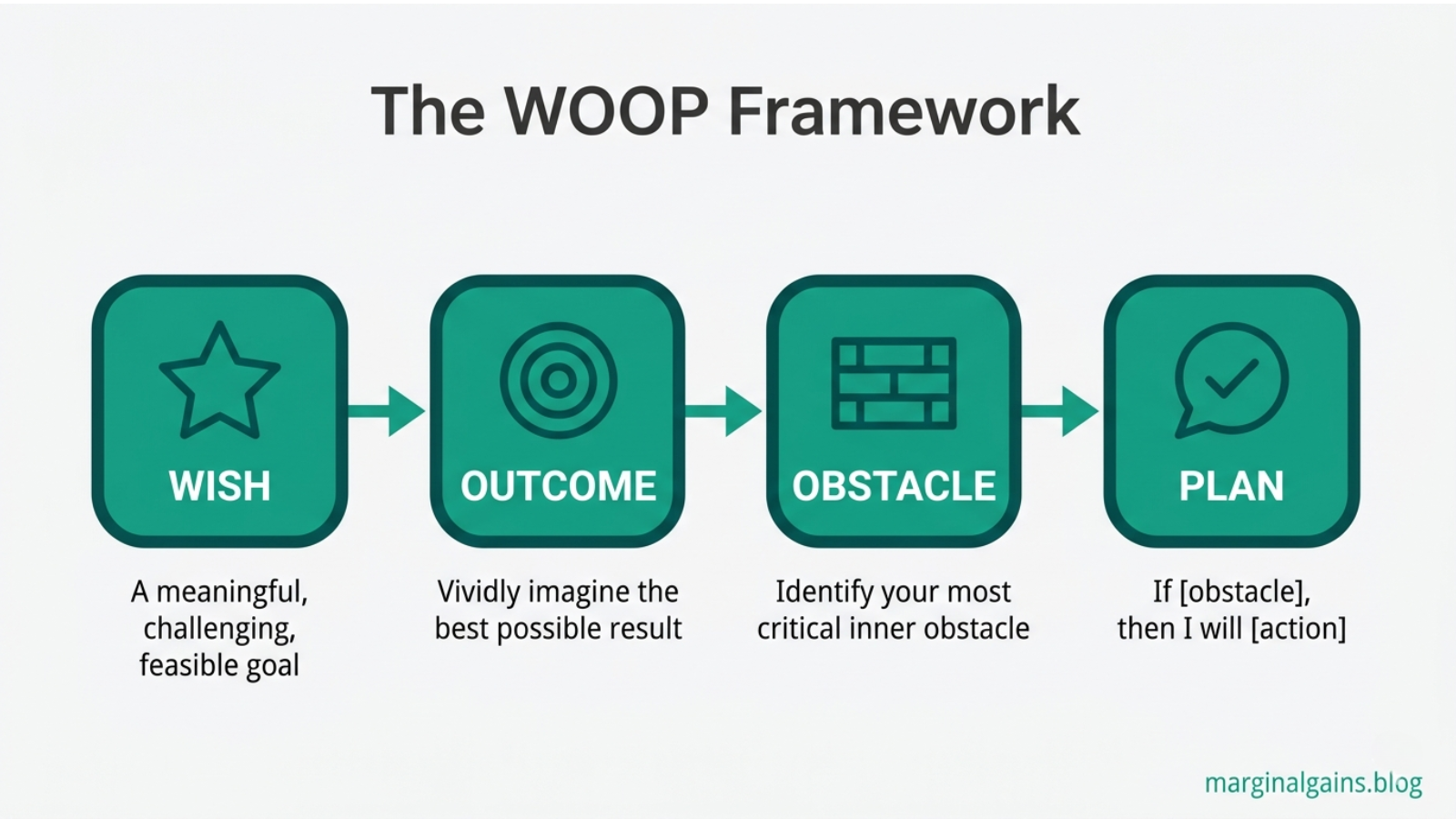
The core idea is this: to pursue a goal effectively, you need to do two things simultaneously. First, you need to feel motivated — which comes from vividly imagining what success will look and feel like. Second, you need to be prepared — which requires honestly identifying what is likely to get in your way, and deciding in advance how you will respond. WOOP structures both of these steps into a single, repeatable process that takes most people between five and fifteen minutes to complete.
As a Chartered Occupational Psychologist, I’ve worked with coaching clients across a wide range of settings, and often the challenge isn’t people not knowing what they want; it’s the gap between their intentions and their action. WOOP is one of the most evidence-based tools available for closing that gap.
The science: why positive thinking alone doesn’t work
Before exploring how WOOP works, it helps to understand what it’s designed to correct.
For decades, popular psychology and self-help culture have promoted the idea that visualising success is sufficient — that if you imagine your goal vividly enough, you’ll be drawn towards it. Oettingen spent years testing this assumption, and her findings are striking. In a series of studies published in leading psychology journals, she found that positive fantasising about future success consistently reduced motivation and follow-through, particularly for challenging goals.
Why? When you vividly picture achieving something, your brain does something unhelpful: it treats the imagined success as a partial taste of the real thing. That small hit of satisfaction quietly reduces the mental energy pushing you towards the goal. In short, your brain has already begun celebrating — and that takes the edge off your drive to actually do the work.
This doesn’t mean visualisation is useless. It means it needs a counterweight. Immediately after imagining success, WOOP asks you to confront the obstacles standing in your way — honestly and specifically. This contrast between the future you want and the reality blocking it keeps your motivation alive whilst anchoring you in the real world. Instead of drifting into daydreams, you stay purposeful. Oettingen calls this “energisation” — the fired-up, directed state that actually gets things done.
QUICK WIN:
Think of one goal you’ve set recently and not followed through on. Ask yourself honestly: did you spend more time imagining how good it would feel to achieve it than thinking about what would actually get in the way? If so, that imbalance is likely part of the reason it stalled. Keep that goal in mind as you read — by the end of this article you’ll have run a proper WOOP on it.
The four steps of WOOP explained
Step 1: Wish
Your wish is your goal — but not every wish is a good starting point for WOOP. Oettingen’s research specifies that the ideal wish has three qualities.
1. It should be meaningful to you personally (not just something you feel you ought to want).
2. It should be challenging — easy goals don’t need this kind of scaffolding).
3. It should be feasible — genuinely within your reach, even if it will require effort.
A wish that is too vague (“I want to be healthier”) won’t give WOOP enough to work with. A wish that is genuinely impossible (“I want to run a sub-two-hour marathon by next month, having never run before”) will produce unhelpful plans. The sweet spot is a goal that stretches you but is genuinely attainable within a realistic timeframe.
Good examples include: running a 5k in under 30 minutes within three months, finishing a first draft of a report by Friday, or consistently leaving work on time twice a week for a month.
Step 2: Outcome
The outcome step is where you visualise success — but with a specific quality that distinguishes it from fanciful positive thinking. You’re not just picturing the achievement itself; you’re imagining the best possible feeling or result that would come from achieving your wish. The more vivid and personally meaningful this visualisation, the better.
Oettingen’s instructions are deliberately sensory: close your eyes, and genuinely step into this imagined future. What can you see? What does it feel like? What has changed as a result of achieving this goal? This isn’t wishful indulgence — it’s engaging the part of your brain that decides whether a goal is worth working for.
Step 3: Obstacle
This is the step that most goal-setting systems miss — and it’s where WOOP earns most of its psychological power. Having just imagined success, you now ask: what is the most critical inner obstacle that could prevent you from achieving this?
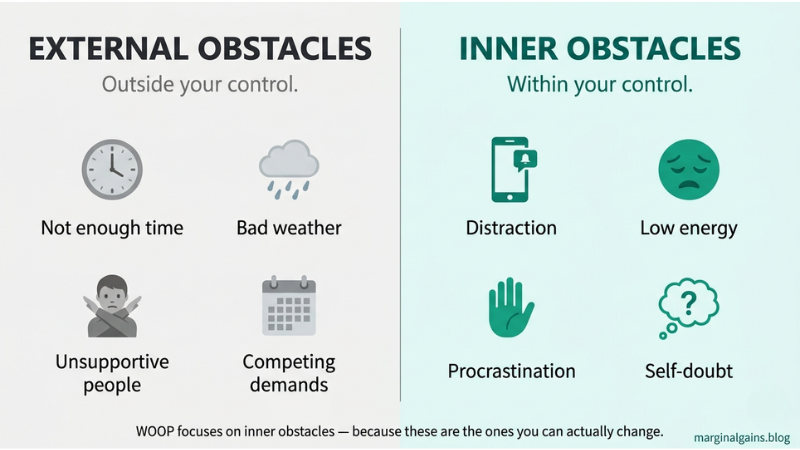
The emphasis on inner obstacles is deliberate and important. External obstacles (your boss is unsupportive, the gym is far away, you don’t have time) are real, but they are largely outside your direct control. Inner obstacles — habitual thoughts, emotional reactions, competing priorities, self-doubt, impulsive behaviour, self-limiting beliefs — are where WOOP focuses, because these are the things you can actually work with. These are the things that – if not thought through properly – are likely to cause you to sabotage your goal.
Be honest here. The obstacle should be something specific and genuine: “I get distracted by my phone when I sit down to write,” or “I feel too tired by 6pm to go to the gym,” or “I tend to say yes to last-minute requests that push my own work back.” Vague obstacles produce vague plans.
Step 4: Plan
The Plan step takes everything you’ve just identified and turns it into a single, specific commitment you make in advance. It uses a simple “if-then” format, developed by psychologist Peter Gollwitzer, whose research shows that deciding ahead of time exactly what you’ll do in a difficult moment makes you far more likely to actually do it.
The format is: “If [obstacle occurs], then I will [specific action].”
This is not a general intention. It’s a precise response to a precise situation you’ve already anticipated. “If I feel too tired to go to the gym after work, then I will put my gym kit on anyway and commit to just ten minutes” is the kind of plan that works. “If obstacles come up, I’ll deal with them” is not — it’s too vague to be useful when the moment actually arrives.
Being really specific here matters: you’re making the decision now, when you’re thinking clearly and feeling motivated, rather than leaving it to your future self — who may be tired, distracted, or looking for any reasonable excuse not to bother. When the obstacle appears, there’s nothing left to decide. You’ve already worked it out.
WOOP in practice: worked examples
Abstract explanations only go so far. Here are three complete WOOP examples across different areas of life to show how the framework works in practice.
Example 1: A health goal
Wish: Go for a 20-minute walk every morning before work for the next month.
Outcome: I’d feel calmer and more focused at the start of the day. I’d arrive at my desk having already done something for myself, which would give me a sense of control and momentum I rarely feel first thing.
Obstacle: When my alarm goes off, I lie there telling myself I’ll go later — and I never do.
Plan: If I’m lying in bed when my alarm goes off, then I will put my feet on the floor within five seconds and pick up my trainers before I’ve made any decision about going.
Example 2: A work goal
Wish: Complete the first draft of my project proposal before the end of this week.
Outcome: I’d feel the relief of having it done, and the clarity that comes from having my thinking on paper. It would free up my headspace for everything else I’ve been putting off because this is looming over me.
Obstacle: I open my email first thing and get pulled into responding to messages, so I never reach the proposal until the afternoon when my focus has gone.
Plan: If I sit down at my desk in the morning, then I will open the proposal document before I open my email, and write for at least 25 minutes before checking anything else.
Example 3: A relationship goal
Wish: Have one meaningful conversation with my partner each evening this week without my phone in hand.
Outcome: We’d feel more connected. I’d feel less like we’re just managing logistics and more like we’re actually in each other’s lives. That matters to me more than I usually acknowledge.
Obstacle: I pick my phone up automatically when I sit down after dinner — it’s a reflex, not a decision.
Plan: If I sit down after dinner, then I will put my phone face-down on the kitchen counter before I sit.
QUICK WIN:
Run a WOOP on one goal right now. Keep it small — something you’ve been meaning to do this week. Write down your Wish (one sentence), your best Outcome (two to three sentences, be specific about how it will feel), your most honest inner Obstacle (one sentence), and your if-then Plan (one sentence in the exact format: “If [obstacle], then I will [action]”). The whole thing should take under ten minutes. That’s a complete WOOP.
Implementation intentions: the hidden engine of WOOP
The Plan step draws on a strand of psychological research that doesn’t get nearly enough attention outside academic circles. If-then plans — known formally as “implementation intentions” — were developed and extensively studied by Peter Gollwitzer at New York University, and the evidence behind them is compelling.
In one large review of 94 studies involving more than 8,000 participants, Gollwitzer and colleague Paschal Sheeran found that people who formed if-then plans were significantly more likely to achieve their goals than those who didn’t — across health, education, diet, and more. By the standards of psychology research, the results were strong.
So why do they work so reliably? The reason is surprisingly simple. When you write an if-then plan, you create a direct mental connection between a specific trigger (the “if”) and a specific response (the “then”). That connection gets stored in memory in a way that makes the response feel almost automatic when the situation actually arises. You’re not making a decision in the moment — you’ve already made it. Your brain just executes it.
This matters because willpower is far less dependable than we’d like to believe. Most goals don’t fail because people stop caring. They fail because the critical moment arrives when someone is tired, stressed, or distracted — and they default to whatever is easiest. An if-then plan sidesteps this entirely. When the obstacle appears, the response is already there, ready to go.
The final piece is this: combining vivid outcome visualisation with if-then planning produces better results than either approach on its own. WOOP is simply the practical, accessible way of doing both together.
What the research actually shows
WOOP is one of the better-evidenced goal-setting interventions in the psychological literature. Oettingen and her colleagues have tested it across a remarkable range of contexts, and the results are consistently positive. A summary of some of the key findings gives a sense of how broadly it applies.
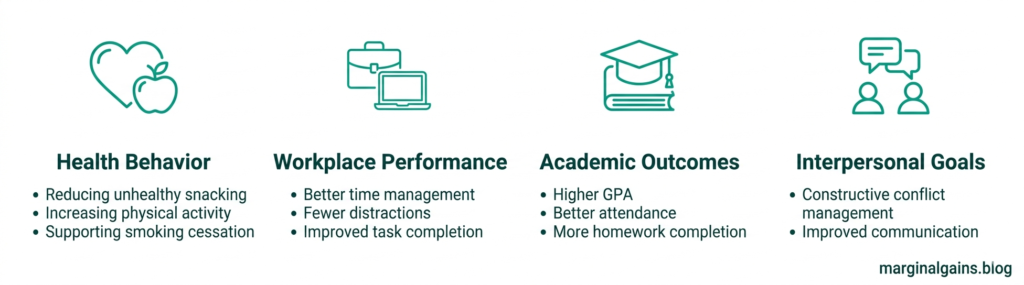
In a study of people trying to reduce unhealthy snacking, participants who used WOOP consumed significantly fewer unhealthy snacks over a two-week period compared to control groups. In research with school students, WOOP improved attendance, homework completion, and GPA. A study in the workplace showed that employees who used WOOP were more effective at time management and less likely to be distracted from important tasks.
Studies on physical health goals have shown WOOP to be effective for increasing physical activity in sedentary adults, improving exercise adherence in rehabilitation contexts, and supporting smoking cessation. Research on interpersonal goals found it helped people manage conflict in close relationships more constructively.
What’s notable across all of this research is that WOOP tends to produce modest but consistent improvements — this is not a technique that promises transformational overnight change, but rather one that reliably shifts the probability of follow-through in the right direction. That framing fits well with the marginal gains philosophy: a consistently applied, evidence-based technique that incrementally improves your hit rate over time.
It’s worth noting that WOOP is most effective for goals that are genuinely challenging but within reach. For goals that are either very easy or genuinely outside your control, the technique adds less value. And as with any psychological intervention, individual results vary — context, commitment to the process, and the quality of the obstacle and plan identification all matter.
WOOP vs SMART goals: which should you use?
SMART goals — Specific, Measurable, Achievable, Relevant, Time-bound — are the most widely taught goal-setting framework in professional and educational settings, and they’re not without value. SMART goals are effective at helping people clarify vague intentions into concrete targets. If someone’s goal is “I want to get fitter,” SMART provides a useful structure for turning that into “I will run 5km three times a week for the next eight weeks.”
WOOP does something different. It doesn’t help you specify a goal — it assumes you already have one. What it adds is the motivational and planning infrastructure to actually pursue it. WOOP addresses the follow-through problem that SMART goals leave largely unresolved.
The two approaches are therefore complementary rather than competing. SMART is useful at the goal-formation stage; WOOP is useful at the goal-pursuit stage. A sensible approach for any significant goal is to use SMART thinking to define it clearly, then run a WOOP to prepare yourself for pursuing it. In practice, WOOP is particularly valuable for goals where you’ve already experienced repeated failures to follow through — because those failures are usually symptomatic of an obstacle that’s never been properly named, and a plan that’s never been properly formed.
The GROW coaching model — which you may have encountered if you’ve worked with a coach — also complements WOOP well. GROW helps you explore a goal and understand your current situation, options, and will to act; WOOP provides the specific psychological tools to convert that intention into behaviour. You can read more about how the GROW coaching model works and how to apply it to self-coaching.
How to start using WOOP today
WOOP works best as a short, focused practice rather than a lengthy planning exercise. Oettingen recommends spending roughly five minutes on a single goal — enough to engage meaningfully with each step, but not so long that it becomes burdensome.
There are a few practical points worth knowing before you begin.
Work on one goal at a time. Attempting to WOOP several goals simultaneously dilutes the focus of each one. Start with a single goal — ideally one that matters to you and where previous attempts have faltered.
The obstacle must be internal. This is the most common mistake. If your obstacle is “I don’t have enough time” or “my manager doesn’t support me,” you’ve identified an external obstacle. These may be real, but WOOP is designed to work with inner obstacles — your own thoughts, emotions, habits, and impulses. Ask yourself: when this goal has stalled in the past, what was happening inside me?
Make the if-then plan specific. “If I feel unmotivated, I’ll push through” is not an implementation intention — it’s a vague aspiration. The plan needs a precise situational trigger (when exactly will the obstacle occur?) and a precise behavioural response (what exactly will you do?).
Revisit your WOOP regularly. A WOOP is not a one-time exercise. Goals evolve, obstacles shift, and plans need updating. Running a WOOP weekly on your current most important goal takes about five minutes and keeps your intention-action gap narrow. The free WOOP My Life app and website offer a simple digital tool for doing this regularly.
Use it alongside your broader goal-setting approach. If you’ve worked through the process of setting goals you’ll actually achieve, WOOP is the natural follow-on for whichever goals feel most challenging to follow through on. Equally, if you’ve identified your core values, use those as a filter when choosing which wishes to pursue — goals aligned with your values tend to produce richer, more motivating outcome visualisations.
QUICK WIN:
Set a five-minute reminder on your phone for the same time each morning this week. When it goes off, spend those five minutes running a WOOP on your most important goal for that day. One wish, one outcome, one obstacle, one if-then plan. Try this once a week, and this small habit will do more for your follow-through than any amount of planning done once and forgotten.
Frequently asked questions
How long does WOOP take?
Oettingen’s research suggests five to ten minutes per goal is sufficient. Longer isn’t necessarily better — the quality of your obstacle identification and if-then plan matters more than the time spent.
Can I use WOOP for long-term goals?
Yes, but it works best for goals with a clear and relatively near endpoint. For a long-term goal spanning months or years, consider breaking it into sub-goals and running a WOOP on each one as it becomes your current focus.
What if I can’t identify an inner obstacle?
This is usually a sign that you’re thinking about external obstacles instead. Ask yourself: in the past, when I’ve tried to pursue this kind of goal, what was happening in my own head or body that made it hard? Procrastination, avoidance, distraction, self-doubt, competing impulses — these are the kinds of inner obstacles WOOP is designed to work with.
Does WOOP work for everyone?
The research suggests WOOP is effective for most people and most types of goal, but it’s not a universal solution. It tends to be less effective for goals where the person has very low self-efficacy (where they genuinely don’t believe they can succeed) or where the goal is not genuinely motivating. If positive visualisation produces anxiety rather than motivation, or if the goal feels imposed rather than chosen, the technique may need to be adapted.
Is WOOP the same as the law of attraction?
No! The law of attraction suggests that positive thinking and visualisation alone will bring about desired outcomes. Oettingen’s research directly contradicts this: positive fantasising without obstacle-mapping tends to reduce motivation and follow-through. WOOP uses visualisation as one component of a process that explicitly includes confronting obstacles and forming concrete plans. The two approaches have almost nothing in common beyond the use of mental imagery.
WOOP is not a complicated technique, but it is a precise one. Its effectiveness comes from following the steps faithfully — particularly the obstacle step, which most people are tempted to rush or soften. The research is clear: the combination of vivid outcome visualisation and honest inner-obstacle mapping produces a psychological state that simple positive thinking does not. Pair that with a specific implementation intention, and you’ve built something genuinely more robust than most goal-setting systems offer.
The best way to test it is to use it. Pick one goal — something you’ve been meaning to do and haven’t — and run through the four steps today.
RESOURCES:
I only recommend resources that I either use personally or have researched and feel are genuinely helpful for my readers. Resources sometimes contain affiliate links; if you purchase through these, I may earn a small commission at no extra cost to you.
Recommended Reading
Rethinking Positive Thinking by Gabriele Oettingen — The definitive account of the WOOP research from the psychologist who developed it. Accessible and compelling. Paperback
Other Helpful Resources:
WOOP My Life — Gabriele Oettingen’s free app and website for practising WOOP, with guided exercises and a digital worksheet
Related Articles from the Marginal Gains blog:
How to Set Goals You’ll Actually Achieve — The complete goal-setting guide.
The GROW Coaching Model — A complementary framework to the WOOP model for structured self-coaching
How to Find Your Values — Use your values to choose goals worth WOOPing
I'm Simon Shaw, a Chartered Occupational Psychologist with over 20 years of experience in workplace psychology, learning and development, coaching, and teaching. I write about applying psychological research to everyday challenges - from habits and productivity to memory and mental performance. The articles on this blog draw from established research in psychology and behavioural science, taking a marginal gains approach to help you make small, evidence-based changes that compound over time, allowing you to make meaningful progress in the areas you care about most.