
How to Set Goals You’ll Actually Achieve

Most people know they should set goals. Fewer people actually do it well. And a striking number who do set goals — with genuine enthusiasm, on January the first or the back of a napkin or in a fresh new notebook — wake up six weeks later wondering what happened.
This isn’t a motivation problem. It isn’t a willpower problem either, despite what much of the self-help industry would have you believe. It’s a goal-setting problem. The way most of us learn to set goals — either intuitively or through the SMART framework we were taught at school or work — simply doesn’t account for the psychology of how people actually pursue and achieve things.
This guide covers what the research says about how to set goals effectively, why so many common approaches fall short, and how to set goals in a way that actually fits who you are — because the best goal-setting system in the world is useless if it’s the wrong system for your personality, values and circumstances.
Why Most Goals Fail — and It’s Not What You Think
The failure rate for goals is genuinely sobering. A study by Professor Richard Wiseman of the University of Hertfordshire, which tracked over 3,000 people throughout 2007, found that 88% failed to achieve their New Year’s resolution by the end of the year (along with some interesting differences in how men and women should set goals). Even people with strong intentions and clear plans often don’t follow through, and understanding why is the first step to doing better.
The most common reasons goals fail have nothing to do with character flaws or lack of discipline. They tend to come down to a handful of structural problems with how the goals were set in the first place.
The goal doesn’t belong to you. Goals driven by external pressure — what you think you should want, what your partner expects, what society defines as success — tend to run out of fuel surprisingly quickly. Decades of psychology research consistently shows that goals you pursue because they genuinely matter to you produce far more sustained effort than goals you’re working towards to please someone else or meet an external standard.
The goal is too vague. “Get fitter”, “be more productive”, “improve my relationship” — these feel like goals but they aren’t. They’re directions. Without being specific, you have no clear target to aim for, no way to measure progress, and no moment at which you can say “I’ve done it.” Your brain doesn’t know what to do with vague intentions, and so it defaults to doing nothing.
The goal ignores the gap between wanting and doing. There’s a well-documented psychological gap between intending to do something and actually doing it — what psychologists call the “intention-behaviour gap”. Knowing how to set goals is not the same as knowing how to pursue them. You need a plan for execution, not just a statement of intent.
The goal doesn’t account for who you are. Generic goal-setting advice treats everyone as the same. But personality, strengths, values and lifestyle all influence which goals are realistic for you and which strategies will actually work. Someone who thrives on structure needs a different approach to someone who finds rigid systems suffocating.
What the Research Actually Says About How to Set Goals
Goal-setting has been one of the most thoroughly researched areas of applied psychology for over five decades. The starting point for most of this work is Goal Setting Theory, developed by psychologists Edwin Locke and Gary Latham, which drew on decades of studies to produce a set of practical, evidence-backed principles. But the research goes well beyond their work — findings from motivation psychology, positive psychology, and behavioural science all add important pieces to the picture. Here are the conclusions that matter most in practice, and some of them are genuinely counterintuitive.
1. Specific, challenging goals outperform vague, easy ones
This is probably the most robust finding in the entire goal-setting literature. Locke and Latham’s research showed that specific, difficult goals consistently led to higher performance than easy goals or vague “do your best” instructions — across hundreds of studies, in laboratory and real-world settings, with a wide range of tasks and populations.
Specific goals direct attention to what’s relevant and away from what isn’t. They mobilise effort in proportion to the difficulty of the task. They promote persistence in the face of obstacles. And they lead to more strategic thinking about how to achieve the outcome. A vague goal activates none of these mechanisms reliably.
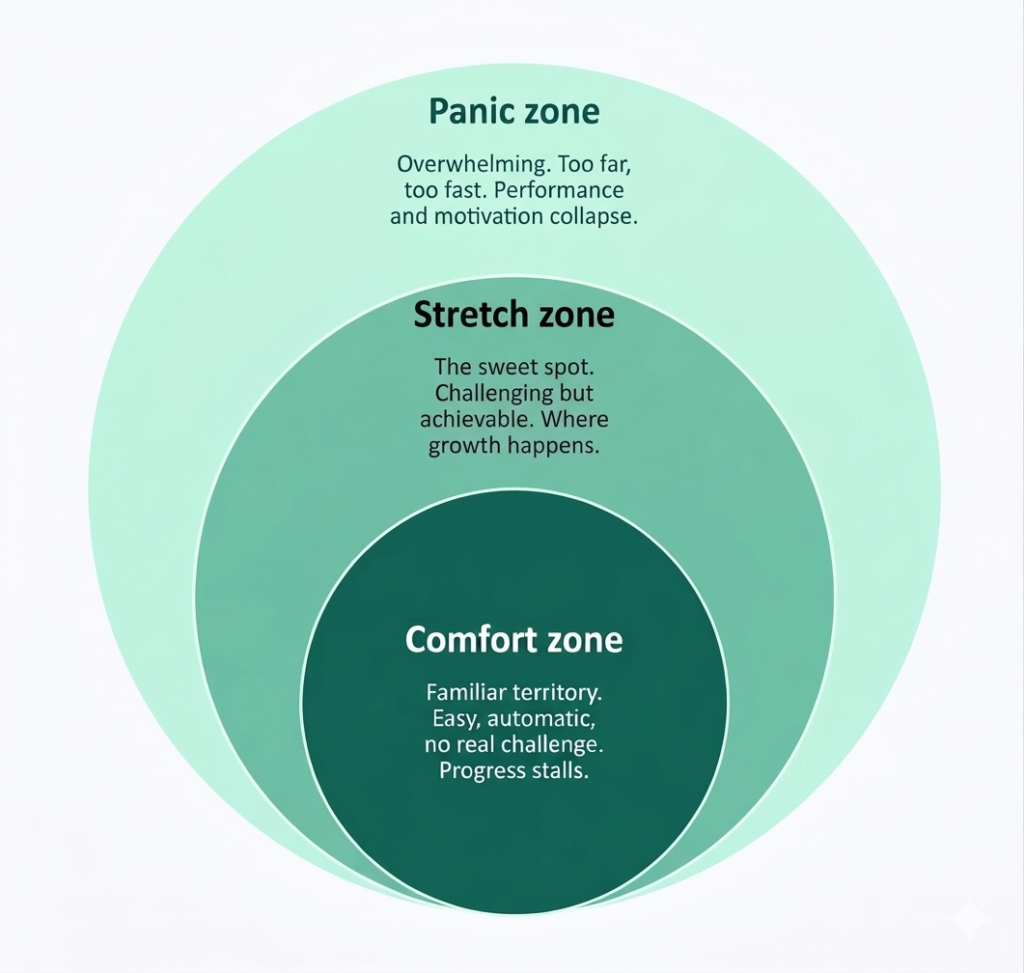
“Difficult” in this context doesn’t mean impossible — it means genuinely stretching. Goals that are too hard produce panic. Goals that are too easy produce complacency. Goals that are genuinely challenging but achievable produce the kind of focused effort that leads to real progress. The sweet spot is ambitious but realistic — hard enough to get out of your comfort zone, but not so hard that you enter the panic zone.
2. Goals work better when they connect to your values
A goal that aligns with what you genuinely care about is not just more motivating — it’s more likely to survive the inevitable obstacles and setbacks that come with any meaningful pursuit. Research from positive psychology consistently shows that goals congruent with personal values contribute to wellbeing and life satisfaction, while goals that conflict with values tend to generate internal resistance even when you’re nominally committed to them.
This is why identifying your core values before setting goals is such a powerful exercise, and why so many people find that the goals they’ve been working towards don’t actually make them happy when they achieve them. If you haven’t thought carefully about what you genuinely value — not what you think you should value — your goals may be pointing you in the wrong direction entirely.
3. Approach goals outperform avoidance goals
Psychologists distinguish between approach goals (moving towards something desirable) and avoidance goals (moving away from something undesirable). “Run three times a week” is an approach goal. “Stop being so sedentary” is an avoidance goal. They may seem equivalent, but research consistently shows that approach goals produce better outcomes — more positive emotions, greater persistence, and higher rates of success.
Avoidance goals keep your focus on the thing you don’t want, which makes you notice what you don’t have or can’t do. Approach goals, by contrast, create a positive target and orient your attention towards what you do want. Whenever you’re tempted to frame a goal as something you want to stop or avoid, it’s worth asking whether you can restate it as something you’re moving towards instead.
4. Writing goals down significantly increases follow-through
A study by psychology professor Dr Gail Matthews found that people who wrote down their goals and shared their progress with a friend achieved significantly more than those who simply thought about them — 76 percent success versus 43 percent. Writing forces you to be really specific, creates a record you can return to, and makes the goal real in a way that mental notes rarely achieve.
QUICK WIN:
Right now, pick one goal you’ve been thinking about but haven’t written down. Write it in a single, specific sentence — not “get healthier” but “run for 20 minutes three times a week by the end of next month.” Just writing it down puts you significantly ahead of where you were a minute ago.
SMART Goals: Useful but Not Enough
If you’ve ever been through any kind of performance management process, you’ve almost certainly encountered SMART goals — Specific, Measurable, Achievable, Relevant, Time-bound. It’s a genuinely useful framework, and the specificity principle it promotes is well-supported by the research described above.
The problem is that SMART was originally designed to help managers write business objectives for quarterly reports. It was never intended as a comprehensive framework for personal goal achievement, and it shows. SMART goals address the structure of a goal — how it’s worded and scoped — but say very little about the psychology that drives (or undermines) the pursuit of it.
Specifically, SMART doesn’t ask whether the goal actually matters to you. It doesn’t address motivation or values. It doesn’t help you think about the obstacles you’re likely to face, or how your personality and circumstances will shape your approach. A perfectly formed SMART goal can still be exactly the wrong goal for the person setting it.
Used as a starting point for making a goal concrete and time-bound, SMART is fine. Used as the whole answer to how to set goals effectively, it falls short.
How to Set Goals That Actually Work: Going Beyond SMART
Building on the research, here is what a more complete approach to how to set goals looks like — one that addresses not just the structure of a goal but the psychology behind pursuing it.
1. Start with your values, not your goals
Before deciding what to pursue, it’s worth getting clear on what you actually care about. Your core values are the principles that give your life meaning — the things that, when you’re living in accordance with them, make you feel like you’re on the right track. Goals that align with your values are self-sustaining in a way that externally driven goals never are.
A useful exercise is to write down five to ten things that matter most to you — not roles or achievements, but underlying qualities. Things like freedom, connection, learning, contribution, health, creativity, security. Then look at the goals you’re considering and ask: which of my values does this goal express? If the answer is “none that I can identify,” that’s worth taking seriously before you invest significant time and energy into it.
If you want to explore this more thoroughly, identifying your core values is one of the most high-leverage things you can do before setting any significant goal.
2. Make your goal specific and personally meaningful
Apply the ‘specificity principle’ — the goal needs to be precise enough that you know exactly what you’re aiming for and when you’ve achieved it. But combine this with personal meaning. A goal should feel like it’s truly yours, not a generic version of something everyone is supposed to want.
“Get fit” becomes “run a 5K in under 30 minutes by June, so that I feel physically capable again and set a good example for my kids.” The second version is specific, time-bound, and carries a personal reason that will sustain motivation when the initial enthusiasm fades.
3. Distinguish between outcome goals and process goals
An outcome goal is the result you want — lose 10 kilograms, get a promotion, finish writing a novel. A process goal is the behaviour that produces the result — eat 500 fewer calories per day, complete three development conversations with my manager this quarter, write 500 words every morning.
Outcome goals give you direction and meaning. Process goals give you something to actually do on a Tuesday morning. Both are necessary, and one of the most common goal-setting mistakes is stopping at the outcome without specifying the process that will deliver it. Focus too narrowly on outcomes and you can become paralysed or demoralised when external factors interfere with your progress. Focus entirely on process and you may lose sight of why you’re doing it.
The most effective goal-setters tend to hold both simultaneously — a clear outcome you’re working towards, and specific behaviours they commit to regardless of short-term results.
4. Set goals that fit your personality
This is where most goal-setting advice fails entirely, and it’s where occupational psychology has something genuinely useful to contribute. Personality traits, particularly those captured by the Big Five model of personality – Extraversion, Openness, Agreeableness, Conscientiousness and Neuroticism (that’s anxiety to you and me) — reliably predict how people pursue goals, what kinds of goals suit them, and which strategies are likely to work.
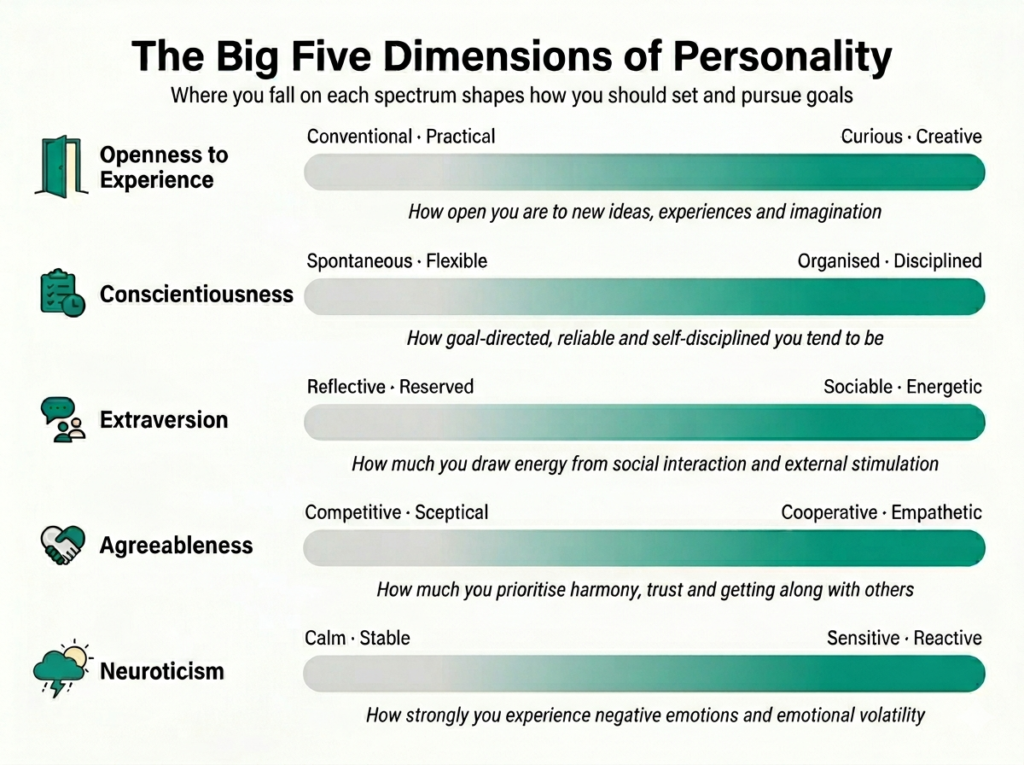
Someone high in conscientiousness tends to thrive with structured plans, detailed milestones, and tracking systems. Someone lower in conscientiousness often finds that kind of structure suffocating and performs better with flexible, values-led goals and minimal administration. Someone high in openness to experience is typically energised by ambitious, novel goals — but may need accountability structures to see things through. Someone high in neuroticism benefits from smaller, achievable milestones that build confidence progressively rather than a single large target that can feel overwhelming.
The implication is that when a goal-setting approach isn’t working for you, it’s often not that you’re failing — it’s that the approach doesn’t match how you’re wired. Adjusting the strategy to fit your personality is far more effective than trying to override your personality to fit the strategy.
5. Anticipate obstacles — don’t just visualise success
There’s a well-established body of research showing that pure positive visualisation — imagining your goal achieved without also thinking about the obstacles — can actually reduce motivation and follow-through. The brain interprets the vividly imagined success as something already partly accomplished, which dampens the drive to actually do the work.
One of the most evidence-based techniques for bridging the gap between setting goals and actually achieving them is WOOP (Wish, Outcome, Obstacle, Plan). Unlike traditional goal-setting frameworks that focus only on defining what you want, WOOP helps you anticipate the internal obstacles that typically derail progress and create specific if-then plans to overcome them. Learn more about how WOOP goal setting works.
A practical implementation of this is implementation intentions — “if-then” planning. “If I feel too tired to go to the gym after work, then I will go before work instead.” “If I miss a day of writing, then I will make it up the following morning rather than abandoning the goal.” Pre-deciding how you’ll handle predictable obstacles dramatically increases follow-through.
A Practical Step-by-Step Process for Setting Goals That Stick
Bringing all of the above together, here is a practical process you can follow whenever you’re setting a significant goal.
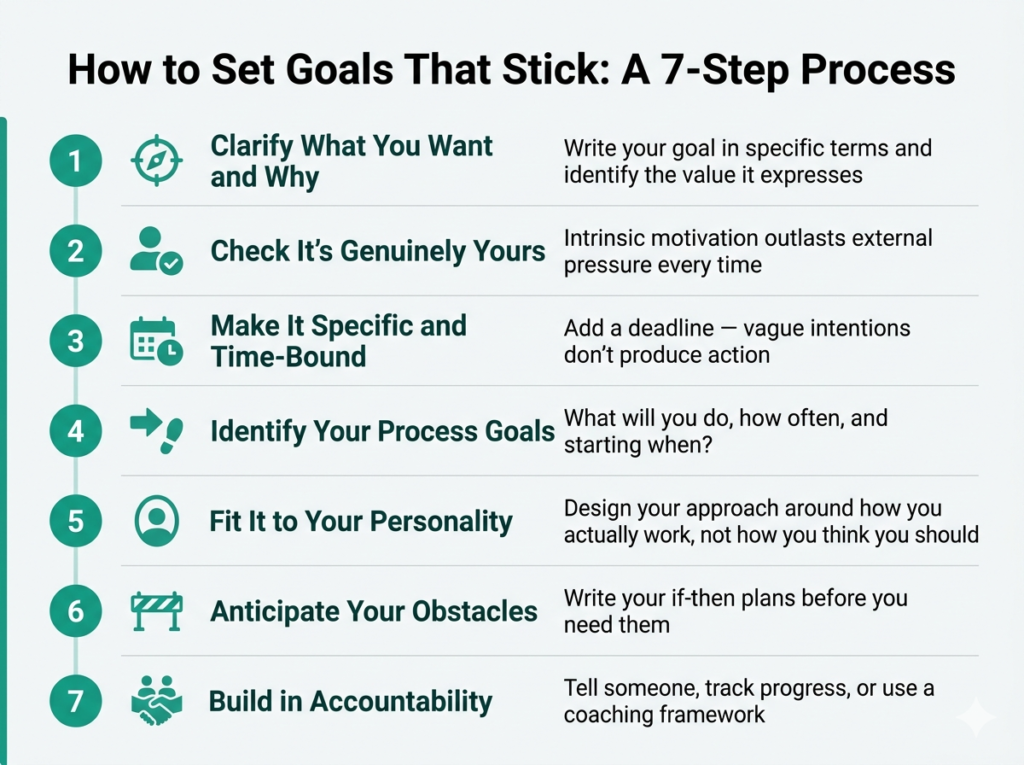
Step 1: Clarify what you want and why
Start with the outcome you’re aiming for. Write it down in specific, concrete terms. Then ask: why does this matter to me? What value does it express? What will be different about my life if I achieve it? If you can’t answer these questions convincingly, you’ll need to revisit your goal and amend it until you’re crystal clear about what you want and why.
Step 2: Check the goal is genuinely yours
Ask yourself honestly: am I pursuing this because I want to, or because I feel I should? Goals driven by external pressure aren’t automatically wrong — sometimes external expectations line up well with what you really want — but they deserve scrutiny. Pursuing a goal because you’re genuinely excited about achieving it is more reliable than setting a goal to please someone else or avoid a negative judgement.
QUICK WIN:
If you’re unsure whether a goal is genuinely yours, you can uncover your deepest motivation for setting it by grabbing a pad of paper and writing down this question: “If I achieve [my goal], what would that get for me?” Then take your answer and ask the question again: “If I get [your last response], what would that get for me?” and write down your response again. Repeat this several more times until you start to notice the same answer repeating. This is your true motivation for wanting the goal.
Step 3: Make it specific and time-bound
Apply the SMART principle of specificity and add a deadline. Vague intentions don’t produce action. “I want to save more money” becomes “I want to have £5,000 in savings by December 31st.” The deadline creates urgency and makes it possible to work backwards to the actions needed (which will become your process goals – the mini stepping stone goals you’ll take to achieve your bigger outcome goal).
Step 4: Identify the process goals
For every outcome goal, identify the specific behaviours that will produce it. What do you need to do, how often, and starting when? These are your process goals — the daily or weekly actions that, if followed consistently, make the outcome almost inevitable. Be realistic about what you can actually sustain given your current commitments and lifestyle.
Step 5: Think about your personality and what’s worked before
Consider: what approaches have actually worked for you in the past when you’ve made sustained progress on something difficult? What tended to derail you? Use this self-knowledge to design your approach. Don’t adopt a tracking system because someone else swears by it — adopt it if tracking suits how you work. If it doesn’t, find something that does.
Step 6: Anticipate obstacles
Identify the two or three most likely obstacles to this goal and decide in advance how you’ll handle them. Write down your “if-then” plans – for example, “if bad weather means I can’t run, then I’ll do bodyweight exercises at home”. This isn’t pessimism — it’s preparation, and the research is clear that it significantly improves success rates.
Step 7: Build in accountability
Decide how you’ll track progress and who, if anyone, will know about your commitments. Even sharing your goal with one trusted person and agreeing to check in periodically can make a significant difference. If a formal accountability structure feels right, consider whether a framework like the GROW coaching model might help you review progress and problem-solve when you get stuck.
QUICK WIN:
Take your written goal from the first Quick Win and apply steps 4 and 6 right now. Write down one specific behaviour you’ll do this week to move towards it, and one obstacle that might prevent you. Decide now how you’ll handle that obstacle if it arises. You’ve just done more to move towards your goal than most people do.
Tracking Progress and Reviewing Your Goals
Setting a goal is the beginning, not the end. What happens in the weeks and months that follow — how you track progress, respond to setbacks, and adjust your approach — determines whether the goal gets achieved or quietly abandoned.
Review regularly, not obsessively
Build a regular review rhythm into your goal-pursuit — weekly for process goals (am I doing what I committed to doing?), monthly for outcome goals (am I making the progress I expected?). Regular review serves two purposes: it catches problems early when they’re still manageable, and it provides the kind of feedback that the research shows maintains motivation.
If you’re not making expected progress, the right response is curiosity, not self-criticism. What’s getting in the way? Is the obstacle something you can address? Does the goal need to be adjusted? Self-compassion and strategic problem-solving are far more useful responses to setbacks than guilt, and the evidence consistently supports this. Harsh self-criticism following a setback tends to produce disengagement from the goal, not renewed effort.
Adjust goals when circumstances change
Goals set at the start of the year may not still be the right goals six months later. Life changes — circumstances shift, priorities evolve, new information emerges. Revising a goal in light of changed circumstances isn’t failure; it’s rational. The problems arise when people abandon goals at the first sign of difficulty (often before they’ve given the approach a fair chance) or, at the other extreme, rigidly pursue goals that no longer make sense for their life.
Celebrate progress, not just outcomes
Recognising progress along the way — not just at the final destination — is important for sustaining motivation over longer time horizons. Dopamine, the brain’s reward signal, is released not only when goals are achieved but when progress is perceived. Actively noticing and acknowledging what you’ve done, not just what remains, keeps the motivational system engaged.
The Role of Identity in Goal Setting
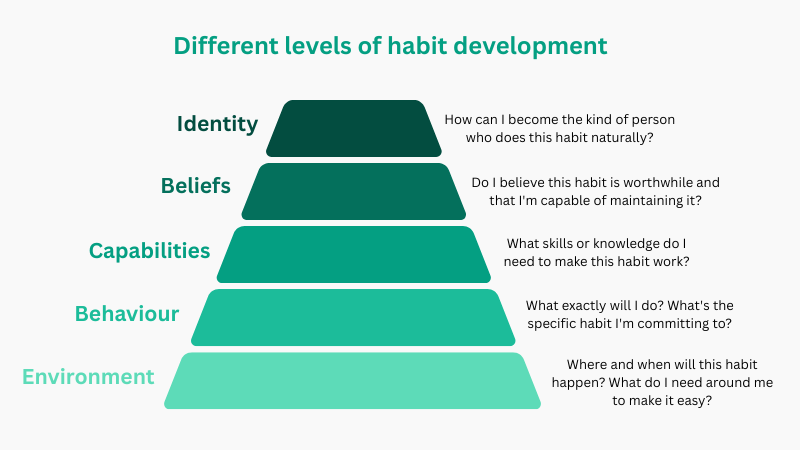
One of the most powerful insights from recent goal-setting research is the role of identity. Goals that align with how you see yourself — or how you want to see yourself — are far more durable than goals that sit outside your sense of who you are, which are likely to cause you to sabotage your goal.
The shift from “I’m trying to run” to “I’m a runner” sounds trivial but isn’t. Identity-based goals create a fundamentally different relationship with the behaviours needed to achieve them. Rather than the goal being an external commitment you’re working to fulfil, it becomes an expression of who you are — which makes the associated behaviours feel natural rather than effortful.
This doesn’t mean you can simply decide to see yourself differently and have it stick. Identity changes gradually, through the accumulation of consistent behaviour. But it does mean that as you pursue a goal, consciously reinforcing the identity it expresses — “I’m someone who prioritises my health”, “I’m someone who takes my career seriously” — tends to accelerate the process. The psychology of habit formation covers this connection between identity and behaviour in more depth.
Common Goal-Setting Mistakes to Avoid
Even with the best intentions and the right framework, there are predictable traps that catch most people at some point.
Setting too many goals at once. There’s a common assumption that more goals means more progress. The evidence suggests the opposite. Cognitive resources for self-regulation are finite, and dividing them across too many simultaneous goals tends to reduce performance on all of them. Focusing on one or two significant goals at a time, and completing or embedding them before adding more, tends to produce better results than pursuing five or six in parallel.
Focusing entirely on the destination. Outcome goals are motivating, but if your satisfaction depends entirely on reaching the final destination, you’ll spend most of your time in a state of frustration, because most of the journey is not-yet-there. Learning to value the process — the daily practice, the incremental improvement, the person you’re becoming — makes the whole pursuit more sustainable.
Treating early failure as evidence the goal is unachievable. A missed day, a bad week, a temporary reversal — these are normal features of any meaningful goal pursuit. What distinguishes people who achieve long-term goals from those who don’t is often not that the successful ones didn’t stumble, but that they got back on track faster when they did. The story you tell yourself about what early failure means can either support recovery or undermine it completely. Our article on challenging self-limiting beliefs explores this further.
Confusing busyness with progress. Activity and progress aren’t the same thing. It’s possible to be very busy on tasks that feel related to your goal without actually moving towards it. Regular honest review of whether your actions are producing the outcomes you intended is the antidote to this.
Waiting for motivation before taking action. Motivation is often thought of as a prerequisite for action — you need to feel motivated before you start. The research suggests it usually works the other way around. Action tends to generate motivation, not follow it. Starting small, even when enthusiasm is low, tends to produce the momentum that makes continued effort feel easier.
A Note on Goals, Wellbeing and the Bigger Picture
As a Chartered Occupational Psychologist, I’ve worked with enough people pursuing enough different goals to notice something that the research also supports: achieving goals doesn’t automatically produce wellbeing. People who reach significant goals and find themselves not much happier are doing something psychologically interesting — they’ve been pursuing the wrong goals, or pursuing goals in the wrong way, or measuring their progress against a moving target that shifts further away with every step forward.
The research from positive psychology suggests that the goals most associated with wellbeing tend to be:
- intrinsically motivated (i.e. are pleasurable in themselves rather than what they get for you)
- aligned with your unique personal values
- oriented towards growth and connection with others (rather than status and acquisition)
- pursued because you enjoy the process rather than purely as a means to an end.
This doesn’t mean ambition is a problem. It means that the question “what do I want?” is worth complementing with “what kind of person do I want to become in the process of pursuing it?”
Goals, at their best, are not just a mechanism for getting things done. They’re how we take an active role in shaping who we become. Used well, they create direction, generate meaning, and produce the kind of consistent effort that turns potential into reality. Used poorly — as external obligations, as performance targets for someone else’s scorecard — they can be a source of chronic dissatisfaction and a significant drain on energy and self-esteem.
The difference, almost always, comes down to how they were set in the first place.
RESOURCES:
I only recommend resources that I either use personally or have researched and feel are genuinely helpful for my readers. Resources sometimes contain affiliate links; if you purchase through these, I may earn a small commission at no extra cost to you.
Recommended Reading
The Happiness Advantage by Shawn Achor — Explores the research showing that positive states fuel performance, with practical application to how goals connect to wellbeing and motivation. Paperback
Creating Your Best Life by Caroline Adams Miller — One of the most thorough applications of positive psychology research to goal setting, written by a practitioner with deep knowledge of the evidence base. Paperback
Other Helpful Resources:
VIA Character Strengths Survey — Free, well-validated assessment of your personal strengths. Useful for setting goals that play to what you’re naturally good at.
Related reading on Marginal Gains:
The GROW Coaching Model — A practical framework for coaching yourself through any goal or challenge, step by step.
Habit Formation: The Complete Guide — Turning the process goals you set into automatic behaviour through the science of habit.
12 Reasons Habits Fail — Understanding the obstacles that undermine the goals you set.
How to Stop Overthinking — Clearing the mental clutter that gets in the way of clear goal-setting.
How to Maintain Mental Energy — Protecting the cognitive resources you need to pursue goals consistently.
I'm Simon Shaw, a Chartered Occupational Psychologist with over 20 years of experience in workplace psychology, learning and development, coaching, and teaching. I write about applying psychological research to everyday challenges - from habits and productivity to memory and mental performance. The articles on this blog draw from established research in psychology and behavioural science, taking a marginal gains approach to help you make small, evidence-based changes that compound over time, allowing you to make meaningful progress in the areas you care about most.