Why Habits Fail: 12 Common Mistakes and How to Avoid Them

Understanding why habits fail is the first step towards building ones that actually stick. Most habits fail within the first month — research on New Year’s resolutions suggests around 80% have been abandoned by February. Gym memberships purchased in January go unused by March. Meditation apps downloaded with enthusiasm gather digital dust.
After twenty years working with people on behaviour change, the reasons habits tend to fail are remarkably consistent. It isn’t because people lack discipline or willpower, though that’s the story many tell themselves. Habits fail for specific, identifiable reasons. Understanding these patterns can shift you from repeatedly failing at the same attempts to building habits that last.
1. Starting Too Big
The most common mistake is also the most obvious: people try to change too much too quickly.
You decide you’re going to exercise for an hour every morning, meditate for twenty minutes, journal three pages, read for thirty minutes, and prepare a healthy breakfast. This comprehensive routine will transform your life, you’re certain. It lasts four days before collapsing under its own weight.
The problem isn’t that these are bad activities. The problem is that you’re trying to establish five or six new habits simultaneously, each requiring time, energy, and mental bandwidth you don’t have unlimited supplies of. Our guide to using the GROW model helps you set effective goals and ensure these are achievable in the context of real life.
Why Size Matters
Habit formation requires repetition to become automatic. The behaviour needs to be simple enough and easy enough that you can execute it consistently even when motivation is low, energy is limited, or circumstances aren’t ideal.
When you start with an hour-long exercise routine, you need high motivation every single day to follow through. High motivation is inherently unstable — some days you have it, many days you don’t. The habit becomes dependent on a resource (motivation) that isn’t reliably available.
When you start with five minutes of movement, you can do it even on days when you feel terrible. The behaviour is small enough that motivation barely matters. This consistency is what allows the neural pathways to form that make the behaviour eventually automatic.
The Solution
Use the two-minute rule: start with a version of the habit that takes two minutes or less. This feels embarrassingly small, which is exactly right. You’re not trying to achieve impressive results immediately; you’re trying to establish a pattern that can grow over time.
Two minutes of exercise every day beats hour-long sessions twice per week for habit formation. Once the two-minute version is genuinely automatic (you do it without thinking), you can gradually expand it. But if you skip the foundation phase, you end up repeatedly starting and stopping rather than building.
QUICK WIN:
Take one habit you’ve been trying to build and shrink it until it feels almost ridiculous. “Go to the gym” becomes “put on gym clothes.” “Meditate for 20 minutes” becomes “sit quietly for two minutes.” Write your shrunken version down and start it tomorrow.
2. Vague Intentions
Another key reason why habits fail is that people set vague aspirations rather than specific behaviours. “Exercise more” or “eat healthier” or “be more productive” are not habits — they’re intentions. Without specific behavioural definitions, you can’t execute consistently, which means you can’t form a habit.
The research on implementation intentions shows that vague goals (“I want to exercise more”) produce significantly worse outcomes than specific plans (“I will run for ten minutes at 7am on Monday, Wednesday, and Friday before showering”).
Why Being Specific Matters
Your brain can’t automate vague concepts. It can automate specific sequences of behaviour in specific contexts. When you decide to “exercise more”, your brain has no clear cue for when to start exercising or what exercise means. Every instance requires a fresh decision, which requires willpower, which depletes.
When you decide “I run for ten minutes at 7am before showering”, your brain can link the behaviour to a specific time and context. After enough repetitions, 7am becomes a cue that automatically triggers thoughts of running. You stop deciding whether to exercise and start just doing it because that’s what happens at 7am.
The Solution
Define your habit using this format: “I will [BEHAVIOUR] at [TIME] in [LOCATION].” Make it specific enough that someone else could watch you and verify whether you did it.
“Meditate more” becomes “I will sit on my meditation cushion for five minutes at 6:30am in my bedroom.” “Eat healthier” becomes “I will eat a piece of fruit with breakfast every day.” “Be more productive” becomes “I will spend the first hour of my workday (9–10am) on my most important project with my phone in another room.”
The more specific, the more automatable. The more automatable, the less it requires ongoing willpower. You can also get specific about what will get in the way of your new habit. This is where WOOP goal setting excels—it forces you to confront obstacles before they derail you and create specific if-then plans for handling them.
3. Poor Environment Design
People try to establish habits using only willpower whilst leaving their environment unchanged. The environment wins — and this is one of the most overlooked reasons why habits fail repeatedly.
You decide to eat more healthily, but your kitchen is full of biscuits and crisps. You rely on willpower to resist them every single time you’re hungry. Eventually, willpower fails (it always does), and the habit collapses.
Or you decide to read more, but your phone is next to your bed and the book is in another room. You intend to read before sleep, but reaching for your phone requires less effort than getting up to fetch the book. Over time, the path of least resistance (phone) wins over the path requiring effort (book).
Why Environment Dominates
Your environment shapes behaviour far more powerfully than your intentions. When the environment makes the desired behaviour easy and the undesired behaviour difficult, you don’t need willpower. When the environment makes the undesired behaviour easy and the desired behaviour difficult, willpower rarely suffices.
Research shows that designing your environment to support your habits produces larger and more sustained behaviour change than using willpower alone.
The Solution
Design your environment to make the desired behaviour the path of least resistance. Put running shoes by your bed if you want to exercise in the morning. Remove biscuits from your house if you want to stop eating them. Put your phone in a drawer if you want to reduce screen time. Put a book on your pillow if you want to read before sleep.
The environment should do the work of reminding and enabling the behaviour. Your willpower should be backup, not the primary mechanism.
4. Unrealistic Expectations
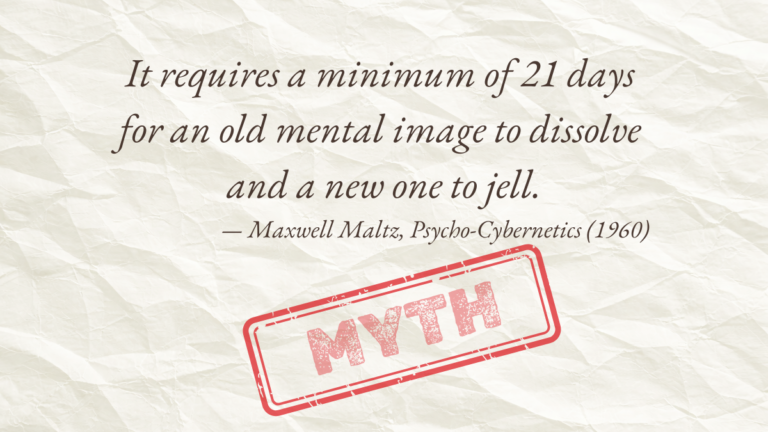
The myth that habits form in 21 days has done enormous damage to people’s habit-building efforts, and is one of the most insidious reasons why habits fail. People try a new habit for three weeks, it still requires effort, they conclude they’ve failed and abandon it.
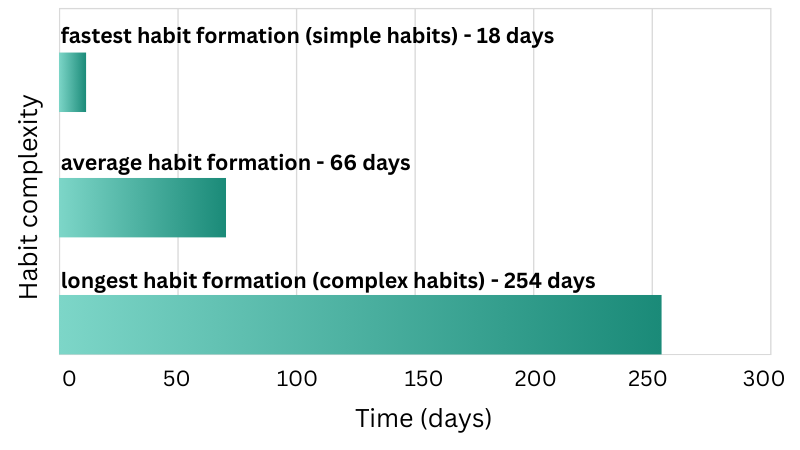
The actual research tells a very different story. A study by Phillippa Lally and colleagues at University College London found that habit formation takes an average of 66 days, with a range from 18 to 254 days depending on the complexity of the behaviour and individual variation. Simple habits (drinking a glass of water after breakfast) form faster. Complex habits (running for thirty minutes every morning) take longer.
Why Timeline Matters
When you expect a habit to be automatic after three weeks and it isn’t, you interpret this as personal failure rather than normal timescale. This misinterpretation often leads to abandonment right before the habit would actually begin to feel easier.
The research shows that consistency matters far more than timeline. Missing a day here and there doesn’t significantly impact habit formation if you resume the next day. But giving up because you think three weeks should have been enough destroys all the progress you’ve made.
The Solution
Plan for at least two months of consistent repetition before expecting automaticity. Track your habit not to measure perfection but to maintain awareness and identify when you’re making progress even if it doesn’t feel automatic yet.
Accept that some discomfort and effort are normal even weeks into a new habit. The goal isn’t for the behaviour to become effortless immediately; it’s for it to gradually require less conscious decision-making over time.
Read our detailed examination of how long habits actually take to form to set realistic expectations from the start.
5. No Clear Cue
Habits need triggers. Without a clear cue that signals it’s time to perform the behaviour, you’re relying on remembering to do it, which is inherently unreliable — and another reason why habits fail so often despite genuine commitment.
People decide they’ll meditate daily but don’t link it to a specific time or preceding behaviour. Some days they remember, some days they forget. Without consistency of timing, the neural pathways that create automaticity never form.
Why Cues Matter
Understanding the habit loop reveals why cues are essential. The sequence is: cue → routine → reward. Without a consistent cue, your brain never learns to automatically trigger the routine.
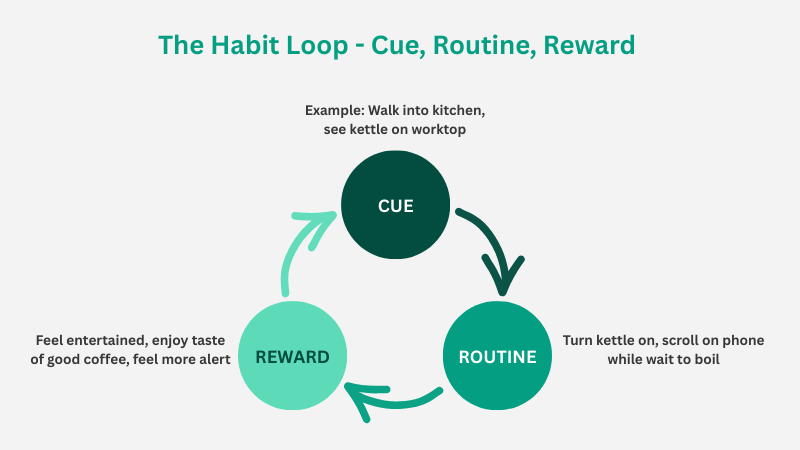
The most reliable cues are either times (“every day at 7am”) or existing habits (“right after I make coffee”). These create consistency that allows the cue-behaviour link to strengthen with each repetition.
The Solution
Attach your new habit to a specific time or to an existing habit. Time-based cues work well for behaviours that can happen at a consistent time each day. Habit-based cues (also called habit stacking) work well for behaviours that can attach to your existing routine.
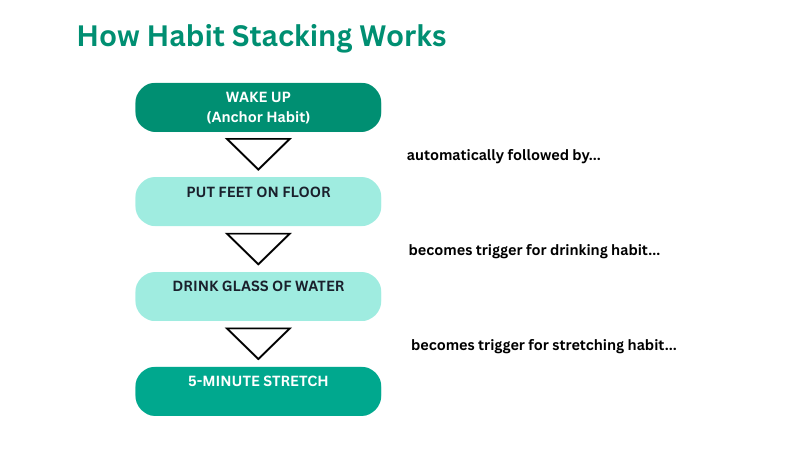
Some examples:
“After my feet touch the carpet in the morning, I will spend pour a glass of water. When I put my glass on the counter, I will do 5 minutes of stretching.”
“Every evening at 9pm, I will prepare tomorrow’s clothes.”
“Right after I brush my teeth before bed, I will write three things I’m grateful for.”
The cue shouldn’t be something that might or might not happen. It should be inevitable and consistent.
QUICK WIN:
For the habit you want to build, identify one thing you already do every day without fail — make coffee, brush your teeth, sit at your desk. Now write: “After I [existing habit], I will [new habit for two minutes].” Pin this somewhere visible. You’ve just given your brain the consistent cue it needs.
6. No Immediate Reward
Habits form when behaviours produce rewards. If the behaviour is unpleasant and the rewards are only theoretical or far in the future, your brain has no reason to automate it — and this is why habits fail even when you genuinely care about the outcome.
You know exercise will improve your health and longevity, but those rewards are months or years away. The immediate experience is discomfort and effort. Without an immediate reward that your brain recognises as positive, the behaviour remains effortful rather than becoming automatic.
Why Immediate Rewards Matter
Your brain’s reward system operates on immediate feedback. Delayed rewards (health in six months, fitness in three months) don’t trigger the neurological mechanisms that create habits. Immediate rewards (the endorphin hit after exercise, the sense of accomplishment, the pleasant sensation) do.
This is why many unhealthy habits are so sticky — they provide immediate rewards even though long-term consequences are negative. Scrolling social media gives immediate entertainment even though it displaces more valuable activities. Eating biscuits provides immediate pleasure even though it undermines health goals.
The Solution
Build immediate rewards into your habits, even if they’re artificial. After you complete your writing session, have a cup of coffee that you enjoy. After you exercise, have a pleasant shower. After you finish your focused work block, allow yourself to check messages.
Track your habit completion visually — the act of marking an X on a calendar or adding a check mark to a tracker provides a small immediate reward (visible progress) that can be enough to reinforce the behaviour.
Sometimes the reward is making the behaviour itself more pleasant. Listen to podcasts you enjoy whilst exercising. Use pleasant-smelling soap that makes showering more rewarding. Choose healthy foods you actually like rather than foods you think you should eat.
7. All-or-Nothing Thinking
People abandon habits entirely after missing a day or two, operating under the assumption that if they can’t do it perfectly, they might as well not do it at all. This all-or-nothing mindset is one of the most destructive reasons why habits fail.
You miss your morning exercise because you stayed up late dealing with a work crisis. Rather than resuming the next day, you tell yourself you’ve already failed, and the whole week becomes a write-off. By the following week, the habit feels like ancient history.
Why This Destroys Habits
Research on habit formation shows that occasional missed days don’t significantly damage habit strength if you resume quickly. What damages habits is the psychological story you tell about missing a day.
If you frame it as “I failed, so I might as well give up”, you will. If you frame it as “unusual circumstances, I’ll resume tomorrow”, you probably will resume, and the habit remains intact.
All-or-nothing thinking treats a single missed day as a categorical failure rather than a normal variation in an otherwise consistent pattern. This makes the habit unnecessarily fragile.
The Solution
Expect to miss days occasionally. Build this expectation into your mental model of habit formation. The question isn’t whether you’ll ever miss a day (you will), but what you do the next day.
Use the “never miss twice” rule: missing once is normal, missing twice is the start of a pattern you need to interrupt. After you miss a day, the next day becomes crucial. Don’t try to make up for the missed day by doing twice as much — just resume the normal pattern.
If you miss multiple days due to illness or travel, that’s fine. Restart when circumstances normalise. The habit isn’t gone just because you paused it for a week; it’s still there waiting to be resumed.
8. No Accountability or Tracking
Habits that exist only in your head are easy to abandon because no one knows except you. Adding external accountability or visible tracking significantly increases success rates.
When you tell no one about your habit and don’t track it, you can quietly stop doing it and pretend it never happened. The lack of visibility makes abandonment psychologically easy.
Why Tracking and Accountability Work
Tracking makes the habit visible. When you mark off each day you complete the behaviour, you create a visual record of your commitment. Breaking the streak becomes psychologically costly in a way that helps maintain consistency.
Accountability to another person adds social pressure. You’re less likely to skip the gym if you’re meeting a friend there. You’re less likely to abandon your writing habit if you’re sharing your progress with a writing group.
The Solution
Track your habit using whatever method you’ll actually use. This might be a habit tracking app, a calendar with X marks, a spreadsheet, or a journal. The method matters less than having some visible record. See our guide comparing methods of habit tracking for more about this.
Add accountability by telling someone about your habit and sharing your progress, joining a group pursuing similar goals, or working with a coach or accountability partner. Even posting about your progress on social media can add enough social pressure to improve consistency.
9. Choosing the Wrong Habit
Sometimes the reason that habits fail has nothing to do with execution — it’s because you’ve chosen a habit that doesn’t fit your actual life circumstances.
You decide to start running outside every morning, but you live somewhere with harsh winters and running in freezing rain is genuinely unpleasant and potentially dangerous. The habit fails not because you lack discipline, but because it requires heroic effort to maintain in adverse conditions.
Why Fit Matters
Sustainable habits work with your circumstances, personality, and core values rather than requiring constant battle against them. When there’s fundamental misalignment, you need enormous willpower to maintain the habit, and willpower is a depletable resource.
The Solution
Choose habits that fit your actual life. If you’re not a morning person, don’t force morning habits. If you have unpredictable work schedules, don’t choose habits that require strict timing. If you have young children, don’t choose habits that require extended uninterrupted time.
Sometimes this means modifying the habit to fit better. Home workouts instead of gym sessions if you struggle with travel time. Evening reading instead of morning reading if you’re cognitively sharper in the evenings. Audio books instead of physical books if your hands are busy with childcare.
The goal is making the desired behaviour achievable within your actual constraints, not forcing yourself to maintain behaviours that require constant battle with your circumstances.
10. Trying to Change Someone Else’s Habit
A surprising number of habit failures occur because you’re trying to build a habit someone else thinks you should have rather than one you genuinely want. This is why habits fail even when you start with real effort — the motivation was never truly yours.
Your partner thinks you should meditate, so you try to start a meditation practice. Your colleague raves about their morning run, so you decide you should run in the morning too. The habit fails because you never really wanted it; you wanted to want it, which isn’t the same thing.
Why Intrinsic Motivation Matters
Habits require consistent repetition, often before rewards become apparent. Without genuine internal motivation, you simply won’t maintain the behaviour long enough for it to become habitual.
External motivation (“I should”) works briefly when novelty and social pressure are high. It doesn’t sustain through the difficult middle period when the behaviour still requires effort but hasn’t yet produced noticeable results.
The Solution
Build habits you actually want, not habits you think you should want. This requires honesty about your genuine priorities and preferences.
Sometimes this means accepting that you’re not going to adopt habits that seem universally beneficial. That’s fine. Better to have three habits you genuinely want and will maintain than fifteen habits you should want but won’t.
11. Not Replacing, Only Removing
When trying to break bad habits, people often try to simply stop the behaviour without replacing it with anything. This leaves a gap that the old habit rushes back to fill — and is one of the clearest reasons why habits fail when breaking patterns rather than building them.
You decide to stop checking social media, but you don’t replace the behaviour with anything else. When you feel bored or stressed (the cues that triggered social media checking), you have no alternative response. Eventually you default back to the familiar behaviour.
Why Replacement Matters
Bad habits persist because they serve some function, even if the long-term costs outweigh the immediate benefits. Removing the habit without addressing the underlying need it serves creates a vacuum.
The cue (boredom, stress, anxiety) still exists. If you don’t provide an alternative routine that responds to that cue, your brain will default back to the existing habit because it’s the established pathway.
The Solution
When breaking a habit, identify what cue triggers it and what reward it provides, then design an alternative routine that responds to the same cue and provides a similar reward.
If you check social media when bored, replace it with reading articles or doing a brief physical activity. If you eat biscuits when stressed, replace it with going for a walk or doing breathing exercises. Keep the cue and reward structure, change the routine in the middle.
12. Building on Sand
Some habits depend on foundations that aren’t stable. You try to establish a morning exercise routine whilst sleeping poorly, or build a meditation practice whilst maintaining a schedule that leaves no margin for anything.
The habit fails not because there’s anything wrong with the habit itself, but because the supporting conditions don’t exist to sustain it.
Why Foundations Matter
Certain keystone habits create platforms that make other habits easier. Sleep, for instance, affects energy, mood, decision-making, and willpower. Trying to build exercise habits whilst chronically sleep-deprived is building on sand.
The Solution
Sometimes you need to establish foundational habits before attempting more complex ones. Fix your sleep before trying to fix your diet. Create margin in your schedule before trying to add new commitments. Build financial stability before attempting expensive habits.
This doesn’t mean you can’t work on multiple things, but it does mean being strategic about sequencing. Start with keystones that create enabling conditions, then build dependent habits on that foundation.
Putting It All Together
Looking across these failure modes, a pattern emerges. Why habits fail almost always comes down to mismatch — between the behaviour you’re attempting and either your capacity, your circumstances, or your genuine priorities.
Successful habit formation requires alignment at every level. At the base, the environment needs to make the behaviour easy — the right cues, the right setup, the right context. The behaviour itself needs to be specific and within your actual capacity. You need the capabilities — the skills or knowledge — to actually execute it. Your beliefs about whether the habit is worthwhile and achievable need to support it. And at the deepest level, the habit needs to connect to your sense of identity — who you are or who you’re becoming.
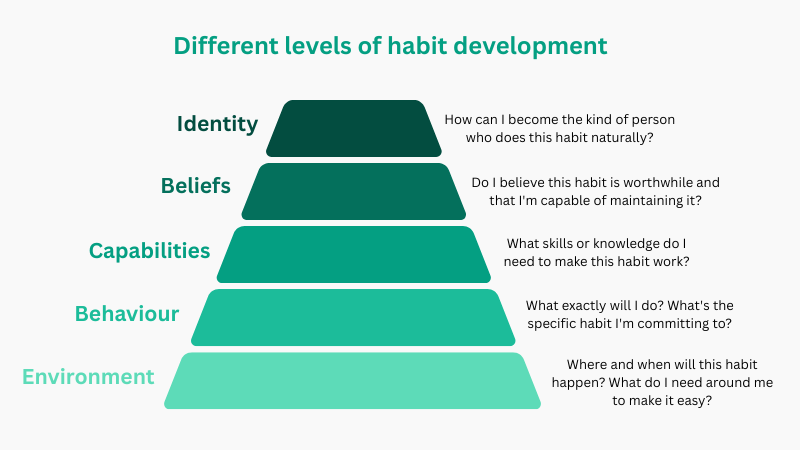
When habits fail repeatedly, the misalignment is usually visible somewhere in this hierarchy. A habit that fits your environment but conflicts with your beliefs won’t last. A behaviour you’re capable of but haven’t connected to your identity will always feel like an effort. The question isn’t just “why am I so undisciplined?” — it’s “at which level is the alignment breaking down?” Answer that honestly, and you can redesign the habit to work with your reality rather than against it.
QUICK WIN:
Think of a habit you’ve tried and abandoned. Work through this checklist: Was it too big? Too vague? No clear cue? No immediate reward? Wrong for your circumstances? Identifying which of these caused the failure tells you exactly what to change when you try again — and why habits fail is often simpler to fix than it first appears.
RESOURCES:
I only recommend resources that I either use personally or have researched and feel are genuinely helpful for my readers. Resources sometimes contain affiliate links; if you purchase through these, I may earn a small commission at no extra cost to you.
Recommended Reading
Atomic Habits by James Clear — The definitive practical guide to understanding why habits fail and how to build systems that make good behaviour inevitable. Paperback
The Power of Habit by Charles Duhigg — A compelling, research-rich exploration of the science behind why habits form, why they fail, and how to change them. Paperback
Related Articles from the Marginal Gains Blog:
Habit Formation Guide — The complete guide to building habits that last
The Habit Loop Explained — Understanding the cue-routine-reward cycle
The Two-Minute Rule for Habits — The simplest fix for habits that keep failing
Environment Design for Habits — How to make good behaviour the default
Keystone Habits — The foundational habits that make everything else easier
The 21-Day Habit Myth — What the research actually says about timelines
How to Break Bad Habits — A psychologist’s guide to lasting behaviour change
I'm Simon Shaw, a Chartered Occupational Psychologist with over 20 years of experience in workplace psychology, learning and development, coaching, and teaching. I write about applying psychological research to everyday challenges - from habits and productivity to memory and mental performance. The articles on this blog draw from established research in psychology and behavioural science, taking a marginal gains approach to help you make small, evidence-based changes that compound over time, allowing you to make meaningful progress in the areas you care about most.