
How to Use Spaced Repetition to Remember What You Learn

You spent three hours studying on Sunday. By Monday morning, half of it was gone. By Wednesday, most of the rest had quietly packed its bags and left. By the following week, you could remember that you’d studied something, but not what. The problem isn’t your memory—it’s your timing. Spaced repetition is a learning technique that works with your brain’s natural forgetting curve, transforming temporary knowledge into permanent retention through strategically timed reviews.
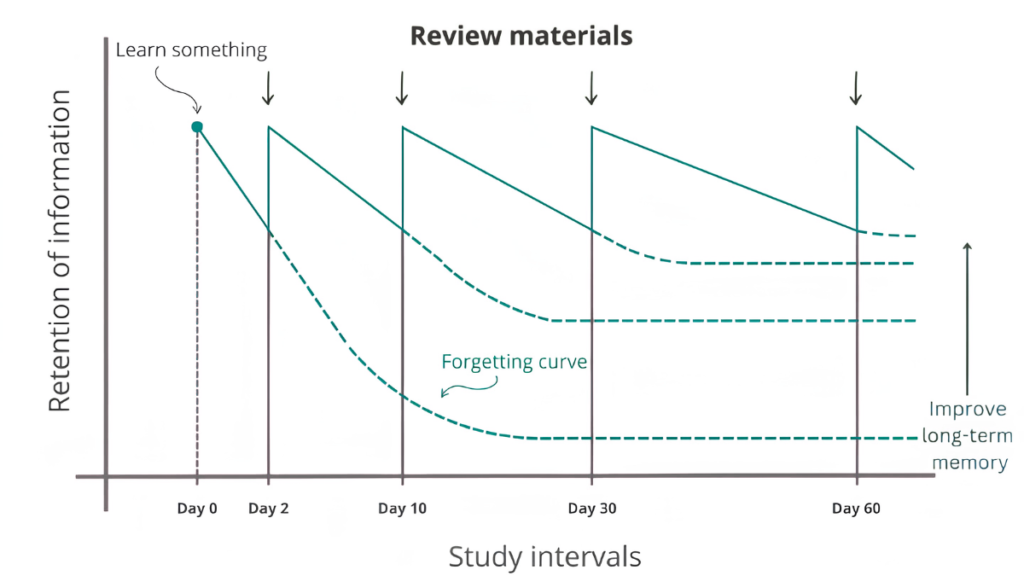
Without review, research suggests you forget roughly 70% of new material within 24 hours (for more on why this happens, see our article Why do we forget?). Spaced repetition directly counteracts this — each review resets the curve and slows the rate of forgetting. This isn’t about studying harder; it’s about studying smarter by exploiting how memory consolidation actually works.
As a psychologist who’s worked with hundreds of learners, I understand how spaced repetition can transform struggling students into efficient learners. The technique isn’t complicated, but it does require understanding the science and implementing a consistent system. This guide shows you exactly how to use spaced repetition effectively.
What Is Spaced Repetition?
Spaced repetition is a learning method where you review material at systematically increasing intervals. Instead of studying something repeatedly in one session, you spread reviews over days, weeks, and months—with the gaps getting progressively longer as the information becomes more firmly established in your memory.
The technique is based on the “spacing effect,” a psychological phenomenon discovered by Hermann Ebbinghaus in 1885. He found that information reviewed at intervals is retained far better than information studied in a single session, even when total study time is identical.
Here’s how it works in practice: You learn something today, review it tomorrow, then again in a few days, then perhaps a week later, then two weeks after that, and so on. Each successful recall strengthens the memory and extends the time until the next review is needed.
Spaced repetition works best when your notes give you something rich to review — our guide on how to remember what you read covers the dual coding method that creates far more memorable notes than text alone.
The Science Behind Spaced Repetition
Your brain doesn’t retain information simply because you’ve seen it. Memory formation requires consolidation—a process where short-term memories are gradually converted into stable long-term storage. This consolidation happens most effectively when you actively retrieve information just as you’re about to forget it.
The ‘forgetting curve’ describes how quickly we lose new information. Without review, research suggests you forget around 50% within the first hour, roughly 70% within a day, and close to 90% within a week — though the exact rate depends on how meaningful the material is to you. But each time you successfully recall information, you reset this curve to a slower rate. Eventually, the memory becomes so stable that you retain it almost indefinitely.
This is why cramming fails. When you review the same material over and over in a short session, it starts to feel like you know it — but that feeling is misleading. Recognition isn’t recall. Spaced repetition works differently: it makes your brain actively retrieve the information, and that retrieval process is what makes memories stick.
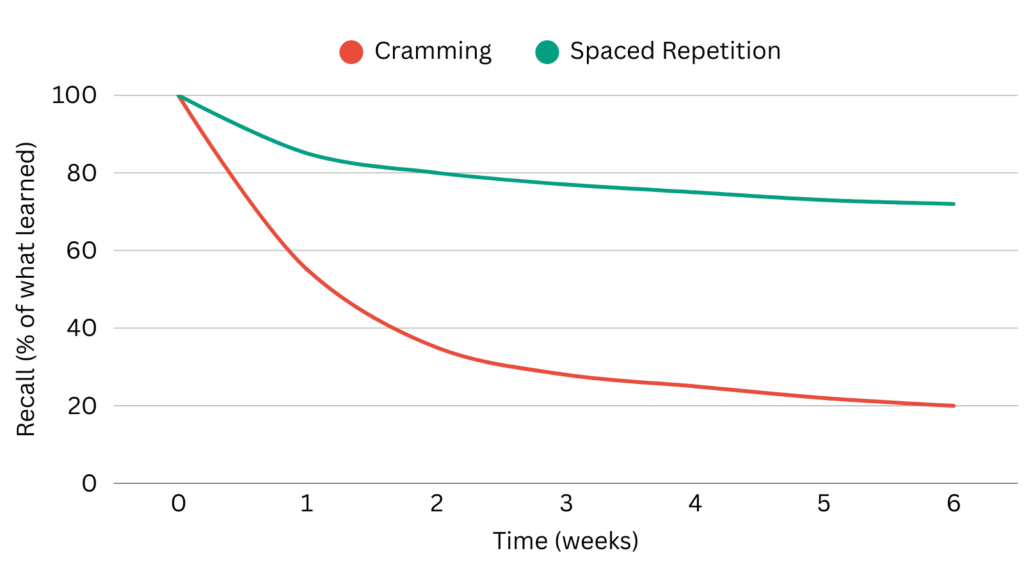
Spaced repetition works best when you pair it with active recall techniques—testing yourself, not just re-reading. The effort of trying to remember — even when it feels difficult — is exactly what makes the memory stronger. Space out those attempts correctly, and you’ll retain more in 15 minutes than most people do in an hour of passive review. Similarly, it becomes even more powerful when combined with mnemonic devices — use a mnemonic to encode information quickly, then spaced review to keep it there long-term.
QUICK WIN:
Pick one thing you’re trying to learn right now. Write three questions about it on separate pieces of paper or index cards. Schedule a reminder to test yourself tomorrow, then again in three days. You’ve just started your first spaced repetition cycle—no app required.
Optimal Review Intervals: The Schedule That Works
The most effective way to use spaced repetition is to base your review schedule on actual performance. When you easily recall something, you extend the interval; when you struggle or fail, you shorten it. However, for practical implementation, you can start with a standard schedule and adjust as needed.
The Basic Schedule
A practical starting point — adjust based on how well you’re recalling each item:
• First review: 1 day after initial learning
• Second review: 3 days after first review
• Third review: 7 days after second review
• Fourth review: 14 days after third review
• Fifth review: 30 days after fourth review
• Sixth review: 60 days after fifth review
After six successful reviews, most information is sufficiently consolidated for long-term retention. You might schedule annual refreshers for critical knowledge, but frequent review becomes unnecessary.
Adjust Based on Difficulty
Not all information is equally difficult to remember. Adjust intervals based on:
• Difficulty level: Complex concepts need shorter initial intervals
• Prior knowledge: Information connecting to existing knowledge can have longer intervals
• Recall accuracy: If you recall something effortlessly, double the next interval; if you struggle, halve it
• Importance: Critical information might warrant more frequent early reviews
Breaking complex information into smaller pieces using the chunking method can make initial learning easier and improve your ability to recall it during spaced reviews. When information is properly chunked, each review reinforces the connections between related pieces. For example, someone learning basic first aid might chunk the primary survey into the acronym DR ABC — Danger, Response, Airway, Breathing, Circulation. Instead of five separate facts to recall, there’s one memorable sequence. Each spaced review reinforces the whole chain rather than isolated pieces.
There’s a Goldilocks zone to scheduling your spaced repetitions: too frequent, and you’re doing more than you need to; too far apart, and you’ll have forgotten, requiring you to relearn rather than review.
How to Implement Spaced Repetition in Your Learning
Knowing the theory is one thing; actually using spaced repetition consistently requires a system. Here’s how to build one that works.
Step 1: Choose Your Content Format
Spaced repetition works with any type of information, but you need to format it for efficient review. The most effective formats are:
Flashcards: Questions on one side, answers on the other. Keep them atomic—one concept per card. This format works well for facts, vocabulary, definitions, and formulas.

Question prompts: For deeper concepts, create questions that require you to explain or apply knowledge rather than just recall facts. For example, “Explain why spaced repetition works better than cramming” requires deeper processing than “What is spaced repetition?”
Practice problems: For mathematical or technical subjects, create problems that test your ability to apply concepts. The answer includes not just the solution but the reasoning process.
Whatever format you choose, make sure you can quickly assess whether your recall was correct. Ambiguous questions slow down your review sessions and reduce effectiveness.
Step 2: Create a Review System
You need a way to track when each item should be reviewed next. Three practical approaches:
Physical card box system (Leitner system): Use multiple boxes or sections representing different review intervals. Cards move to the next box when recalled correctly, return to the first box when missed. Simple and tangible, though requires manual tracking.
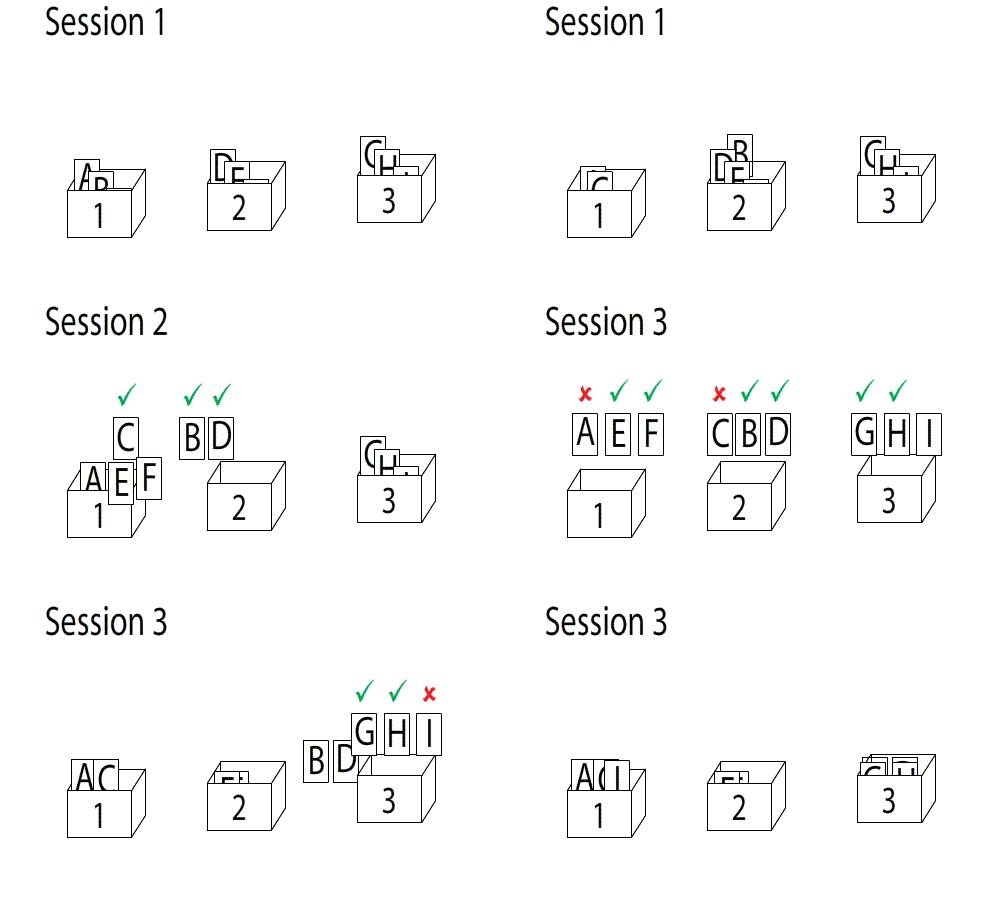
The animation shows how flashcards move between boxes in progressive study sessions. The learner moves cards to the box on the right when they recall them correctly and move cards that they cannot recall correctly to the box on the left. Cards in box 1 are reviewed most frequently, and cards in box 3 are reviewed least frequently. Flashcards that are consistently remembered progress through the boxes and are reviewed less and less frequently, while forgotten cards return to the start for more intensive practice.
Digital apps: Programs like Anki, SuperMemo, or RemNote automatically calculate optimal review intervals based on your performance. More efficient for large volumes of material, though it requires initial setup time.
Spreadsheet tracking: Create columns for item, last review date, next review date, and difficulty rating. Sort by next review date each day. More flexible than apps but requires manual calculation of intervals.
Ultimately, the best system is the one you’ll actually use consistently. If digital tools feel overwhelming, start with physical cards. If you’re studying hundreds of items, invest time in learning a dedicated app.
Step 3: Build the Habit of Daily Review
Spaced repetition only works if you actually review on schedule. Miss reviews, and items pile up, overwhelming your system and forcing you to relearn rather than review.
The solution is making your review sessions a non-negotiable daily habit. Start by identifying a consistent time and trigger. For instance, “After my morning coffee, I’ll complete today’s reviews” or “During my commute, I’ll review on my phone.” Try to build consistent habits to make your reviews automatic. Start small—commit to just 10 minutes daily. This prevents the system from feeling overwhelming while still maintaining the spacing intervals.
Most people find that daily review sessions of 15–30 minutes are sustainable long-term. If you’re exceeding this, you’re either creating too many new cards or need to adjust your intervals.
QUICK WIN:
Choose a fixed daily review time right now—morning coffee, lunch break, or before bed. Set a recurring 10-minute alarm with the label “Review.” Anchor it to something you already do every day. That single decision removes the need to negotiate with yourself about it every day.
Common Mistakes and How to Avoid Them
Creating Too Many Cards at Once
Enthusiasm leads many people to create hundreds of cards in their first week, only to be overwhelmed by review load within days. Create cards gradually—no more than 10–20 new items per day unless you have significant study time available.
Remember that each card you create is a commitment to review it multiple times over weeks or months. Be selective about what genuinely needs to be memorised versus what can be referenced when needed.

Making Cards Too Complex
Each card should test one atomic piece of knowledge. If you’re writing paragraph-long answers, you’re creating study notes, not review cards. Break complex concepts into multiple simple cards instead.
Bad card: “Explain everything about spaced repetition”
Good cards: “What is the spacing effect?”, “Why does spacing improve retention?”, “What happens during memory consolidation?”
Passive Recognition Instead of Active Recall
The power of spaced repetition comes from retrieval practice. If you’re just reading the question and immediately flipping to check the answer, you’re not getting the benefit. Force yourself to actually attempt recall before checking, even if it takes a few seconds of mental effort.
This active engagement is what strengthens memory pathways. Reading answers feels easier, but it creates the illusion of knowledge rather than genuine mastery. Some learners find it helpful to combine spaced repetition with visualisation techniques like the memory palace method, which forces active mental reconstruction of information.
Skipping Difficult Items
When you encounter a card you can’t remember, the natural response is frustration. Some people skip these items or mark them as “sort of correct.” This defeats the purpose. Items you struggle with are exactly the ones that need more frequent review.
When you fail to recall something, mark it as incorrect and reset it to the shortest review interval. This ensures you see it again soon, giving your brain another opportunity to consolidate it properly.
Practical Applications: What to Use Spaced Repetition For
Spaced repetition excels at helping you retain specific, factual knowledge that you need to recall reliably. Here’s where it works best:
Languages
Vocabulary acquisition is the most common use of spaced repetition, and for good reason. Learning a language requires remembering thousands of words, and spaced repetition is far more efficient than traditional vocabulary lists.
Create cards for vocabulary, grammar patterns, and common phrases. Include example sentences to provide context.
Medical and Scientific Knowledge
Medical students use spaced repetition to memorise anatomy, drug names, disease presentations, and diagnostic criteria. The technique is equally valuable for other sciences—biology taxonomy, chemical formulas, physics equations, or programming syntax.
The key is breaking complex material into reviewable chunks. Don’t try to memorise entire chapters; instead, extract the specific facts and concepts you need to recall instantly.
Professional Development
Technical knowledge in your field—keyboard shortcuts, regulatory requirements, client specifications, product features—all benefit from spaced repetition. Rather than repeatedly looking up the same information, invest a few weeks using spaced repetition to make it permanently accessible.
General Knowledge
History dates, geographical facts, literary works, or any information you want to retain long-term can be learned through spaced repetition. This is particularly useful for students or anyone who values broad knowledge retention.
Skill Acquisition
Spaced repetition is one of several evidence-based techniques covered in our full guide on how to learn any skill fast, alongside deliberate practice and interleaving.
Combining Spaced Repetition with Other Learning Techniques
Spaced repetition is powerful, but it’s most effective as part of a broader learning system. Here’s how it integrates with other evidence-based learning strategies:
Initial Learning Before Repetition
Before you create spaced repetition cards, you need to understand the material. Use these techniques for initial learning:
• Read actively, taking notes on key concepts
• Explain ideas in your own words
• Create connections to existing knowledge
• Work through examples and applications
Spaced repetition helps you retain what you’ve learned, but it can’t replace the initial comprehension phase. Don’t try to memorise things you don’t yet understand.
Interleaving and Variation
When reviewing cards, mix different topics together rather than studying one subject at a time. This “interleaving” improves your ability to distinguish between concepts and apply knowledge flexibly.
Most spaced repetition apps do this automatically by showing cards from different decks in each session. If you’re using a manual system, ensure your daily review includes variety rather than focusing on just one subject.
Focus and Environment
Spaced repetition sessions require concentration to be effective. Trying to review while distracted wastes time and reduces retention. Try the 50/10 method to ensure your review time is productive.
Set up your study environment for productivity. Our guide to setting up your home office explains how to optimise temperature, light and ergonomics for focus.
Remove distractions and work at the times of day when your focus tends to be sharpest. Finally, sleep is essential to learning and memory. Read our guide to improving sleep quality for 7 ideas to get better sleep.
Tools and Resources for Spaced Repetition
Digital Tools
Anki: The most popular spaced repetition software. Free, highly customisable, and works across all devices. The interface isn’t beautiful, but it’s powerful and reliable. Best for serious learners willing to invest time in setup. Free on desktop and Android (iOS app is a one-time purchase).
RemNote: Combines note-taking with spaced repetition. You can convert notes directly into flashcards, making it ideal for students who want an all-in-one system. More intuitive than Anki but with fewer customisation options. Freemium — core features are free with optional paid upgrades.
SuperMemo: The original spaced repetition software, using the most sophisticated algorithms. Powerful but with a steep learning curve. Recommended for researchers and extremely dedicated learners. Paid (free trial available).
Quizlet: User-friendly and visually appealing, with a large library of pre-made card sets. However, its spaced repetition algorithm is less sophisticated than dedicated tools. Good for casual learners or beginners. Freemium — free plan available, paid plan required for full features.
Physical Systems
Physical flashcards remain effective, particularly for visual learners or those who prefer tactile learning. The Leitner box system uses multiple compartments to track review schedules mechanically.
Benefits include no screen time, better retention through writing cards by hand, and a tangible sense of progress. Drawbacks are the space requirement and difficulty of managing large card sets.
How to Use Spaced Repetition as a Sustainable Practice
The biggest challenge with spaced repetition isn’t understanding it—it’s maintaining it long-term. Here’s how to make it stick:
Start Smaller Than You Think
Any new habit should be easy at first to gain momentum (see our guide to 2-minute habits). For example, you could begin with just one deck of flashcards in a single subject area and commit to 10 minutes a day for the first month. Once this feels automatic, expand gradually. Starting too ambitiously leads to burnout and abandonment.
Track Your Streak
Seeing a “consecutive-days” streak builds motivation to maintain the habit. Many apps track this automatically, or you can mark a calendar. The psychological benefit of not wanting to “break the chain” is surprisingly powerful.
Review at a Consistent Time
Habit research shows that consistency of timing strengthens habits more effectively than consistency of volume. Reviewing for 10 minutes at the same time each day is better than reviewing for an hour whenever you remember.
Accept Imperfect Days
You will occasionally miss reviews. When this happens, don’t abandon the system. Simply do your reviews the next day, accepting that some cards will need to be reset to earlier intervals. The long-term pattern matters more than perfect adherence.
Conclusion
Knowing how to use spaced repetition transforms learning from a frustrating cycle of forgetting into an efficient system for building permanent knowledge. By reviewing information at strategically timed intervals, you work with your brain’s natural consolidation processes rather than against them.
The technique requires initial effort to set up—creating cards, choosing a system, and building the review habit. But once established, it’s remarkably efficient. Fifteen minutes of daily review can help you retain thousands of pieces of information that would otherwise be forgotten within weeks.
Start today with a single subject you want to master. Create 10–20 cards, schedule your first review for tomorrow, and build from there. The compound effect of consistent spaced repetition over months and years is extraordinary—transforming fleeting information into permanent, accessible knowledge.
RESOURCES:
I only recommend resources that I either use personally or have researched and feel are genuinely helpful for my readers. Resources sometimes contain affiliate links; if you purchase through these, I may earn a small commission at no extra cost to you.
Recommended Reading
Make It Stick: The Science of Successful Learning by Brown, Roediger & McDaniel — The definitive guide to evidence-based learning, covering spaced practice, retrieval, and interleaving. Paperback
A Mind for Numbers by Barbara Oakley — Practical techniques for learning maths and science, with a strong focus on spaced and active practice. Paperback | Kindle | Audible
Moonwalking with Einstein by Josh Foer — A practical tour of techniques to improve your memory, based on cutting-edge research with memory masters. Paperback | Kindle | Audible
Helpful Tools
Anki: The most popular spaced repetition software. Free, highly customisable, and works across all devices. The interface isn’t beautiful, but it’s powerful and reliable. Best for serious learners willing to invest time in setup. Free on desktop and Android (iOS app is a one-time purchase).
RemNote: Combines note-taking with spaced repetition. You can convert notes directly into flashcards, making it ideal for students who want an all-in-one system. More intuitive than Anki but with fewer customisation options. Freemium — core features are free with optional paid upgrades.
SuperMemo: The original spaced repetition software, using the most sophisticated algorithms. Powerful but with a steep learning curve. Recommended for researchers and extremely dedicated learners. Paid (free trial available).
Quizlet: User-friendly and visually appealing, with a large library of pre-made card sets. Its spaced repetition algorithm is less sophisticated than dedicated tools — good for casual learners or beginners. Freemium — free plan available, paid plan required for full features.
Further Reading on Marginal Gains Blog
Active recall vs passive reading — why testing yourself beats re-reading, and how to make retrieval practice a daily habit.
The chunking method — how to break complex information into memorable groups to make it easier to learn and review.
How to learn faster — a broader guide to evidence-based learning strategies that complement spaced repetition.
The memory palace technique — a powerful visualisation method for memorising sequences and complex information.
I'm Simon Shaw, a Chartered Occupational Psychologist with over 20 years of experience in workplace psychology, learning and development, coaching, and teaching. I write about applying psychological research to everyday challenges - from habits and productivity to memory and mental performance. The articles on this blog draw from established research in psychology and behavioural science, taking a marginal gains approach to help you make small, evidence-based changes that compound over time, allowing you to make meaningful progress in the areas you care about most.