
The Chunking Method: Remember More by Grouping Information

Look at this sequence for thirty seconds: 14921789194519891969. Now look away and try to recall it.
Difficult, isn’t it? Now try this version: 1492-1789-1945-1989-1969.
Same digits, completely different experience. Those random numbers suddenly become Columbus’s voyage, the French Revolution, the end of World War II, the fall of the Berlin Wall, and the moon landing. The second version feels manageable because it uses the chunking method — the memory strategy your brain naturally prefers for handling information.
The chunking method transforms overwhelming amounts of information into manageable, memorable units. It’s why you remember phone numbers in groups, why postcodes have distinct sections, and why skilled chess players see patterns rather than individual pieces.
This guide explains exactly how the chunking method works, why it’s so effective, and how to apply it deliberately to remember more with less effort.
What Is the Chunking Method?
The chunking method is a memory strategy that groups individual pieces of information into larger, meaningful units. Instead of trying to remember seven separate items, you remember two or three groups containing those items. This reduces cognitive load and makes retrieval dramatically easier.
Psychologist George Miller introduced the concept in his landmark 1956 paper “The Magical Number Seven, Plus or Minus Two.” Miller demonstrated that working memory typically holds 5-9 individual items — but through the chunking method, people can effectively expand this capacity by treating groups as single items.
When you use the chunking method, you’re essentially creating compressed files in your mental filing system. Just as a computer stores a complex image as a single file rather than millions of individual pixels, chunking lets your brain store related information as a single retrievable unit. The chunking method is itself one of the most widely used mnemonic techniques — grouping information into meaningful units is exactly how acronyms and acrostics work.
How Working Memory Creates the Chunking Effect
Your working memory — the mental workspace where you consciously process information — has strict limitations. It can actively hold and manipulate only a small number of items simultaneously.
Try this: look at these letters for a few seconds, then look away and recall them:
F I A I C B A N S U H S
Most people struggle with 12 random letters. Now try these same letters differently organised:
FBI CIA NHS USA
Suddenly manageable. You’ve gone from remembering 12 items to remembering 4 — four familiar acronyms rather than individual letters. The chunking method works because each meaningful group counts as a single item in working memory, despite containing multiple elements.
The Science Behind the Chunking Method
Research consistently shows that the chunking method isn’t just a useful trick — it fundamentally changes how your brain processes and stores information.
When you encounter unchunked information, each element demands separate attention and working memory resources. Your brain treats each item as distinct, quickly overwhelming its limited capacity. Once you hit that 5-9 item threshold, new information starts pushing out existing information before you’ve had chance to consolidate it. Learn more about the processes that drive forgetting in our article, Why do we forget?
The chunking method bypasses this limitation through pattern recognition. When your brain identifies a meaningful pattern linking several items, it creates a single representation for the entire group. That representation occupies one slot in working memory rather than multiple slots.
A 2019 study found that the chunking method doesn’t just help initial encoding — it fundamentally changes memory retrieval. Across four experiments, chunking benefits were found not only for recall of the chunked material, but also for other unchunked information held in working memory simultaneously. The chunking method actually frees up cognitive resources for everything else you’re trying to remember.
Brain imaging studies show that when experts use the chunking method in their domain of expertise, different neural patterns emerge compared to novices. Chess masters viewing board positions activate pattern recognition systems rather than visual processing systems — they literally see meaningful chunks rather than individual pieces.
Chunking and visual organisation work hand in hand — the dual coding techniques in our guide on how to remember what you read show how combining visual structure with chunked content dramatically improves retention.
Types of Chunking Strategies
The chunking method isn’t a single technique but a category of strategies. Different approaches work better for different types of information.
Category-Based Chunking
Group items by natural categories or themes. Shopping lists work perfectly with this approach — instead of memorising “apples, bread, milk, bananas, cheese, yoghurt, oranges, butter” as eight separate items, you chunk into three categories:
- Fruit: apples, bananas, oranges
- Bakery: bread
- Dairy: milk, cheese, yoghurt, butter
Now you remember three categories with items nested within them, dramatically reducing cognitive load.
Pattern-Based Chunking
Identify patterns or relationships that connect information. When learning historical dates, instead of memorising “1066, 1215, 1588, 1666” as four separate numbers, notice patterns — two events in the 11th-13th centuries, two in the 16th-17th centuries. The pattern creates the chunk.
Acronym Chunking
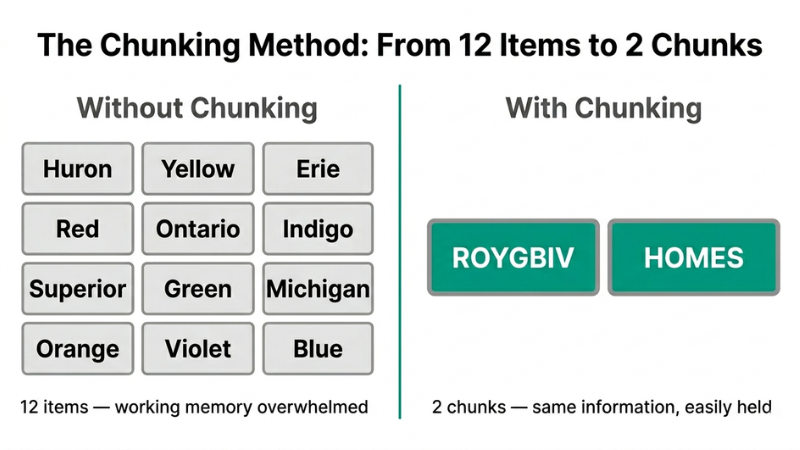
Create memorable words or phrases from first letters. Medical students learn cranial nerves using “On Old Olympus’ Towering Top, A Finn And German Viewed Some Hops.” The rainbow’s colours become ROYGBIV. Twelve separate letters collapse into one memorable acronym — a classic example of the chunking method in action.
Hierarchical Chunking
Organise information in layers, with main topics containing subtopics. When studying for exams, you might apply the chunking method like this:
World War II
- Causes: Treaty of Versailles, Economic depression, Rise of fascism
- Major battles: Dunkirk, Battle of Britain, D-Day
- Outcomes: United Nations, Cold War begins, European reconstruction
You remember three main chunks, each containing three elements — far more manageable than nine separate historical facts with no structure.
Numerical Chunking
Break long numbers into meaningful groups. Credit card numbers use this instinctively: 4532-8769-1234-5678. Same with National Insurance numbers: AB-12-34-56-C. The spacing creates automatic chunks, making numbers dramatically easier to remember and communicate.

QUICK WIN:
Try the chunking method right now with your next shopping list. Instead of writing items in order, group them by category — fruit, dairy, bakery, household. You’ll move through the supermarket faster and forget fewer items. That’s the chunking method doing exactly what the research says it should.
How to Apply the Chunking Method Effectively
Knowing about the chunking method and actually using it well are different skills. Here’s the practical process for applying it to any learning situation.
Step 1: Gather and Display All Information
Before applying the chunking method, you need to see everything you’re working with. Write out the complete list, lay out all your study notes, or collect all the concepts you need to learn in one place.
This overview stage is crucial. You can’t identify meaningful groups until you can see potential relationships between items. Trying to chunk information as you encounter it piece by piece rarely works as effectively.
Step 2: Look for Natural Groupings
Scan your information for obvious connections. Items might group by function or purpose, category or type, time or sequence, location, characteristics, or first letters. The best chunking strategy reveals itself through these natural relationships. Don’t force artificial groupings — look for connections that make intuitive sense to you.
Step 3: Create Meaningful Labels
Each chunk needs a clear label that captures its contents. The label serves as your mental retrieval cue, so it must be memorable and descriptive.
For a history exam covering the Tudor period, you might chunk into: The Power Struggle (Wars of the Roses, Henry VII’s consolidation), The Religious Revolution (Break with Rome, dissolution of monasteries), and The Golden Age (Elizabeth I’s reign, defeat of Armada). Three vivid labels, each immediately cueing multiple related facts.
Step 4: Limit Chunk Size
Keep individual chunks small — typically 3-5 items per chunk. If a group grows beyond this, it probably needs subdividing. Remember Miller’s magic number: you want around 3-7 main chunks, each containing 3-5 elements. This two-level structure keeps information organised without becoming overwhelming.
Step 5: Test and Refine
Try recalling your chunked information. If you’re consistently forgetting items or confusing which chunk they belong to, reorganise. Effective use of the chunking method should make recall feel easier, not harder. Some people find certain chunking strategies more intuitive than others — experiment until you discover what clicks with your natural thinking style.
QUICK WIN:
Take any set of notes you’re currently trying to learn and apply the chunking method in five minutes. Write all the key points on a blank page, then draw circles around natural groupings. Give each circle a label. You now have a chunked structure you can memorise as 3-5 groups rather than a long list of individual facts.
Practical Applications of the Chunking Method
Studying for Exams
When facing large volumes of study material, apply the chunking method by grouping content into major themes before diving into details. For a biology exam covering cell biology, genetics, and ecology, create three main chunks with subcategories: Cell Biology (Structure, Processes, Division), Genetics (DNA, Inheritance, Mutations), Ecology (Populations, Communities, Ecosystems).

This structure gives you a mental map before memorising specific facts. Each fact then slots into an existing framework rather than floating in isolation. Combining the chunking method with active recall practice makes this even more powerful — test yourself on each chunk separately before attempting to recall the whole.
Learning Languages
Group vocabulary by theme rather than alphabetically. Instead of learning “apple, building, car, dog…” learn in chunks: Food (apple, bread, cheese, egg), Transport (car, bus, train, plane), Animals (dog, cat, horse, bird). Thematic grouping creates context that reinforces memory — each word triggers associations with related words in its chunk.
Professional Presentations
Structure presentations in clear chunks of 3-5 main points, with supporting details nested within each point — a principle that underpins effective techniques for memorising a presentation without notes. Instead of 15 separate recommendations, present “Three Key Strategies,” each containing five specific actions. The chunked structure helps both you and your audience retain the message.
Project Management
Break large projects into phases, then divide phases into specific tasks. A house renovation becomes: Planning (design, permits, budget), Demolition (removal, disposal, cleaning), Construction (building, installing, finishing). The chunked structure makes overwhelming projects manageable by creating clear, logical segments.
Common Mistakes to Avoid
Creating Too Many Chunks
Ten chunks of three items each isn’t really using the chunking method effectively — you’re still trying to remember ten things. Aim for fewer main chunks (3-7), even if that means some chunks contain more elements.
Using Arbitrary Groupings
Chunks must be meaningful to you. Grouping items simply to create chunks, without logical connection, adds cognitive load rather than reducing it. If a grouping feels forced, it probably is — and the chunking method won’t work as intended.
Making Chunks Too Large
A single chunk containing ten items defeats the purpose of the chunking method. If a chunk grows unwieldy, subdivide it into smaller, more manageable units.
Neglecting Labels
Unlabelled chunks are hard to retrieve. You might remember that information is chunked but struggle to recall what the chunks were. Clear, memorable labels are essential to making the chunking method work reliably.
Chunking Too Early
If you don’t understand the material, the chunking method won’t help. Ensure you grasp individual concepts before organising them into chunks. Chunking aids memory, not comprehension.
Combining the Chunking Method with Other Techniques
The chunking method becomes even more powerful when combined with complementary memory strategies.
Chunking and Spaced Repetition
Use the chunking method to organise information, then review chunks at increasing intervals using spaced repetition schedules. This combination leverages both structural organisation and optimal timing for maximum retention.
Chunking and the Memory Palace Technique
Instead of placing individual items at each station in a memory palace, place entire chunks. Each station holds a labelled group of related information, dramatically increasing how much you can store per palace. The chunking method and memory palace technique are a natural pairing.
Chunking and Mind Mapping
Mind maps naturally create chunks through their branch structure. Main branches represent major chunks, with sub-branches containing elements within each chunk. The visual format reinforces the chunked organisation and makes the chunking method visible on the page.
QUICK WIN:
Supercharge the chunking method by combining it with spaced repetition. Once you’ve grouped your information into 3-5 chunks with clear labels, add each chunk as a single flashcard in Anki — the label on the front, the items in the chunk on the back. You’ll review them at increasing intervals automatically, building long-term retention alongside short-term recall.
The Chunking Method in the Real World
The chunking method isn’t just for students. It appears throughout professional and everyday life, often invisibly.
Software developers chunk code into functions, functions into modules, modules into programmes. Each level of chunking makes complex systems manageable. Writers chunk information into sentences, sentences into paragraphs, paragraphs into sections, sections into chapters. Businesses chunk strategies into objectives, objectives into initiatives, initiatives into projects, projects into tasks. Even music uses the chunking method — phrases combine notes, movements combine phrases, compositions combine movements.
In each case, the principle is identical: breaking information into meaningful groups makes it manageable, memorable, and retrievable. The chunking method scales from a shopping list to a corporate strategy.
Start Using the Chunking Method Today
The chunking method works because it aligns with how your brain naturally processes information. You’re already chunking unconsciously every day — phone numbers, postcodes, the way you organise your day into morning, afternoon, and evening.
The difference between unconscious chunking and deliberate application of the chunking method is control. When you apply it intentionally to learning challenges, you gain a reliable tool for making any volume of information manageable.
Pick one area where you’re currently trying to memorise multiple items: study notes, a presentation, a new system at work, vocabulary in a foreign language. Look for the natural groupings. Apply the chunking method. Add clear labels. Then test whether recall improves.
You’ll discover that remembering three groups of four feels fundamentally different from remembering twelve scattered items. That difference is the chunking method doing exactly what decades of research say it should — making memory work with your brain rather than against it. Pair it with evidence-based learning strategies and you have a genuinely powerful system for retaining more of what you study.
RESOURCES:
I only recommend resources that I either use personally or have researched and feel are genuinely helpful for my readers. Resources sometimes contain affiliate links; if you purchase through these, I may earn a small commission at no extra cost to you.
Recommended Reading
Make It Stick — Brown, Roediger & McDaniel. The definitive evidence-based guide to effective learning. Covers how the chunking method fits within a complete system of retrieval practice, spaced repetition and interleaving. Paperback
A Mind for Numbers — Barbara Oakley. Practical strategies for learning difficult material, with strong emphasis on chunking, pattern recognition and spaced practice. Paperback | Kindle | Audible
Related Articles from the Marginal Gains Blog:
How to Build a Memory Palace — Use the chunking method and memory palace together: place labelled chunks at each station to store far more information per palace.
Do Mnemonic Devices Work? — How the chunking method relates to the broader family of mnemonic techniques, and which methods work best for different types of information.
How to Use Spaced Repetition — Combine the chunking method with spaced review schedules for maximum long-term retention.
I'm Simon Shaw, a Chartered Occupational Psychologist with over 20 years of experience in workplace psychology, learning and development, coaching, and teaching. I write about applying psychological research to everyday challenges - from habits and productivity to memory and mental performance. The articles on this blog draw from established research in psychology and behavioural science, taking a marginal gains approach to help you make small, evidence-based changes that compound over time, allowing you to make meaningful progress in the areas you care about most.