
Why Do We Forget? The Science of Everyday Forgetting

You spend Sunday afternoon studying for Monday’s exam. You test yourself before bed and know the material perfectly. Monday morning, you sit down to write and half of it has vanished. Or perhaps you meet someone at a networking event, have a great conversation, and ten minutes later you’ve completely forgotten their name. You read an article that fascinated you last week, but now you can barely remember what it was about.
If any of this sounds familiar, you’re experiencing one of the most frustrating aspects of being human: your brain’s natural tendency to forget. Whether it’s study material, people’s names, where you left your keys, or that brilliant idea you had in the shower, information seems to slide out of your mind almost as quickly as it arrives.
But here’s what most people don’t understand — why do we forget at all? Forgetting isn’t a bug in your mental system. It’s a feature. Your brain is designed to forget, and for good reason. The problem isn’t that you forget. The problem is that you’re not working with your brain’s natural forgetting processes.
This article explains exactly why we forget things — from exam material to everyday information — backed by over a century of memory research. More importantly, it shows you what actually works to improve retention across all areas of life.
The Forgetting Curve: The Science of Why We Forget
In the 1880s, German psychologist Hermann Ebbinghaus conducted a remarkable experiment. He created 2,300 nonsense syllables — meaningless combinations like “WID,” “ZOF,” and “KAF” — and spent years memorising them, testing himself at different time intervals to track exactly how quickly he forgot.
What he discovered became known as the forgetting curve, and it explains precisely why we forget so much so quickly. Without any review, you forget roughly 50% of new information within an hour. By the next day, you’ve lost about 70%. After a week, you retain perhaps 10% of what you originally learned.
This isn’t because Ebbinghaus had a poor memory, and it’s not because you do either. This is simply how human memory works. Your brain assumes that if information doesn’t come up again soon after you first encounter it, it’s probably not important — so it discards it to make room for new information.
The forgetting curve affects everything from exam revision to remembering people’s names at conferences. It explains why you forget the main points from that podcast you listened to last week, or why the instructions someone gave you yesterday are now fuzzy. It’s not selective forgetting of unimportant things — it’s your brain’s default response to all new information.
But the forgetting curve isn’t inevitable. Ebbinghaus also discovered that strategic review dramatically slows the rate of forgetting. Each time you successfully retrieve information, the forgetting curve becomes less steep. Review after one day, then three days, then a week, and you can maintain nearly perfect recall with surprisingly little ongoing effort.
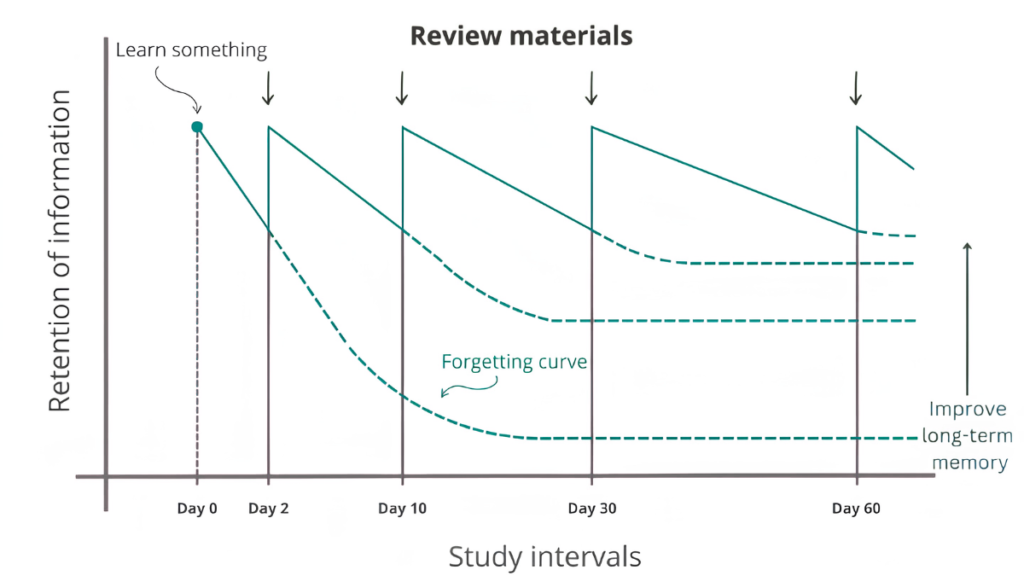
This is why cramming before exams fails so spectacularly. Students who use spaced repetition strategies consistently outperform those who cram. The same principle applies to any information you want to retain — from professional knowledge to the plot details of books you’ve read.
QUICK WIN:
After your next meeting or lecture, wait two hours then try to write down the five most important points from memory — without checking your notes. This deliberate retrieval practice interrupts the forgetting curve and dramatically strengthens retention. It takes five minutes and works every time.
Memory Decay: Why We Forget “Useless” Information
Your brain processes an overwhelming amount of information every single day. The number plate of the car in front of you. Background conversations in the café. The name of that person you were just introduced to. Most of this information is genuinely useless — you’ll never need it again.
Memory decay is your brain’s efficiency mechanism. Rather than storing every trivial detail indefinitely, your brain lets unused information gradually fade. This is a core part of why we forget — and it isn’t malicious. It’s practical. If you couldn’t forget, your mind would be cluttered with millions of irrelevant details competing for attention.
The problem is that your brain can’t always distinguish between information you want to keep and information you don’t. If someone tells you something once and you never think about it again, your brain treats it the same as that forgotten number plate — potentially important in the moment, completely irrelevant afterwards.
Preventing decay requires making information seem important to your brain. How? By retrieving it repeatedly, connecting it to existing knowledge, and using it in multiple contexts. Your brain interprets frequency and utility as signals of importance — information that keeps coming up gets protected from decay.
This is why explaining concepts in your own words helps memory. The act of reformulation signals to your brain: “This is worth keeping — I’m actively using it.” This kind of deep processing, which you can achieve through connection-based learning, naturally reduces decay across all types of information.
Interference: When Memories Fight Each Other
Even if information survives initial decay, it can still become inaccessible through interference — another key answer to why we forget. This happens when similar memories compete for space in your mind, making it difficult to retrieve the specific information you need.
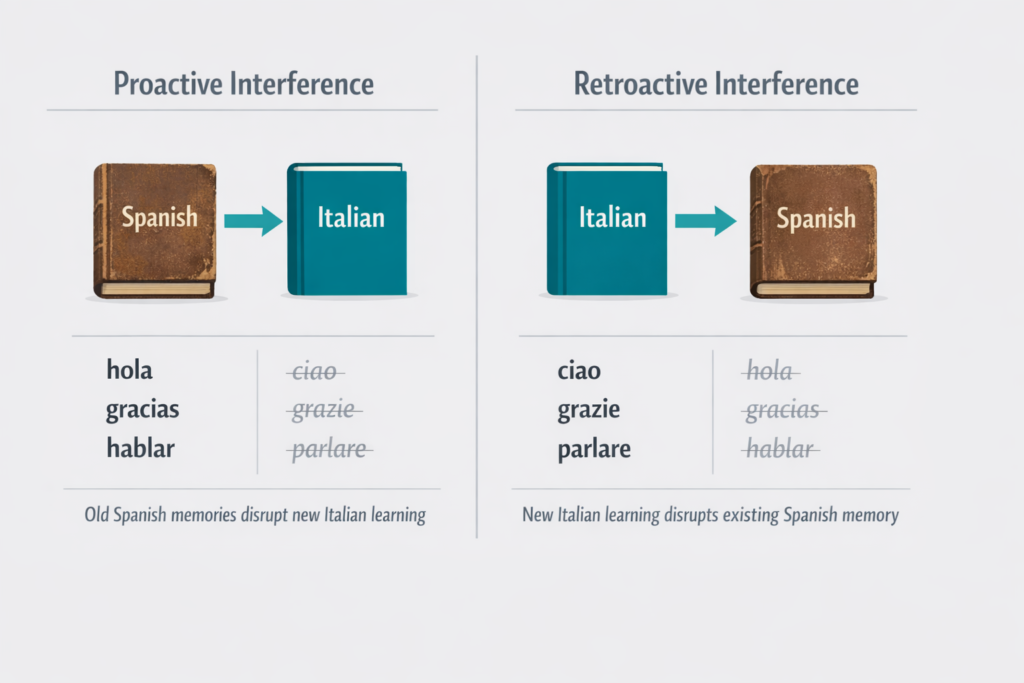
There are two types of interference. Proactive interference occurs when old learning interferes with new learning. If you studied Spanish years ago and are now learning Italian, your existing Spanish knowledge might intrude when you’re trying to recall Italian words. This also explains why you sometimes call your current partner by your ex’s name, or why you keep typing your old password when you’ve just changed it.
Retroactive interference works in reverse — new learning interferes with old learning. Your developing Italian knowledge might start corrupting your Spanish. Similarly, your new mobile number might make you forget your old one, or learning a new route to work might override your memory of the previous route.
The most effective way to reduce interference is by making information distinctive. If every password is a variation of the same pattern, they’ll blur together. But if each connects to something meaningful about the specific service, they become distinct. The same applies to people’s names — connecting each name to something unique about the person reduces interference and answers why we forget names so quickly after meeting someone new.
Retrieval Failure: The Memory Exists But You Can’t Access It
Sometimes the answer to why we forget isn’t that information has gone — it’s that you can’t access it. This is retrieval failure, and it’s remarkably common. You know that feeling of having something “on the tip of your tongue”? That’s retrieval failure in action. The word, name, or fact is definitely stored in your memory, but the retrieval pathway is temporarily blocked.
Retrieval depends on cues. You encode information in a specific context — certain surroundings, emotional state, type of activity — and those contextual factors become part of the memory. When you later try to recall, having similar cues available makes retrieval easier.
This explains several everyday experiences. Students sometimes struggle during exams even though they knew the material whilst studying — the exam context is completely different from the study context. You can’t remember where you left your keys until you retrace your steps, recreating the context in which you last had them. A song comes on the radio and suddenly floods you with memories from when you first heard it years ago.
Improving retrieval requires two strategies. First, vary your contexts — don’t always learn in the same place, at the same time, in the same way. Second, practise retrieval itself. Regular use of active recall methods dramatically improves your ability to access information when you need it, whether that’s for exams, presentations, or simply remembering where you parked.
QUICK WIN:
Next time you meet someone new and want to remember their name, use it three times in the conversation naturally — “Great to meet you, Sarah”, “So Sarah, what brought you to this event?”, “Really enjoyed talking with you, Sarah.” This retrieval practice in the moment dramatically reduces why we forget names so quickly after meeting people.
Shallow Processing: When We Forget Because We Never Really Learned It
Sometimes we forget because the information never properly encoded in the first place. You went through the motions of paying attention, but your brain never moved the information from temporary working memory into durable long-term storage. This is one of the most underappreciated answers to why we forget.
This happens through shallow processing — engaging with information at only a surface level without thinking about meaning or connections. Reading and re-reading notes is shallow processing (see our guide to taking better notes for more on this). So is half-listening during meetings whilst thinking about other things, skimming emails without really absorbing the content, or nodding along in conversations whilst planning what you’ll say next.
Your brain decides what to commit to long-term memory based partly on how deeply you process it. Shallow processing signals: “This is just passing through, no need to store it permanently.” Deep processing — thinking about meaning, making connections, generating examples, relating to your own experience — signals: “This matters, store it properly.”
People often confuse familiarity with understanding or genuine encoding. After hearing something mentioned three times, it feels familiar. But familiarity isn’t memory. The test comes when you need to recall without support — and that’s when many people realise they never actually encoded the information. This fluency illusion is a major reason why we forget material we thought we’d learned.
Preventing shallow processing requires forcing yourself to engage actively. After a meeting, write a quick summary from memory. When reading, pause periodically to think about how the information relates to what you already know. These activities feel harder than passive reception, but that difficulty is exactly the point — the mental effort of active engagement is what drives deep processing and lasting storage. Our guide on how to remember what you read covers this in detail.
Stress and Anxiety: Why We Forget Under Pressure
Even with optimal encoding, stress can sabotage memory and explain why we forget things we were certain we knew. Exam anxiety creates one vicious cycle — you’re worried about forgetting, the worry itself impairs memory, which increases anxiety, which further impairs memory.
Stress hormones like cortisol directly interfere with memory formation and retrieval. In moderate amounts, these hormones can actually enhance memory — they signal that something important is happening. But high stress levels, particularly chronic stress, damage the hippocampus, the brain region crucial for memory consolidation.
Anxiety also consumes working memory capacity. Your working memory — your mental scratch pad for holding and manipulating information — has limited space. When anxiety fills that space with worries, you have less capacity available for the actual task at hand. This is why anxious students sometimes blank during exams despite knowing the material, and why you forget simple things when stressed about bigger issues.

Managing stress isn’t just about feeling better — it’s a legitimate memory strategy. Regular physical activity reduces baseline stress levels. And sleep is crucial: your brain consolidates memories during sleep, particularly during deep sleep phases. People who regularly get insufficient sleep might work hard to encode information, but without sleep to consolidate those memories, much of it vanishes. Staying up late to study actively prevents you from remembering what you’re trying to learn.
Attention and Distraction: The Information That Never Arrives
You can’t remember what you never paid attention to in the first place. This seems obvious, yet it’s one of the most common and overlooked answers to why we forget so much in modern life.
Multitasking — checking your phone during meetings, scrolling whilst watching television, having conversations whilst thinking about something else — doesn’t just reduce efficiency. It prevents information from properly encoding. Your brain can’t deeply process material it’s only giving partial attention to.
Research on multitasking is unambiguous: it doesn’t work. People who think they’re good at multitasking are actually just faster at switching between tasks, and every switch carries a cognitive cost. That cost includes reduced depth of processing and impaired memory formation — which is a direct answer to why we forget so much of what happens during distracted periods.
The solution is obvious but difficult: eliminate distractions during important activities. Put your phone in another room during meetings. Close unnecessary tabs when reading something important. Actually listen during conversations rather than planning your response. The goal isn’t to do more — it’s to fully attend to what matters so information actually encodes properly.
QUICK WIN:
For your next important conversation, meeting, or reading session, put your phone in a different room entirely — not face down, not on silent, but out of the space. Research shows that even the visible presence of a phone reduces cognitive capacity. Remove the distraction at source and you’ll remember significantly more without any other change.
What Actually Works: Evidence-Based Strategies
Understanding why we forget is valuable, but the real question is: what do you do about it? Based on decades of memory research, here are the strategies that actually work.
First, accept that initial forgetting is normal and use it to your advantage. The encode-forget-retrieve cycle actually strengthens memory. Allow yourself to partially forget something, then actively retrieve it. This effortful retrieval makes the memory more durable than simply reviewing something you can still remember perfectly.
Second, space your exposure. Distributed practice — encountering information multiple times over several days — consistently outperforms cramming. Whether you’re learning a new skill, studying material, or trying to remember professional knowledge, spacing works better than massing. Each session feels less productive than a marathon one-off, but the long-term retention is dramatically superior.
Third, test yourself constantly. Self-testing isn’t just for exams — it’s one of the most powerful memory tools available. Every time you successfully retrieve something from memory, you’re strengthening the memory itself. Close the article and summarise from memory. Put away the instructions and see what you remember. Make retrieval practice a habit.
Fourth, connect new information to existing knowledge. Information that links to what you already understand resists forgetting much better than isolated facts. Whether it’s connecting a person’s name to something memorable about them, or relating new work processes to ones you already know, connections are your memory’s best defence against forgetting. Using mnemonic devices is one of the most effective ways to create these connections deliberately.
Fifth, vary your contexts. Encounter information in different locations, at different times, using different methods. This reduces dependence on specific contextual cues and makes knowledge accessible from any situation.
Finally, prioritise sleep and manage stress. No strategy can compensate for chronic sleep deprivation or high anxiety. Your brain consolidates memories during sleep. Stress hormones actively interfere with memory. Protecting these basics matters more than any clever technique.
Why Understanding Why We Forget Matters
Many people blame themselves for forgetting. They assume they have poor memories, that they’re not smart enough, or that something’s wrong with them. But forgetting isn’t a personal failing — it’s a normal neurological process that affects everyone equally.
Understanding the science of why we forget is liberating. It explains why certain approaches fail despite feeling productive. It shows why cramming produces such temporary results. It reveals why some strategies work dramatically better than others regardless of the context.
More importantly, it gives you agency. You can’t prevent forgetting entirely — that’s neurologically impossible and wouldn’t be desirable anyway. But you can work with your brain’s design rather than against it. You can use strategies that minimise decay, reduce interference, strengthen retrieval, and create deep processing.
As a psychologist who taught memory and forgetting, I’ve seen this understanding transform people’s relationship with information. Once they grasp why we forget, they stop using ineffective techniques out of habit and start using evidence-based approaches that actually work. Their retention improves not because they’re working harder, but because they’re working smarter.
Moving Forward
If you take one thing from this article, let it be this: forgetting is normal, predictable, and manageable. You don’t forget because you’re not trying hard enough or because your memory is defective. You forget because your brain is working exactly as designed. Our article how to keep memory sharp provides more strategies to support your memory as you age.
The question isn’t whether you’ll forget — you will. The question is whether you’ll use strategies that work with your brain’s forgetting processes or continue fighting against them with approaches that feel productive but don’t actually create lasting memory.
Start with one change. Perhaps you begin spacing your exposure to important information instead of cramming it. Perhaps you commit to testing yourself from memory rather than passively reviewing. Perhaps you start looking for connections between new information and what you already know. Any of these shifts will produce noticeable improvements within weeks.
Understanding why we forget is the first step towards remembering what matters. Now that you know the science, you can work with your memory accordingly.
Recommended Resources
RESOURCES:
I only recommend resources that I either use personally or have researched and feel are genuinely helpful for my readers. Resources sometimes contain affiliate links; if you purchase through these, I may earn a small commission at no extra cost to you.
Recommended Reading
Make It Stick — Brown, Roediger & McDaniel. The definitive evidence-based guide to effective learning. Covers exactly why we forget and which strategies — retrieval practice, spaced repetition, interleaving — actually work to prevent it. Paperback
Moonwalking with Einstein — Joshua Foer. A compelling exploration of memory, forgetting, and the techniques that memory champions use to retain extraordinary amounts of information. Paperback | Kindle | Audible
Related Articles from the Marginal Gains Blog:
How to Use Spaced Repetition — The most powerful evidence-based solution to the forgetting curve, explained step by step.
Active Recall vs Passive Reading — Why testing yourself beats re-reading every time, and how to build the habit.
How to Remember What You Study — Practical strategies for students and professionals who need information to stick.
I'm Simon Shaw, a Chartered Occupational Psychologist with over 20 years of experience in workplace psychology, learning and development, coaching, and teaching. I write about applying psychological research to everyday challenges - from habits and productivity to memory and mental performance. The articles on this blog draw from established research in psychology and behavioural science, taking a marginal gains approach to help you make small, evidence-based changes that compound over time, allowing you to make meaningful progress in the areas you care about most.