
Do Mnemonic Devices Work? How to Boost Memory

If you’ve ever used the phrase “Richard Of York Gave Battle In Vain” to remember the colours of the rainbow, or arranged items on your shopping list so their first letters create a word, you’ve used a mnemonic device. These memory aids promise to transform how we learn and retain information — but do mnemonic devices work, or are they just clever party tricks?
The short answer is yes — mnemonic devices work remarkably well, but with important caveats. A 2021 meta-analysis of 13 randomised controlled trials found the method of loci produced a medium-to-large effect on recall performance. Their effectiveness depends on how you use them, what you’re trying to learn, and whether you’re willing to invest the initial effort required.
Understanding when and how to use mnemonics properly can transform them from occasional shortcuts into genuine learning tools — ones that complement techniques like active recall and spaced repetition in a complete study system.
What Are Mnemonic Devices?
A mnemonic device is any memory technique that transforms difficult-to-remember information into a more memorable format. The term comes from Mnemosyne, the Greek goddess of memory, and encompasses a wide range of strategies that make information “stickier” in your brain. Rather than relying on rote repetition, mnemonics work by creating associations, patterns, or mental structures that your brain naturally finds easier to encode and retrieve.
Common types include acronyms (like “HOMES” for the Great Lakes), visual imagery (picturing items in familiar locations), rhymes (“i before e except after c”), chunking (grouping phone numbers into segments), and the keyword method (linking new vocabulary to similar-sounding familiar words through vivid imagery). What unites all these techniques is their fundamental approach: they take abstract, arbitrary information and connect it to something more concrete, meaningful, or emotionally engaging. This transformation leverages how your memory naturally works — storing meaningful, interconnected information far more effectively than isolated, meaningless data.
The Research Evidence: Do Mnemonic Devices Work?
Decades of cognitive psychology research have consistently demonstrated the power of mnemonic techniques. A 2021 meta-analysis of 13 randomised controlled trials found that the method of loci — one of the oldest and most studied mnemonic techniques — produced a medium-to-large effect size (g = 0.65) on recall performance compared to control conditions. This is robust evidence that mnemonic devices work, not just in laboratory settings but in real educational contexts.
Research on specific techniques provides further insight. The keyword method, extensively studied by Atkinson and Raugh in the 1970s, showed that students learning Spanish vocabulary retained 88% of words after one session compared to 28% using rote repetition. Even more impressively, retention remained at 72% after six weeks without review — a retention rate that most language learners would envy.
Bower and Clark’s 1969 study on narrative mnemonics found that participants remembered 93% of word lists when using story-based mnemonics versus just 13% with standard memorisation. The dramatic difference highlights how our brains are wired to remember meaningful narratives rather than isolated facts.
Common Mistakes That Sabotage Mnemonic Effectiveness
Understanding that mnemonic devices work is only half the battle. Many people try mnemonics, achieve disappointing results, and conclude they don’t work when the real problem lies in how they’re using them. Research reveals several common mistakes that dramatically reduce mnemonic effectiveness.
Using Weak or Generic Imagery
The single biggest mistake is creating bland, forgettable images. If you’re trying to remember “apple” using the method of loci and you simply imagine an apple sitting on your kitchen counter, you’ve gained nothing — that’s not memorable enough to stick. Research consistently shows that bizarre, exaggerated, emotionally charged images work best.
Instead of a normal apple, imagine a massive apple the size of your refrigerator, pulsating with bright neon colours, singing opera while juggling smaller apples. The more unusual and vivid the image, the better it works. Studies by Paivio on dual coding theory explain this: bizarre images engage both your verbal and visual processing systems more intensely, creating stronger memory traces.
Creating Mnemonic Devices for the Wrong Content
Not all information benefits equally from mnemonic techniques. They excel for arbitrary associations — facts that have no inherent logical connection, like dates, names, vocabulary, or the order of planets. They’re less effective for conceptual material you can understand through logic or narrative.
Trying to create elaborate mnemonics for how photosynthesis works wastes time. Understanding the process through a clear explanation proves more efficient than building mental images for each chemical step. Similarly, mathematical formulas derived through logical reasoning don’t need mnemonic aids — the derivation itself provides the memory structure.
Research on memory for meaningful versus arbitrary information shows that when material has inherent structure or logic, that structure itself serves as the best retrieval cue. Save mnemonic devices for genuinely arbitrary content where no natural pattern exists.
Skipping the Practice Phase
Creating a mnemonic isn’t enough — you must practise retrieving information using it. Many people craft elaborate acronyms or mental images, then never test whether they can actually use them to recall the information. Studies consistently show that retrieval practice, not encoding alone, determines long-term retention.
After creating your mnemonic, practise recalling the information multiple times, spacing these practice sessions over days and weeks. This combines mnemonic devices with another powerful evidence-based technique: spaced repetition. The mnemonic makes initial encoding easier, while spaced practice ensures long-term retention.
QUICK WIN:
Pick one fact you need to remember this week — a name, a date, a term. Create a vivid, bizarre mental image that links the sound of it to its meaning. Make it strange enough that it would embarrass you to describe it aloud. Then close your notes and try to retrieve it from memory three times today, spaced an hour apart. That’s mnemonic devices working in practice.
Overcomplicating Simple Information
Sometimes people create mnemonics that are harder to remember than the original information. If remembering your mnemonic requires as much effort as remembering the original facts, you’ve defeated the purpose. This typically happens when trying to encode too much information in a single mnemonic device.
Research suggests the sweet spot for individual mnemonics is 5-9 items — matching the capacity of working memory. Beyond this, break the information into multiple smaller mnemonics. Better to have three simple, memorable mnemonic devices than one complex, forgettable system.
How Different Mnemonic Techniques Compare
Not all mnemonic devices are created equal. Research reveals clear performance differences between techniques, and understanding these differences helps you choose the right tool for each learning challenge.
Visual Imagery Mnemonics
Visual mnemonics, including the method of loci and the peg system, consistently rank among the most powerful techniques. The key is creating vivid, unusual mental images that your brain naturally finds memorable.
For example, to remember that the atomic number of gold is 79, you might imagine a pirate with 79 gold teeth. The more bizarre and vivid the image, the better it sticks. Paivio’s dual coding theory (1971) explains this works because you’re encoding information both verbally and visually, creating two retrieval pathways instead of one.
Acronyms and Acrostics
These verbal mnemonic devices — like “HOMES” for the Great Lakes or “Every Good Boy Deserves Favour” for musical notes — work best for ordered lists of 5-9 items. They improve recall meaningfully, though not as dramatically as visual techniques.
Their main advantage is speed: you can create them quickly and they require minimal training. However, they only work when the first letter provides enough information to cue the full word, which limits their application.
The Keyword Method
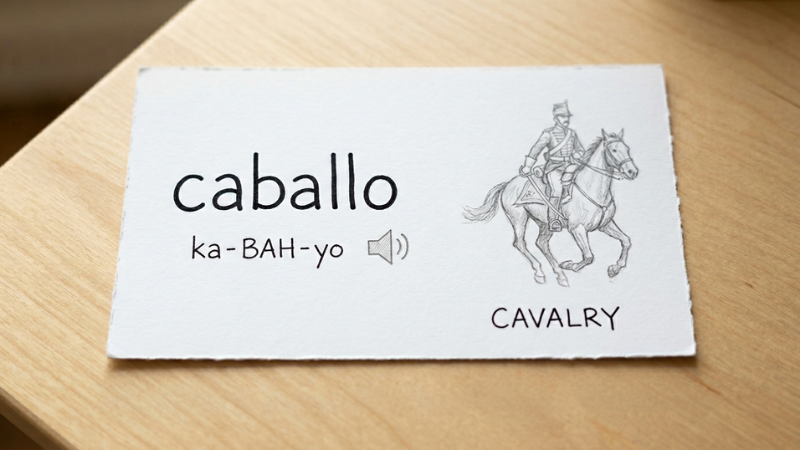
The keyword method deserves special attention because it’s been extensively researched and has practical applications beyond vocabulary learning. The technique involves two steps: first, identify a familiar word that sounds similar to the foreign word (the “keyword”), then create a vivid mental image linking this keyword to the word’s meaning.
Consider learning the French word “poubelle” (dustbin). You might use “poo-bell” as your keyword, then imagine a bell covered in rubbish ringing loudly — bizarre, memorable, effective. Or for the Spanish “ventana” (window), you could picture a van driving through a window, linking “van” to the word’s meaning.
Atkinson and Raugh’s landmark studies in the 1970s with Russian vocabulary found students using the keyword method retained 88% of words after initial learning compared to just 28% with rote repetition. Even after six weeks without review, retention remained at 72%.
However, the keyword method has clear limitations. It works brilliantly for concrete nouns but struggles with abstract concepts, verbs, and grammatical structures. Creating a vivid image for “although,” “subsequently,” or “synthesise” proves challenging. This explains why comprehensive language learning requires multiple strategies — keyword mnemonic devices for basic vocabulary, chunking for organising information, and contextual practice for grammar and usage.
QUICK WIN:
Try the keyword method right now with a word you need to remember. Find a familiar English word that sounds like part of it. Create a vivid mental image linking that sound to the meaning — the stranger the better. Test yourself on it tomorrow morning without looking at your notes first.
The Method of Loci: Memory’s Most Powerful Mnemonic Device
The method of loci, also called the memory palace technique, stands out as perhaps the most extensively researched and reliably effective mnemonic device. Dating back to ancient Greek orators who memorised hours-long speeches, this technique has been validated by modern neuroscience and deployed by contemporary memory champions.
The technique works by leveraging your brain’s exceptional spatial memory. You mentally place information at specific locations along a familiar route — perhaps your journey from home to work or a walk through your house. To recall the information, you mentally revisit each location in order, “picking up” the memories you stored there.
Suppose you need to remember a presentation on climate change covering rising temperatures, sea level rise, extreme weather, biodiversity loss, and carbon emissions. Using your home as a memory palace, you might place vivid images at each room: a giant thermometer bursting through the front door (rising temperatures), water flooding the hallway (sea level rise), a tornado spinning furniture in the living room (extreme weather), empty shelves in the kitchen representing vanished species (biodiversity loss), and thick black smoke filling the bedroom (carbon emissions).
Research by Dresler and colleagues (2017) used brain imaging to study 23 of the world’s top memory athletes. They found these champions didn’t have structurally different brains, but rather showed distinct patterns of brain connectivity during memory tasks. When ordinary people received just six weeks of method of loci training, their brain connectivity patterns began resembling those of memory champions — and participants remembered an average of 62 words compared to 27 words before training.
What makes this mnemonic device so effective? Neuroimaging studies reveal it simultaneously activates multiple brain regions: the hippocampus (critical for memory formation), retrosplenial and parahippocampal cortices (involved in spatial navigation), and visual processing areas. This multi-region activation creates richer, more interconnected memory traces than simple repetition.
Research by Maguire, Valentine, Wilding and Kapur (2003) studied memory champions and found they weren’t born with superior memories — they simply used the method of loci systematically. Brain scans revealed they activated spatial navigation areas during memorisation, essentially hijacking their brain’s powerful location memory systems.
The method of loci is particularly effective because it leverages our evolutionary heritage. Our ancestors needed excellent spatial memory to navigate environments, find food sources, and return home. This ancient brain system is robust and reliable — which is why you can probably remember the layout of your childhood home decades later but struggle to recall what you had for lunch last Tuesday.
Common Mistakes That Undermine Mnemonic Effectiveness
Knowing that mnemonic devices work is one thing — using them effectively is another. Research reveals several common mistakes that prevent people from getting the full benefits.
Creating Weak or Generic Images
The most frequent mistake is using bland, forgettable mental images. Research shows that bizarre, emotionally charged, or personally meaningful images produce significantly better recall than ordinary ones. If you’re trying to remember that Bangkok is Thailand’s capital by imagining a boring postcard, you’re wasting the technique’s potential.
Instead, make it vivid and unusual: imagine a gigantic wok (bang-wok = Bangkok) cooking pad Thai noodles on top of a government building. The stranger the image, the more memorable it becomes.
Neglecting the Retrieval Practice
Creating a mnemonic is only half the process. Research on active recall demonstrates that you must practise retrieving information using your mnemonic devices to cement them in long-term memory.
Many learners create elaborate mnemonic devices but never test themselves, assuming the creation process alone guarantees retention. Studies show that retrieval practice is essential — testing yourself strengthens the mnemonic-information link and reveals gaps in your memory system before they matter.
Using Mnemonic Devices for Everything
Not every piece of information benefits from a mnemonic. Research suggests mnemonic devices work best for information that’s difficult to connect to existing knowledge, arbitrary associations like dates or technical terms, ordered lists or sequences, and foreign vocabulary. They’re less effective for concepts you can understand through logic or narrative.
Trying to create mnemonic devices for conceptual material often wastes time. Understanding how photosynthesis works through a clear explanation is more efficient than building elaborate mental images for each chemical step.

Failing to Maintain Your Memory Palaces
If you’re using the method of loci, you need to “clear out” your memory palaces between uses. Otherwise, old information interferes with new information placed at the same locations. Memory champions typically maintain dozens of different routes they can rotate between to avoid confusion.
How Mnemonic Devices Compare to Other Learning Techniques
Understanding where mnemonic devices fit in your learning toolkit requires comparing them to other evidence-based study methods.
Spaced repetition systems, which schedule review sessions at optimal intervals, often outperform mnemonics for long-term retention of large bodies of information. Research by Cepeda et al. (2006) found that properly spaced practice produces superior retention across months and years.
However, mnemonic devices and spaced repetition aren’t competitors — they’re complementary. You can use mnemonics to learn information initially, then employ spaced review to maintain it. Medical students often use this combination: mnemonic devices to learn anatomy terms initially, then Anki flashcards with spaced intervals to prevent forgetting.
Elaborative interrogation — asking yourself “why” and “how” questions about material — produces deeper understanding than mnemonic devices alone. If you’re learning about historical events, asking “Why did this happen?” creates meaningful connections that mnemonics can’t match for conceptual learning.
The key insight: mnemonic devices excel at rapid acquisition of factual information, while other techniques better support deep understanding and long-term retention. The most effective learners use mnemonics strategically within a broader study system rather than relying on them exclusively.
QUICK WIN:
Build a simple two-step system for your next piece of factual learning: first, create a mnemonic device to encode it quickly; second, add it to a spaced repetition app like Anki and review it at increasing intervals. The mnemonic gets information in; spaced repetition keeps it there. Together they’re significantly more powerful than either alone.
Individual Differences: Who Benefits Most from Mnemonic Devices?
Research reveals that mnemonic effectiveness varies significantly between individuals, and understanding these differences can help you predict whether they’ll work well for you.
Visual Thinkers vs. Verbal Thinkers
People who naturally think in images typically find visual mnemonic devices (like the method of loci) easier to use and more effective than those who think primarily in words. However, this doesn’t mean verbal thinkers can’t benefit — it simply means they may need more practice to build their visualisation skills.
Interestingly, research shows that with training, most people can improve their mental imagery abilities. A study by Richardson (1995) found that participants who initially reported poor visualisation skills showed substantial improvement after just a few weeks of practising vivid mental images.
Age Considerations
Older adults often benefit particularly well from mnemonic training. Research by Verhaeghen, Marcoen and Goossens (1992) found that mnemonic instruction produced larger memory improvements in older adults than younger ones, possibly because older adults have more prior knowledge to link new information to.
Children can use mnemonic devices successfully from around age 7-8 onwards, once they’ve developed sufficient metacognitive awareness. However, younger children often need more guidance in creating and using mnemonics effectively.
Prior Knowledge and Expertise
Somewhat paradoxically, people with more domain knowledge sometimes benefit less from mnemonic devices because they already have rich mental frameworks for organising new information. A chess expert learning new opening sequences might not need mnemonics because they understand the strategic logic behind each move.

Conversely, beginners in a field often find mnemonic devices invaluable precisely because they lack those organisational frameworks. This explains why medical students rely heavily on mnemonics during their first year but use them less as they develop clinical understanding.
Practical Applications Beyond Academic Learning
While mnemonic devices are extensively researched in educational contexts, they have practical applications across many areas of life.
Professional and Business Contexts
Sales professionals use mnemonic devices to remember client names, preferences, and conversation details — creating stronger relationships and closing more deals. Research shows that people feel more valued when you remember details about them, and mnemonics make this skill learnable rather than innate.
Public speakers employ the method of loci to deliver presentations without notes, appearing more confident and engaging. Studies of TED speakers reveal many use spatial memory techniques to structure their talks.
Daily Life and Practical Tasks
You probably already use simple mnemonic devices without realising it. “Spring forward, fall back” for daylight saving time changes, or “lefty loosey, righty tighty” for screws and bottle tops — these are mnemonics that have proven so useful they’ve become cultural fixtures.
Mnemonic devices can help you remember where you parked your car (create a visual image linking your parking spot to something distinctive), shopping lists (use the method of loci with your home), or medication schedules (create a narrative linking each medication to a daily routine).
Learning and Creative Work
Writers and creatives use mnemonic devices to remember plot points, character details, and research findings. The technique integrates naturally with the creative process — many mnemonics themselves are creative acts, making them enjoyable rather than tedious.
Musicians use mnemonics for chord progressions, scales, and theory concepts. The famous “Every Good Boy Deserves Favour” for treble clef notes has helped countless music students, demonstrating how effective simple mnemonic devices can be when they match the learning need.
Making Mnemonic Devices Work for You
The evidence is clear: mnemonic devices work, and work well — but only when used appropriately. Success requires understanding when to use them (for arbitrary associations and factual learning), how to use them (with vivid, bizarre imagery and regular practice), and where they fit (as part of a broader learning system including active recall and spaced repetition).
Don’t fall into the trap of thinking mnemonic devices are either miraculous or useless. They’re powerful tools that require initial effort and strategic application. Start small — use the keyword method for a few foreign vocabulary words, or create a simple memory palace for your shopping list. As you experience success, you’ll naturally expand your use of these techniques to learn faster and retain more.
The question isn’t really “do mnemonic devices work?” — decades of research confirms they do. The real question is: will you invest the small amount of effort required to make them work for you?
Recommended Resources
RESOURCES:
I only recommend resources that I either use personally or have researched and feel are genuinely helpful for my readers. Resources sometimes contain affiliate links; if you purchase through these, I may earn a small commission at no extra cost to you.
Recommended Reading
Moonwalking with Einstein — Joshua Foer. A journalist’s account of training for the US Memory Championship, exploring the ancient techniques used by memory champions — including the method of loci — and the science behind how they work. Paperback | Kindle | Audible
Make It Stick — Brown, Roediger & McDaniel. The definitive evidence-based guide to effective learning. Covers retrieval practice, spaced repetition and how mnemonic devices fit into a complete study system. Paperback
A Mind for Numbers — Barbara Oakley. Practical strategies for learning difficult material, with strong emphasis on memory techniques, chunking and spaced practice. Paperback | Kindle | Audible
I'm Simon Shaw, a Chartered Occupational Psychologist with over 20 years of experience in workplace psychology, learning and development, coaching, and teaching. I write about applying psychological research to everyday challenges - from habits and productivity to memory and mental performance. The articles on this blog draw from established research in psychology and behavioural science, taking a marginal gains approach to help you make small, evidence-based changes that compound over time, allowing you to make meaningful progress in the areas you care about most.