
How Does Sleep Affect Memory? The Science Explained

How does sleep affect memory? It’s one of the most important questions in cognitive neuroscience — and the answer goes far beyond simply “getting enough rest”. Have you ever studied something late into the evening, slept on it, and found it clearer the next morning? Or conversely, pulled an all-nighter before an exam and struggled to recall material you’d known reasonably well the night before? Neither experience is coincidental.
The relationship between sleep and memory is one of the most consistently supported findings in cognitive neuroscience. Sleep doesn’t simply preserve memories — it actively transforms them. Your brain replays, reorganises, and strengthens what you’ve learned during the day, in ways that only happen during sleep. Different stages serve different purposes, and understanding how they work has direct implications for how you approach learning and retention.
Memory Consolidation: What Happens After You Learn
When you learn something new — a name, a concept, a skill — it’s initially stored in a part of the brain called the hippocampus. Think of this as your brain’s short-term holding area: quick to take in new information, but not built for permanent storage. In this early state, memories are fragile. They can be disrupted, overwritten, or simply fade. For learning to truly stick, the brain needs to move information into longer-term storage — and this process, called memory consolidation, happens primarily during sleep.
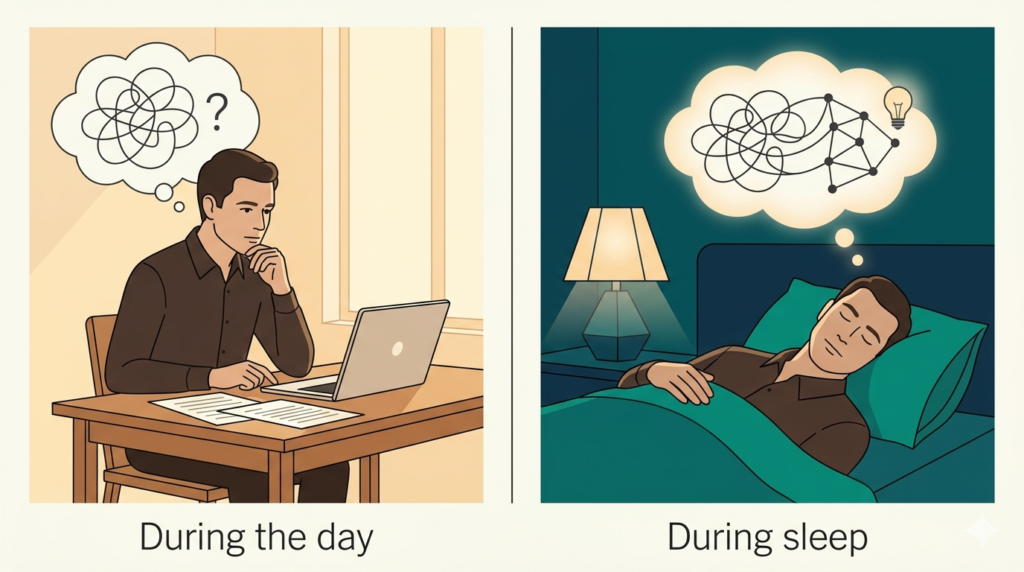
During deep sleep, the hippocampus replays what you learned during the day — like a highlight reel running quietly in the background — and gradually transfers those memories into the broader cortex, the part of the brain responsible for long-term knowledge. This isn’t a simple copy-and-paste. The brain integrates new information with what you already know, finds patterns, and sometimes makes connections you weren’t consciously aware of. This is one reason why active recall before sleep works better than re-reading — you’re giving your brain richer material to work with overnight.
It also explains why sleeping on a problem often works. Research consistently shows that people solve challenges after sleep that they couldn’t crack beforehand. The brain has been working quietly, joining dots that weren’t visible during waking hours.
How Does Sleep Affect Memory: The Role of NREM Sleep
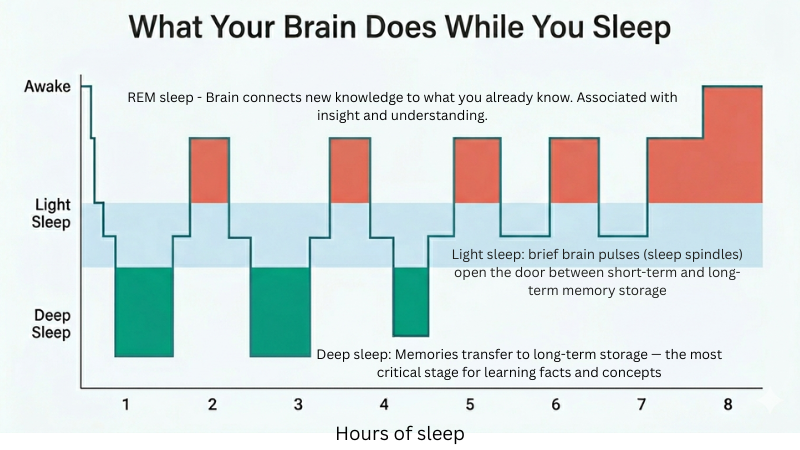
Non-REM (NREM) sleep — particularly its deepest phase, often called slow-wave or deep sleep — is the most important stage for cementing factual knowledge: the kind of memory that covers facts, events, concepts, and information you can consciously recall and explain.
Sleep spindles and their significance
During lighter NREM sleep (stage 2), the brain produces brief rhythmic pulses of activity called sleep spindles. These happen automatically — you’re not aware of them — but they matter enormously. Research consistently shows that people who produce more sleep spindles perform better on memory tasks the next day: they remember words more easily, think more clearly, and retrieve information more quickly.
Sleep spindles appear to act as a coordination signal — a kind of neural handshake — that allows information to move from the hippocampus (short-term storage) into longer-term brain networks. Disrupting this stage through early wake-ups, fragmented sleep, or alcohol — which suppresses this type of sleep — measurably reduces how well memories are retained.
Deep sleep and factual learning
The deepest stage of NREM sleep is where the real heavy lifting happens for learning. During this phase, the brain generates slow, rolling waves of activity — and the stronger those waves, the better the memory consolidation. Even a 60–90 minute afternoon nap that reaches this deep stage can meaningfully improve your ability to remember factual information compared to staying awake.
This is why studying before sleep — using active methods like spaced repetition — has genuine scientific backing. Study in the evening, sleep shortly after, and your brain gets to work on consolidating that material overnight. Study first thing in the morning and then stay awake for sixteen hours before sleeping, and there’s a much longer window for those fragile memories to degrade before they’re properly stored.
QUICK WIN:
If you have something important to memorise — a presentation, new material, a skill — do a final active recall session within 30–60 minutes of sleep rather than first thing in the morning. You’ll be giving your brain freshly activated material to replay and store during the night. This is one of the simplest and most evidence-supported adjustments you can make to your learning schedule.
How Does Sleep Affect Memory: The Role of REM Sleep
REM sleep — the stage associated with vivid dreaming, where brain activity looks surprisingly similar to wakefulness — plays a different but equally important role in how sleep affects memory. Where deep NREM sleep locks memories in place, REM sleep appears to weave them together. During this stage, the brain connects newly stored information to things you already know, finding relationships and building a richer, more integrated understanding.
This is why REM sleep is associated with insight and creativity — the moments where something suddenly makes sense that didn’t before. It’s also why it matters for genuine understanding rather than surface recall. Cramming facts without deep sleep might help you remember a list; sleeping well helps you understand what the list means and how to use it.
For skill-based learning — whether that’s playing an instrument, learning a new software tool, or mastering a physical technique — research suggests you need both deep sleep and REM sleep, in sequence, to consolidate properly. Full sleep cycles, not just an early night that cuts off before morning, produce the best outcomes.
The practical implication here is significant: REM sleep clusters in the final one to two hours of the night. Cut your sleep short by an hour and you lose a disproportionate amount of the stage most associated with understanding and integration. A seven-hour night doesn’t contain slightly less REM than an eight-hour night — it contains dramatically less.
Sleep Clears the Way for New Learning
There’s a third way sleep affects memory that most people don’t know about — and it’s nothing to do with replaying or connecting memories. It’s about cleaning up.
During deep sleep, the spaces between brain cells expand significantly, allowing fluid to flow through and flush out waste products that accumulate during the day. Among these waste products are proteins linked to Alzheimer’s disease. This brain-cleaning process — called the glymphatic system — operates far more efficiently during sleep than during wakefulness. It essentially resets the brain for the following day.
The implication for learning is direct: a brain carrying a build-up of waste products from insufficient sleep doesn’t work as well, regardless of how good your study technique is. Research suggests insufficient sleep can reduce the brain’s capacity to form new memories by up to 40%. You can’t fully compensate for poor sleep through better learning strategies — the brain itself is less capable of absorbing new information when it hasn’t been properly cleared overnight.
This cleaning process also becomes less efficient as we age, which helps explain why sleep quality — not just the number of hours — becomes increasingly important for memory as we get older.
How Sleep Deprivation Specifically Affects Memory
The memory costs of poor sleep are substantial — and the numbers are worth sitting with. A single night of no sleep can reduce memory recall by 20–40% compared to well-rested individuals. Even restricting sleep to three to six hours produces impairments comparable to pulling an all-nighter.
One study tracked participants through five nights of reduced sleep — just six hours per night — and found their working memory deteriorated progressively to a level equivalent to two consecutive all-nighters. What made this particularly striking was that participants didn’t realise how impaired they were becoming. They felt they’d adjusted to the shorter sleep, but their actual performance told a very different story.
Sleep deprivation also affects your ability to form new memories in the first place, not just to store them overnight. Brain scans show that a sleep-deprived hippocampus — your short-term memory holding area — is significantly less active when trying to take in new information. This means late-night cramming creates a double problem: memories form less effectively in the first place, and then the impaired sleep that follows provides less opportunity to consolidate what little did stick.
Age and Sleep-Dependent Memory Consolidation
The way sleep affects memory isn’t the same throughout life — and the differences are worth understanding at every age.
Children benefit especially well from sleep-based memory processing. A study published in Nature Neuroscience found that sleeping children outperformed adults at converting things they’d absorbed indirectly into clear, accessible knowledge — suggesting the developing brain is remarkably efficient at using sleep for learning. This is one reason why teenagers genuinely need more sleep (eight to ten hours) than adults, not just because they’re growing, but because their brains are doing intensive memory work overnight.
For older adults, the picture is more complicated. As we age, we naturally spend less time in deep sleep — precisely the stage most important for locking in factual memories. Many older adults get an adequate number of hours in bed but insufficient time in deep sleep for optimal memory consolidation. This is likely a significant factor in the normal memory changes many people notice as they get older.
This is directly relevant to the advice on keeping memory sharp with age: sleep quality — specifically the depth of sleep — matters as much as the hours spent sleeping, and becomes increasingly important to protect through regular exercise, consistent sleep timing, and reduced evening alcohol.
QUICK WIN:
If you want to protect your slow-wave sleep — the stage most critical for memory consolidation — three evidence-backed strategies have the most consistent support: regular aerobic exercise (even 20–30 minutes most days), consistent sleep and wake times, and eliminating or significantly reducing alcohol in the evenings. Of the three, consistent wake time is the highest-leverage single change for most people.
Practical Strategies for Sleep-Optimised Learning
The neuroscience of how sleep affects memory isn’t just academically interesting — it has direct implications for how you structure your learning.
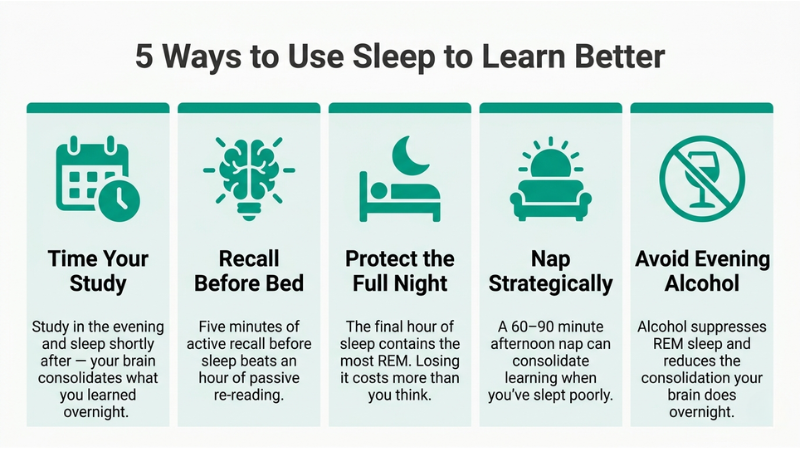
Time your study sessions strategically
Learning followed by sleep produces superior long-term retention compared to learning followed by an equivalent period of wakefulness. For important material, a focused study session in the evening — using active methods like retrieval practice or chunking — gives the brain an immediate consolidation window. Distribute practice across multiple evenings followed by sleep rather than massing it in a single session.
Use active recall before sleep
Trying to recall what you’ve learned — rather than re-reading your notes — is particularly effective immediately before sleep. The act of retrieval activates the memory traces your brain will replay and consolidate overnight. Think of it as giving your brain a clear target to work on. Even five to ten minutes of active recall before bed can meaningfully improve what you remember the next day, compared to spending the same time passively reviewing.
Protect the full night
Given that REM sleep — critical for integration and conceptual understanding — clusters in the final cycles of the night, protecting the full sleep period matters. A seven-hour night is significantly better than six for learning, not proportionally but disproportionately, because of what you preserve by not cutting the final hour. Prioritising this the night before a test, presentation, or day when you’ll need to apply new learning is well-supported by the evidence.
Consider strategic napping
Naps of 60–90 minutes — long enough to reach deep sleep — can provide genuine memory consolidation benefits, particularly when you haven’t slept well the night before. Early afternoon napping (between 1 and 3pm) is least likely to disrupt your sleep that night. Even a 20-minute nap has been shown to improve alertness and the ability to take in new information in the hours that follow.
Avoid alcohol before sleep when learning matters
Alcohol suppresses REM sleep and fragments the second half of the night — the stages most associated with integration and the consolidation of complex, conceptual material. If you have an important learning period underway, the cognitive cost of regular evening drinking is more significant than most people appreciate. It’s not just about feeling sharp the next morning; it’s about whether the consolidation process that happens overnight is operating at full capacity.
Sleep as Part of Your Learning System
The most effective learners treat sleep not as recovery time between study sessions but as an active component of the learning process itself. Once you understand how sleep affects memory — how the hours between study sessions are when your brain does some of its most important work — the relationship between effort and results shifts.
Studying hard and then sleeping well is more effective than studying harder and sleeping less. The evidence here is unusually consistent across different types of learning, different age groups, and different research methodologies. Sleep is not something you do when you’ve finished learning. It’s part of how learning works.
QUICK WIN:
Tonight, pick one thing you want to remember tomorrow — a presentation, a concept, a skill. Five minutes before bed, close your notes and try to recall it from memory. Write down what you can remember without looking. Then sleep. You’ve just given your brain a clear target to work on overnight. This is how sleep affects memory most powerfully — and it costs you five minutes.
For a broader look at how sleep affects overall cognitive performance — attention, decision-making, and long-term brain health beyond memory — see our companion article on sleep and cognitive function.
Key Takeaways
- Sleep doesn’t just preserve memories — it actively processes them, moving information from short-term storage in the hippocampus into longer-term networks across the brain.
- Deep (NREM) sleep is the primary stage for consolidating factual knowledge — names, concepts, information you can consciously recall. Brief pulses of brain activity called sleep spindles play a key coordinating role and correlate with next-day memory performance.
- REM sleep — which clusters in the final hours of the night — supports understanding and insight, connecting new knowledge to what you already know. It’s disproportionately lost when you cut sleep short.
- A single night of no sleep can reduce memory recall by 20–40%. Even restricting sleep to six hours per night produces significant cumulative impairment — and people tend not to notice how impaired they’ve become.
- During sleep, the brain also flushes out waste products that accumulate during the day. Poor sleep reduces the brain’s ability to form new memories the following day, not just to store them overnight.
- Trying to recall material immediately before sleep — rather than re-reading it — is one of the most effective things you can do to improve retention. It gives your brain richer material to work with overnight.
- Alcohol suppresses both deep sleep and REM sleep, reducing consolidation of factual and conceptual material.
- Deep sleep naturally declines with age, which is why sleep quality — not just total hours — becomes increasingly important for memory as we get older.
RESOURCES:
I only recommend resources that I either use personally or have researched and feel are genuinely helpful for my readers. Resources sometimes contain affiliate links; if you purchase through these, I may earn a small commission at no extra cost to you.
Recommended Reading
Why We Sleep by Matthew Walker — The definitive popular science account of sleep research, with extensive coverage of how sleep affects memory, learning, and long-term brain health. Paperback
Make It Stick: The Science of Successful Learning by Brown, Roediger and McDaniel — The most practical evidence-based guide to learning that sticks, with strong coverage of sleep, spacing, and retrieval practice. Hardcover
Moonwalking with Einstein by Joshua Foer — An engaging account of memory science and technique, excellent for understanding how memories form and how to work with them. Paperback
Related reading on Marginal Gains:
Learn Faster, Remember Longer — the full guide to evidence-based learning strategies, of which sleep is one of the most important
How to Use Spaced Repetition — the learning technique that works in direct partnership with sleep-based consolidation
Active Recall vs Passive Reading — why retrieval practice before sleep is more effective than re-reading
Sleep and Cognitive Function — how sleep affects attention, decision-making, and long-term brain health beyond memory
Keeping Memory Sharp with Age — why sleep quality becomes increasingly important as slow-wave sleep declines
Sleep Hygiene Tips — practical strategies to protect the sleep stages that matter most for learning
I'm Simon Shaw, a Chartered Occupational Psychologist with over 20 years of experience in workplace psychology, learning and development, coaching, and teaching. I write about applying psychological research to everyday challenges - from habits and productivity to memory and mental performance. The articles on this blog draw from established research in psychology and behavioural science, taking a marginal gains approach to help you make small, evidence-based changes that compound over time, allowing you to make meaningful progress in the areas you care about most.