
How to Maintain Mental Energy: Stop the 3pm Crash

You wake feeling sharp and capable. By mid-morning, complex problems seem solvable, decisions flow naturally, and your thinking feels crisp. Then afternoon arrives. Suddenly, simple choices become surprisingly difficult. The email you need to write sits unfinished. Tasks that would have taken minutes this morning now require mysterious quantities of willpower. Your brain hasn’t broken — it’s simply running low on cognitive fuel. Understanding how to maintain mental energy throughout the day changes everything about how you work.
QUICK WIN:
Schedule your most cognitively demanding task for tomorrow morning, ideally 2–3 hours after waking. Protect that window — no meetings, no email. Notice how much easier the work feels compared to tackling the same type of task in the afternoon.
Mental energy operates differently from physical stamina. Whilst your legs might carry you through a marathon, your brain’s capacity for sustained cognitive effort follows more restrictive rules. Understanding these limitations — and the psychological principles governing mental fatigue — allows you to work with your brain’s natural rhythms rather than against them.
How to Maintain Mental Energy: Why Your Brain Runs Out of Fuel
Your brain represents roughly 2% of body weight but consumes approximately 20% of your metabolic energy. This disproportionate demand creates a fundamental constraint: cognitive resources are finite and deplete with use. Psychologist Roy Baumeister termed this phenomenon “ego depletion” — the observable decline in self-control and decision quality following sustained mental effort.
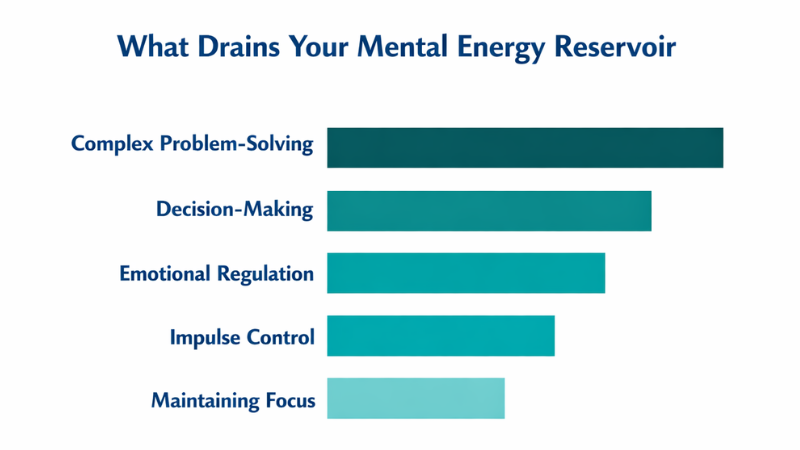
Think of mental energy as a reservoir that drains with each cognitive demand. Complex problem-solving draws heavily from this reservoir. Decision-making — even trivial choices — extracts a cost. Inhibiting impulses, regulating emotions, and maintaining focus all tap the same limited resource. Unlike physical fatigue, which localises to specific muscle groups, mental depletion affects all cognitive functions simultaneously.
Research by Kathleen Vohs demonstrates this clearly. Participants who made numerous choices — even simple ones like selecting between consumer products — subsequently showed reduced physical stamina and diminished willpower. The cognitive effort of choosing depleted resources needed for entirely different tasks. Your morning decisions about what to wear literally reduce afternoon capacity for complex analytical thinking.
Cognitive load theory provides an explanation. Your working memory — the mental workspace where active thinking occurs — has severely limited capacity. Research suggests humans can hold approximately three to five chunks of information in working memory simultaneously. Every task competing for attention increases cognitive load. When load exceeds working memory capacity, performance degrades: errors increase, processing slows, and learning deteriorates.
Decision Fatigue: The Hidden Drain on Mental Energy
Decision fatigue represents one of the most researched aspects of mental energy depletion. Each decision you make — whether trivial or consequential — extracts cognitive resources. The cumulative effect becomes substantial: by afternoon, the average professional has made hundreds of decisions, leaving cognitive reserves severely depleted. Clearing mental clutter reduces the number of open decisions your brain is tracking, which directly preserves energy for what matters.
A landmark study examining parole board decisions revealed striking patterns. Judges granted parole to approximately 65% of cases heard early in the morning. That rate dropped nearly to zero for cases heard immediately before breaks, then rebounded after judges ate. The evidence wasn’t different — the judges’ cognitive resources were. Decision fatigue led to the mentally easier default: deny parole.
The phenomenon extends beyond judicial decisions. Research shows people make poorer financial decisions later in the day. Medical residents show increased prescribing errors during extended shifts. Even ethical behaviour declines — studies demonstrate increased cheating and dishonesty when cognitive resources are depleted.
The type of decision matters significantly. Complex choices requiring evaluation of multiple variables deplete resources more rapidly than binary selections. Decisions involving self-control — resisting tempting but counterproductive options — prove particularly taxing. This explains why maintaining dietary restrictions becomes progressively harder throughout the day, and why evening hours present the greatest challenge for habit change.
QUICK WIN:
Eliminate one trivial daily decision this week. Wear the same style outfit every workday, eat the same breakfast, or set a standard lunch time. Notice how this small change preserves mental energy for decisions that actually matter.
Understanding Your Cognitive Energy Patterns to Maintain Mental Energy
Mental energy doesn’t decline linearly throughout the day. Research reveals predictable patterns of cognitive performance that follow both circadian rhythms and task-specific factors. Understanding these patterns allows strategic alignment of cognitively demanding work with periods of peak mental energy.
For most people, cognitive performance peaks approximately 2–4 hours after waking. This “golden window” occurs when sleep inertia has dissipated but mental resources remain largely intact. Complex analytical work, strategic decisions, and creative problem-solving benefit most from scheduling during these peak hours.
The post-lunch dip represents a well-documented phenomenon. Circadian rhythms naturally lower alertness in early afternoon, compounded by cognitive depletion from morning activities. Research shows processing speed slows, attention lapses increase, and error rates rise during this trough. Fighting this biology proves largely futile — better to acknowledge the limitation and adjust accordingly.
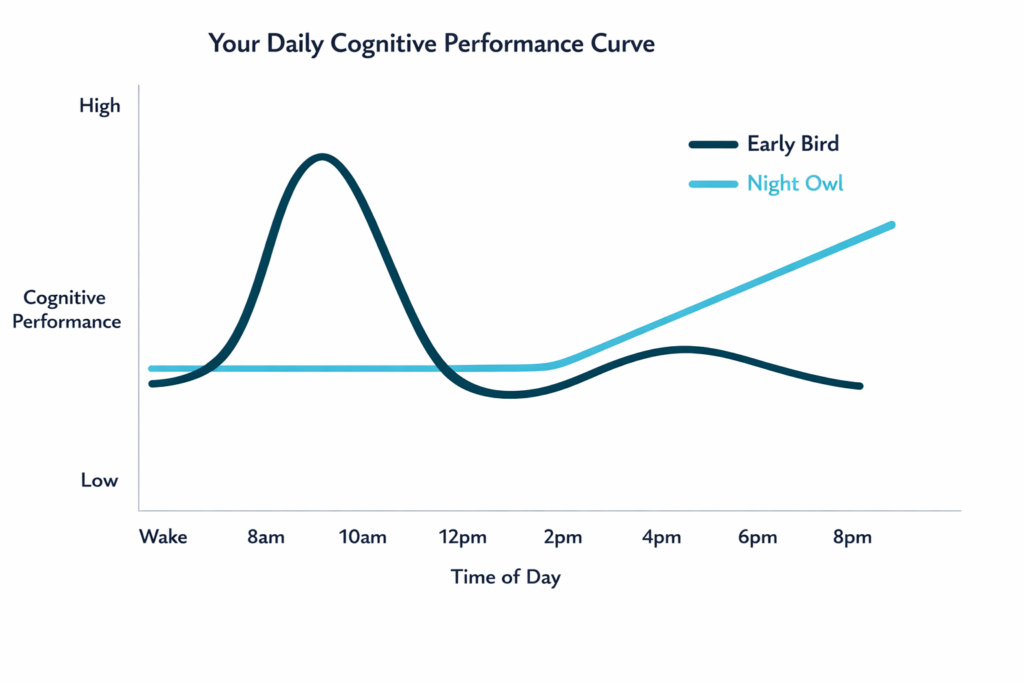
Individual chronotype significantly influences these patterns. “Larks” — morning-preferring individuals — experience earlier and more pronounced morning peaks but steeper afternoon declines. “Owls” — evening-preferring individuals — show delayed peaks and better late-day performance. Knowing your chronotype allows better task scheduling aligned with personal cognitive rhythms.
Cognitive recovery follows specific patterns. Brief breaks (5–15 minutes) provide partial restoration, particularly when involving physical movement or nature exposure. Longer breaks (30–60 minutes) allow more substantial recovery, especially when including food. One of the most effective — and most overlooked — cognitive resets isn’t a break at all. Genuine conversation with someone you trust provides restoration that solo downtime simply can’t replicate. See our guide on social connection and brain health for more about this. Finally, sleep provides complete restoration, replenishing the neurochemical resources depleted during waking hours. Without adequate sleep, cognitive performance deteriorates progressively across successive days.
The Strategic Use of Breaks to Maintain Mental Energy
Breaks aren’t indulgences — they’re neurological necessities. Attention Restoration Theory, developed by environmental psychologists Rachel and Stephen Kaplan, explains how different types of rest affect cognitive recovery. The theory distinguishes between directed attention — the effortful focus required for most work — and involuntary attention — the effortless engagement triggered by naturally interesting stimuli.
Directed attention operates like a muscle. Sustained use leads to fatigue, manifesting as difficulty concentrating, increased distractibility, and reduced impulse control. Recovery requires shifting to involuntary attention, allowing directed attention systems to rest.
Natural environments provide particularly effective restoration. Research consistently demonstrates that exposure to nature — even brief views of trees from windows — improves subsequent cognitive performance. A University of Michigan study found that participants who walked in nature for 50 minutes performed significantly better on attention tests than those who walked in urban areas. The nature walkers also reported better mood and lower anxiety.
Effective breaks share specific characteristics. They involve genuine mental disengagement from work — checking email doesn’t qualify. Physical movement enhances restoration, likely through increased cerebral blood flow. Social interaction can be restorative, provided it’s not mentally demanding. Activities requiring minimal cognitive effort but providing mild interest prove optimal.
Break timing matters as much as content. Research supports frequent brief breaks over infrequent long breaks. However, optimal timing depends on task difficulty. Complex cognitive work may require breaks every 40–50 minutes, whilst routine tasks sustain longer periods.
QUICK WIN:
Take a 10-minute walk outside during your next break — don’t check your phone. Just walk and notice your surroundings. Compare how your thinking feels when you return to work versus a break spent scrolling.
Decision Hygiene: How to Maintain Mental Energy by Reducing Cognitive Load
Since decision-making depletes mental energy, reducing trivial decisions preserves resources for important choices. This principle — termed “decision hygiene” — involves systematically eliminating unnecessary cognitive demands from daily routines.
Steve Jobs famously wore the same outfit daily. Barack Obama limited his wardrobe to blue or grey suits. These weren’t quirks — they represented deliberate strategies to preserve cognitive resources for consequential decisions. Research validates this approach: reducing trivial choices demonstrably improves performance on subsequent cognitively demanding tasks.
Practical applications extend beyond clothing. Establish default meal patterns rather than deciding what to eat each time. Create standard routines for morning activities. Batch similar decisions together — respond to all emails in one session rather than throughout the day. Automate recurring choices through habits and systems.
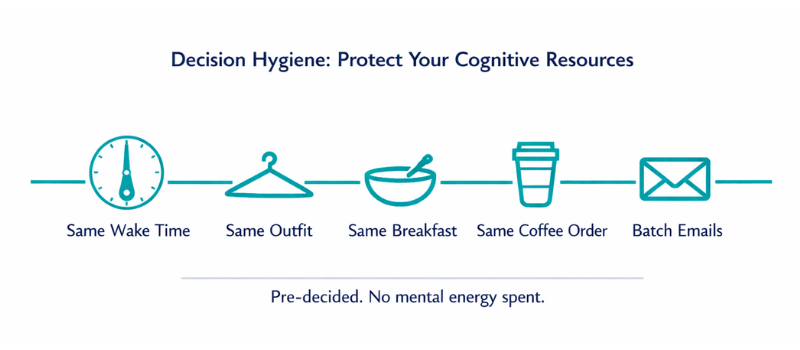
The key involves distinguishing between decisions that matter and those that don’t. Spending fifteen minutes choosing between functionally identical products wastes cognitive resources. Establishing clear criteria for routine decisions — “I always order the same coffee,” “I work out at the same time daily” — eliminates the decision entirely.
As a psychologist who has designed assessment frameworks and coached executives, I have observed that high performers instinctively protect their cognitive resources. They don’t agonise over trivial choices. They establish systems, routines, and defaults that preserve mental energy for strategic thinking and complex problem-solving.
Use the 2-minute rule to get rid of small tasks that sit on your to-do list (and for more inspiration, see our list of 50 two-minute tasks to help you reduce procrastination).
Managing Cognitive Load During Work
Beyond eliminating trivial decisions, managing cognitive load during work tasks directly affects how well you maintain mental energy. Cognitive load theory identifies three types: intrinsic load (task complexity), extraneous load (poor design or distractions), and germane load (learning and schema building).
You control extraneous load. Close unnecessary browser tabs. Silence notifications. Clear your workspace. Each environmental distraction increases cognitive load, forcing your brain to expend resources filtering irrelevant stimuli. Research shows that merely having your phone visible — even face-down — reduces available cognitive capacity.
Task switching proves particularly costly. When you shift between tasks, your brain requires time to reorient. This “switching cost” accumulates throughout the day. Studies show that people who engage in heavy multitasking perform worse on tests of attention and working memory. Focus on single tasks in dedicated blocks rather than fragmenting attention across multiple concurrent demands.
Chunking information reduces intrinsic load. Breaking complex tasks into smaller, manageable components makes them less cognitively demanding. Rather than “write report,” define specific subtasks: “outline main sections,” “draft introduction,” “find supporting data.” Each small task feels achievable and requires less working memory capacity than holding the entire project in mind.
Physical Foundations of Mental Energy
Cognitive performance depends fundamentally on physical factors. Your brain’s energy demands require consistent fuel supply, adequate rest, and proper physiological conditions. Neglecting these basics undermines any psychological strategy for how to maintain mental energy.
Sleep provides the only complete restoration of cognitive resources. During sleep, the brain clears metabolic waste products, consolidates memories, and replenishes neurotransmitters. Even modest sleep restriction — reducing sleep by 1–2 hours nightly — produces measurable cognitive impairment. Chronic sleep deprivation creates a cognitive debt that compounds across days. Prioritise consistent sleep schedules and adequate sleep duration (7–9 hours for most adults) as the foundation of mental energy management. When mental energy stops recovering overnight — when rest no longer restores you — that’s the point where depletion tips into burnout. See our guide on how to recover from mental burnout for what to do at that stage.
Nutrition directly affects cognitive function. Blood glucose fluctuations impact mental performance — both hypoglycaemia and hyperglycaemia impair cognitive processing. Stable blood glucose through regular, balanced meals supports consistent mental energy. Research shows that eating breakfast correlates with better morning cognitive performance. The post-lunch dip intensifies after large, carbohydrate-heavy meals. Smaller, protein-rich meals maintain more stable energy levels throughout the day.
Physical activity paradoxically increases mental energy. Moderate exercise improves cerebral blood flow, promotes neurogenesis, and releases neurotransmitters that enhance mood and cognition. Even brief movement breaks — 5–10 minutes of walking — improve subsequent cognitive performance. Regular exercise builds baseline cognitive capacity, making the brain more resistant to fatigue.
Stress management preserves cognitive resources. Chronic stress elevates cortisol, which impairs hippocampal function and reduces cognitive flexibility. The physiological arousal of stress itself consumes mental energy. Effective stress management techniques — whether meditation, exercise, or social support — protect cognitive capacity by preventing the sustained activation of stress response systems.
Your Mental Energy Action Plan: How to Maintain Mental Energy All Day
Understanding mental energy principles means nothing without implementation. Start with these evidence-based strategies:
Morning protection: Schedule your most cognitively demanding work for 2–4 hours after waking. Protect this golden window fiercely. No meetings, no email, no trivial decisions. Use peak cognitive capacity for work requiring peak cognitive capacity.
Decision reduction: Identify and eliminate three trivial daily decisions this week. Establish defaults, create routines, or simply commit to arbitrary but consistent choices. Monitor how this affects afternoon cognitive performance.
Strategic breaks: Take a 10-minute break every 50 minutes during demanding cognitive work. Include movement or nature exposure when possible. Genuine disengagement — not checking email or scrolling social media — allows actual restoration.
Environmental design: Reduce extraneous cognitive load. Clear workspace, silence notifications, close unnecessary applications. Create physical and digital environments that support focus rather than fragment attention.
Physical foundation: Prioritise sleep consistency, eat regular balanced meals, and incorporate brief movement throughout the day. These aren’t optional extras — they’re prerequisites for sustained cognitive performance.
Knowing how to maintain mental energy isn’t about willpower or motivation. It’s about understanding the psychological and physiological constraints governing cognitive performance, then designing your day around these realities. Your brain has limitations. Work with them, not against them.
The 3pm crash isn’t inevitable — it’s predictable. And what’s predictable can be managed.
Our Mental Performance Checklist helps you assess how you’re doing across ten areas of mental performance and consider where you can make the greatest gains.
RESOURCES:
I only recommend resources that I either use personally or have researched and feel are genuinely helpful for my readers. Resources sometimes contain affiliate links; if you purchase through these, I may earn a small commission at no extra cost to you.
Recommended reading
When: The Scientific Secrets of Perfect Timing — Daniel Pink. The most accessible and thoroughly researched book on cognitive timing — peak performance windows, the hidden cost of the afternoon trough, and how to restructure your day around when your brain actually works best. Paperback | Kindle | Audible
Indistractable: How to Control Your Attention and Choose Your Life — Nir Eyal. A practical framework for managing the internal triggers that drain mental energy before external distractions even get a look in. Essential reading if decision fatigue and task-switching are your primary challenges. Paperback | Kindle | Audible
Related Articles
How to Improve Mental Performance — The complete framework for optimising your cognitive output.
Mental Clutter Clearing — Reduce the open decisions draining your mental energy right now.
Best Exercise for Brain Health — Which types of physical activity produce the greatest cognitive benefits.
Sleep and Cognitive Function — How sleep quality directly affects memory, attention and decision-making.
Stress Management for Mental Performance — Practical techniques to stop chronic stress consuming your cognitive reserves.
I'm Simon Shaw, a Chartered Occupational Psychologist with over 20 years of experience in workplace psychology, learning and development, coaching, and teaching. I write about applying psychological research to everyday challenges - from habits and productivity to memory and mental performance. The articles on this blog draw from established research in psychology and behavioural science, taking a marginal gains approach to help you make small, evidence-based changes that compound over time, allowing you to make meaningful progress in the areas you care about most.