
Why Time Blocking Fails (And How to Fix It for Good)

Most people discover why time blocking fails the same way: you’ve blocked out every hour. The week looks perfect — a symphony of productivity. Then one meeting runs long, and suddenly the entire week falls apart. A beautifully colour-coded calendar on Monday, a cascading collapse by Tuesday afternoon.
If you’ve abandoned time blocking after a few failed attempts, you’re not broken. The system you were using was.
Here’s what nobody tells you: traditional time blocking fails because it assumes your day will unfold exactly as planned. But when does that ever happen? The good news is that time blocking can work — but only if you stop treating your calendar like a rigid contract and start building flexibility into the system itself.
Why Time Blocking Fails: 5 Reasons (And What to Do Instead)
1. You’re Scheduling Every Minute (The Overplanning Trap)
The mistake: You fill your calendar with back-to-back blocks, leaving zero room for the inevitable. One email takes longer than expected. A colleague stops by. Your brain needs a moment to shift gears between tasks. And just like that, your carefully constructed schedule collapses like dominoes.
When you over-schedule, you’re not planning — you’re creating a stress trap. The planning fallacy causes us to consistently underestimate how long tasks actually take. Research shows we’re often off by 50% or more — which means a calendar that looks achievable on paper is already broken before the week begins.
The fix: Track your actual task durations for one week using a timer. Note how long everything really takes — not how long you think it should take. Then apply the 1.5x rule: if a task usually takes 60 minutes, block 90 minutes. If writing typically takes two hours, block three. This isn’t pessimism. It’s realism that reduces stress and keeps your schedule manageable.
Start here: Build in 15-minute buffers between major blocks — schedule transition time to mentally reset, grab coffee, or handle quick interruptions.
Next step: Create a daily “flex block” of 30–60 minutes. Use this for overflow tasks, unexpected requests, or — if your day runs smoothly — as a bonus break.
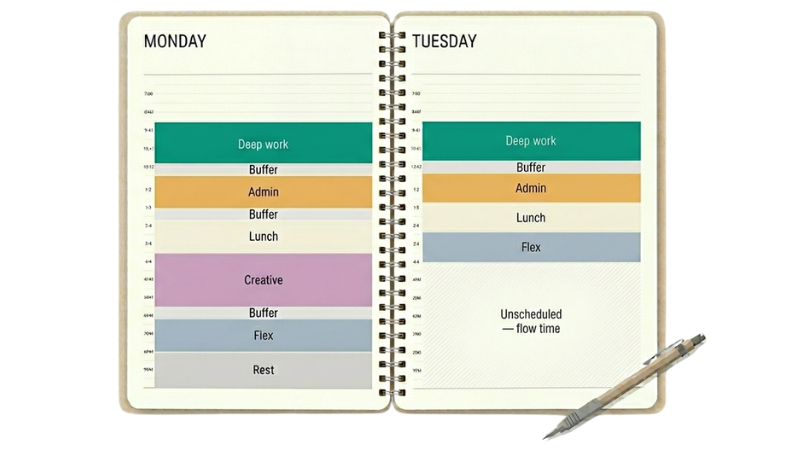
If you’re ready to go further: Schedule only 60–70% of your week. Leave entire afternoons or mornings unscheduled for deep work that requires flow. This paradoxically makes you more productive.
QUICK WIN:
Never schedule more than 80% of your available work hours. If you have 8 hours, only time block 6.5 hours maximum. The remaining 20% is your buffer — not wasted time, but the structural margin that keeps the whole system from collapsing when reality intervenes.
2. You’re Treating All Hours Equally (Energy Ignorance)
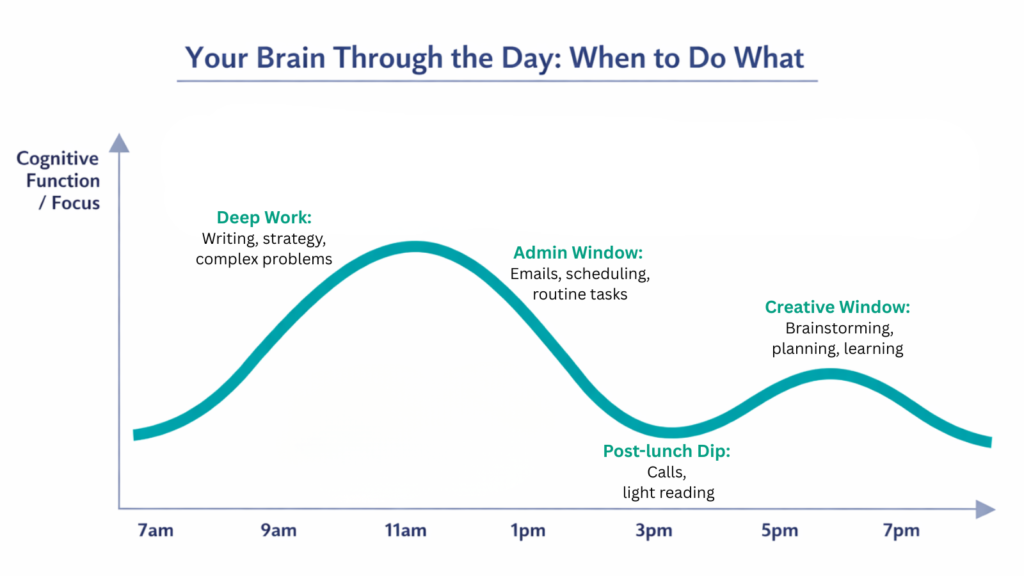
The mistake: You schedule your most demanding work for 3pm — right when your brain is at its foggiest. Time blocking assumes consistent energy throughout the day. But humans run on rhythms, not batteries. Your focus peaks and dips based on circadian rhythms, meal timing, and mental fatigue. Scheduling cognitively demanding work during low-energy periods leads to poor quality output, frustration, and the feeling that time blocking “doesn’t work.” It’s not the system — it’s the timing.
The fix: Identify your biological prime time. For one week, note when you feel most alert and focused. Most people experience peak cognitive function in mid-morning (roughly 9am–11am), with a second smaller peak in late afternoon. Ruthlessly protect your top 3–4 peak hours for deep work: writing, strategy, complex problem-solving, creative tasks. Reserve low-energy periods for shallow work: batching emails, administrative tasks, meetings that don’t require heavy thinking.
For a deeper look at managing energy across the day, see my guide on how to maintain mental energy and avoid the 3pm crash.
Start here: Simply pay attention this week. When do you knock out tasks effortlessly? When do you stare blankly at your screen? Notice the pattern before you try to change anything.
Next step: Match task type to energy level. Morning peak? Schedule writing or analysis. Afternoon slump? Batch emails or light admin work.
If you’re ready to go further: Design your whole week around energy cycles — Mondays for planning, Tuesday–Wednesday for deep work, Thursday for meetings, Friday for creative experiments. The 50/10 Focus Method pairs well here — structured focus periods aligned to your peak hours rather than arbitrary slots.
3. You’re Blocking Tasks Instead of Categories (Micromanagement Madness)
The mistake: Your calendar reads like a minute-by-minute task list — “Reply to client email (10:15–10:30),” “Brainstorm post ideas (11:00–11:25).” One late start, one task that takes longer than expected, and your entire day unravels. You spend more time rescheduling than actually working. A calendar cluttered with micro-tasks leaves no flexibility for real life. It’s mentally exhausting and breaks the moment anything unexpected happens.
The fix: Time block categories, not individual tasks. Instead of “Write quarterly report,” schedule “Deep Work: Writing” from 9:00–11:00. During that block, pull from your task list. Maybe you write the report. Maybe you draft three blog posts. Maybe you do both. The category provides structure whilst maintaining flexibility.
Start here: Create 3–5 category blocks per day — “Deep Work,” “Communications,” “Meetings,” “Admin,” “Learning.” Choose what to work on within each block rather than pre-specifying tasks.
Next step: Theme your days — Marketing Monday, Writing Wednesday, Admin Friday. Batching similar work reduces context-switching fatigue.
If you’re ready to go further: Combine category blocking with must-do lists. Identify 1–3 must-complete items daily using the 1-3-5 rule for productivity. Everything else is flexible within your category blocks.
4. You’re Being Too Rigid (Calendar Perfectionism)
The mistake: You treat your time blocks like sacred appointments. When reality diverges from your plan, you feel guilty, frustrated, or defeated. Rigid calendars crumble when life intervenes — and life always intervenes. Unexpected client calls, family emergencies, colleagues needing urgent help, or simply needing more time on a task than you’d planned. When your system feels like a moral test you’re constantly failing, you’ll abandon it altogether.
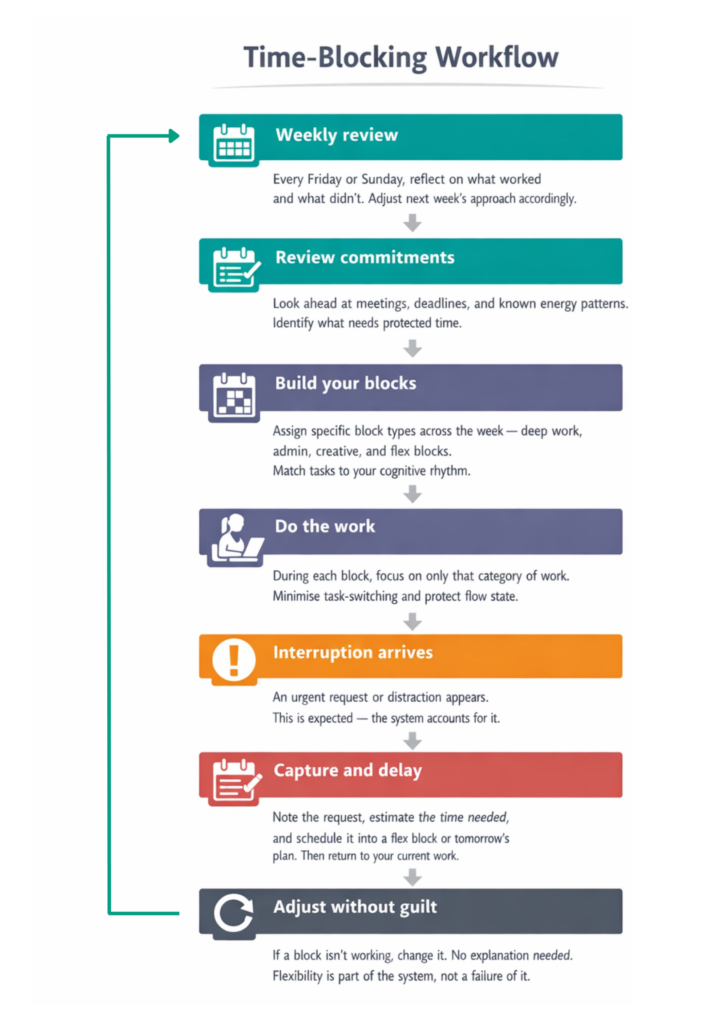
The fix: View time blocking as a framework, not a promise. Your calendar is a guide that helps you make intentional choices, not a contract you must honour at all costs. If a block slips, simply drag it forward or delete it. No guilt, no rewriting your entire week, no staying up late to “catch up.” The goal is consistency over time, not perfection on any given day. Think of your time blocks as default settings that can be overridden when circumstances warrant. Just like the 2-minute rule helps you start tasks, flexible time blocking helps you sustain them.
Start here: Give yourself permission to adjust. If a block isn’t working, change it. No explanation needed, no guilt required.
Next step: Build a weekly review and reset. Every Friday or Sunday, look at what worked and what didn’t. Adjust next week’s blocks accordingly.
If you’re ready to go further: Build “interrupt protocols.” When urgent requests arrive, use the “capture and delay” technique: note the request, estimate time needed, schedule it in a flex block or tomorrow. Then return to your current work. A reliable system for capturing ideas and requests makes this effortless in practice.
5. You’re Missing the Personal Stuff (Life Isn’t Just Work)
The mistake: Your calendar is packed with work tasks, but doesn’t include meals, commuting, exercising, family time, or simply existing as a human being. Then you take an unscheduled lunch break and suddenly you’re “behind schedule.” The stress mounts. The system feels unrealistic. If personal time isn’t represented in your plan, your plan won’t work.
The fix: Block time for everything, not just work. Include your morning routine, meals, exercise, family time, and relaxation. This isn’t over-scheduling life — it’s acknowledging reality. When everything has a place in your calendar, you can actually see whether your commitments are realistic. Bonus: your brain stops trying to remember everything, reducing mental load significantly. For more on managing the invisible cognitive load of daily life, see my guide on mental clutter clearing.
Start here: Add your morning and evening routines. Block “Morning routine 7:00–8:30” and “Evening wind-down 8:00–9:30.” Suddenly your available work hours become clearer.
Next step: Schedule breaks and meals. Lunch, coffee breaks, school pickups — they all get blocks. Your calendar now reflects your actual life, not an idealised version.
If you’re ready to go further: Protect white space deliberately. Block “Unscheduled” time for spontaneity and rest. This paradoxically makes you more productive because your brain needs downtime to process and create.
QUICK WIN:
Open your calendar right now and add one non-work block that’s consistently missing — lunch, a 20-minute walk, or your evening wind-down. Treat it as a fixed appointment. When personal time has a visible place in your schedule, the whole system becomes more honest — and more sustainable.
When Time Blocking Still Doesn’t Work for You
Even with these fixes, time blocking might not suit your working style — and that’s perfectly okay. If you’re someone who thrives on spontaneity, finds structured schedules suffocating, or works in an extremely reactive role, time blocking may never feel natural. Some personality types — particularly those who prefer flexibility and big-picture thinking — naturally resist minute-by-minute planning.
In those cases, consider alternatives like day blocking (dedicating whole days to categories without specific times), theme-based planning, or simply maintaining a prioritised to-do list with deadlines. There’s no universal time management system. The best approach is the one you’ll actually use.
Why Time Blocking Fails: Your Next Steps
If you’re ready to give time blocking another chance — this time with flexibility built in — start small. This week, identify your three peak energy hours. Protect them fiercely for your most important work. Let everything else flow around them.
Next week, add category blocks instead of task-by-task scheduling. Try “Deep Work 9:00–11:00” and see how it feels compared to micro-planning every task. The following week, build in buffers and flex time. Never schedule more than 80% of your day.
Time blocking doesn’t fail because it’s fundamentally flawed. It fails when it’s implemented as a rigid, perfectionist system that ignores human reality. Build in flexibility, honour your energy rhythms, and remember: your calendar serves you, not the other way round. For a broader view of how time and energy management fit into overall cognitive performance, use the Mental Performance Checklist to see where your biggest gains are across all ten pillars.
QUICK WIN:
The goal isn’t a perfect schedule. The goal is intentional choices about where your attention goes — with enough flexibility to adapt when life inevitably happens. Start with just one change this week: apply the 1.5x rule to your three most important recurring tasks, and build in one flex block per day. That’s it. Master those before adding anything else.
RESOURCES:
I only recommend resources that I either use personally or have researched and feel are genuinely helpful for my readers. Resources sometimes contain affiliate links; if you purchase through these, I may earn a small commission at no extra cost to you.
Recommended reading
Deep Work: Rules for Focused Success in a Distracted World — Cal Newport. The definitive case for protecting peak-focus time — essential context for understanding why time blocking is worth getting right. Paperback
When: The Scientific Secrets of Perfect Timing — Daniel Pink. Covers the science of circadian rhythms and cognitive peaks in depth — directly relevant to the energy-matching approach in this article. Paperback
Related articles
How to Focus Better at Work — Build and protect the deep focus that time blocking is designed to create.
How to Maintain Mental Energy — Understand your energy cycles before designing your time blocking system.
The 50/10 Focus Method — A focus rhythm that pairs naturally with category-based time blocking.
The 1-3-5 Rule — A daily planning framework that works inside category blocks without micromanagement.
Email Batching — The practical companion to energy-matched time blocking.
Friction Logging — Identify exactly where your time blocking keeps snagging.
Mental Performance Checklist — See how time and energy management fits into your full cognitive profile.
I'm Simon Shaw, a Chartered Occupational Psychologist with over 20 years of experience in workplace psychology, learning and development, coaching, and teaching. I write about applying psychological research to everyday challenges - from habits and productivity to memory and mental performance. The articles on this blog draw from established research in psychology and behavioural science, taking a marginal gains approach to help you make small, evidence-based changes that compound over time, allowing you to make meaningful progress in the areas you care about most.