
How Self-Limiting Beliefs Hold You Back (And How to Challenge Them)

You’ve probably caught yourself thinking something along these lines: “I’m not really a creative person.” “I’m terrible with money.” “I’ve never been good at speaking in public.” These thoughts feel like observations — accurate assessments of who you are and what you can and can’t do. But in most cases, they’re something more interesting: self-limiting beliefs that have quietly shaped your behaviour for years, often without you realising.
Understanding how self-limiting beliefs form and why they persist is considerably more useful than being told to “replace negative thoughts with positive ones” — which is the advice most articles on this topic offer, and which tends not to work particularly well in practice. Self-limiting beliefs don’t just affect how you feel about yourself. They determine what you attempt, what you avoid, how you interpret setbacks, and — crucially — what becomes possible in your life.
What Are Self-Limiting Beliefs?
A self-limiting belief is a conviction about yourself — your abilities, your worth, your possibilities — that constrains what you think, feel, and do. They differ from ordinary negative thoughts in an important way: they’re held as facts rather than as opinions. You don’t think “I sometimes struggle with public speaking” — you think “I’m not a public speaker.” The belief has been generalised, solidified, and incorporated into your self-concept.
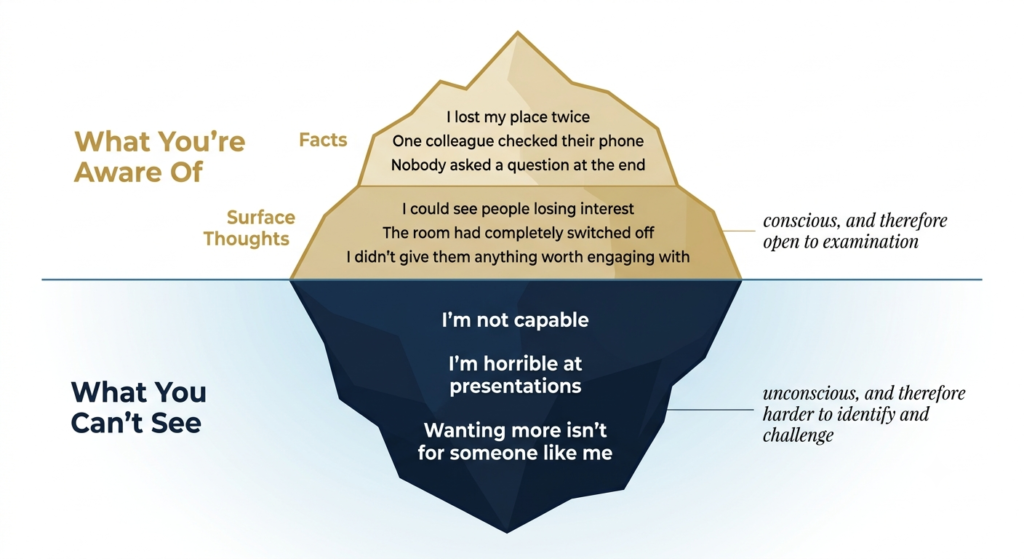
Psychologists working in the cognitive tradition describe these as ‘core beliefs’ — deep-level assumptions about the self that act as filters through which new information is processed. Unlike surface-level thoughts (“that went badly”), core beliefs operate at a more fundamental level (“that went badly because I’m fundamentally not capable at this”). They’re typically formed early in life, reinforced by experience, and become baked into your self-concept over time.
The distinction between a belief and a fact matters enormously here. Most self-limiting beliefs are not accurate assessments of fixed reality — they’re narratives that you treat as if they were accurate assessments. The person who “can’t do maths” has usually had specific experiences of difficulty with maths at a particular time, under particular conditions, with particular teaching. The generalisation from those experiences to a fixed personal trait is a cognitive leap, not a logical conclusion.
How Self-Limiting Beliefs Form
Understanding where self-limiting beliefs come from helps explain why they can be so difficult to shift. They rarely arrive fully formed — they’re usually constructed gradually, often from experiences that were significant at the time they occurred.
Early experiences and formative feedback
Much of what we believe about ourselves was formed before we had the maturity to evaluate it critically. A child told repeatedly that they’re “not academic,” “clumsy,” “too sensitive,” or “not as clever as their sibling” doesn’t have the capacity to examine those messages and reject the ones that don’t hold up. Instead, the messages get absorbed and acted upon as if they were true.
This isn’t only about overt criticism. Subtler messages are equally formative: noticing which children get called on in class and which don’t, observing which of your interests are encouraged and which are ignored, absorbing the implicit beliefs your family holds about what people “like us” can and can’t achieve. These experiences create what psychologists call ‘schema’ — mental frameworks that shape how future experiences are interpreted, for better or worse.
Confirmation bias: how beliefs sustain themselves
Once a self-limiting belief is in place, a powerful psychological mechanism works to keep it there: confirmation bias. You become primed to notice and remember information that confirms what you already believe, while discounting information that contradicts it.
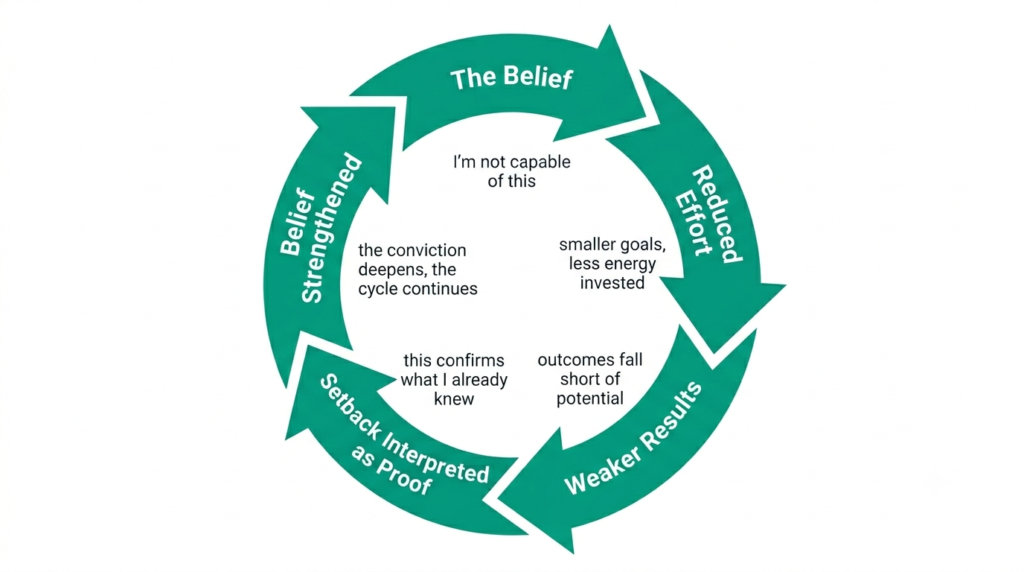
If you believe you’re bad at speaking in public, you will vividly recall every moment that felt uncomfortable, every stumble or blank, every time you saw someone in the audience look away. You will not register the times it went reasonably well, or if you do register them, they get explained away (“that was a small group,” “they were being polite,” “I just got lucky”). The belief becomes self-perpetuating: it shapes experience, which confirms the belief, which shapes the next experience.
This is why being told you’re actually capable rarely changes anything. You’re not dismissing the message — you’ve just built a system for handling evidence that doesn’t fit with your self-concept, and it operates so smoothly you barely notice your self-limiting belief working against it.
Learned helplessness: when the belief becomes a given
When confirmation bias has been running long enough, a sense of futility can set in. Psychologist Martin Seligman’s research on learned helplessness showed that repeated exposure to situations where a person’s effort produces no positive outcome leads to stopping trying — even in new situations where taking action could actually make a difference.
This explains why some self-limiting beliefs are particularly resistant to challenge. The belief that effort won’t change anything becomes self-fulfilling: you don’t try, nothing changes, and the belief is confirmed.
Seligman also identified the thought pattern that sustains a sense of helplessness (known as the “3 Ps”):
- Permanent (“no matter what I do, these setbacks will always happen”)
- Pervasive (“this problem will happen in all areas of my life, not just this situation”)
- Personal (“I failed because I wasn’t good enough”)
This explanatory style is worth noticing in your own self-talk because it hardens surface beliefs into core beliefs over time.
Identity entrenchment
Another factor that makes self-limiting beliefs particularly sticky is that they become part of your identity. “I’m not a creative person” is not just a belief about a skill — it’s a statement about who you are. And identity is something people protect, often unconsciously, because it provides a stable and coherent sense of self.
This creates a situation where evidence of your creativity feels threatening rather than reassuring. If you’ve defined yourself as “not creative” for twenty years, being confronted with evidence that you are doesn’t just update a belief — it destabilises part of your self-concept. The psychological resistance to that update is real, even when the evidence is clear.
QUICK WIN:
To surface a self-limiting belief, complete this sentence: “I’m not the kind of person who…” Write down the first three or four completions that come to mind without filtering. Then ask of each one: where did this idea come from? Is it a fact, or a story I absorbed from somewhere? When did I first start believing this? You’re not trying to challenge it yet — just to notice that it has a history, which means it isn’t simply the truth.
How Self-Limiting Beliefs Affect Goals and Performance
The practical effects of self-limiting beliefs on goal-setting and achievement are well-documented. They operate at multiple points in the goal pursuit process — and understanding where they intervene makes it easier to address them directly.
At the goal identification stage, self-limiting beliefs narrow the range of goals you consider. If you believe you’re “not ambitious” or “not the kind of person who runs businesses,” you won’t seriously entertain goals that contradict those beliefs — they simply won’t appear as options. The constraint is invisible precisely because you never get as far as considering and rejecting those goals; you’re screening them out before you even consider them.
When you’re taking actions to achieve your goals, self-limiting beliefs affect your effort and persistence. Albert Bandura’s research on self-efficacy — the belief in your capacity to perform specific tasks — shows that the higher a person’s perceived self-efficacy, the wider the range of options they seriously consider, the greater their interest in challenging goals, and the greater their staying power when those goals become difficult. The reverse is equally well-established: those with low self-efficacy tend to avoid difficult tasks, set less ambitious goals, and dwell on personal deficiencies when facing challenges. Self-limiting beliefs about ability directly suppress self-efficacy, producing a more tentative, lower-effort approach — which then generates weaker results, confirming the original belief.
When setbacks happen, a self-limiting belief determines what story you tell yourself about them. The person without a self-limiting belief in that area reads a setback as a problem to solve: “that didn’t work, I’ll try something different.” The person with one reads the same setback as evidence of something they already suspected: “I knew I wasn’t cut out for this.” Failure can reduce self-efficacy further, leading to goal abandonment or the setting of lower goals — while those with higher self-efficacy respond to the same setbacks with greater effort and commitment. It’s not the setback that derails people. It’s the meaning the belief attaches to it.
Why “Think Positive” Doesn’t Work
Understanding why the most common advice on this topic fails is a useful starting point for what actually works. Most popular advice on self-limiting beliefs involves replacing negative thoughts with positive ones: turn “I can’t do this” into “I can do anything I set my mind to.” This approach is not only ineffective for most people — it can make things worse.
The problem is that positive affirmations that contradict deeply held self-limiting beliefs create an uncomfortable mental conflict. The gap between “I am a confident, capable speaker” and your actual lived experience of struggling with public speaking isn’t bridged by the affirmation — it’s highlighted by it. Social psychologist Joanne Wood at the University of Waterloo described the “Peril of Positive Affirmations” (you can read more about this here), finding that people with low self-esteem who used positive self-statements actually felt worse afterwards: the statement highlighted the gap between the affirmation and their actual self-concept rather than bridging it.
Genuine belief change requires something different: disputing the evidence on which the self-limiting belief rests. This is what cognitive behavioural approaches do well when applied properly — not affirmations, but structured inquiry into the accuracy of the belief itself.
How to Challenge a Self-Limiting Belief: A Step-by-Step Process
The approaches below follow a logical order — each step builds on the previous one. You don’t have to work through all of them in a single sitting, but the sequence matters. If you’d find a structured framework useful for working through this process in the context of a specific goal, the GROW coaching model provides a useful scaffold.
Step 1: Surface the belief clearly
Before you can examine a self-limiting belief, you need to state it precisely. Vague discomfort isn’t workable — a clearly articulated belief is. Write it down in plain language: not “I’m not really a people person” but “I believe I’m not capable of building professional relationships.” Be specific.
Step 2: Treat the belief as a hypothesis, not a fact
This is the core move of cognitive restructuring from CBT. A self-limiting belief feels like a fact from the inside. However, the question isn’t whether it feels true, it’s whether it is true. Ask yourself: what is my evidence for this belief? When did the experiences that formed it occur, and under what conditions? Would those same experiences lead someone else to the same conclusion? Is there counter-evidence you’ve been discounting?
A useful CBT prompt here: what would you say to a close friend who told you they believed this about themselves? Most people apply considerably harsher standards to themselves than to others, and the question makes that double standard visible.
Step 3: Examine your language
The language of self-limiting beliefs tends to be absolute and permanent: “I’m not good at X,” “I never manage to Y,” “I’m just someone who can’t Z.”
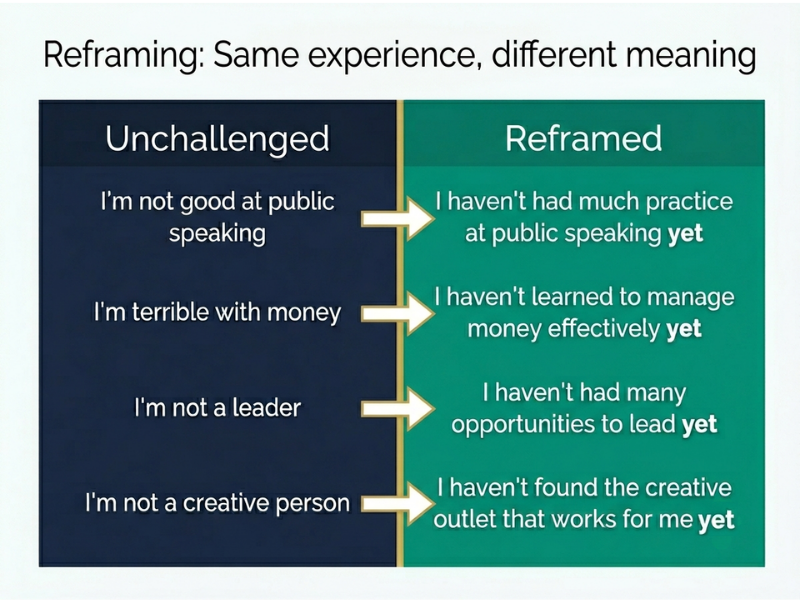
Rewrite your self-limiting belief in language that’s more accurate: something genuinely defensible. For example, “I’m not good at public speaking” becomes “I haven’t had much practice at public speaking yet, and the experiences I’ve had felt uncomfortable.” This reframe matters. “I’m not good at public speaking” sounds like a fact about the kind of person you are. “I haven’t had much practice yet” sounds like a fact about where you currently are. One closes the door, the other leaves it open.
This kind of language shift is sometimes called cognitive reframing — a technique drawn from both CBT and NLP that involves changing the way a situation or belief is described in order to change how it’s perceived. The reframe doesn’t deny the original experience; it places it in a more accurate and less fixed context. Notice how adding the word “yet” — a small change — moves the belief from a permanent statement about identity to a temporary description of where you currently are.
Step 4: Understand what your self-limiting belief is protecting you from
Self-limiting beliefs often have a function: they protect against the pain of genuinely trying and not succeeding. “I’m not creative” means you never have to submit creative work and face the vulnerability of having it judged. “I’m not good with money” means you never have to look at your finances and confront what you might find. For each belief you’re working with, ask yourself: what would I have to risk or face if this belief turned out to be wrong?
The second question to sit with is whether that protection is still worth what it costs you. The protection made sense when the belief formed — often in circumstances very different from your life now — but has since become a constraint rather than a resource. Write down what you’re protecting yourself from, and then write down what holding the belief is costing you. Most people find the cost has quietly grown to outweigh the protection, and seeing that clearly is often what makes the next steps feel worth attempting.
Step 5: Build new evidence by taking action
Examining a self-limiting belief can loosen its grip — but it rarely shifts it completely. What actually changes a belief, in the end, is experience. Specifically, experiences that contradict it. Bandura’s research shows that your sense of what you’re capable of changes most reliably when you do something and see what happens — not when you think differently or repeat a more positive version of the belief.
The key is to start small. If you believe you’re bad at public speaking, the goal isn’t to immediately address a conference — it’s to speak up once in a meeting where you’d normally stay silent. Notice what actually happens. Nothing terrible, in all likelihood. Write that down. That’s real evidence that doesn’t fit the old story, and it counts — even if it feels minor. Then find the next small opportunity and repeat. Over time, those experiences accumulate into a genuinely different evidence base, and the belief has less and less to stand on.
The question to ask yourself at this stage: what is the smallest action I could take this week that would test this self-limiting belief? Not disprove it in one leap — just test it. Start there.
Step 6: Monitor how you explain setbacks to yourself
Setbacks will happen, and when they do, your old self-limiting belief will try to reclaim its status as a fact. When you notice that happening, pause and look at the story you’re telling yourself about what went wrong. It will probably have one or more of these characteristics: it implies the setback will always happen (“I knew I couldn’t do this”), that it affects everything (“this proves I’m just not capable”), or that it says something fixed about who you are (“this is just the way I am”).
When you spot that pattern, rewrite the explanation — literally, on paper if possible. Force yourself to be specific: what exactly went wrong, in this particular situation, on this particular occasion? What was the context? What would you try differently next time? A setback that started as “this confirms I’ll never be any good at this” should end up as something closer to “that specific approach didn’t work in that specific situation — here’s what I’d adjust.”
This isn’t false positivity — it’s about accuracy. The absolute version of the story is almost never the true one, and catching yourself in it, and narrowing it back down to what actually happened, is one of the most practical things you can do to stop a setback from resetting the progress you’ve made.
A note on expectations: this process unfolds over weeks and months, not days. A self-limiting belief that has been in place for decades, reinforced by hundreds of confirming experiences, won’t dissolve after one journalling session. What changes gradually is the weight of evidence — and each time you work through these steps, you’re shifting that balance. Over time, the belief loses its status as obvious fact and becomes something more like a provisional hypothesis that is increasingly hard to sustain.
QUICK WIN:
Pick one limiting belief you identified earlier. Write down: (1) three pieces of evidence that seem to support it, (2) three pieces of evidence that contradict it — experiences where things went differently to what the belief would predict. Most people find step 2 harder, not because the counter-evidence doesn’t exist, but because confirmation bias means it hasn’t been registered or remembered. The exercise itself begins to rebalance the evidence base.
Self-Limiting Beliefs and Individual Differences
The six steps above apply broadly, but the pattern of your self-limiting beliefs — where they cluster, what themes they share, how strongly they’re held — is shaped by personality and history. Understanding your own pattern is more useful than working through a generic list of “top ten limiting beliefs.”
People higher in Neuroticism — a personality trait associated with emotional reactivity, anxiety, and a tendency toward negative self-evaluation — can tend to have a broader and more active set of self-limiting beliefs, and those beliefs are often more tightly connected to the anticipation of failure, rejection, or humiliation. For this group, belief work may need to address the underlying anxiety alongside the beliefs themselves, rather than treating them as separate problems.
People with high Conscientiousness sometimes encounter a subtler form of self-limiting belief: perfectionism that has tipped from a genuine quality standard into a reason not to start. The pattern tends to show up as “if I can’t do this properly, I shouldn’t do it at all” — and while it can masquerade as high standards, it functions as avoidance. It’s worth noting that this isn’t an inevitable feature of conscientiousness; many highly conscientious people don’t fall into it. But for those who do, recognising it as a belief rather than a standard is the first step to working with it.
Values awareness also matters here: self-limiting beliefs that conflict with deeply held values tend to be more distressing and more motivating to change than those in domains you don’t care much about. Identifying which self-limiting beliefs sit at the intersection of your values and your goals is a useful prioritisation tool.
When to Seek Professional Support
The approaches described above are genuinely useful for many self-limiting beliefs, particularly those in the mild-to-moderate range. But some self-limiting beliefs are deeply entrenched, bound up with significant past experiences, or connected to clinical-level anxiety or depression in ways that make self-directed work insufficient.
If a self-limiting belief is causing significant distress, is connected to traumatic past experiences, or has proven highly resistant to your own attempts to shift it, a qualified CBT therapist or coach with appropriate psychological training is worth engaging. These issues work better with a skilled practitioner guiding the process than as a solo self-help exercise — particularly for deeply held beliefs where the emotional charge is high.
Key Takeaways
- Self-limiting beliefs are convictions about yourself held as facts rather than opinions. They operate as filters that shape what you attempt, how you interpret setbacks, and what becomes possible.
- They form through formative experiences — particularly early ones — and are sustained by confirmation bias and identity entrenchment. They are not accurate assessments of fixed reality.
- Repeated exposure to situations where effort produces no result can lead to learned helplessness — a generalised sense of futility that transfers even to situations where action could make a difference.
- Positive affirmations that contradict deeply held self-limiting beliefs typically don’t work and can make things worse by highlighting the gap between the affirmation and lived experience.
- Effective challenge involves treating the self-limiting belief as a hypothesis and subjecting it to genuine evidential scrutiny — not replacing it with its opposite, but examining whether the evidence actually supports it.
- Behavioural experiments — small, graduated actions that test the belief — build genuine disconfirming evidence over time. This is more effective than any purely cognitive technique.
- Self-limiting beliefs often have a protective function: understanding what a belief is shielding you from is important for working with it effectively.
- How you explain setbacks matters: reading them as permanent, pervasive, and personal reinforces self-limiting beliefs; reading them as specific and situational preserves momentum.
- Individual differences matter: the pattern, content, and emotional charge of self-limiting beliefs varies by personality, history, and values. Working on the beliefs most relevant to your goals and values is more effective than working through a generic list.
- Belief change is a gradual process of evidence accumulation, not a single transformative insight.
RESOURCES:
I only recommend resources that I either use personally or have researched and feel are genuinely helpful for my readers. Resources sometimes contain affiliate links; if you purchase through these, I may earn a small commission at no extra cost to you.
Recommended Reading
Nudge: Improving Decisions About Health, Wealth and Happiness by Thaler and Sunstein — not exclusively about self-limiting beliefs, but provides excellent grounding in how cognitive biases shape behaviour in ways we’re rarely aware of. Paperback
Atomic Habits by James Clear — particularly strong on how identity-level beliefs shape behaviour, and how small behavioural changes can shift both habits and the self-concept underlying them. Paperback
Learned Optimism by Martin Seligman — the original source for the explanatory style framework discussed in this article, and a practical guide to shifting the way you interpret setbacks. More accessible than its academic origins suggest. Paperback
Related reading on Marginal Gains:
How to Identify Your Core Values — understanding your core values helps you identify which self-limiting beliefs matter most to work on, and why.
The GROW Coaching Model — a structured framework for working through self-limiting beliefs in the context of specific goals.
How to Set Goals You’ll Actually Achieve — connecting belief work to practical goal setting.
I'm Simon Shaw, a Chartered Occupational Psychologist with over 20 years of experience in workplace psychology, learning and development, coaching, and teaching. I write about applying psychological research to everyday challenges - from habits and productivity to memory and mental performance. The articles on this blog draw from established research in psychology and behavioural science, taking a marginal gains approach to help you make small, evidence-based changes that compound over time, allowing you to make meaningful progress in the areas you care about most.