
Self-sabotage: Why You Do It and How to Stop

You know what you want. You’ve set the goal, made the plan, perhaps told people about it. And then — almost imperceptibly at first — you start creating obstacles. You miss the gym session, ignore the email, eat the thing you said you wouldn’t, pick the argument that derails the relationship. Part of you watches this happening and doesn’t understand it. Another part, if you’re honest, feels almost relieved.
Self-sabotage is one of the most frustrating experiences in goal pursuit precisely because it’s internally generated. It’s not bad luck or external circumstances — it’s you, working against yourself. Understanding why this happens is much more useful than trying to motivate yourself past it, because most self-sabotage isn’t a motivation problem. It’s a protection problem.
What Self-Sabotage Actually Is
Self-sabotage refers to behaviours and thought patterns that interfere with your own goals and interests — actions that, from the outside, seem to contradict what you say you want. It shows up in recognisable forms: procrastination on something that genuinely matters to you, perfectionism that prevents starting, withdrawing from relationships just as they deepen, underperforming in situations where you’re capable of more, or creating crises that conveniently derail progress.
What these patterns share is an apparent paradox: you want the outcome, but you’re undermining your chances of achieving it. This paradox is the key to understanding what’s actually happening. In most cases, self-sabotage isn’t irrational — it’s a rational response to a perceived threat that your conscious mind hasn’t fully registered.
The threat isn’t the goal itself. It’s what achieving the goal might mean — or what attempting it and failing might prove.
The Psychology Behind Self-Sabotage
Several well-established psychological mechanisms explain why self-sabotage occurs. Understanding them doesn’t make the behaviour disappear, but it does make it considerably less mysterious — and mystery is part of what gives self-sabotage its power.
1. Cognitive dissonance and identity threat
One of the most important mechanisms is ‘cognitive dissonance’ — the uncomfortable mental friction that occurs when what you’re doing contradicts what you believe to be true about yourself. Think of it as your mind’s need for a consistent internal story. When the story doesn’t add up, something has to change.
If you hold a deep, identity-level belief that you’re ‘not the kind of person who succeeds at things like this,’ then actually succeeding creates exactly that friction. Your behaviour and your self-concept are pulling in opposite directions, and that tension is uncomfortable — more uncomfortable, for many people, than simply not succeeding.

Self-sabotage resolves this tension by undermining your attempt to change, and your sense of who you are stays intact. The behaviour that looks self-defeating from the outside is actually doing an important job on the inside: keeping your identity consistent and stable, even when that identity is holding you back.
2. Fear of failure — and fear of success
Fear of failure is the more obvious driver. If you don’t fully commit, you can’t fully fail — so holding back, procrastinating, or underperforming gives you a built-in excuse. Psychologists call this self-handicapping: creating obstacles or reducing effort so that if things go wrong, you can blame the circumstances rather than your own ability. It costs you performance, but it protects your ego.
Less obvious, but just as common, is fear of success. This sounds strange at first — why would anyone fear getting what they want? But success brings its own threats: higher expectations, shifting relationships, a version of yourself that feels unfamiliar. If your identity is built around being “not quite there yet,” actually arriving raises an uncomfortable question: who are you now? For some people, the familiar ache of falling short feels safer than the unknown pressure of having to stay there.
3. The upper limit problem
Gay Hendricks calls this the Upper Limit Problem — the idea that we each have an internal thermostat set to a certain level of success and happiness, and when we exceed it, we unconsciously sabotage ourselves back down to familiar ground (The Big Leap, 2009). When things are going well — perhaps unusually well — this internal thermostat kicks in and generates behaviour that brings things back to a more familiar level.
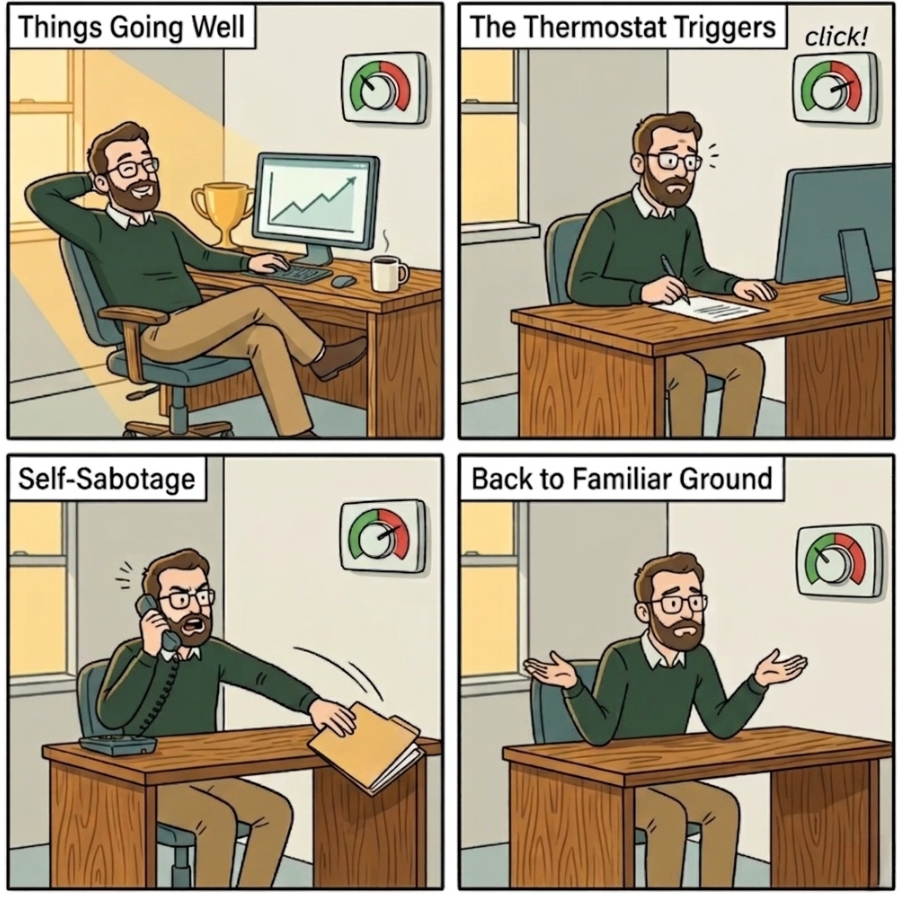
This isn’t mystical — it maps onto basic psychology. We get used to a certain level of functioning, and a big shift upward can feel just as unsettling as a drop. That’s why self-sabotage often strikes precisely when things are going well: the argument after a good week, the missed opportunity just as momentum builds. It’s not random. It’s the mind trying to return to familiar ground.
4. Avoidance and the short-term relief trap
Avoidance works — in the short term. When you put off something difficult, you get an immediate hit of relief. That relief is real and feels genuinely good, which is exactly the problem: it trains your brain to avoid again next time. The future payoff of having done the hard thing is abstract and distant; the relief of not doing it is right now.
Over time, avoidance shrinks your world. The list of things you’re dodging grows, and the anxiety around each one quietly intensifies — because you never get to find out that you could have handled it. Every time you sidestep something, you send yourself a small message: this is dangerous, and staying away is the right call. Eventually, the avoidance feels less like a choice and more like a fact about who you are.
QUICK WIN:
Think of a goal you’ve repeatedly started and abandoned, or an area where you consistently underperform relative to your ability. Ask: what would it mean about me if I succeeded here? And: what would I have to give up or face if things actually went well? The answers often surface the real obstacle — which is rarely lack of motivation or discipline.
How to Recognise Your Self-Sabotage Patterns
Self-sabotage is easier to tackle once you can spot your own patterns. It looks different for everyone — shaped by your personality, your history, and the particular areas of life where your deepest doubts tend to show up.
How many of these common self-sabotage patterns do you find yourself doing?
Procrastination on meaningful work — distinct from ordinary procrastination, this specifically targets things that matter. The bigger the investment you have in an outcome, the stronger the avoidance can be, because more is at stake if it doesn’t go well.
Perfectionism as avoidance — setting standards so high that starting becomes impossible, or abandoning work before it’s finished because it isn’t yet good enough. This protects against the vulnerability of releasing something imperfect and having it judged.
Self-handicapping — creating obstacles before attempting something: staying up too late before an important meeting, not preparing adequately, or taking on too much so that any failure has a ready external explanation.
Relationship withdrawal — pulling back, creating conflict, or finding fault with a relationship just as it deepens or goes well. Often driven by fear of loss, abandonment, or the vulnerability of genuine closeness.
Comfort eating, excessive alcohol, or other numbing behaviours — particularly when they occur specifically in response to progress or positive momentum, rather than just stress.
Success followed by sudden self-destruction — the pattern of things going well, then an inexplicable decision that undoes the progress. This is the upper limit problem in its clearest form.
The key question for any of these patterns is: does this happen specifically in areas where something important to me is at stake? If yes, self-sabotage is the more likely explanation than simple bad habits or poor discipline.
The Role of Personality and Individual Differences
Self-sabotage patterns vary significantly between people, and personality plays a meaningful role in shaping both the form they take and the underlying drivers.
Psychologists commonly use the Big Five model to describe personality — five broad traits that capture how people differ in the way they think, feel, and behave: Openness, Conscientiousness, Extraversion, Agreeableness, and Neuroticism.
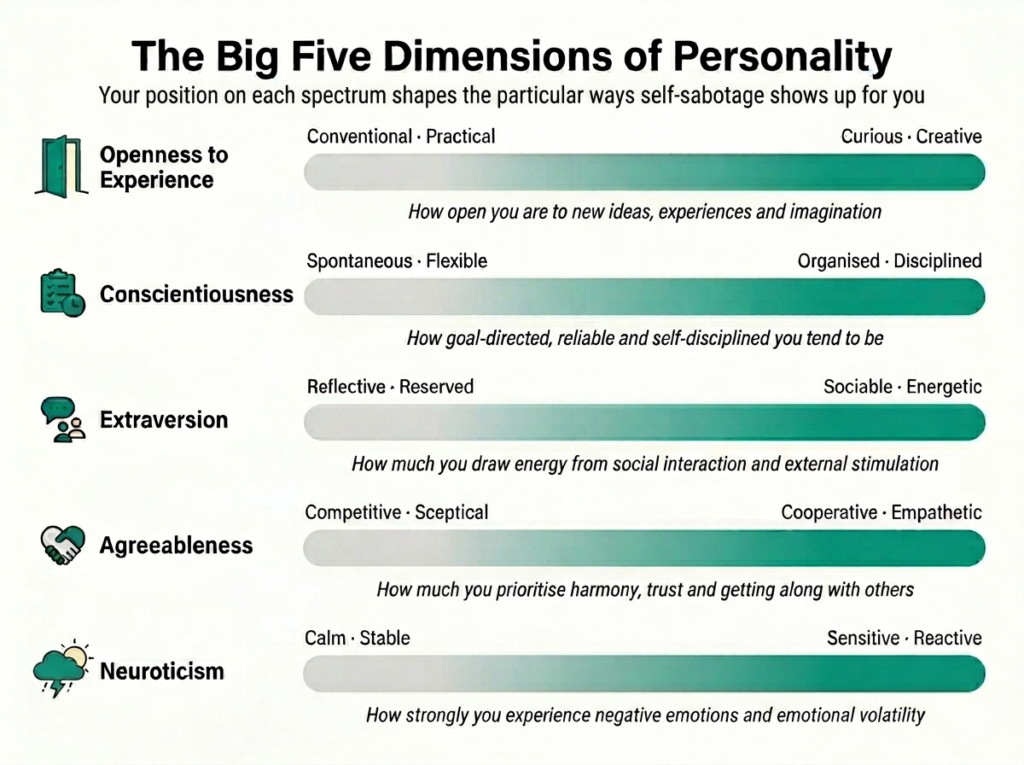
These aren’t categories you fall into, but dimensions everyone sits somewhere on. Three of them are particularly relevant to self-sabotage:
People higher in Neuroticism — the trait associated with emotional sensitivity and anxiety — tend to experience more frequent and intense self-sabotaging behaviour. Because anxiety is more easily triggered in this group, the relief that comes from avoidance is particularly compelling and hard to resist.
People high in Conscientiousness often express self-sabotage through perfectionism: the drive for high standards tips into paralysis when those standards become a threat (if my work isn’t perfect, it says something damaging about me). This can look like high achievement on the outside while producing significant internal distress and avoidance of anything where performance can’t be controlled.
Those with a strong need for others’ approval — sometimes associated with high Agreeableness or people-pleasing tendencies — may self-sabotage specifically when pursuing their own goals feels selfish or risky. Their self-sabotage often serves a social function: keeping themselves small enough not to threaten relationships or invite judgment.
Understanding how your personality shapes the goals you set and how you go about achieving them is directly relevant here — knowing your profile helps you anticipate which forms of self-sabotage you’re most susceptible to and why.
Working with Self-Sabotage: A Toolkit
Because self-sabotage often operates without us realising it — and is driven by genuine emotional needs like protection, stability, and safety — approaches that focus purely on thinking have limits. What works is a combination of insight, behavioural change, and compassion. The approaches below draw on these three elements. They aren’t steps to follow in order: they address different aspects of self-sabotage, and you can use whichever is most relevant to your situation, or work with several in combination.

Name the pattern without judgment
The first step is simply noticing — and doing so without turning the observation into another reason to feel bad about yourself. Self-sabotage is already a response to threat; layering shame on top of it tends to intensify the very anxiety that drives the behaviour in the first place.
This is consistent with a well-evidenced concept in psychology called self-compassion, developed by researcher Kristin Neff. Self-compassion doesn’t mean letting yourself off the hook — it means observing your own behaviour with the same openness you’d extend to someone else in the same situation. Research consistently shows that self-compassion is associated with greater motivation and resilience after setbacks, not less — which runs counter to the intuition that being hard on yourself is what drives improvement.
In practice, this means noticing a pattern — the procrastination, the argument, the missed opportunity — and naming it neutrally: “this is self-sabotage, and it’s serving a function.” Not “I’m doing it again” as a condemnation, but “I’m doing it again” as a piece of information. That shift in tone, small as it sounds, changes what becomes possible next.
Identify the underlying threat
Once you’ve noticed a pattern, the more useful question is: what is this behaviour protecting me from? What am I afraid would happen if this went well? What belief about myself is this behaviour consistent with?
This kind of inquiry sits at the heart of both cognitive behavioural therapy (CBT) and schema therapy — two well-evidenced psychological approaches that treat problematic behaviour not as a flaw to be corrected, but as a response to a perceived threat. The behaviour makes sense once you understand what it’s protecting against.
The answers are often uncomfortable — which is part of why self-sabotage is preferable to asking the questions. But naming the threat explicitly reduces its power. It also shifts the frame from “I keep failing at this” to “I have a particular fear in this domain, and I’ve been managing it through avoidance.” That’s a much more workable starting point.
Lower the stakes of single attempts
Self-sabotage thrives when each attempt feels like a verdict on who you are. If trying and failing would confirm your worst fears about yourself, the stakes become enormous — and enormous stakes generate enormous avoidance.
This is consistent with what psychologists call evaluative threat — the fear that performance will reveal something damaging about your fundamental worth or ability. One well-supported way to reduce this is to shift from outcome goals (“succeed at this thing”) to process goals (“try this approach today”). When the measure of success is showing up and attempting rather than achieving a specific result, failure carries much less identity weight. This is one reason why the approach described in our goal-setting post directly addresses self-sabotage — breaking goals into smaller, lower-stakes experiments reduces the pressure that drives avoidance.
Build evidence against the underlying belief
Since self-sabotage is often driven by self-limiting beliefs about what you’re capable of or worthy of, thinking your way out of those beliefs rarely works on its own. What does work is accumulating real experience that contradicts them.
In CBT, this is called a behavioural experiment — instead of trying to think your way into a new belief, you gather real evidence that challenges the old one. In practice, that means creating small wins in the area where sabotage keeps happening. Not dramatic breakthroughs, just consistent small actions that slowly build a different picture of what you’re capable of. It’s a gradual process, but it tends to work in a way that insight alone doesn’t — because the belief wasn’t formed by reasoning in the first place. It was formed by experience. And experience is what changes it.
Notice when things are going well — and stay alert
If your pattern involves things going well and then imploding, anticipating this is more useful than being surprised by it. Psychologists have documented a phenomenon called the self-licensing effect — the well-evidenced finding that doing well can paradoxically give us unconscious permission to ease off or self-destruct. Research by Merritt, Effron and Monin (2010) showed that past good deeds can liberate people to engage in behaviours they would otherwise avoid — as if progress earns a kind of psychological permission slip to undermine it. This is distinct from laziness or lack of commitment: it’s an automatic response to feeling that you’ve already done enough.
When you notice momentum building — a good week, positive feedback, meaningful progress — that’s precisely the moment to be more attentive, not less. The pull toward sabotage often doesn’t feel like self-destruction. It shows up as vague restlessness, irritability, or a sudden urge to do anything other than keep going. Naming it when it arises — “this might be the self-licensing effect kicking in” — creates a pause between the feeling and the behaviour. This is what mindfulness-based approaches call urge surfing: observing the impulse without immediately acting on it. That pause is where the choice lives.
QUICK WIN:
Next time you notice yourself avoiding something important, instead of pushing through with willpower, pause and ask: “What am I protecting myself from right now?” Write down the honest answer — not the logical reason you’re procrastinating, but the emotional one. You don’t need to solve it immediately. Simply making the implicit fear explicit shifts your relationship with the behaviour.
When Self-Sabotage Goes Deeper
For most people, the approaches above — combined with honest self-reflection and patient behavioural work — are sufficient to meaningfully reduce self-sabotaging patterns over time. But some self-sabotage is deeply entrenched, rooted in significant early experiences, or connected to clinical-level anxiety, depression, or trauma responses that go beyond what self-directed work can address.
If your self-sabotage is causing significant life disruption, is connected to painful early experiences you haven’t fully processed, or has proven highly resistant to your own efforts over a long period, working with a qualified therapist or psychologist is worth considering. For everyday patterns of avoidance and self-sabotage, CBT (cognitive behavioural therapy) has a strong evidence base. For deeper patterns — the kind that feel like they’ve always been there, woven into how you see yourself — schema therapy is worth exploring. It works with the early beliefs and coping styles that tend to drive the most stubborn forms of self-sabotage. A good coaching relationship — using frameworks like the GROW model — can also be effective for self-sabotage that’s more goal-specific and less clinically complex.
Sustainable change comes from values alignment and intrinsic drive, not from forcing yourself past protective mechanisms with willpower. Addressing the underlying fear is more effective — and more lasting — than repeatedly trying to override the self-sabotage through sheer determination.
Key Takeaways
- Self-sabotage is behaviour that undermines your own goals — but it’s rarely irrational. It typically serves a protective function, managing fears about failure, success, identity, or vulnerability.
- Cognitive dissonance is a key driver: when succeeding would conflict with your beliefs about yourself, sabotage restores internal consistency. It’s identity-preserving, not self-destructive in intent.
- Fear of failure drives self-handicapping — creating obstacles so failure has an external explanation. Fear of success drives withdrawal when things are going well.
- The upper limit problem describes the tendency to unconsciously cap positive experience at familiar levels, generating disruptive behaviour when things go unusually well.
- Avoidance provides immediate relief from anxiety, reinforcing self-sabotaging patterns even when they undermine long-term goals.
- Personality shapes which forms of self-sabotage you’re most susceptible to — higher Neuroticism amplifies avoidance; perfectionism is common in high Conscientiousness individuals; people-pleasing drives self-suppression in those with a strong need for others’ approval.
- Working with self-sabotage involves noticing patterns without judgment, identifying the underlying threat, reducing the stakes of individual attempts, and building counter-evidence through consistent small actions.
- Self-sabotage and self-limiting beliefs are closely connected — if one resonates, the other is worth exploring too.
RESOURCES:
I only recommend resources that I either use personally or have researched and feel are genuinely helpful for my readers. Resources sometimes contain affiliate links; if you purchase through these, I may earn a small commission at no extra cost to you.
Recommended Reading
Atomic Habits by James Clear — particularly strong on the identity-level dimension of behaviour change, which connects directly to why self-sabotage occurs and how consistent small actions rebuild a different self-concept. Paperback
Nudge: Improving Decisions About Health, Wealth and Happiness by Thaler and Sunstein — excellent grounding in how unconscious patterns and cognitive biases shape behaviour in ways we’re rarely aware of. Paperback
Related reading on Marginal Gains:
How to Set Goals You’ll Actually Achieve — structuring goals to reduce the identity threat that drives self-sabotage.
WOOP: The Goal-Setting Technique Backed by Science — a structured method for anticipating obstacles before they derail you, which maps directly onto the self-sabotage patterns described in this article.
How to Identify Your Core Values — self-sabotage often happens when goals aren’t aligned with what genuinely matters to you; this article helps you identify that foundation.
I'm Simon Shaw, a Chartered Occupational Psychologist with over 20 years of experience in workplace psychology, learning and development, coaching, and teaching. I write about applying psychological research to everyday challenges - from habits and productivity to memory and mental performance. The articles on this blog draw from established research in psychology and behavioural science, taking a marginal gains approach to help you make small, evidence-based changes that compound over time, allowing you to make meaningful progress in the areas you care about most.