
How to Identify Your Core Values (And Why They Matter)

What are your core values? It’s one of those questions that sounds like it should have a quick answer. Jot down a few words — honesty, family, creativity — and move on. But if you’ve ever sat with the question properly, you’ll know it’s more slippery than that. Most people have a rough idea about what they value, but unexamined values tend to be vague and sometimes contradictory — which makes them useless as practical guides. Some people also have a big gap between what they say they care about and what their actual behaviour reveals they prioritise. Someone who says they value health but consistently works late and sacrifices sleep isn’t being dishonest; they simply haven’t examined the gap.
Most goal-setting advice skips straight to the goals: what you want to achieve, by when, with what steps. What it rarely asks first is what actually matters to you. That omission is why so many goals get abandoned — not because you lacked discipline, but because the goal was never properly yours to begin with.
Getting clear on how to identify your core values isn’t a philosophical exercise — it’s practical and well worth the time invested. Goals that align with your values are more motivating and easier to commit to. Goals that don’t feel like hard work, even when you’re achieving them. Understanding the difference changes everything about how you approach goal setting — and psychologists have been studying exactly this for over 50 years.
What Are Core Values?
Values are distinct from beliefs and attitudes. Beliefs are something you hold to be true about the world — “hard work leads to success” or “people are fundamentally good.” An attitude is an evaluation about something specific — your feelings about a particular job, person, or situation. Values are also different from goals. A goal is specific and time-bound: “I want to be promoted within 18 months.” A value is ongoing and directional: “I care about doing meaningful, high-quality work.” Goals are achieved and replaced; values endure. Understanding your values helps you set goals that are genuinely yours, rather than goals you feel you should set to please others or because everyone else is pursuing them.
Values sit at a deeper level. They’re not claims about how the world is, nor reactions to specific things — they’re enduring convictions about what matters and what kind of person you want to be. Beliefs, attitudes and goals can shift relatively quickly in response to new information or experience (see our article on challenging self-limiting beliefs for more on this); values tend to be more stable, and when they do change, it usually signals something significant has shifted in your life.
Values are the principles that matter to you — things like honesty, creativity, fairness, freedom, achievement or security. When your life and work reflect your values, you tend to feel energised. When they conflict, you feel a sense of dissatisfaction that’s hard to ignore. How are you feeling about your life and work right now? Do they truly reflect your values?
QUICK WIN:
Take two minutes to rate each of your main life areas — work, relationships, health, finances (plus any others that feel important to you) — out of ten for how satisfied you feel right now. For any area scoring six or below, ask: is there a values conflict here? Is something I care about being consistently overlooked or compromised in this area? Notice where the dissatisfaction is pointing.
A Brief History of Values Research
The science of personal values has a serious academic history stretching back over half a century — and understanding where it came from helps explain why the tools built on it are genuinely useful, rather than just interesting exercises. Two researchers in particular defined the field.
Rokeach’s Terminal and Instrumental Values
The modern era of values research began with American social psychologist Milton Rokeach. In his landmark 1973 book The Nature of Human Values, he proposed something deceptively simple: that all human values could be organised into just two lists of 18. Both matter, and they tend to cluster into a coherent personal value system unique to you.
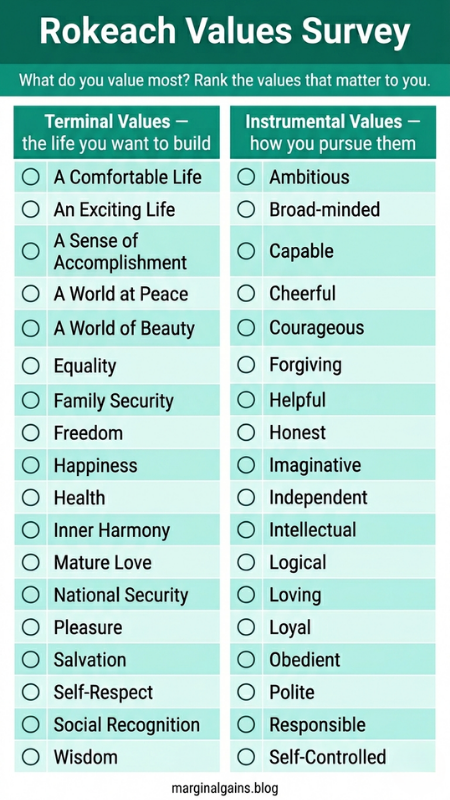
The first list (terminal values) describes desired end-states of existence — the kind of life you want to build: things like freedom, equality, happiness, wisdom, and a comfortable life. The second (instrumental values) describes how you’d like to behave in getting to your terminal values — for example, honesty, ambition, courage, self-control, or imagination.
Rokeach gave participants each list and asked them to rank the 18 values from most to least important. The forced ranking is the key feature — you can’t just agree with everything. This discipline makes the trade-offs visible, which is where the real insight lies. You can download our version of the Rokeach Value Survey here to explore your own terminal and instrumental values.
Rokeach’s contribution was to find a way to measure a person’s values — something you could study rigorously, compare across people, and track over time. It laid the groundwork for everything that followed.
Schwartz and the 10 Universal Values (1992 Onwards)
Psychologist Shalom Schwartz built on Rokeach’s foundations. Conducting surveys across more than 80 countries, he identified 10 basic human values that appear across cultures:
- Self-Direction (independent thought and action) — freedom, independent, curious, creativity, choosing own goals, privacy, self-respect
- Stimulation (excitement and novelty) — daring, variation in life, excitement in life
- Hedonism (pleasure and personal gratification) — enjoying life, self-indulgent, pleasure
- Achievement (personal success and competence) — capable, successful, influential, ambitious, intelligent
- Power (social status and dominance) — wealth, social recognition, authority, social power, preserving my public image
- Security (safety and stability) — healthy, family security, social order, clean, reciprocation of favours, sense of belonging, national security
- Conformity (self-restraint in social situations) — self-discipline, politeness, honouring of elders, obedience
- Tradition (respect for cultural customs and ideas) — humble, detachment, respect for tradition, devout, moderate, accepting my portion in life
- Benevolence (care and concern for close others) — a spiritual life, forgiving, helpful, honest, true friendship, meaning in life, responsible, loyal, mature love
- Universalism (understanding and care for all people and nature) — broadminded, unity with nature, equality, protecting the environment, inner harmony, a world of beauty, a world at peace, wisdom, social justice
He illustrated the relationships between values using a circular structure with two sets of opposing dimensions: (i) Self-Transcendence (caring about the welfare of others and the world) vs Self-Enhancement (prioritising personal success and status) and (ii) Openness to Change (valuing independence, novelty, and pleasure) vs Conservation (valuing stability, tradition, and conformity to expectations).
Neighbouring values tend to be compatible (pursuing one supports the other), while values on opposite sides conflict (pursuing one comes at the expense of the other). For example, Achievement and Power sit together, but Achievement and Benevolence sit on opposite sides.
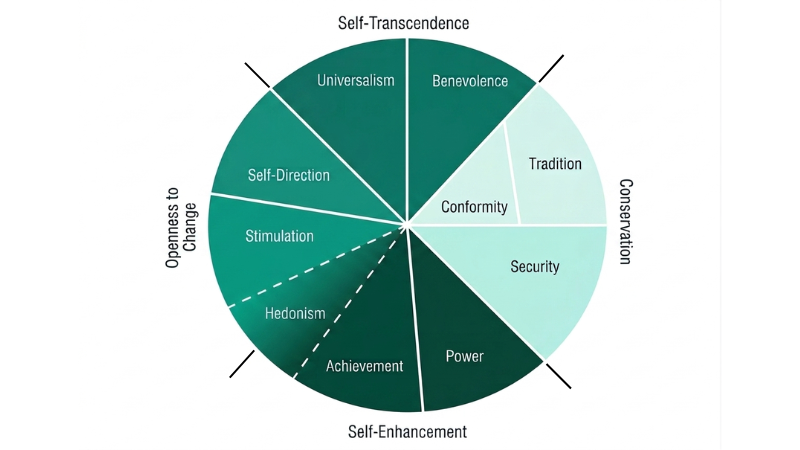
This maps onto real human experience in a way that’s immediately recognisable. If your core values include both Security and Stimulation, you’re likely feeling these pulling you in different directions. Simply identifying these value clashes can help you clarify what you truly want.
Notice two quirks: 1. Hedonism straddles two dimensions, because seeking pleasure is both an act of personal freedom (Openness to Change) and an act of self-interest (Self-Enhancement). 2. Conformity and Tradition appear in the same segment as both involve aligning your own desires with something outside yourself: others’ expectations (conformity), or culture and religion (tradition).
Schwartz’s framework of human values has been tested extensively and found to apply across different cultures and age groups. It underpins much of the values work you’ll find in psychology and coaching. His assessment tools — the Schwartz Value Survey and Portrait Values Questionnaire — are available free for non-commercial use.
QUICK WIN
Set a timer for five minutes and answer this in writing: “When have I felt most like myself — most energised, most in flow?” Don’t overthink it. Write whatever comes up. The values driving that experience are likely among your most important, and you’ll probably spot them immediately when you read it back.
A Step-by-Step Process for Identifying Your Core Values
The process below draws on values clarification methods from coaching that you can use to clarify your own core values. Work through the steps in order — each one builds on the last. The five steps are sufficient on their own; the tools linked along the way are optional if you’d prefer a more structured approach at any stage.
Step 1: Generate a Broad List of Values
Start by reviewing a values list. James Clear provides a useful list of common values that you can work from.
Go through and mark anything that creates a sense of recognition — an internal “yes, that really matters to me.” Don’t worry about how many you mark at this stage — just flag any that feel truly important to how you live your life.
If you’d prefer to do this online, try the University of Cambridge’s Portrait Values Questionnaire (PVQ), which takes less than 10 minutes and shows which of Schwartz’s 10 values are most important to you.
Step 2: Reflect on Your Peak Experiences
Think back to times when you felt most alive, most engaged, most like yourself. These might be professional moments, personal ones, or both. Ask: what was present in those experiences? What made them feel meaningful or right?
Equally useful is the negative version: recall times you felt genuinely uncomfortable or out of place — not just difficult, but wrong in some way you couldn’t quite articulate. What value was being violated in those situations?
This step is often more revealing than the list review, because it grounds values in lived experience rather than abstract preference. The patterns you notice here are harder to idealise or ignore.
If you’d like a more structured prompt for this reflection, try the “what would I want said about me?” exercise: imagine someone who knows you well giving a short speech about the life you lived. What qualities would you most want them to describe? What would feel like a painful omission? The values that surface are usually among your most important — and because the exercise is rooted in imagined experience rather than a list of words, it tends to bypass the self-flattering answers.
Step 3: Look at Your Behaviour, Not Your Intentions
Where do you consistently invest time and energy without being asked to? What genuinely angers or upsets you? What consistently feels energising versus draining? Objective records of what you actually do — your calendar or your bank statement — can be painfully honest indicators of what you truly value.
This step closes the gap between espoused values (what you say is most important) and lived values (what you actually do day to day). If you claim to value learning but never voluntarily pursue it, that’s worth examining — either learning isn’t as core as you thought, or something is getting in the way.
Step 4: Reduce and Prioritise

From your initial list, identify your top ten, then reduce again to your top five. This is where things get genuinely difficult: you’ll have to move some values to the “less important” pile in order to focus on your highest priorities.
When choosing between values, ask: if I had to give up one of these, which would feel more of a loss? Which would genuinely hurt to live without? This exercise forces you to acknowledge the trade-offs that real life involves — and to be honest about what actually drives you, rather than what you wish drove you.
Many people find that several of their initial selections were actually instrumental values (the means) rather than terminal ones (the ends). “Success,” for example, often turns out to be instrumental — the underlying value might be achievement, recognition, security, or financial freedom. Getting to the underlying value makes it a more useful guide.
This is where a card sort comes into its own. The University of New Mexico’s Personal Values Card Sort is free to download, takes around 20 minutes, and the physical act of sorting can be particularly helpful. If you prefer to work online, try Russ Harris’s Values Checklist, which asks you to place only five values in your “most important” pile.
Step 5: Test Against Your Current Life
With your refined list, look at the commitments in your schedule — your work, your relationships, how you spend your time. For each, ask: is this consistent with my values? Where are the alignments? Where are the conflicts?
This isn’t meant to trigger a life overhaul. It’s diagnostic. Most people find some areas of strong alignment and others where they’ve drifted — usually without consciously deciding to. That information is precisely what you need to set meaningful goals and make better decisions going forward.
If you want to explore your values in a group context — with a partner, family, or team — the Good Project Value Sort from Harvard (free at thegoodproject.org/value-sort) includes a comparison feature that makes shared and divergent values immediately visible. It works particularly well once you’ve completed steps 4 and 5 individually.
QUICK WIN
Look at your top five values and your current week. If you could make just one small change to bring them into better alignment — not a life overhaul, just one thing — what would it be? Write it down and schedule it.
How to Link Core Values to Other Aspects of Your Life
Use Values to Set Better Goals
Once you have a clear sense of your core values, they become a filter for goal setting. Before committing to any significant goal, it’s worth asking: which of my values does this serve? If you can’t identify a clear connection, that’s a signal worth paying attention to — either the goal isn’t genuinely yours, or you need to reframe it in a way that makes the values connection explicit.
Values-aligned goals are also more resilient to setbacks. When you’re clear on why a goal matters — not just what you want to achieve but what value it serves — you have an intrinsic reason to persist that survives bad weeks, external obstacles, and the loss of initial enthusiasm. Intrinsic motivation outlasts the extrinsic kind: it’s rooted in values, not circumstances.
You can also use your values to resolve apparent goal conflicts. When two goals feel in competition — career ambition and family time, for example — looking at the underlying values often reveals whether the conflict is real or apparent. Sometimes it is real, and you have to make a genuine trade-off. More often, there’s a way of pursuing both that simply requires more creative thinking about how.
Align Your Values and Your Identity
There’s a deeper dimension to values clarification worth naming. Your values don’t just guide your goals — they define your sense of who you are. When you act consistently with your values, you experience what psychologists call value congruence: a sense of wholeness and alignment between inner and outer. Research consistently links this to greater life satisfaction, self-esteem, and resilience.
When you repeatedly act against your values, the opposite happens: a quiet dissonance that erodes self-respect and motivation over time, often leading to your sabotaging your goals. This is why values-based goal setting is ultimately about more than productivity. It’s about living intentionally — building a version of your life that reflects what you actually care about rather than what you’ve drifted into.
Your mental performance and natural strengths play into this too — understanding how you’re wired complements your values to give you a fuller picture of what meaningful, sustainable goal pursuit looks like for you specifically.
QUICK WIN
Take your top five values and write one sentence for each: “I know I’m living this value when I…” This turns abstract words into concrete, observable behaviour — and makes it much easier to notice when you’re aligned and when you’re not.
Use Values in Habit Formation
There’s a strong and often overlooked connection between values and the habits that shape daily life. Your habits are, in practice, the most honest expression of your values. What you do repeatedly — without much deliberate thought — reflects what you’ve implicitly decided matters most in the allocation of your time and attention.
This cuts both ways. Identifying your values and then designing your habits to reflect them is a powerful way to create alignment between what you care about and how you actually live. But examining your existing habits can also reveal values you’ve been enacting unconsciously — sometimes productively, sometimes not.
When you’re trying to build new habits and finding it difficult, checking whether the habit genuinely reflects a value you hold is worth doing. Habits that are extrinsically motivated — built because you think you should, not because they connect to something you care about — tend to require sustained willpower to maintain. Habits rooted in genuine values tend to require far less effort once established, because the motivation is already there. Combining habit formation strategies with values work is more powerful than either alone.
When Values Conflict

Most people hold values that are, at least partially, in tension with each other. Achievement and family. Career and connection. Security and adventure. Freedom and belonging. This is exactly what Schwartz’s circumplex predicts — and it’s the normal condition of a complex human life, not a sign of confusion or inconsistency.
The mistake is to try to resolve these tensions by suppressing one value in favour of another — deciding, for example, that you only value achievement and not family, because acknowledging both makes things complicated. This kind of false resolution produces goals that are impoverished and lives that feel imbalanced in ways that are hard to articulate.
A better approach is to acknowledge the tension explicitly and manage it consciously. This might mean creating distinct domains for different values — protecting time for family as deliberately as you create time for achievement. Or it might mean finding goals that satisfy multiple values simultaneously: a project that’s professionally ambitious but also deeply meaningful, or a role that offers autonomy alongside genuine connection.
A Few Things Worth Keeping in Mind
Values can shift over time — usually gradually, in response to significant life experiences. It’s worth revisiting them periodically, particularly after major transitions: career changes, relationship shifts, or significant loss. What mattered most at 25 may not be what matters most at 45, and that’s entirely normal. The goal isn’t to fix your values in amber; it’s to stay in honest conversation with yourself about what actually drives you.
It’s also fine to hold values that are in some tension with each other. Most people do. Acknowledging that tension — rather than resolving it artificially by downgrading one value — gives you a more accurate picture of the trade-offs you’re genuinely navigating.
Finally: values are personal. They’re not a moral hierarchy. Having security as a core value isn’t less worthy than having adventure. Having family at the centre of your life isn’t less admirable than having professional ambition. The goal of this work is clarity and congruence, not conformity to an external standard of what a well-lived life should look like.
RESOURCES:
I only recommend resources that I either use personally or have researched and feel are genuinely helpful for my readers. Resources sometimes contain affiliate links; if you purchase through these, I may earn a small commission at no extra cost to you.
Recommended Reading
The Happiness Trap by Russ Harris — the most accessible introduction to the role of values in building a meaningful life. Practical rather than theoretical, and more useful than most self-help books on the topic.
Free Tools Referenced in This Article
Core Values List — James Clear (free, useful starting point for Step 1)
Portrait Values Questionnaire (PVQ) — University of Cambridge (free online, under 10 minutes, best for Step 1)
Personal Values Card Sort — University of New Mexico (free PDF download, best for Step 4)
Values Checklist — Russ Harris (free PDF, online alternative for Step 4)
Value Sort — Harvard’s Good Project (free online, works on mobile, best for Step 5 and group use)
Rokeach Values Survey — our own printable version (free download)
Related Articles
How to Set Goals You’ll Actually Achieve — using values as the foundation for goal setting
Why Willpower Fails at Building Habits — why values-aligned goals are more durable than willpower alone
The GROW Coaching Model — a practical framework for self-directed goal reflection
How to Improve Mental Performance — understanding your cognitive strengths and how to work with them
Habit Formation — combining values work with the mechanics of lasting behaviour change
I'm Simon Shaw, a Chartered Occupational Psychologist with over 20 years of experience in workplace psychology, learning and development, coaching, and teaching. I write about applying psychological research to everyday challenges - from habits and productivity to memory and mental performance. The articles on this blog draw from established research in psychology and behavioural science, taking a marginal gains approach to help you make small, evidence-based changes that compound over time, allowing you to make meaningful progress in the areas you care about most.
Similar Posts
Self-sabotage: Why You Do It and How to Stop
You know what you want. You’ve set the goal, made the plan, perhaps told people about…
How Self-Limiting Beliefs Hold You Back (And How to Challenge Them)
You’ve probably caught yourself thinking something along these lines: “I’m not really a creative person.” “I’m…
How to Set Goals You’ll Actually Achieve
Most people know they should set goals. Fewer people actually do it well. And a striking…
WOOP Goal Setting: The Science Behind Why It Works
Most goal-setting advice tells you to think positively. Visualise success. Picture where you want to be….
The GROW Coaching Model: How to Coach Yourself
Most of us have areas of our lives we’d like to change — a career that…