
Habit Formation: How to Make Small Changes That Actually Stick
Most of us have a graveyard of abandoned habits somewhere in our past. The gym membership that lasted three weeks. The meditation app with seventeen sessions before it became digital furniture. The journal that got as far as January 12th. If that sounds familiar, the good news is that it almost certainly wasn’t a willpower problem — it was a strategy problem.
As a Chartered Occupational Psychologist, I’ve spent over two decades helping people understand and change their behaviour. And the single most consistent finding from both research and practice is this: the people who build lasting habits aren’t the ones who try harder. They’re the ones who make it easier to succeed.
This guide cuts through the pop-psychology noise to give you what the evidence actually shows about habit formation — how habits work neurologically, why they fail, and the practical strategies that genuinely hold up when life gets messy. No 21-day promises. No motivation speeches. Just a clear framework for making small changes that actually stick.
What Is Habit Formation? The Science Explained
Habit formation is the process by which behaviours become automatic through repeated practice in consistent contexts. A substantial proportion of our daily behaviours are performed habitually, requiring minimal conscious thought or effort — meaning much of what you do today, you’re likely to do tomorrow without giving it a moment’s conscious thought.
That’s not laziness, it’s efficiency. Our brains are a “cognitive misers”, conserving mental energy by converting frequently repeated actions into automatic routines. The same mechanism that makes it hard to break a bad habit is precisely what makes good habits so valuable once they’re established.
The Neuroscience of Habit Formation
The brain region most involved in habit formation is the basal ganglia — an ancient cluster of structures deep within the brain that coordinates voluntary movement and, crucially, converts repeated goal-directed actions into automatic routines.
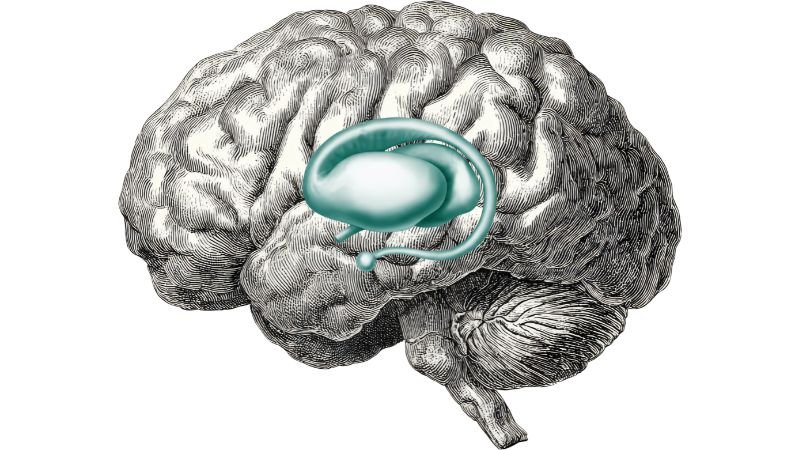
When you first learn a new behaviour — driving a car, for instance, or learning to touch-type — your prefrontal cortex (the brain’s decision-making centre) is working hard. Every step requires conscious attention. But as you repeat the behaviour in consistent contexts, the basal ganglia begin to encode the sequence as a single chunk. The prefrontal cortex gradually hands over control, freeing up mental resources for other things. This is why an experienced driver can navigate a familiar route whilst holding a conversation — the driving habit runs on autopilot whilst conscious attention goes elsewhere.
Habits create and strengthen neural pathways through a process called long-term potentiation. Each repetition deepens the connection between neurons. Think of it as creating a path through a field — the more times you walk the same route, the clearer and easier to follow it becomes. And just as a well-worn path doesn’t disappear overnight, an established neural pathway doesn’t simply vanish when you decide to change. It must be weakened through disuse whilst you simultaneously build a new, competing pathway. That’s why behaviour change takes patience rather than just intention.
Habits vs Conscious Behaviour: Why the Difference Matters
Understanding the distinction between habitual and goal-directed behaviour is one of the most practically useful things you can take from the psychology of habit formation. Goal-directed behaviour is flexible — if the outcome changes, the behaviour adapts. Habitual behaviour is triggered by context cues and continues even when outcomes change, which is why you might reach for your phone the moment you sit on the sofa even when you’d genuinely rather read a book. The cue (sofa) triggers the routine (phone) before conscious intention gets a look in.
This also explains why telling yourself to “just stop” a bad habit rarely works. You’re trying to override an automatic process with conscious effort — and conscious effort is exactly the resource that gets depleted first under stress, tiredness, or distraction.
The Habit Loop: How Every Habit Actually Works
At the heart of every habit — good, bad, or indifferent — lies a neurological pattern known as the habit loop. Understanding this loop is the foundation for both building new habits and changing unwanted ones.
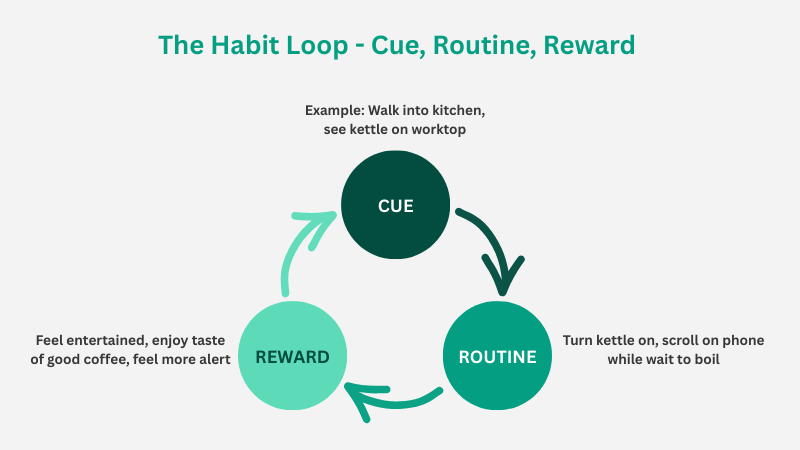
Cue: The Trigger
The cue is the signal that tells your brain to initiate the automatic behaviour. Cues can be time-based (“it’s 7am”), location-based (“I’ve just walked into the kitchen”), emotional (“I’m feeling stressed”), action-based (“I’ve just finished brushing my teeth”), or social (“my colleague has suggested coffee”). The most effective cues are obvious, consistent, and built into contexts you already encounter daily. Vague or inconsistent cues — “I’ll go for a run when I feel like it” — are one of the main reasons new habits fail before they’ve started.
Routine: The Behaviour
The routine is the behaviour itself — what you actually do in response to the cue. When designing new habits, the routine should be as simple and specific as possible, particularly in the early stages. Research consistently shows that simpler behaviours become automatic more quickly than complex ones. “Do ten minutes of yoga after my morning coffee” will stick faster than “complete a full yoga practice whenever I have time.” Start smaller than feels necessary. You can always build up later.
Reward: The Reinforcement
The reward is what makes your brain register the behaviour as worth repeating. Crucially, you don’t actually crave the habit itself — you crave the reward it delivers. The person who checks their phone compulsively doesn’t crave the act of scrolling; they crave the dopamine hit of novelty or social connection. Understanding what reward your habits are providing is the key to changing them, because you can’t simply remove a reward — you have to replace it with something that meets the same underlying need.
Effective rewards are immediate (they occur shortly after the behaviour), genuinely satisfying (they fulfil a real need), and consistent (they reliably follow the behaviour). Distant rewards — “I’ll feel healthier in six months” — are poor reinforcers for new habits because the brain struggles to connect a behaviour today with a consequence that far away.
QUICK WIN:
Map one existing habit using the habit loop right now. Pick something you do automatically every day — making tea, checking your phone, sitting at your desk. Write down: What’s the cue? What’s the routine? What reward does it deliver? Once you can see the loop clearly, you can start designing around it — either reinforcing it if it’s a good habit, or replacing the routine if it isn’t.
Evidence-Based Habit Formation Strategies
With the science established, here are the strategies that consistently hold up in research — and in practice.
Habit Stacking
Habit stacking, popularised by James Clear in Atomic Habits, builds on decades of research into implementation intentions. The principle is simple: rather than trying to create a new cue from scratch, you attach your new habit to an existing one. The formula is “After [current habit], I will [new habit].” After I pour my morning coffee, I will write one sentence in my journal. After I sit at my desk, I will write today’s three priorities. After I brush my teeth, I will do two minutes of stretching.
The power of habit stacking lies in leveraging an already-established cue. You don’t have to remember to do the new thing — the existing habit reminds you automatically. The key is choosing an anchor habit that’s rock-solid. If your “current habit” is something you only do sometimes, the stack becomes unreliable. Learn more about how to use habit stacking effectively, including how to build multi-habit stacks without overcomplicating things.
The Two-Minute Rule
When starting a new habit, make the initial version take less than two minutes to complete. Not because two minutes of exercise will transform your health, but because the hardest part of any habit is starting. Once you’ve started, continuation is far more likely than you’d expect.
“Read before bed” becomes “read one page.” “Go to the gym” becomes “put on my gym kit.” “Meditate daily” becomes “sit quietly for two minutes.” These aren’t the end goals — they’re the entry points. Once the two-minute version is automatic, extending it is straightforward. But you can’t extend a habit you never started. Find out more about the psychology behind the two-minute rule and how to use it to overcome the activation energy barrier.
Environment Design
Your environment shapes your behaviour far more than most people realise — and far more reliably than willpower does. Rather than relying on motivation, design your surroundings so that good habits require less effort and bad habits require more.
Making good habits obvious means placing cues in your path: running shoes by the bed, healthy snacks at eye level, guitar on a stand rather than in a case. Making bad habits invisible means removing cues: social media apps off your home screen, tempting foods not in the house, television unplugged when you’re not actively choosing to watch it. These aren’t dramatic lifestyle overhauls — they’re small environmental nudges that quietly tip the scales in your favour hundreds of times a day. Read our complete guide to designing your environment for better habits.
Implementation Intentions
An implementation intention is a specific plan that links a situational cue to a goal-directed response. Psychologist Peter Gollwitzer’s research shows that people who use implementation intentions are significantly more likely to follow through on their goals than those who rely on general intentions alone. The format is: “When situation X arises, I will perform response Y.”
The difference between “I want to exercise more” and “When I finish work on Monday, Wednesday, and Friday, I will go directly to the gym before going home” is not just specificity — it’s the pre-commitment that removes the need for in-the-moment decision-making. The decision has already been made. When the situation arises, you just follow the plan. This is particularly useful for habits that require you to overcome temptation or resistance, because it removes the moment of deliberation where those forces do their worst work.
QUICK WIN:
Write one implementation intention for a habit you’ve been meaning to start. Use the full format: “When [specific situation], I will [specific behaviour].” Be precise about the situation — “when I sit down at my desk at 9am” beats “when I start work.” Vague intentions produce vague results. Write it down somewhere you’ll see it tomorrow morning.
Common Obstacles in Habit Formation
Understanding why habits fail is just as useful as knowing how to build them. Most habit failures come down to a handful of predictable patterns — which means they’re largely avoidable once you know what to look for.
Why Habits Fail
The most common culprit is starting too big. We set ambitious targets — daily gym sessions, complete dietary overhauls, hour-long morning routines — and then feel like failures when real life intervenes after a fortnight. The research consistently shows that smaller habits form faster and more durably than ambitious ones. If your new habit feels easy, you’ve probably got the starting size about right.
Vague intentions are the second major failure mode. “Exercise more” isn’t a habit — it’s a wish. “Walk for fifteen minutes after lunch on weekdays” is a habit. The specificity of when, where, and what is what makes the difference between a behaviour that happens and one that perpetually feels like it’s about to start. Our detailed article on habit triggers covers this in depth, including how to design reliable cues for new behaviours.
Poor environment design — essentially, relying on willpower instead of making good choices automatic — accounts for a significant proportion of habit failures, particularly in the evenings and at weekends when structure tends to disappear. And finally, perfectionism: the belief that missing one day means the habit is broken. It doesn’t. Missing one day is a blip. Missing two consecutive days can become a pattern. The response to a missed day matters more than the missed day itself. Read more about why habits fail and how to avoid the most common pitfalls.
The Truth About Willpower
Willpower is real, but it’s a deeply unreliable foundation for habit change. Research treats it like a muscle — it can be depleted through use and weakened by stress, poor sleep, hunger, or decision fatigue. This is why your good intentions tend to hold up well in the morning and quietly collapse by 8pm. It’s not a character flaw. It’s neuroscience.
The people who seem to have remarkable willpower typically aren’t exerting more of it — they’ve designed their lives so they need less of it. They’ve removed temptations from their environment, built habits that run on autopilot, aligned their habits with their personal values, and reduced the number of daily decisions that drain the resource. The goal of good habit formation isn’t to strengthen your willpower; it’s to make willpower largely unnecessary. Learn more about the role of willpower in habit formation and why it’s overrated in behaviour change.
Overcoming Setbacks
Phillippa Lally’s habit formation research at University College London found something genuinely reassuring: missing a single opportunity to perform a behaviour did not significantly impact the overall habit formation process. One missed day doesn’t reset the clock. What matters is how quickly you return to the habit after a disruption.
When a setback happens — and it will — the useful response has four steps: acknowledge what happened without self-criticism, identify the specific obstacle that interfered, create a concrete plan for handling that obstacle next time, and resume the habit as soon as possible. The plan for next time is the most important part. Without it, the same obstacle will produce the same result, and you’ll find yourself back in the same conversation with yourself in three weeks.
QUICK WIN:
Think of a habit you’ve tried and abandoned before. Write down the specific moment it broke down — not “I lost motivation” but the actual situation: what day was it, what else was happening, what made that day different? That moment is your obstacle. Now write one sentence describing what you’d do differently if that situation arose again. That’s your contingency plan. You’ve just made the next attempt more likely to succeed than the last one.
Habit Tracking: Making Progress Visible
There’s a reason habit trackers are everywhere — they work. Not because ticking a box has magical properties, but because making a behaviour visible changes your relationship with it in several useful ways.
Tracking creates awareness of your actual behaviour patterns rather than your imagined ones (these are often quite different). It builds momentum — seeing a streak of consecutive days creates a mild but genuine motivation to maintain it. And it generates data: after a few weeks of tracking, patterns emerge about when habits fail, which contexts support them, and which obstacles keep recurring.
Research also demonstrates what’s known as the “mere measurement effect” — simply tracking a behaviour often leads to improvement in that behaviour, even without any conscious effort to change. You don’t fully understand why you do what you do until you start watching yourself do it.
Whether you prefer digital or analogue tracking is largely a matter of personal preference. Digital apps offer automatic reminders, data visualisation, and always being on your phone. Analogue options — bullet journals, wall charts, simple tick lists — offer the tactile satisfaction of physically marking progress and the visual presence of something on your wall that you walk past every day. The best method is whichever one you’ll actually use. Explore the differences in our comparison of bullet journal versus digital habit tracking methods.
Breaking Bad Habits vs Building Good Ones
The strategies for breaking unwanted habits differ meaningfully from those for building new ones — and confusing the two is one of the reasons “just stop doing it” rarely works.
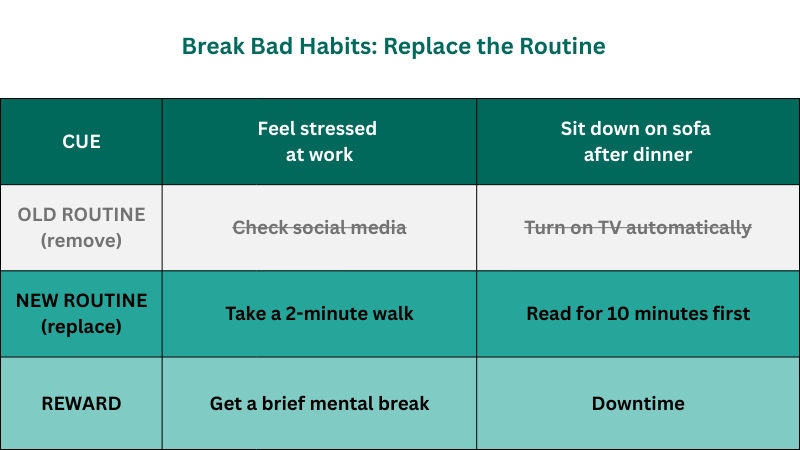
Building a new habit focuses on making the behaviour easy, obvious, and rewarding. Breaking a bad habit requires a different approach: identifying and removing or avoiding the cues that trigger it, increasing the friction involved in performing it, and — most importantly — replacing the routine whilst keeping the underlying reward intact.
That last point is crucial. You rarely can simply stop a bad habit cold. The cue still fires, the craving still arises, and without an alternative routine to satisfy it, the original behaviour wins by default. The most effective approach is habit replacement: keep the cue, keep the reward, change the routine. Someone who smokes when stressed (cue: stress; reward: brief break, stress relief, sometimes social connection) is more likely to succeed by replacing smoking with a five-minute walk outside than by attempting pure cessation — the walk meets the same underlying needs.
Keystone Habits: The Habits That Change Everything Else
Not all habits are created equal. Some — called keystone habits — have a disproportionate impact because they trigger cascading changes in other areas of your life, often without any deliberate effort on your part.
Keystone habits work through three mechanisms: they create identity shifts (you start to see yourself differently), they generate small wins that build positive momentum, and they produce spillover effects into unrelated areas. Research on behavioural spillover consistently shows that people who establish one strong positive habit often spontaneously improve in adjacent areas. People who start exercising regularly frequently report eating better, sleeping more consistently, and managing their time more effectively — changes they didn’t consciously set out to make.
Common keystone habits include regular exercise (arguably the most powerful, with documented effects on diet, sleep, stress, mood, and productivity), maintaining a consistent sleep schedule, daily journaling, and meal planning — all themes explored in our look at the daily habits of successful people. The specific habit matters less than finding one that creates genuine momentum in your particular life. When starting out, establishing one strong keystone habit is typically more effective than attempting to change multiple behaviours simultaneously. Discover how to identify and build your own keystone habits, or build your first keystone habit with our keystone habit tool.
How Long Does Habit Formation Really Take?
Let’s address the 21-day myth directly, because it’s probably the single most damaging piece of misinformation in popular habit advice. It originated from plastic surgeon Maxwell Maltz’s observation in the 1960s that patients took around 21 days to adjust to their new appearance (later popularised in his bestselling book Psycho-Cybernetics). Somewhere along the way, this became “it takes 21 days to form a habit” — a claim that has since been repeated so many times it feels like established fact. It isn’t.
The most rigorous research on habit formation timelines comes from UCL psychologist Phillippa Lally, whose 2010 study tracked participants developing new habits and measured how long behaviours took to become genuinely automatic. The average was 66 days. The range was 18 to 254 days, depending on habit complexity, frequency of practice, and individual differences.
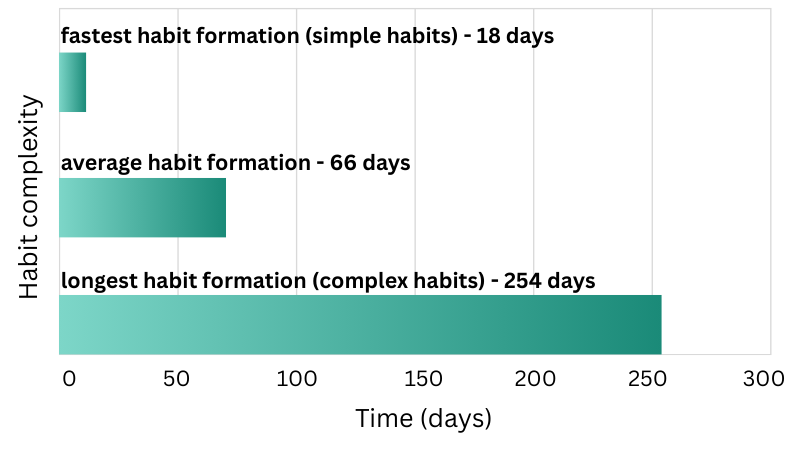
The practical implication isn’t discouraging — it’s liberating. It means that if your new habit hasn’t felt automatic by day 21, nothing has gone wrong. You’re just not finished yet. It also means that simpler habits genuinely do form faster, which is another argument for starting smaller than you think necessary. For a detailed breakdown of the research and what it means for your approach, read our article on how long it actually takes to form a habit.
Keystone Habits in Practice: A Starting Framework
Theory is only useful if it leads somewhere practical. Here’s a simple framework for choosing and launching your first habit — or restarting one that’s stalled before.
Start by choosing a habit that meets five criteria:
- it’s genuinely aligned with something you care about (not something you think you should care about)
- it’s specific enough to be measurable
- it’s small enough to feel almost embarrassingly easy
- it can be done daily, and
- it can be attached to an existing routine through habit stacking.
Then write your implementation intention — the specific when, where, and what — and identify your reward. Not a distant outcome, but something immediate and satisfying that follows the behaviour directly. Set up your environment to make the habit obvious and easy. And track it, simply, from day one.
In the first week, success means showing up — nothing more. Doing the minimum version of the habit consistently is far more valuable than doing the full version sporadically. In weeks two and three, maintain the daily practice and notice what makes it easier or harder. In week four, optimise: adjust the cue, refine the environment, tweak the reward if motivation is dipping. After thirty days you won’t have a fully formed automatic habit — but you’ll have genuine momentum, real data about your own patterns, and a much clearer sense of what this habit needs to become durable.
QUICK WIN:
Choose one habit you want to build and run it through the five criteria above — aligned with something you care about, specific, small, daily, stackable. If it fails any of these, adjust it until it passes all five. Then write your implementation intention and put it somewhere you’ll see it tomorrow. That’s your entire setup. Everything else — tracking, environment design, rewards — can follow once the habit has its first few days under its belt.
The Bigger Picture: Identity and Lasting Change
There’s one more dimension of habit formation worth understanding, because it’s what separates people who maintain habits long-term from those who cycle through the same attempts repeatedly.
Most people approach habit change outcome-first: they want to lose weight, read more, stress less. The habit is a means to an end. James Clear argues — persuasively, and in line with the psychological evidence — that the most durable habits are rooted in identity rather than outcomes. Not “I want to run a 5k” but “I’m becoming someone who moves their body regularly.” Not “I want to read more books” but “I’m a person who reads.”
This isn’t just motivational framing. It works because identity-based habits survive the inevitable moments when outcomes feel distant or uncertain. When you miss a target, an outcome-based approach can make the whole endeavour feel pointless. When your identity is at stake, a single missed day is just a missed day — it doesn’t threaten who you are.
Every small habit you build is a vote for the kind of person you’re becoming. The cumulative effect of those votes — the marginal gains of consistent, manageable behaviour change — is what creates genuinely lasting transformation. Not a dramatic overhaul, not a perfect streak, not an iron will. Just small steps, repeated consistently, over enough time for the neuroscience to do its work.
That’s not a particularly exciting promise. But it’s an honest one — and in twenty years of working with people on behaviour change, it’s the only one I’ve seen consistently delivered.
Habit creation and tracking tool
Ready to create and track your first 30-day habit? Download our free tool below.
RESOURCES:
I only recommend resources that I either use personally or have researched and feel are genuinely helpful for my readers. Resources sometimes contain affiliate links; if you purchase through these, I may earn a small commission at no extra cost to you.
Recommended Reading
Atomic Habits by James Clear – The definitive guide to building good habits and breaking bad ones through small, consistent changes. Paperback | Kindle | Audible
The Atomic Habits Workbook by James Clear – A practical companion to put the Atomic Habits framework into action. Paperback | Kindle | Audible
Tiny Habits by BJ Fogg – Stanford researcher BJ Fogg’s evidence-based method for making new behaviours automatic through small starting steps. Paperback | Kindle | Audible
The Power of Habit by Charles Duhigg – A compelling exploration of the science behind why habits exist and how to change them. Paperback | Kindle | Audible
Nudge by Richard Thaler & Cass Sunstein – How small environmental changes can make good habits easier to stick to without relying on willpower. Paperback | Kindle | Audible
Other Helpful Resources:
Streaks Habit Tracker – Simple iOS app for tracking daily habits and building streaks
Habitify – Cross-platform habit tracker with progress analytics (iOS, Android, Mac)
James Clear’s 3-2-1 Newsletter – Weekly habit and performance insights (free)
British Psychological Society research into habit formation – Summary of research into how to make a new habits stick
Related Articles from the Marginal Gains Blog:
Habit Stacking: How to Build New Habits Faster – How to attach new behaviours to existing routines
Keystone Habits: The Small Changes That Trigger Big Results – Why some habits matter more than others
The Two-Minute Rule for Habit Formation – Making habits so small they’re impossible to skip
Habit Tracking Methods: Bullet Journal vs Digital Apps – Different ways to track your habits
I'm Simon Shaw, a Chartered Occupational Psychologist with over 20 years of experience in workplace psychology, learning and development, coaching, and teaching. I write about applying psychological research to everyday challenges - from habits and productivity to memory and mental performance. The articles on this blog draw from established research in psychology and behavioural science, taking a marginal gains approach to help you make small, evidence-based changes that compound over time, allowing you to make meaningful progress in the areas you care about most.