
The 21-Day Habit Myth: What Science Really Shows
The 21-day habit myth is one of the most persistent — and damaging — pieces of advice in personal development. If you’ve ever attempted to build a new habit, you’ve probably heard the popular claim that it takes just 21 days. This “fact” appears in countless self-help books, productivity blogs, and motivational speeches. There’s just one problem: it’s not true.
As a psychologist who has studied behaviour change for over two decades, I can see how the 21-day habit myth sets people up for disappointment. When their habit hasn’t become automatic after three weeks, they assume they’ve failed — when in reality, they’re right on schedule.
In this article, we’ll explore where the myth came from, what research actually shows about habit formation timelines, and how you can use this knowledge to set realistic expectations for your own habit-building journey.
The Origin of the 21-Day Habit Myth
To understand how this myth became so widespread, we need to travel back to 1960.
Dr Maxwell Maltz and Psycho-Cybernetics
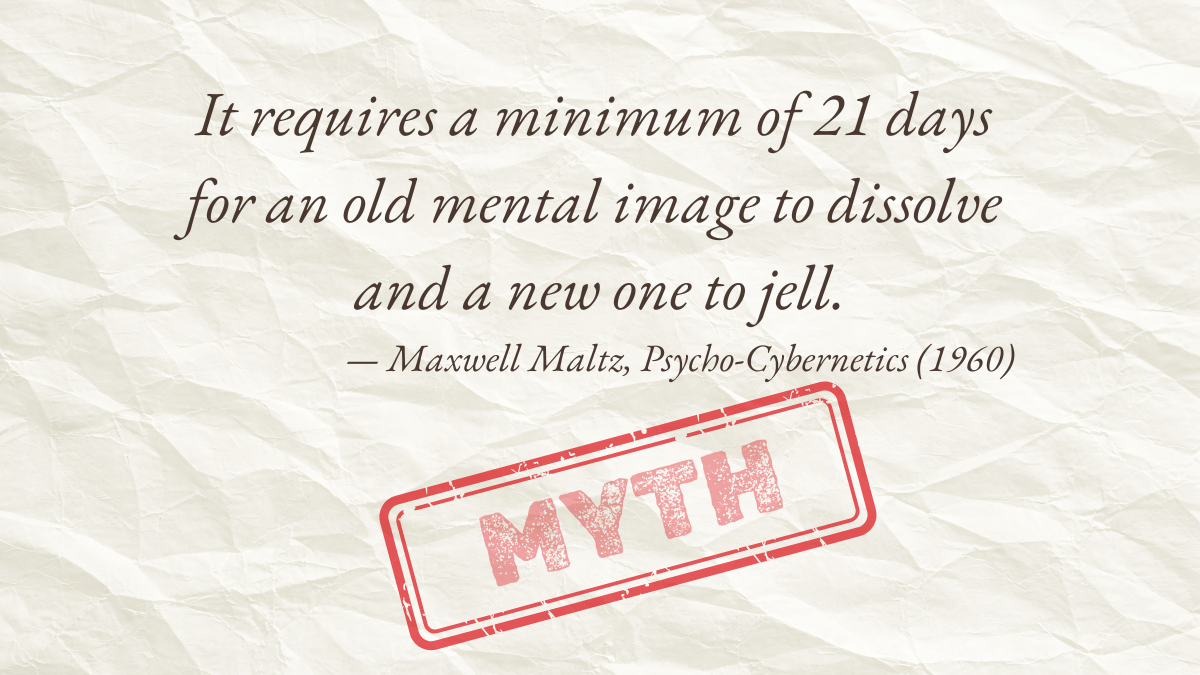
The 21-day claim originates from Dr Maxwell Maltz, a plastic surgeon who published a book called Psycho-Cybernetics in 1960. Maltz observed that his patients took approximately 21 days to adjust to their new appearance after plastic surgery. He wrote that it requires “a minimum of about 21 days for an old mental image to dissolve and a new one to jell.”
Notice two critical words: minimum and about. Maltz wasn’t making a definitive claim about habit formation — he was noting a rough observation about psychological adjustment. His focus was on self-image, not habits. Additionally, Maltz observed patients adapting to external changes (a new nose, a different appearance), not actively building new behaviour patterns. These are fundamentally different processes.
How the 21-Day Habit Myth Spread
Despite Maltz’s cautious wording, the “21 days” figure was too catchy to resist. It’s a perfect soundbite — short enough to seem achievable, long enough to sound credible, specific enough to be memorable. Over subsequent decades, self-help authors and motivational speakers repeated the claim, often dropping the qualifying words “minimum” and “about.” The nuanced observation became a rigid rule.
By the time social media emerged, the myth had solidified into “fact.” Today, a quick search reveals thousands of articles, apps, and programmes built around the 21-day framework — despite having no scientific basis.
QUICK WIN:
Think of a habit attempt that you abandoned — one where you felt you’d failed. Now ask: how long did you give it? If the answer is three to four weeks, the 21-day habit myth is likely what derailed you, not a lack of willpower. Note down what the habit was and how long you actually stuck at it. That’s your starting point for trying again with realistic expectations.
What Research Actually Shows About the 21-Day Habit Myth
Fortunately, we don’t need to rely on anecdotal observations. Rigorous scientific research has examined how long it actually takes to form a habit — and the findings demolish the 21-day habit myth entirely.
The Phillippa Lally Study (University College London)
The most comprehensive study on habit formation timelines was conducted by health psychology researcher Phillippa Lally and her colleagues at University College London in 2009. The study tracked 96 participants over 12 weeks as they attempted to build new habits, ranging from simple (drinking a glass of water after breakfast) to more complex (running for 15 minutes before dinner). Each day, participants reported whether they’d performed the behaviour and rated how automatic it felt.
Average Time: 66 Days (Range 18–254 Days)
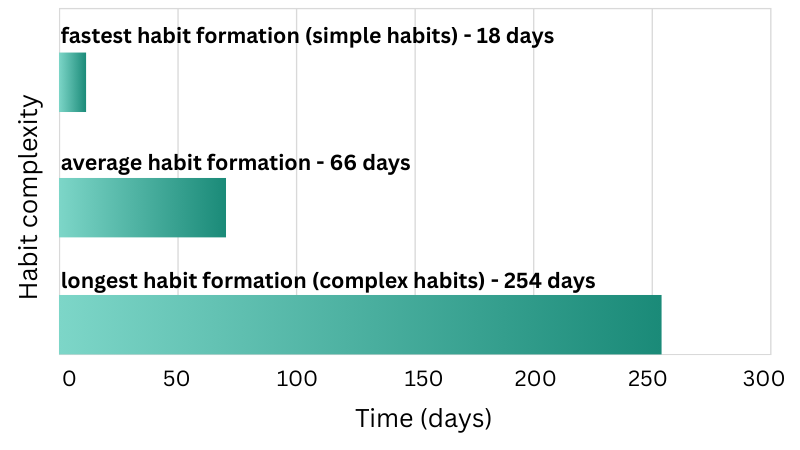
The results were striking. On average, it took 66 days for a habit to feel automatic — not 21. And the range was vast: anywhere from 18 days for the simplest behaviours to 254 days for the most complex ones. There was no single magic number.
The pattern the researchers observed was consistent: habit strength grew quickly at first, then gradually slowed and settled into a steady state — like a car accelerating and then cruising at a comfortable speed. That settling point, where the behaviour started happening without much conscious effort, came around the 66-day mark for most participants.
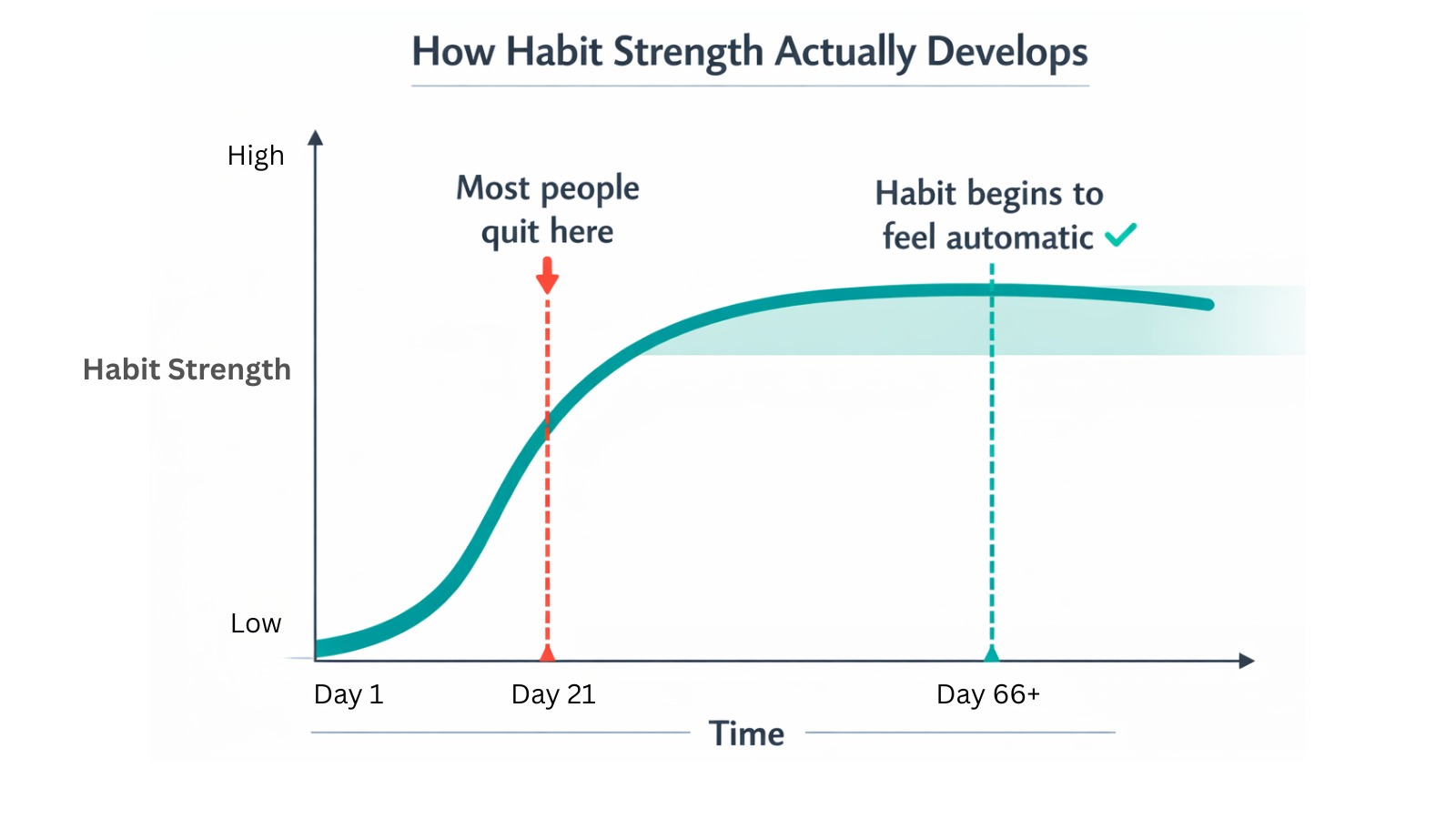
Perhaps the most reassuring finding was this: missing a day didn’t matter nearly as much as people fear. The occasional lapse didn’t wipe out progress or reset the process. When participants picked the behaviour back up, their habit continued to develop from where it had left off. Skipping a day is human. What matters is what you do the day after.
The 2025 Systematic Review
More recent evidence reinforces this picture. A 2025 systematic review from the University of South Australia, analysing 20 studies across 2,601 participants, found that habits can begin forming within about two months but can take up to 335 days to establish. The researchers concluded that “it’s important for people who are hoping to make healthier habits not to give up at that mythical three-week mark.” The 21-day habit myth, in other words, is not just inaccurate — it actively causes people to quit too soon.
What Affects How Quickly a Habit Forms
The enormous range in the research — 18 to 254 days in the Lally study, and up to 335 days in the 2025 systematic review — makes one thing clear: habit formation isn’t one-size-fits-all. Several factors determine where on that spectrum your habit will fall.
1. Complexity
The single biggest factor is how demanding the behaviour is. Simple habits — a single, discrete action requiring minimal preparation, like drinking a glass of water after breakfast or taking a daily vitamin — can approach automaticity in as little as 20–40 days. Moderate habits involving multiple steps or some preparation, like packing a healthy lunch or maintaining a journalling practice, typically take 40–80 days. Complex habits requiring sustained effort and significant time — a regular exercise routine, a meditation practice, meal preparation — commonly take 80–150 days or longer.
This is why the two-minute rule is so effective. Starting with the smallest possible version of your habit directly reduces complexity — and faster initial formation builds the momentum that sustains the longer journey.
2. Frequency and Consistency
Habits performed daily form faster than those performed weekly or sporadically. The more repetitions you accumulate, the more quickly the behaviour becomes automatic. This is why “I’ll exercise three times a week” is harder to establish than “I’ll do ten press-ups every morning.” The daily commitment provides two to three times as many repetitions per month. Performing your habit at the same time and in the same context speeds things up further — which is the principle behind habit stacking.
3. Immediate Reward
Behaviours with satisfying immediate rewards become habitual faster than those with distant payoffs. This explains why unhealthy habits can form disturbingly quickly — they provide instant gratification — whilst healthy habits, whose benefits accrue over weeks or months, require more patience. When building a habit with delayed rewards, consider adding an immediate, artificial reward to accelerate the process: a favourite coffee after your morning workout, or a podcast you love reserved for your commute run.
4. Individual Differences
People vary significantly in how quickly they form habits, and this is worth acknowledging honestly. Your natural ability to follow through on intentions, the consistency of your existing daily routines, the strength of your motivation, and personality traits — particularly conscientiousness — all affect timelines. If you find habits take longer than the average suggests, this isn’t failure. It’s individual variation within a wide, well-documented range.
5. Environment
Your surroundings shape habit formation more than most people realise. Stable routines and consistent contexts accelerate the process; friction, obstacles, and frequent disruptions slow it down. If you’re building a new habit during a period of significant life change — a new job, a house move, a new baby — expect the process to take longer and plan accordingly. For specific strategies, see our guide on designing your environment for habit success.
How to Use This Knowledge Practically
Understanding the reality of habit formation timelines changes how you should approach building new habits.
Setting Realistic Expectations
First, abandon the 21-day habit myth entirely. Replace it with these research-based guidelines: simple habits take 20–40 days before they feel reasonably automatic; moderate habits need 40–80 days; complex habits require 80–120 days, potentially longer.
For any new habit, commit to at least two months (approximately 60 days) before evaluating whether the behaviour has become automatic. Better yet, think in terms of 90-day cycles. This longer timeline actually reduces pressure. When you know a habit is supposed to take 60–90 days to solidify, experiencing difficulty on day 25 doesn’t signal failure — it’s completely normal.
Choosing Habits Strategically
Given that habit complexity affects formation speed, start with simple habits first. Beginning with quick wins builds momentum and self-efficacy — the experience of successfully establishing one habit, even a small one, makes you more confident about tackling the next.
For complex habits, break them into component parts. Want to establish a morning exercise routine? Don’t start with “Exercise for 45 minutes each morning.” Instead, build it in stages: begin with simply putting on workout clothes each morning, then add one minute of stretching, then gradually extend the routine. This incremental approach, whilst taking longer overall, has a much higher success rate than attempting the full behaviour from day one.
Planning for the Long Game
Research shows that automaticity continues to develop even after the initial plateau. A habit that feels somewhat automatic at 60 days will feel even more automatic at 120 days. The first 30 days should focus entirely on consistency — showing up matters more than performance. Between days 30 and 60, the behaviour should start feeling easier. Between days 60 and 90, true automaticity develops. Beyond 90 days, the habit is solidifying into your identity.
For a detailed analysis of the research behind these timelines, read our article on how long it really takes to form a habit.
QUICK WIN:
Pick one habit you want to build. Based on its complexity, set a realistic timeline: simple (20–40 days), moderate (40–80 days), complex (80–120 days). Write the end date in your diary and commit to it. Now if day 25 feels hard, you’ll know that’s normal — not failure. The 21-day habit myth loses its power the moment you replace it with realistic expectations.
Making Habits Stick Beyond the Initial Period
Even after a habit reaches automaticity, it can be disrupted by significant life changes or extended breaks. Here’s how to maintain habits long-term.
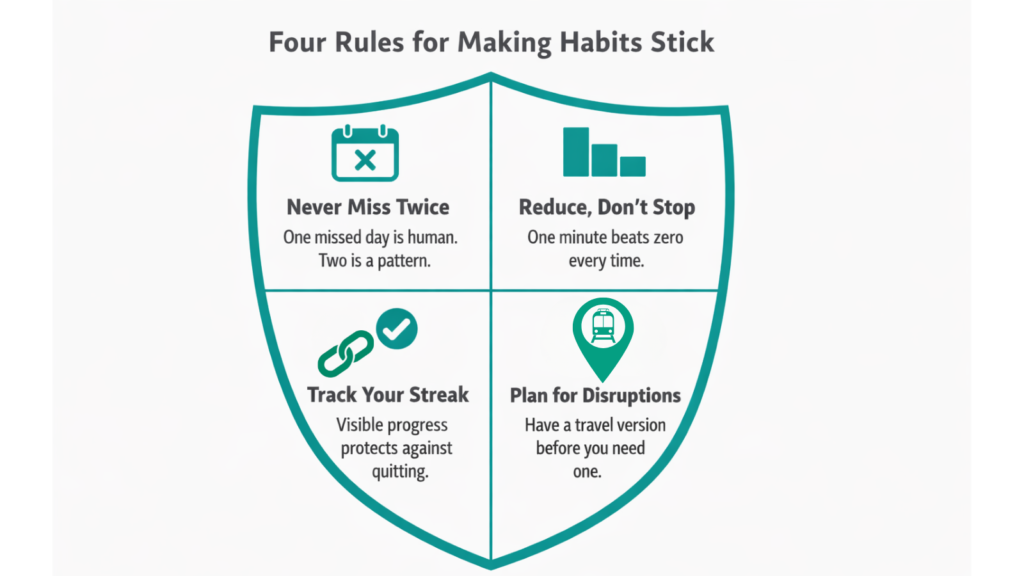
1. Never Miss Twice
Missing one day doesn’t significantly impact habit formation, but missing two consecutive days can initiate a downward spiral. If you miss once, make the next occurrence non-negotiable. This single rule does more to protect habits long-term than any 21-day countdown ever could.
2. Reduce, Don’t Abandon
On challenging days, do a minimal version rather than skipping entirely. One minute of meditation maintains the pattern better than zero. The goal is to keep the cue-behaviour-reward loop intact, even in a reduced form.
3. Track Your Habit Streak
Visual tracking creates mild accountability and allows you to spot patterns. When motivation wanes, the chain of marks becomes motivating — you don’t want to break the streak. Explore various habit tracking methods to find one that works for you.
Plan for Interruptions
Life inevitably disrupts routines — illness, travel, work deadlines, family emergencies. Before disruptions occur, create contingency plans. If you travel regularly, establish a travel version of your habit. When your routine is disrupted, don’t wait for the “perfect time” to restart. The day your routine returns to normal, resume your habit — even a minimal version.
Avoid the abstinence violation effect — the psychological phenomenon where a single lapse triggers an “all or nothing” mindset leading to complete abandonment. Recognise that lapses are normal and don’t negate previous progress. This is the 21-day habit myth’s most insidious legacy: it frames any difficulty as failure rather than as the normal, expected experience of behaviour change.
The Real Damage Done by the 21-Day Habit Myth
Why does debunking the 21-day habit myth matter? Because unrealistic expectations directly contribute to habit failure.
When people believe habits should be automatic in 21 days, on day 22 — when the behaviour still requires conscious effort — they conclude they’re “bad at forming habits” or that the technique doesn’t work. They abandon the attempt just as real automaticity is beginning to develop.
The myth also encourages insufficient planning. A 21-day timeline encourages short-term thinking — people don’t establish the systems and support structures needed for habits that actually take two to three months to solidify. And it encourages starting too big: believing habits form quickly makes people more likely to attempt ambitious changes rather than the smaller, sustainable versions that actually stick.
Our article on why habits fail examines these and other obstacles in detail, with evidence-based solutions for each.
Setting Yourself Up for Success
The 21-day habit myth is one of the most persistent and counterproductive pieces of advice in personal development. By replacing it with research-based timelines, you can set realistic expectations and plan accordingly.
The research is clear: habits take an average of 66 days to become automatic, with a range of 18 to 254 days depending on complexity and individual differences. Simple habits form faster (20–40 days) than complex ones (80–120 days). Missing occasional days doesn’t significantly derail habit formation. And the 2025 University of South Australia systematic review puts the upper end even higher — up to 335 days in some cases.
Rather than viewing the longer timeline as discouraging, recognise it as liberating. You don’t need to have everything figured out in three weeks. You have permission to take the time necessary for real, sustainable change. Habit formation is a journey, not a sprint — and once you let go of the 21-day habit myth, that journey becomes considerably more manageable.
For a comprehensive, evidence-based approach to building lasting habits, read our complete habit formation guide.
QUICK WIN:
The next time you’re tempted to quit a habit because “it’s been three weeks and it still feels hard” — stop. That feeling is not failure. It’s what habit formation actually feels like at day 21. Commit to another 40 days. The research says that’s when things start to shift. The 21-day habit myth only wins if you let it.
RESOURCES:
I only recommend resources that I either use personally or have researched and feel are genuinely helpful for my readers. Resources sometimes contain affiliate links; if you purchase through these, I may earn a small commission at no extra cost to you.
Recommended Reading
Atomic Habits by James Clear — The definitive practical guide to habit formation, with a clear-eyed view of timelines and why the 21-day myth sets people up to fail. Paperback
Tiny Habits by BJ Fogg — Stanford researcher BJ Fogg’s evidence-based approach to starting small — the antidote to the 21-day myth’s encouragement to go too big too fast. Paperback
Related Articles from the Marginal Gains Blog:
How Long Does It Take to Form a Habit? — The full research breakdown on realistic habit timelines
12 Reasons Why Habits Fail — Understanding the real obstacles to behaviour change
The Two-Minute Rule for Habits — The simplest antidote to starting too big
Habit Formation Guide — The complete evidence-based approach to building lasting habits
Environment Design for Habits — How to make behaviour change easier through your surroundings
Habit Stacking — How to attach new habits to existing routines for faster formation
I'm Simon Shaw, a Chartered Occupational Psychologist with over 20 years of experience in workplace psychology, learning and development, coaching, and teaching. I write about applying psychological research to everyday challenges - from habits and productivity to memory and mental performance. The articles on this blog draw from established research in psychology and behavioural science, taking a marginal gains approach to help you make small, evidence-based changes that compound over time, allowing you to make meaningful progress in the areas you care about most.