
The Two-Minute Rule for Habits: Start Small, Build Big

The two-minute rule for habits is one of the most effective tools for making new behaviours stick — and it works even when motivation fails.
A senior manager tried every productivity system going. Gym memberships lapsed after a fortnight. Meditation apps gathered dust. Reading goals reset to zero every January. Then he tried something absurdly simple: he committed to nothing more than putting on his trainers each morning. That was it. Two minutes, maximum.
Within three months, he was running four times a week. Not because he forced himself, but because once the trainers were on, going for a run felt easier than taking them off again.
This is the two-minute rule for habits in action — and it works because it targets the real reason most habits fail. Not a lack of motivation, but a barrier to entry that feels too high. You’ve decided to start exercising regularly, but the thought of a full workout feels overwhelming. You want to meditate daily, but finding 20 minutes seems impossible. You’re determined to read more, but a whole book feels like too much.
This pattern occurs hundreds of times — and the two-minute rule breaks it consistently. It isn’t about lowering your ambitions. It’s about outsmarting the psychological barriers that prevent you from starting in the first place.
What Is the Two-Minute Rule for Habits?
The two-minute rule for habits is a habit formation strategy that states:
When you start a new habit, it should take less than two minutes to complete.
This principle, popularised by James Clear in his book Atomic Habits, transforms ambitious goals into manageable starting points. Rather than committing to “exercise for an hour”, you commit to “put on my workout clothes”. Instead of “write 1,000 words”, you begin with “write one sentence”. The full habit becomes what happens after you start, but the commitment is only to those first two minutes.

The Core Principle
The genius of the two-minute rule lies in its focus on the gateway behaviour — the action that leads to your desired outcome. Every habit has a starting ritual, and that ritual determines whether the full behaviour happens at all. By making the starting ritual absurdly easy, you remove the psychological resistance that kills habits before they begin.
When I’ve coached clients on workplace behaviour change, I often see noble intentions like “process emails more efficiently” or “prepare thoroughly for meetings”. These goals fail not because people don’t want to achieve them, but because the energy required to get started feels like too much in that moment. The two-minute version — “open my task manager” or “read the meeting agenda” — creates momentum that often carries through to the full behaviour.
Origins and Related Concepts
Whilst James Clear brought the two-minute rule for habits into mainstream awareness, the principle builds on decades of behavioural science research. BJ Fogg’s Tiny Habits method, developed through his work at Stanford, operates on similar principles: start with behaviours so small they require minimal motivation to complete.
The underlying psychology draws from research on implementation intentions, activation energy, and self-efficacy. It also connects to the habit loop — the cue-routine-reward cycle that governs how habits form and stick. When you make a habit easy to start, you’re not just saving time — you’re fundamentally changing the psychological calculation your brain makes about whether to act.
David Allen’s Version vs James Clear’s Version
Before we go further, note that there are actually two versions of the two-minute rule, and they serve different purposes. David Allen’s original version, from his book Getting Things Done, is a productivity rule: if a task takes less than two minutes, do it immediately rather than adding it to your to-do list. That’s not what this article is about, but if you’re interested, you can read more about it here.
James Clear’s version, which is the focus of this article, is a habit formation rule: when starting a new habit, scale it down to something that takes two minutes or less. It’s about making the entry point to a new behaviour so ridiculously easy that you can’t say no.
The Science Behind the Two-Minute Rule for Habits
There are three psychological principles that help us understand why the two-minute rule for habits works so reliably.
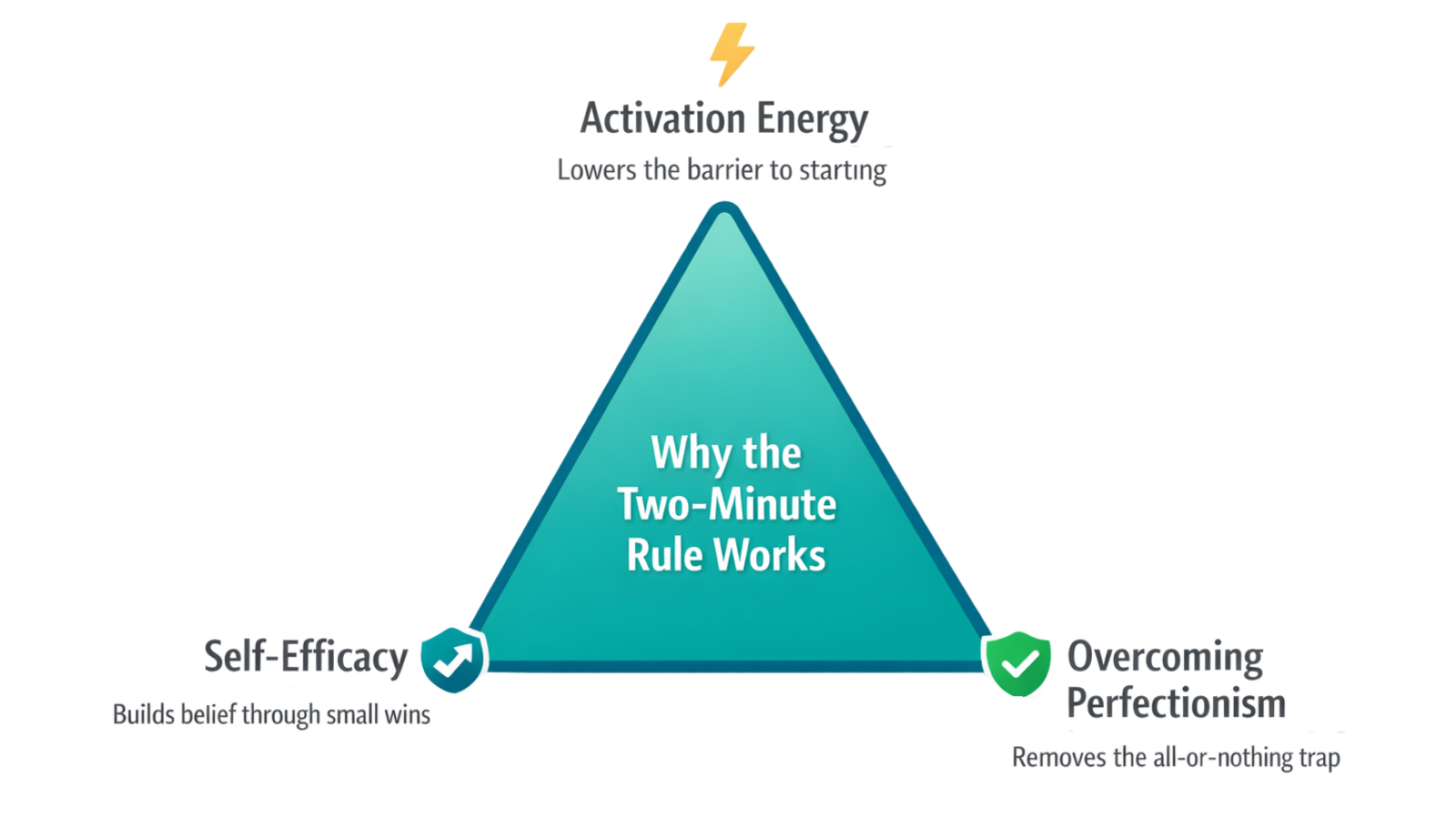
1. Reducing Activation Energy
Every behaviour has what physicists call ‘activation energy’ — the initial push required to set something in motion. For habits, this translates to the mental and physical effort needed to begin. Research in behavioural economics shows that humans are remarkably sensitive to small differences in activation energy. We’ll walk to a bin two metres away but ignore one that’s five metres distant. We’ll click a one-step checkout but abandon a three-step process.
The two-minute rule exploits this sensitivity. By reducing your activation energy to near zero, it removes the moment of decision where most habits die. Your brain doesn’t need to mount a motivational campaign to put on workout clothes — it simply happens. This is why you’ll often find yourself completing the full workout even though you only committed to getting dressed. The hard part wasn’t the exercise; it was overcoming that initial resistance.
2. Building Self-Efficacy
Self-efficacy — your belief in your ability to succeed at a specific task — plays a crucial role in habit formation. Albert Bandura’s research demonstrated that self-efficacy develops through ‘mastery experiences’: successfully completing a behaviour increases your belief that you can do it again.
The two-minute rule creates guaranteed mastery experiences. When you commit only to reading one page, you succeed every single time. These small wins accumulate into a broader sense of competence. After a week of reading one page daily, you’re not just someone who occasionally reads — you’re someone who reads every day. This identity shift, supported by consistent evidence of your capability, makes the behaviour feel increasingly natural.
3. Overcoming Perfectionism
Perfectionism presents one of the most insidious obstacles to habit formation. The thinking goes: if I can’t do this properly, I won’t do it at all. A 20-minute meditation session or nothing. A complete workout or nothing. This binary thinking guarantees failure because life rarely provides perfect conditions.
The two-minute rule dismantles perfectionism by simply deciding to show up. You can’t do two minutes of something perfectly or imperfectly — you can only do it or not do it. This removes the performance anxiety that prevents many capable people from starting. Once you’re actually sitting on your meditation cushion or holding your book, perfectionism loses its grip. You’re already doing the thing, so you might as well continue.
QUICK WIN:
Pick the one habit you’ve been putting off the longest. Now scale it down until it feels almost silly: “Run for 30 minutes” becomes “put on trainers”. “Meditate for 20 minutes” becomes “sit on yoga mat and take three breaths”. Write your two-minute version down right now. That’s your starting commitment from tomorrow.
How to Apply the Two-Minute Rule for Habits
The practical application requires more thought than it might initially appear. Scaling down a habit to two minutes isn’t about doing less of the same thing — it’s about identifying the true gateway behaviour that leads to your desired outcome.
Identify the Gateway Behaviour
For any habit you want to build, ask yourself: what is the absolute minimum action that puts me on the path to completing this behaviour? This gateway must be something that can be completed in two minutes and naturally leads to the full habit.
The key is finding the point of no return — once you’ve started, continuing becomes easier than stopping. If your goal is to run regularly, “put on running shoes” works because once your shoes are on, you’re likely to at least step outside. If you want to cook healthy meals, “place cutting board on counter” works because you’ve already started the prep process.
Poor gateway behaviours feel disconnected from the full habit. “Think about exercising” doesn’t naturally lead to exercise. “Plan to meditate” doesn’t put you any closer to actually meditating. The gateway must be a concrete action that physically or mentally positions you to continue.
The Scaling Process
Take your desired habit and work backwards:
Full habit: “Run for 30 minutes”
Scaled to 10 minutes: “Run for 10 minutes”
Scaled to 5 minutes: “Run around the block”
Scaled to 2 minutes: “Put on running shoes and step outside”
Notice how the two-minute version isn’t “run for 2 minutes” — it’s the action that makes running inevitable. This distinction matters. You’re not creating a shorter version of the habit; you’re isolating the initiation ritual.
Two-Minute Rule for Habits — Examples Across Common Goals
Here are some examples of applying the two-minute rule for habits across different areas of life.
Exercise and Movement
Goal: Exercise regularly
Two-minute version: Change into workout clothes
Why it works: Once you’re in workout gear, the psychological commitment to exercise has already been made. You’re unlikely to change back without doing something active.
Goal: Practice yoga
Two-minute version: Roll out yoga mat
Why it works: The mat on the floor creates a visual cue and physical space that naturally invites practice. You’ve eliminated the setup friction that often prevents yoga sessions.
Learning and Reading
Goal: Read more books
Two-minute version: Read one page
Why it works: One page is never enough to satisfy curiosity. You’ll almost always continue, but you’ve removed the pressure of a longer commitment.
Goal: Learn a language
Two-minute version: Open your language app and complete one exercise
Why it works: Language apps design exercises to be completable quickly, and the gamification often leads you to continue to the next one.
Mindfulness and Mental Health
Goal: Meditate daily
Two-minute version: Sit on meditation mat and take three breaths
Why it works: The physical act of sitting in your meditation space triggers the mental state associated with practice. Three breaths creates a minimal commitment that usually extends naturally.
Goal: Journal regularly
Two-minute version: Write one sentence about your day
Why it works: Opening the journal and writing one sentence removes the blank page intimidation. Thoughts tend to flow once you’ve started.
Nutrition and Health
Goal: Eat more vegetables
Two-minute version: Cut up one vegetable
Why it works: Once vegetables are cut and visible, you’re far more likely to incorporate them into your meal. The preparation step is often the barrier, not the eating.
Goal: Drink more water
Two-minute version: Fill water bottle in the morning
Why it works: A filled water bottle on your desk becomes a constant visual reminder and removes the friction of walking to the tap throughout the day.
Creative Work
Goal: Write regularly
Two-minute version: Write one sentence
Why it works: Writing one sentence bypasses the perfectionism and “waiting for inspiration” that prevents most writing sessions. Momentum builds from having something on the page.
Goal: Practice music
Two-minute version: Take instrument out of case
Why it works: Simply holding your instrument creates an invitation to play. The setup and put-away process creates more friction than the actual practice.
QUICK WIN:
Choose one example from the list above that matches a habit you want to build. Set a phone reminder for tomorrow morning linked to something you already do daily (e.g. “After coffee — roll out yoga mat”). Don’t aim to do the full habit. Just do the two-minute version and give yourself permission to stop (or continue if you want to!).
Common Mistakes with the Two-Minute Rule
The simplicity of the two-minute rule for habits belies the subtle ways people sabotage its effectiveness. Understanding these mistakes helps you implement the strategy properly.
Trying to Do More Than Two Minutes
The most common error is treating the two-minute rule as a goal rather than a permission structure. People think, “Well, if two minutes is good, surely five would be better.” This misses the entire point.
The power lies in the psychological trick: you only commit to two minutes. Once you’ve done those two minutes, you have complete permission to stop. This permission paradoxically makes you more likely to continue because the pressure has been removed. If you secretly plan to continue beyond two minutes, you’re still facing the same motivational resistance that prevented you from starting in the first place.
Not Celebrating the Small Win
When you complete only the two-minute version, there’s a tendency to dismiss it as insufficient. “I only read one page” carries an implicit disappointment, as though you’ve failed by not reading more.
This undermines the self-efficacy building that makes the two-minute rule for habits effective. That one page represents a 100% success rate on your commitment. Your brain needs to register this as a win, not as a consolation prize. The identity shift from “someone who wants to read” to “someone who reads daily” happens through consistent completion, not impressive duration.
Research on habit formation shows that consistency matters far more than intensity, particularly in the early stages. Reading one page every day for a month creates a stronger habit foundation than reading a chapter once a week, even though the total pages might be similar.
Rushing to Scale Up
After a week of successfully completing the two-minute version, many people immediately try to expand it. They’ve been reading one page daily, so surely they should aim for a chapter now. This premature scaling often destroys the habit entirely.
The two-minute version isn’t training wheels you remove once you’ve got your balance — it’s the permanent foundation. Yes, you’ll often naturally continue beyond two minutes, but your commitment remains at the two-minute level. This might seem overly cautious, but it protects against the inevitable days when your motivation is low or your schedule is packed. On those days, you can still honour your commitment with minimal effort, maintaining the consistency that keeps the habit alive.

Scaling Up After the Two-Minute Rule for Habits
Eventually, you might want to formalise longer practice sessions. The two-minute rule for habits provides a framework for this expansion whilst maintaining the psychological safety that made it work initially.
When to Expand
Consider expanding your habit when you meet these criteria: you’ve completed the two-minute version consistently for at least a month, you regularly continue beyond two minutes naturally, you genuinely want more time with the habit rather than feeling you should do more, and crucially, you’re willing to return to the two-minute version when needed.
That last point matters more than people realise. Life will inevitably disrupt your routine. When that happens, maintaining the two-minute version keeps the habit alive whilst allowing the larger practice to pause temporarily. People who scale up but refuse to scale back often lose the habit entirely during stressful periods.
How to Expand Gradually
When expanding, think in small increments rather than doubling or tripling your commitment. If you’ve been writing one sentence daily, move to three sentences, not a full page. If you’ve been sitting on your meditation mat for three breaths, extend to two minutes of actual meditation, not twenty.
The expansion should feel almost trivially easy. If there’s any resistance or you start missing days after scaling up, you’ve moved too quickly. Drop back to the previous level and stay there longer before attempting the next increment.
QUICK WIN:
If you completed your two-minute habit today, pause and acknowledge it. Say “done” out loud, tick it off a list, or just give yourself a mental nod. This tiny act of recognition builds the self-efficacy that keeps you coming back tomorrow. Don’t dismiss it as “only” two minutes — that’s a 100% success rate on your commitment.
Maintaining the Low Barrier
Even as your habit expands to longer durations, preserve the two-minute gateway. Your commitment remains: I will put on my workout clothes. What happens after that can vary by day. Sometimes it’s a full hour at the gym, sometimes it’s a 10-minute walk, sometimes it’s stretching in your living room. The consistency comes from always passing through that two-minute gateway.
This flexibility prevents the all-or-nothing thinking that destroys habits. You don’t skip your workout because you “only” have 15 minutes — you do what you can because your commitment isn’t to a specific duration but to showing up.
Combining the Two-Minute Rule for Habits with Other Strategies
The two-minute rule for habits becomes even more powerful when integrated with other evidence-based techniques. Combined with strategies like keystone habits, these approaches address different aspects of behaviour change and reinforce each other.
Two-Minute Rule and Habit Stacking
Habit stacking involves attaching a new habit to an existing one using the formula: “After [current habit], I will [new habit].” Combined with the two-minute rule, this becomes extraordinarily effective.
“After I pour my morning coffee, I will read one page” creates both a consistent cue (the coffee) and a minimal barrier (one page). The existing habit provides the trigger whilst the two-minute rule ensures the new behaviour happens.
In workplace settings, I often recommend combinations like “After I sit at my desk, I will spend two minutes reviewing my task list” or “After my lunch break, I will write one sentence of my report”. These stack easily onto existing routines whilst remaining achievable even on hectic days.
Two-Minute Rule and Environment Design
Environment design focuses on making good habits easier through strategic organisation of your physical and digital spaces. The synergy with the two-minute rule is natural: design your environment to make the gateway behaviour effortless.
If your two-minute habit is “sit on meditation mat”, place the cushion somewhere you’ll encounter it naturally rather than storing it in a cupboard. If it’s “write one sentence”, leave your notebook open on your desk. The environment design reduces friction for the two-minute action, which already has minimal friction by design.
This combination addresses both the psychological barrier (removed by the two-minute commitment) and the physical barrier (removed by environmental design). When both types of friction disappear, habit formation becomes remarkably consistent.
Two-Minute Rule and Tracking
Tracking your habits provides visibility and accountability. When combined with the two-minute rule for habits, tracking becomes a source of pride rather than pressure. Every check mark represents a completed commitment, regardless of whether you continued beyond two minutes.
I recommend tracking systems that focus on consistency over duration. A simple checkbox for “did I do the two-minute version?” matters more than logging how long you continued. This keeps the focus on the commitment you made rather than creating additional performance pressure.
Some clients maintain two tracks: one for completing the two-minute commitment (which should be near 100%) and one for extended practice (which varies). This clearly separates the non-negotiable consistency from the optional expansion, preventing feelings of failure when you complete only the minimum.
Practical Implementation Guide
Knowing the theory is valuable, but successful implementation requires a concrete plan. Here’s how to apply the two-minute rule for habits to your specific situation.
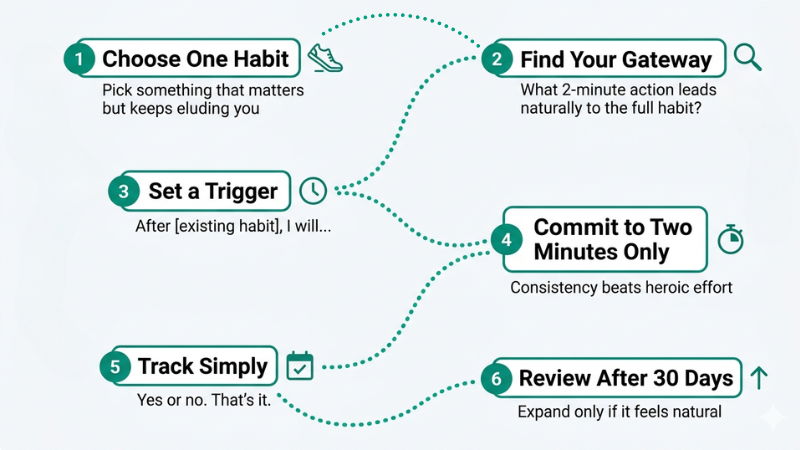
Step 1: Begin by selecting one habit to focus on. Multiple simultaneous habit changes using the two-minute rule can work, but starting with one allows you to learn the process. Choose a habit that matters to you but has consistently eluded your previous attempts.
Step 2: Next, identify the genuine two-minute gateway. Test it honestly: can you complete this action in two minutes or less? Does it naturally lead to the full habit? Would you feel satisfied having done only this much (even if you’d prefer to do more)?
Step 3: Set a specific trigger for your two-minute habit. “After [existing behaviour]” works best because it creates a concrete cue rather than relying on remembering throughout the day. The more specific your trigger, the more reliable your consistency.
Step 4: Commit genuinely to only two minutes. This is where most people struggle because it feels too small to matter. Trust the process. The magic happens through consistency, not heroic effort.
Step 5: Track your completions simply. A checkmark on a calendar suffices. You’re tracking yes/no, not duration or quality.
Step 6: After a month of consistent completion, assess whether you want to formalise any natural expansion. If you regularly continue beyond two minutes, you might choose to acknowledge that in your commitment whilst maintaining the two-minute version as the baseline.
Why the Two-Minute Rule for Habits Matters Long-Term
The two-minute rule for habits represents a fundamental shift in how we think about behaviour change. Rather than relying on motivation, discipline, or willpower, it redesigns the behaviour to require none of these things. This aligns with what research on habit formation and willpower tells us: sustainable change comes from systems, not from force of will.
As a Chartered Occupational Psychologist with over 20 years of experience helping individuals and organisations change behaviour, I’ve observed that lasting transformation rarely comes from dramatic overhauls. It emerges from mundane consistency with behaviours so small they seem trivial. Those one-page readers become people who finish 50 books a year. Those sentence-writers complete novels. Those cushion-sitters develop meditation practices that reshape their relationship with stress.
The two-minute rule for habits isn’t a hack or a shortcut. It’s a recognition that habits form through repetition, and repetition requires showing up. By making showing up absurdly easy, you remove the barriers that prevent most behaviour change attempts from surviving beyond the initial enthusiasm.
Your goal isn’t to do something impressive today. It’s to become the kind of person who does this thing reliably. The two-minute rule is how you get there — not through heroic effort, but through undeniable consistency with actions so small you can’t talk yourself out of them.
Start small. Stay consistent. Trust the process. The results will follow.
Frequently Asked Questions
Does the two-minute rule actually work?
Yes. Research on habit formation consistently shows that consistency beats intensity, particularly in the early stages. The two-minute rule for habits maximises consistency by removing the barriers that cause most people to quit within the first fortnight. In my experience working with clients over 20 years, those who start with a genuinely tiny commitment are far more likely to still be going six months later than those who launch with ambitious targets.
What’s the difference between David Allen’s and James Clear’s two-minute rule?
David Allen’s version is a productivity rule — if a task takes less than two minutes, do it now. James Clear’s version is a habit formation rule — scale any new habit down to two minutes or less. Allen’s clears your to-do list; Clear’s builds lasting behaviours. We cover the differences in detail earlier in this article.
How long before a two-minute habit becomes automatic?
Research suggests habit formation takes anywhere from 18 to 254 days, with an average of around 66 days. But the two-minute rule for habits accelerates this process because it dramatically increases your consistency — and consistency is what drives automaticity. Most people I work with find that the two-minute gateway (putting on trainers, opening a notebook) starts feeling automatic within 2-3 weeks. The full habit takes longer, but the starting ritual becomes second nature relatively quickly. You can read more about this in our article on how long it takes to form a habit.
Can you use the two-minute rule to break bad habits?
The two-minute rule is designed for building new habits rather than breaking existing ones. However, you can use it indirectly by creating a two-minute replacement habit that competes with the bad one. For example, if you want to stop scrolling your phone before bed, your two-minute rule could be “place phone on charger in the kitchen and pick up book”. The new behaviour occupies the same time and space as the old one, making it a practical substitute. For more on this, see our guide on how to break bad habits.
RESOURCES:
I only recommend resources that I either use personally or have researched and feel are genuinely helpful for my readers. Resources sometimes contain affiliate links; if you purchase through these, I may earn a small commission at no extra cost to you.
Recommended Reading
Atomic Habits by James Clear — The definitive guide to building good habits and breaking bad ones. Clear’s two-minute rule for habits is just one of many practical strategies in this essential read. Paperback
Tiny Habits by BJ Fogg — Fogg’s research at Stanford underpins much of the science behind starting small. A brilliant companion to Clear’s work. Paperback
Other Helpful Resources:
Streaks Habit Tracker — Simple iOS habit tracking app, perfect for tracking your two-minute commitments
James Clear’s 3-2-1 Newsletter — Weekly habit insights (free)
Related Articles from the Marginal Gains Blog:
The Habit Loop Explained — Understanding the cue-routine-reward cycle
Habit Stacking — How to attach new habits to existing routines
Keystone Habits — The habits that create a ripple effect across your life
Paper vs Digital Habit Tracking Methods — Tools for maintaining your streak
I'm Simon Shaw, a Chartered Occupational Psychologist with over 20 years of experience in workplace psychology, learning and development, coaching, and teaching. I write about applying psychological research to everyday challenges - from habits and productivity to memory and mental performance. The articles on this blog draw from established research in psychology and behavioural science, taking a marginal gains approach to help you make small, evidence-based changes that compound over time, allowing you to make meaningful progress in the areas you care about most.