
Habit Triggers: The Secret to Making Good Habits Stick (2026)
Every habit you have—good or bad—begins with a trigger. That cup of coffee you automatically reach for when you wake up, the way you check your phone the moment you’re bored, the run you take every Tuesday evening—all of these behaviours are kicked off by cues. Often, these cues are so subtle you don’t even notice them.
Here’s the thing: you’re responding to triggers all day long, whether you’ve designed them deliberately or not. Understanding what they are—and how to use them intentionally—is one of the most practical shifts you can make if you’re trying to build better habits. It moves you from relying on willpower and memory to creating automatic responses that simply happen.
In this article, I’ll explain what habit triggers actually are (without the jargon), introduce you to the five main types, show you how to spot the ones already driving your behaviour, and walk you through how to design triggers that make new habits feel almost effortless. Whether you’re trying to build something new or break something old, this is where to start.

What Are Habit Triggers? (And Why They Matter More Than Motivation)
Habit triggers—also called cues or prompts—are the signals that start a habitual behaviour. They’re the first piece of the habit loop: cue, routine, reward. Without a reliable trigger, a behaviour is just something you have to consciously decide to do each time. With an effective trigger, it starts happening automatically.
Think about how you lock your front door. You probably don’t spend much mental energy on it — you just do it, prompted by the act of leaving the house. That’s a well-formed habit with a clear trigger. The goal with any new habit is to get it to that same place: automatic, reliable, effortless.
QUICK WIN:
Think of one behaviour you already do every single day without fail — make coffee, brush your teeth, sit at your desk. Now write it down in an “if-then” format:
If I [existing habit], then I will [new habit].
This is called an implementation intention — you’ve just created a pre-made decision that fires automatically when the trigger occurs.
How Triggers Work in the Brain
When you repeatedly do something in the presence of a specific cue, your brain strengthens the connection between that cue and the behaviour. Over time, the cue alone is enough to start the behaviour — almost like flicking a switch.
This happens in the basal ganglia, the part of your brain that handles automatic, routine behaviours. Early on, when you’re learning something new, your prefrontal cortex (the conscious, decision-making part) does all the heavy lifting. But as the habit forms through repetition, the basal ganglia takes over. The behaviour becomes background processing — it just runs.
This is why consistent cues matter so much. Every time you perform a behaviour in response to the same trigger, you’re reinforcing that neural pathway in the brain. Vary the trigger too much, though, and the association never becomes strong enough to produce genuinely automatic behaviour.
The Five Types of Habit Triggers
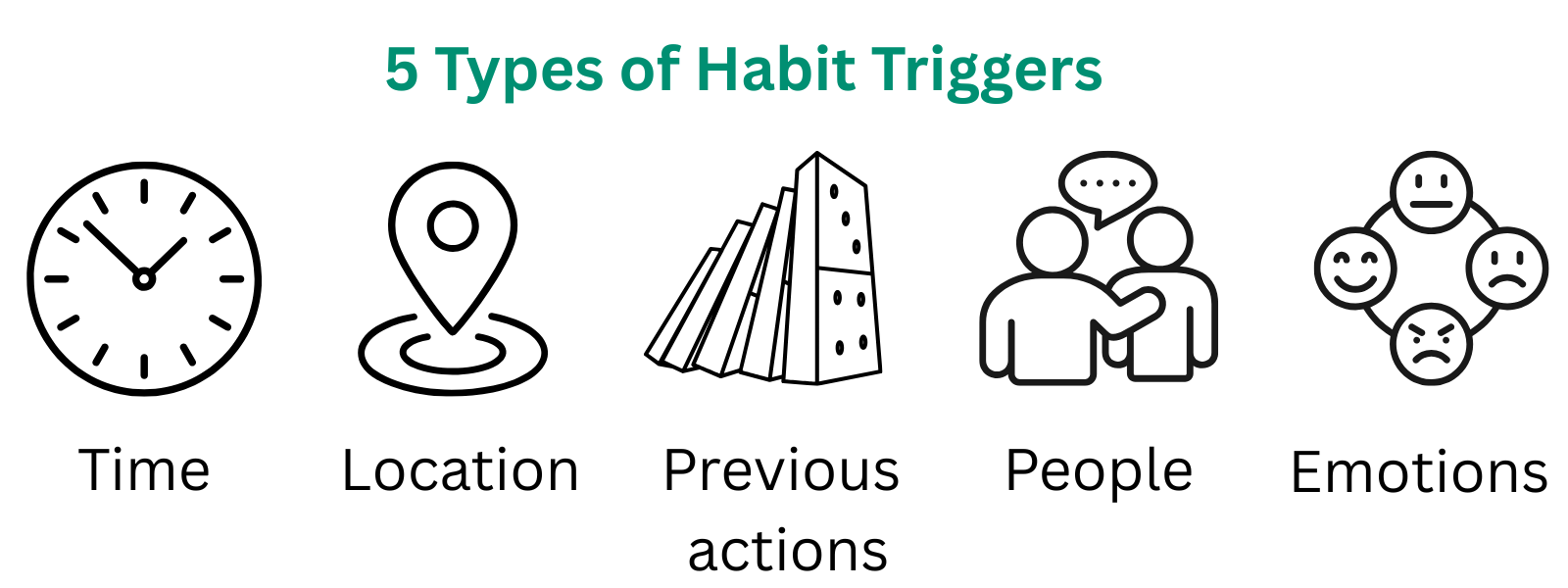
Triggers aren’t one-size-fits-all. They come in five main forms, and understanding each one helps you choose the right cue for the habit you’re trying to build — and identify the triggers behind habits you’re trying to break.
1. Time-Based Triggers
Time-based triggers link a behaviour to a specific time of day. “I meditate at 6am” or “I review my goals every Sunday evening” are both time triggers. They’re popular because they’re consistent — and with enough repetition, your brain actually starts to anticipate the behaviour as the time approaches. You’ll find yourself feeling ready to meditate before your alarm even goes off.
The downside? They require you to be in a position to act at that specific time, and they need an external prompt (an alarm, usually) until the habit is bedded in. If your schedule varies a lot, time-based triggers can be hard to maintain.
2. Location-Based Triggers
Location triggers link behaviours to specific places. “I do press-ups when I enter my bedroom” or “I review my to-do list when I sit at my desk” are both location-based. These work well because your brain naturally forms strong associations with physical environments — you don’t have to think, the place itself does the prompting.
This is also why you might find yourself automatically reaching for your phone the moment you sit on the sofa. The location has become a trigger for that behaviour through repetition. You can use exactly the same mechanism intentionally.
3. Preceding Action Triggers (Habit Stacking)
This is one of the most powerful trigger types for building new habits. The idea is simple: link a new behaviour to something you already do automatically. “After I pour my morning coffee, I will write down three priorities for the day.”
Because the existing habit is already automatic, it reliably cues the new one. You don’t have to remember — completing the first behaviour triggers the second. This is the core idea behind habit stacking, and it’s particularly useful if you’re trying to build several complementary habits without overhauling your entire routine.
One caveat: the existing habit needs to be genuinely automatic. If it still requires conscious thought, it won’t be a reliable enough trigger for something new.
4. Social Triggers (other people)
People trigger behaviours in us too. “I exercise when my friend calls to go for a run” or “I end up having wine whenever I eat out with certain friends” — both are social triggers. The presence or actions of others create a cue.
Social triggers can work powerfully in your favour (an accountability partner whose text cues your workout) or against you (a friend whose habits pull you away from what you want). Being aware of them helps you seek out social contexts that support your goals — and quietly avoid ones that undermine them.
5. Emotional State Triggers
Some behaviours are triggered by how you feel. “When I’m stressed, I go for a walk” — or, more commonly, “When I’m bored, I check social media and eat chocolate.” Emotional triggers are particularly relevant when you’re trying to understand or change unwanted habits. Many problematic behaviours are responses to specific emotional states: stress, anxiety, boredom, loneliness.
They’re harder to use deliberately because emotions are less consistent and controllable than external cues. But they can be genuinely useful for coping habits — “When I notice stress building, I take three slow breaths” is a legitimate emotional trigger.
QUICK WIN:
Text one person today and suggest a regular walking, running, or gym slot together. It doesn’t need to be weekly yet — just one recurring time. Once it’s in both diaries, their message becomes your trigger. Social accountability is one of the most reliable cues there is.
How to Identify Your Current Habit Triggers
Before you can design better triggers, you need to see the ones already driving your behaviour. Most people are surprised when they do this properly — what feels like a random impulse turns out to be a very predictable response to a specific cue.
Track the Context, Not Just the Behaviour
For a week, pick one habit you want to understand — good or bad — and note what surrounds it every time it happens. Don’t just track whether you did it; record when, where, what you’d just been doing, who you were with, and how you were feeling. After a few days, patterns emerge.
You might find that you snack at 3pm (time trigger), but only when you’re working from home (location), after checking emails (preceding action), and when you’re feeling low on energy (emotional). That’s not random — that’s a highly predictable trigger cluster you can work with. Download our free habit trigger tracker template.
The Trigger Journal
If you want to go deeper, keep a brief trigger journal specifically for habits you want to break. Each time you catch yourself doing the unwanted behaviour, pause and work backwards: What was I just doing? How was I feeling? Where was I? What time was it? Who else was there?
The key is to do this without judgement. You’re not trying to stop the behaviour yet — you’re gathering data. Once you can see the trigger clearly, you can decide what to do about it. You can’t change a pattern you haven’t recognised.

Designing Effective Triggers for New Habits
Once you understand how triggers work, you can design them deliberately. The goal is to create cues that make the desired behaviour feel almost inevitable.
Make Them Obvious
The most effective triggers are hard to miss. If you want to take vitamins daily, putting the bottle next to the coffee maker creates an unavoidable visual cue — provided you always make coffee. Your running shoes by the front door, your book on your pillow, your floss next to your toothbrush: all obvious, all powerful.
This is why environment design is such a lever for habit change. Making cues for good behaviours visible, and cues for bad ones invisible, lets your environment do the work instead of your willpower.
Make Them Consistent
Inconsistent triggers don’t build habits — they build occasional behaviours. “I exercise when I have time” means you’re still making a decision every time. “I exercise at 6:30am, Monday, Wednesday, Friday, in my living room” is a trigger. Same cue, same context, every time.
During the habit formation period especially, consistency is what allows the neural pathway to strengthen. You can introduce more flexibility once the habit feels genuinely automatic — but not before.
Make Them Unavoidable
The best triggers are ones you encounter whether you intend to or not. You experience specific times. You visit specific places. You complete existing habits. When you anchor a new behaviour to something that happens naturally in your day, you don’t have to remember to encounter the trigger — it finds you.
QUICK WIN:
Right now, place a physical cue for a habit you want to build somewhere you can’t miss it. Running shoes by the door. Vitamins next to the kettle. Book on your pillow. You’re not relying on memory — you’re making the trigger unavoidable. Do this before you close this tab.
One Trigger to Start, More Later
When building a new habit, start with one clear trigger rather than several. A single, strong cue creates a clear association that becomes automatic faster. Once the habit feels established, you can add additional triggers to make it more resilient across different contexts — if reading is only triggered by bedtime, you’ll struggle when travelling. But during the building phase, simplicity wins.
Common Trigger Mistakes (And How to Avoid Them)
Being Too Vague
“I’ll exercise in the morning” isn’t a trigger — morning is several hours long and still requires you to make decisions. “I’ll exercise at 6:30am in my living room” is a trigger. The more specific the cue, the less work your brain has to do when the moment arrives.
Relying on Motivation or Memory
This is the big one. “I’ll exercise when I feel motivated” isn’t a trigger — it’s a lottery. Motivation fluctuates based on sleep, stress, and a hundred other variables. If your habit depends on feeling up for it, it’ll happen on good days and disappear on bad ones. That’s not a habit; it’s an occasional behaviour. Effective triggers are external and consistent — they happen to you regardless of how motivated you feel.
Too Many Competing Triggers at Once
If you’ve decided to meditate, journal, and plan your day all immediately after making coffee, you’ve given one trigger three jobs. Which one happens first? Do you do all three? The ambiguity gets in the way of automaticity. Start with one or two habits with clear, distinct triggers. Build each one solidly before adding more.
Triggers That Sound Good But Don’t Work in Practice
Test your triggers. If you frequently miss the habit, the cue probably needs adjusting. “I’ll stretch when I finish work” sounds logical, but if your workday has no clear endpoint — you drift into evening, check a few more emails — there’s no actual trigger moment. Sometimes the theoretical trigger simply doesn’t create the right prompt. If it’s not working, change it.
Using Triggers to Break Bad Habits
Understanding triggers is just as important for breaking unwanted habits as for building desired ones. The first step is always identification — use the tracking methods above to find out what’s actually cuing the behaviour you want to change.
Remove the Trigger
Where possible, the most effective strategy is simply eliminating the cue. If you snack on biscuits at 3pm because they’re visible in the kitchen cupboard, removing them removes the trigger. If you scroll social media because your phone is on your desk, putting it in another room removes the cue. This isn’t about willpower — it’s about not putting yourself in the position of having to use it.
Again, environment design is your friend when breaking bad habits. Remove or avoid cues for unwanted habits at the source rather than trying to resist the urge once it’s already been triggered.
Here are some examples of how you can remove bad habit triggers from your environment:
- Time — If you find yourself mindlessly browsing your phone during your lunch break out of habit rather than genuine choice, try replacing that time slot with a short walk. When a specific time of day becomes strongly associated with a behaviour, the clock itself becomes the cue. Filling that window with something deliberate prevents the old trigger from firing.
- Location — If you regularly buy an unhealthy snack when walking past a particular shop on your commute, consider changing your route. It sounds almost too simple, but location-based cues are powerful precisely because they operate below conscious awareness. Not encountering the trigger in the first place is often easier than resisting it.
- Previous action — If sitting down after dinner automatically triggers hours of television, try standing up and doing something else immediately after eating — washing up, a brief tidy, or a short walk around the block. The post-dinner sit-down is the real trigger here. Change that one action and the rest of the sequence loses its momentum.
- People — If you tend to drink more alcohol when socialising with a particular group, suggesting alternative activities like a walk or a coffee catch-up removes the social cue that triggers the behaviour.
- Emotions — If stress at the end of a workday triggers comfort eating, create a physical transition ritual like changing clothes or a short walk that interrupts the emotional state before it leads to the kitchen. Changing the emotional environment removes the cue before it takes hold.
Replace the Response
When you can’t avoid the trigger — for example, no one can avoid boredom or stress all of the time — the next best approach is changing what you do in response to it. This is the principle behind habit replacement (see our article on how to break bad habits): keep the trigger, keep the reward function, but change the behaviour in between.
If stress leads you to snack, try replacing snacking with a short walk. The trigger (stress) and the reward (relief, a break from the feeling) remain — only the routine changes. This tends to be more sustainable than trying to white-knuckle your way through the urge every time.
Advanced Trigger Strategies
Trigger Chains
Trigger chains link multiple habits in sequence, where each behaviour cues the next. This is how morning routines work at their best: waking triggers making coffee, which triggers writing down your three priorities, which triggers getting dressed. You only need to remember to start — after that, each habit flows from the last.
Start with short chains of two or three habits. Build each link until it’s reliable before extending. If any link requires willpower or deliberate thought, the chain breaks there — that’s where to focus your effort.
Implementation Intentions
Already touched on in the Quick Win box above, but worth expanding on. Implementation intentions are a specific form of trigger design with solid research behind them. The “if-then” format creates a mental link between a situation and a response before the situation arises. When it occurs, you don’t have to decide what to do — the decision is already made. This is why “If I feel the urge to check social media, then I’ll take three deep breaths” works better than “I’ll try to use my phone less.”
Environmental Trigger Design
The most systematic approach involves deliberately redesigning your environment to create the cues you want and suppress the ones you don’t. Healthy foods at eye level, treats out of sight. Your desk facing away from distractions. Your gym kit laid out the night before. Your phone charging in another room overnight.
When your environment is designed well, you find yourself doing the right things without deciding to — the triggers are already pointing you there. This is the closest thing to effortless habit change there is.
Making Triggers Work for You: A Practical Starting Point
Here’s the key insight: you’re already responding to triggers all day. Your environment, your routines, your emotional states — all of these are cueing behaviours constantly. The question isn’t whether triggers are shaping your life; it’s whether the ones operating on you are working in your favour.
Pick one habit you want to build or break. Choose the most relevant trigger type based on your circumstances — time or location if it’s a daily behaviour, habit stacking if there’s a strong existing routine nearby, an implementation intention if it’s a situational response. Make the trigger as obvious, consistent, and unavoidable as possible. Test it for a week. If you’re missing it frequently, adjust the cue — not your resolve.
When triggers are well designed, you’ll notice the habit starting to feel less like something you have to make yourself do and more like something that just happens. That’s not passive — that’s the system working. You’ve done the thinking upfront so your future self doesn’t have to.
Get your triggers right, and building habits becomes dramatically more manageable. Get them wrong, and no amount of motivation will make up for it. Start small, start specific, and let the trigger do the work. To learn more about creating new habits, see our guide to habit formation.
RESOURCES:
I only recommend resources that I either use personally or have researched and feel are genuinely helpful for my readers. Resources sometimes contain affiliate links; if you purchase through these, I may earn a small commission at no extra cost to you.
Recommended Reading:
Atomic Habits by James Clear — The most accessible guide to building habit systems, with the best practical treatment of cues and environment design available. Paperback | Kindle | Audible
The Power of Habit by Charles Duhigg — Covers the neuroscience and real-world psychology of habit loops in depth, with compelling case studies. Paperback | Kindle | Audible
Good Habits, Bad Habits by Wendy Wood — Research-backed, focused specifically on context, environment, and how automatic behaviour actually forms. Paperback | Kindle | Audible
Related Articles on Marginal Gains:
The Habit Loop — The cue-routine-reward framework that everything in this article builds on
Habit Stacking — A full guide to preceding action triggers and how to chain habits effectively
Environment Design for Better Habits — How to redesign your surroundings to make good behaviours automatic
How to Break Bad Habits — Habit replacement strategies and why willpower alone doesn’t work
I'm Simon Shaw, a Chartered Occupational Psychologist with over 20 years of experience in workplace psychology, learning and development, coaching, and teaching. I write about applying psychological research to everyday challenges - from habits and productivity to memory and mental performance. The articles on this blog draw from established research in psychology and behavioural science, taking a marginal gains approach to help you make small, evidence-based changes that compound over time, allowing you to make meaningful progress in the areas you care about most.