
Bullet Journal vs Digital Habit Tracking: Which Works?
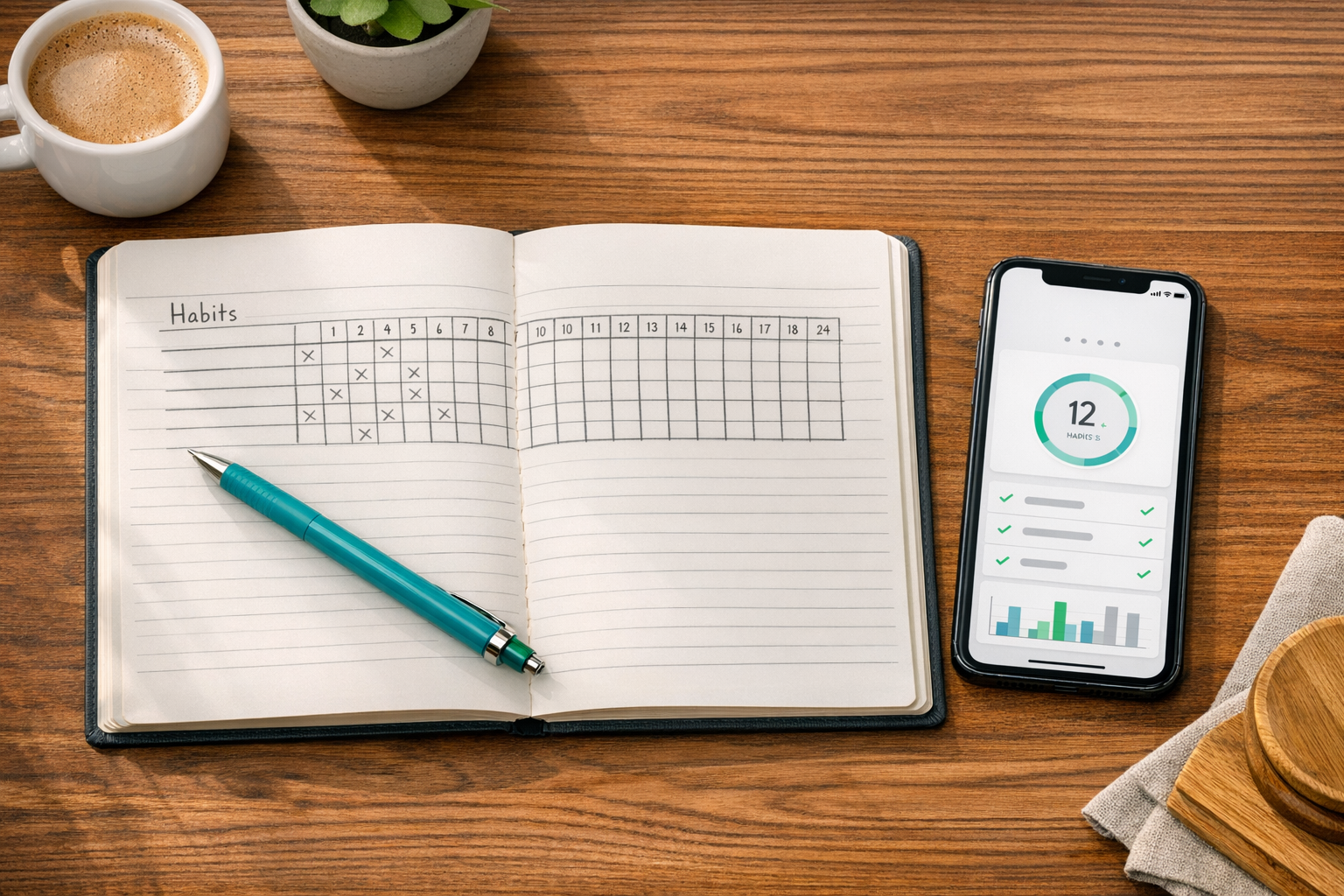
You’ve decided to track your habits. Excellent choice — research consistently shows that tracking significantly increases your likelihood of success. But now you face a surprisingly contentious question: paper or digital?
The bullet journal vs digital habit tracking debate has created devoted camps on both sides. Bullet journal enthusiasts swear by the tactile satisfaction of pen on paper and the mindfulness it creates. App advocates champion the convenience, automation and data insights that only digital tools provide.
The truth? Neither method is universally superior. The best approach depends on your personality, lifestyle and what you’re trying to achieve. This guide examines both sides honestly, explores hybrid options and helps you determine which method — or combination — will actually work for your life.
Bullet Journal vs Digital Habit Tracking: Why the Method Matters
This isn’t just about preference. Research from Stanford’s Behaviour Design Lab identifies tracking method mismatch as one of the top three reasons people abandon habit-building efforts within two weeks. When your tracking system relies on willpower or fights against how your brain naturally works, consistency becomes exponentially harder.
The question isn’t which method is objectively better. The question is which method aligns with your existing behaviours, supports your motivation style and fits seamlessly into your daily routine. A brilliant system you don’t use is infinitely worse than a simple system you actually maintain.
Before we compare specific methods, consider this: the act of tracking itself matters more than the medium. Whether you’re marking X’s in a notebook or tapping your phone screen, the psychological mechanisms driving success are similar. You’re creating visibility, building accountability and generating small rewards for completion. The method simply determines how friction-free and sustainable that process feels.
Bullet Journal Habit Tracking: The Case for Paper
Bullet journal habit tracking involves creating custom spreads in a physical notebook where you manually log each habit completion. The bullet journal system, created by Ryder Carroll, has spawned a massive community of practitioners who’ve developed countless creative tracking layouts.
The Undeniable Advantages
The physical act of writing engages different brain regions than typing or tapping. Research demonstrates that handwriting improves memory retention and comprehension. When you sit down with your journal each evening to fill in your habit boxes, you’re not just recording data — you’re creating a moment of reflection.
This mindfulness represents one of paper tracking’s most significant benefits. Digital trackers get checked mindlessly whilst waiting in queues or during advert breaks. Physical journals demand presence. You must deliberately open your notebook, review your day and consciously mark your progress. This ritual builds a stronger connection between your habits and your identity.

The setup ritual itself creates commitment. Every month, you design your tracker, choosing layouts, drawing boxes, perhaps adding artistic elements. That investment of time and energy signals to your brain that these habits matter. You’re not just deciding to track habits — you’re physically manifesting that commitment on paper.
Flexibility is another major strength. Want to track mood alongside habits? Draw a new column. Want to try a circular tracker instead of a grid? Go ahead. Want to add notes about what made today difficult? You have unlimited space. Physical systems bend to your needs rather than forcing you into predetermined formats.
There’s also something deeply satisfying about the visual impact. Watching a page fill with X’s or colour creates tangible evidence of progress. You can flip backwards through your journal and immediately see patterns. That quick visual scan — impossible with most apps — provides motivation and insight without requiring data analysis.
QUICK WIN:
If you’re drawn to bullet journaling, resist the urge to create an elaborate spread before you start. Draw a simple grid — dates across the top, habits down the side — and use it for two weeks. If the method suits you, invest in making it beautiful. If it doesn’t, you’ve lost nothing.
The Real Challenges
Maintenance creates the first hurdle. Forgot your journal at home? No tracking today. Lost the journal? You’ve lost months of data. Travelling? That notebook needs to come with you. The physical nature that makes journals satisfying also makes them vulnerable.
Journals don’t remind you. Your notebook sits silent on your desk, easily forgotten during busy days. There’s no 9pm notification saying “Hey, did you do your habits today?” The responsibility for remembering falls entirely on you.
Manual analysis presents another challenge. Spotting patterns requires flipping through pages and doing mental mathematics. Questions like “How many times did I exercise in March?” become research projects rather than instant answers. You might notice obvious trends, but subtle patterns often remain hidden.
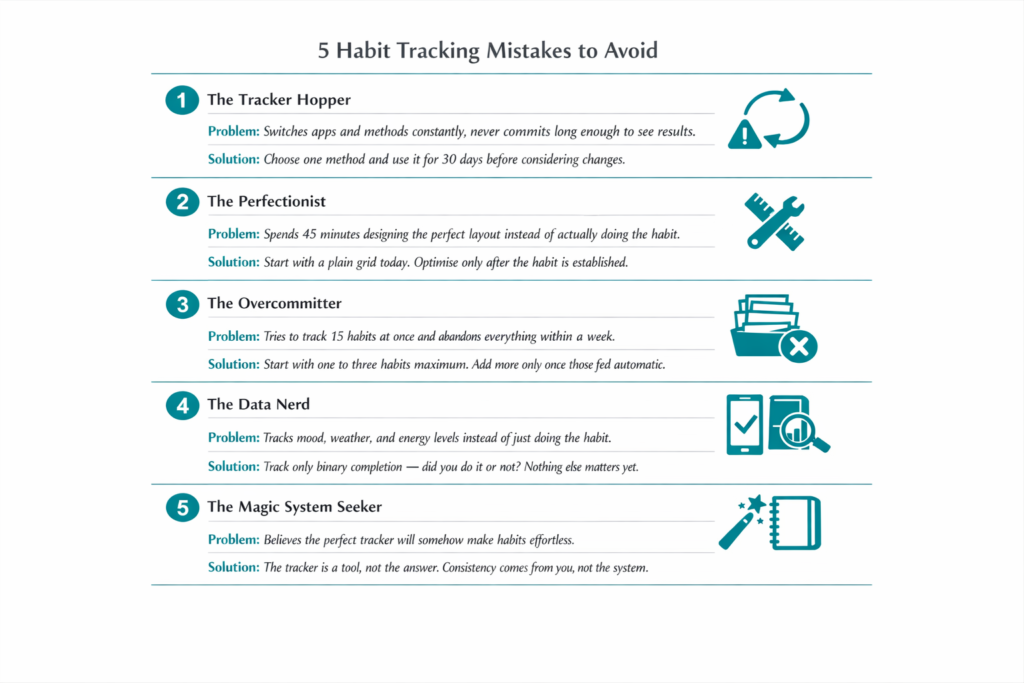
Time investment can become significant. If you love the creative aspect, that’s wonderful. But if you’re spending 45 minutes perfecting your layout instead of actually doing your habits, you’ve created a productivity theatre — the appearance of progress without real results.
Perhaps most critically, bullet journals work brilliantly until life gets chaotic. When you’re overwhelmed, stressed or travelling, maintaining a detailed paper system often becomes the first thing abandoned. One person tracked habits meticulously for 18 months, then had a baby. The journal disappeared, not because the method failed, but because the method required consistent capacity she no longer had.
Digital Habit Tracking: The Case for Apps
Digital habit tracking uses smartphone apps or web platforms to log habit completion. Modern habit trackers range from simple streak counters to sophisticated systems with analytics, social features and AI-powered insights. In the bullet journal vs digital habit tracking debate, apps win decisively on convenience and automation.
The Undeniable Advantages
Portability stands as the most obvious benefit. Your phone is always with you. At work, whilst travelling, in bed at night — you can track anywhere. No risk of forgetting your tracker at home or losing months of data because you misplaced a notebook.
Reminders represent a game-changing feature. Your phone buzzes at the right time: “Did you drink water today?” It’s actively prompting you rather than passively waiting to be remembered. For people who struggle with consistency, these nudges often make the difference between success and failure.
Automation eliminates manual analysis. Apps calculate streaks, generate charts, identify patterns and highlight trends — all instantly. Want to know your workout frequency over the past three months? One tap. Want to see which day of the week you’re most consistent? The app already knows. This automated insight helps you make informed adjustments without tedious data compilation.
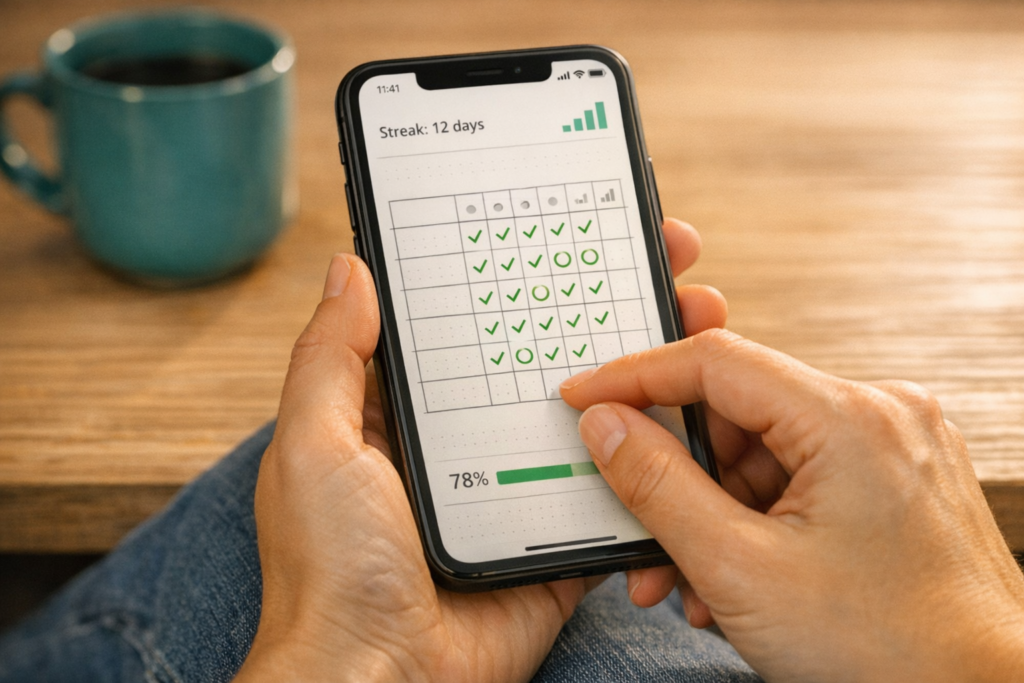
Cross-device syncing means your data lives in the cloud, accessible everywhere. Start tracking on your phone, review progress on your tablet, check stats on your computer. Everything stays synchronised without any effort from you.
Integration with other systems multiplies functionality. Many apps connect with Apple Health, Fitbit or other platforms, automatically tracking certain habits without manual input. Your phone already knows you walked 10,000 steps — why log it manually?
The speed of logging matters more than you might think. Opening a notebook, finding today’s date and filling in boxes takes time. Tapping a button takes seconds. When you’re tired or busy, that friction difference determines whether you bother tracking at all.
QUICK WIN:
If you try a habit app, delete all non-essential notifications from your phone first. Your habit reminder will get lost in the noise if it competes with dozens of other alerts. Give it dedicated space in your notification settings — a single daily prompt at a consistent time works better than multiple scattered reminders.
The Real Challenges
Notification fatigue represents the biggest problem. The same mechanism that reminds you to track habits also bombards you with alerts from every other app. Your habit reminder becomes just another ping to ignore. Unlike a physical journal’s silent presence, digital prompts actively compete for attention in an already noisy environment.
Screen time irony creates an uncomfortable contradiction. You’re trying to reduce phone usage? Here’s an app you need to open multiple times daily. This feels particularly absurd when one of your tracked habits is “less screen time.” The tool meant to solve the problem becomes part of the problem.
Feature bloat affects many popular apps. What started as simple habit tracking evolves into complex systems with community features, challenges, achievement badges, customisation options and premium tiers. Setup takes longer than the habits themselves. You spend more time configuring your tracker than building your habits.
Subscription costs accumulate. Many apps lock useful features behind subscription paywalls, typically $4–8 per month — around $40–80 per year if you opt for annual billing. That’s still more than a £5 notebook provides, though many also offer capable free tiers.
Perhaps most significantly, the ease of digital tracking can undermine mindfulness. Tapping a button whilst scrolling social media doesn’t create the same deliberate moment of reflection as sitting down with your journal. You get convenience but potentially sacrifice the psychological benefits of intentional review.
Completion Data: What the Research Shows
Data from Cohorty, a habit tracking platform, found that among their users, 67% of those using only digital tracking completed their 30-day habit challenges, compared to 59% using only paper methods. Hybrid users achieved the highest completion rate at 71%, though only 12% of participants used this approach — likely reflecting selection bias towards already highly organised individuals.
It’s worth noting that this data comes from a commercial app company’s own user base, which carries obvious limitations. Independent peer-reviewed research directly comparing the two methods at scale doesn’t yet exist. That said, the finding that aligns most closely with the broader behaviour change literature is this: method consistency matters more than method choice. People who stick with one approach succeed at similar rates regardless of which they choose. Those who constantly switch methods in search of the perfect system consistently underperform those who commit to a single approach.
Your best predictor of success isn’t which side of the bullet journal vs digital habit tracking debate you choose, but whether you can maintain that method consistently for at least 30 days.
Hybrid Approaches: Getting the Best of Both
You don’t have to choose exclusively in the bullet journal vs digital habit tracking debate. Many successful habit trackers use hybrid systems that leverage the strengths of both methods.
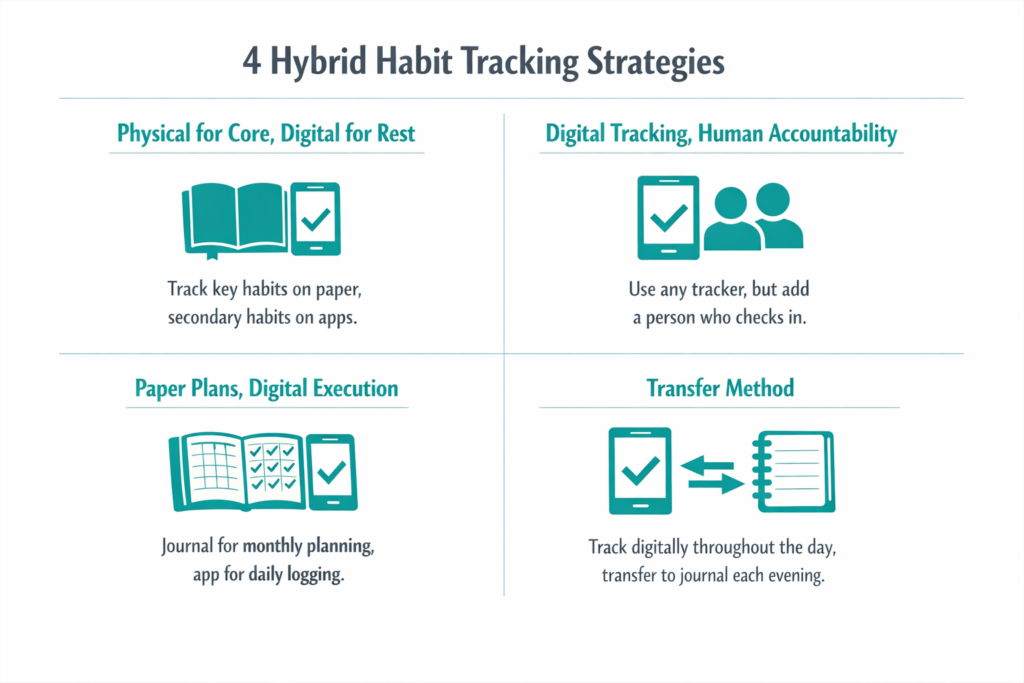
Strategy 1: Physical for Core, Digital for Everything Else
Track your most important keystone habits in a journal where mindfulness and ritual matter most. Use apps for secondary habits where reminders and convenience are more valuable than reflection.
Strategy 2: Digital for Tracking, Human for Accountability
Use whichever tracker is easiest, but add a human accountability partner. Neither paper nor digital stops you from simply ignoring them — a person who asks “did you do it this week?” changes that entirely.
Strategy 3: Physical for Planning, Digital for Execution
Use your journal for monthly planning — deciding which habits matter and why. Use apps for daily execution — the quick logging and reminders that keep you consistent day to day.
Strategy 4: Transfer Method
Track digitally throughout the day for convenience, then transfer key data to your journal each evening. Two touchpoints: a quick digital check-in and a mindful paper review.
Choosing Your Method: A Decision Framework
Match your tracking method to your actual daily routines, not your aspirations. You might love the idea of beautiful bullet journal spreads, but if you’ve never maintained a paper planner for more than two weeks, starting with an elaborate journal system sets you up for failure.
Choose Bullet Journal If You:
Already maintain a paper planning system and enjoy that routine. Value the creative and artistic aspects of journaling. Want to minimise screen time in your life. Have a consistent daily space and routine where you can access your journal. Benefit from the mindfulness and reflection that handwriting creates. Prefer visual/spatial information processing over data analytics. Have a limited number of habits to track (fewer than five works well).
Choose Digital Apps If You:
Have inconsistent daily routines or travel frequently. Need reminders to maintain consistency. Want automatic data analysis and trend identification. Track numerous habits across different categories. Already spend significant time on your phone anyway. Prefer quantitative data and charts over visual grids. Value cross-device access to your tracking data. Struggle with remembering to track without external prompts.
Choose Hybrid If You:
Have different types of habits requiring different tracking approaches. Want the mindfulness of paper with the convenience of digital. Can maintain two systems without either feeling burdensome. Have both core identity habits and numerous secondary habits. Enjoy systems optimisation and don’t mind additional complexity.
Common Mistakes That Undermine Any Method
Regardless of which side of the bullet journal vs digital habit tracking debate you choose, certain mistakes sabotage success across all tracking methods.
Making Your Choice Stick
Once you’ve chosen a method in the bullet journal vs digital habit tracking decision, give it a genuine trial. Thirty days minimum before making changes. Most people quit apps or abandon journals within the first week, before habits have time to form.
Start simple. One tracker. Three habits maximum. Basic setup. You can always add complexity later if needed. A simple system you actually use beats an elaborate system you abandon.
Evaluate honestly at the end of your trial period. Did you use it consistently? Did it feel burdensome or natural? Did you see progress? If it genuinely didn’t work, identify specifically why. Then choose differently based on that insight rather than vague dissatisfaction.
Remember that the right tracker disappears into the background. It should feel automatic rather than another task on your list. If you’re constantly fighting your tracking system, that’s valuable information. Either the method doesn’t match your brain, or you’re tracking too many habits.
QUICK WIN:
Set a calendar reminder for 30 days from today labelled “Habit tracker review.” On that date, ask yourself three questions: Did I use it consistently? Did it feel natural or forced? Did I make progress? Answer honestly, then either commit to the method or switch — but only after 30 days of genuine effort.
When Tracking Isn’t the Problem
Sometimes people cycle through the bullet journal vs digital habit tracking debate indefinitely, certain the next system will finally make habits stick. If you’ve genuinely tried both paper and digital approaches for at least a month each and still struggle, tracking probably isn’t your core issue.
You might need to address habit design itself — perhaps your habits are too ambitious, poorly timed or lack clear cues. You might need external accountability from another person rather than a passive tracking system. You might need to understand why habits fail to identify what’s actually blocking your progress.
The tracking method can facilitate consistency, but it can’t force consistency when other foundational elements are missing. A wall calendar works brilliantly for someone with strong intrinsic motivation and clear habit design. No app, no matter how sophisticated, will save poorly designed habits that don’t fit your life.
The Bottom Line on Bullet Journal vs Digital Habit Tracking
The techniques in this article draw from evidence-based psychological research and practical application with real people building real habits.
Neither bullet journal nor digital habit tracking is universally superior. Both work excellently for the right person in the right context. The question isn’t which is objectively better — it’s which aligns with how your brain works, fits your lifestyle and supports the specific habits you’re building.
If you love paper, design, creativity and have consistent access to your journal, bullet tracking can be profoundly effective. The mindfulness and ritual it creates strengthen habit identity in ways apps cannot replicate.
If you need convenience, automation, reminders and data analytics, digital apps provide functionality impossible with paper. The reduced friction and intelligent prompts often mean the difference between consistency and failure.
If you’re organised enough to manage both, hybrid approaches leverage complementary strengths — using each method for what it does best.
The real secret? Pick one approach based on your honest assessment of your personality and habits. Commit to it for at least a month. Resist the urge to optimise before you have real data about what’s working. The best habit tracking method is the one you’ll actually use every single day.
Stop searching for the perfect system. Choose a good-enough method today and start tracking. Consistency with an imperfect method beats perfect planning that never begins.
RESOURCES:
I only recommend resources that I either use personally or have researched and feel are genuinely helpful for my readers. Resources sometimes contain affiliate links; if you purchase through these, I may earn a small commission at no extra cost to you.
Recommended Reading
Atomic Habits — James Clear. The definitive guide to building habits that stick, covering the psychology of habit formation that underpins any tracking method you choose. Paperback | Kindle | Audible
The Power of Habit — Charles Duhigg. The book that popularised keystone habits and the habit loop — essential background reading for anyone serious about behaviour change. Paperback | Kindle | Audible
Paper Journals
LEUCHTTURM1917 Bullet Journal Edition 2 — The gold standard for bullet journaling. A5 dotted, pre-printed setup pages, 206 numbered pages, hardcover. Best for creative journalers who want to design their own habit tracker layouts. View on Amazon
Clever Fox Habit Calendar — Pre-structured monthly habit tracking pages, undated so you can start any time. Tracks up to 12 daily, 5 weekly, and 5 monthly habits across 24 months. Best for beginners who want to start immediately without designing layouts. View on Amazon
LEUCHTTURM1917 A5 Dotted Notebook — A blank dot-grid notebook for those who prefer total creative freedom. No pre-printed templates — you design your tracker from scratch each month. Best for experienced journalers who want full flexibility. View on Amazon
Digital Apps
Streaks (iOS only) — Clean, minimal streak-based tracker. One-off purchase at $5.99, no subscription. Integrates with Apple Health and Apple Watch. Best for iPhone users who want something beautiful and frictionless. streaksapp.com
Habitify (iOS, Android, Mac, Web) — Cross-platform tracker with clean analytics and morning/evening routine separation. Free tier available, ~$30/year for premium. Best for users who want data insights across multiple devices. habitify.me
Habitica (iOS & Android) — Gamified RPG-style tracking where completing habits earns experience points and rewards. Free with optional paid extras. Best for people who respond well to game-style motivation. habitica.com
Loop Habit Tracker (Android only) — Free, open-source, works fully offline, no account required. Detailed habit strength graphs. Best for Android users who want zero friction and complete privacy. loophabits.org
Related Articles
Habit Formation Guide — The complete evidence-based framework for building habits that last.
Keystone Habits — How to identify the single habit that creates positive ripple effects across your whole life.
The Habit Loop — Understanding cue, routine, reward and how to use it to build better habits.
Why Habits Fail — The most common reasons habits don’t stick and how to fix them.
I'm Simon Shaw, a Chartered Occupational Psychologist with over 20 years of experience in workplace psychology, learning and development, coaching, and teaching. I write about applying psychological research to everyday challenges - from habits and productivity to memory and mental performance. The articles on this blog draw from established research in psychology and behavioural science, taking a marginal gains approach to help you make small, evidence-based changes that compound over time, allowing you to make meaningful progress in the areas you care about most.