
How to Remember What You Read: The Dual Coding Method

If you want to know how to remember what you read, the answer lies in a counterintuitive shift: stop relying on words alone. You finish an excellent book on productivity. The ideas resonated deeply. You felt motivated to apply them. But a week later, when someone asks what you learned, your mind goes blank. You remember vague concepts but can’t recall the specific strategies or frameworks that made the book valuable.
This frustration is universal. Research shows that without specific retention techniques, we forget approximately 50% of what we read within an hour, and up to 90% within a week. The traditional approach — simply reading and perhaps highlighting — creates an illusion of learning without actual retention. Understanding why we forget is the first step toward improving retention.
The problem isn’t your memory. The problem is that reading alone engages only one channel of your memory system. Your brain processes information through multiple pathways, but when you rely solely on words, you’re using a fraction of your memory’s potential.
There’s a more effective approach grounded in decades of cognitive psychology research. The dual coding method combines verbal and visual processing to create stronger, more retrievable memories. This article shows you exactly how to remember what you read — applying dual coding to dramatically improve how much you retain and can actually use.
Why You Forget What You Read
Before exploring the solution, it helps to understand why reading alone produces such poor retention. The answer lies in how your memory systems work.
When you read, information enters your working memory — the temporary storage system where you actively process what you’re currently thinking about. Working memory has severe limitations. It can hold only about four chunks of information at once and maintains them for mere seconds unless you actively rehearse them.
For information to move from working memory into long-term storage — where you can retrieve it days, weeks, or years later — it needs to be encoded in ways that create strong memory traces. Simply reading creates relatively weak encoding. The words pass through your mind, you understand them in the moment, but they haven’t been transformed into a form that sticks.
This explains why you can read an entire chapter, understand it while reading, yet struggle to summarise it afterwards. Understanding and remembering are separate processes. Understanding happens in working memory as you’re reading. Remembering requires transferring that information into long-term memory through effective encoding strategies.
The good news is that cognitive psychologists have identified specific encoding strategies that dramatically improve retention. The most powerful of these is dual coding — using both verbal and visual processing simultaneously.
The Science Behind Dual Coding
Dual coding theory, developed by psychologist Allan Paivio in the 1970s, proposes that the mind processes information through two distinct but interconnected channels: a verbal system for language-based information and an imagery system for visual and spatial information. InstructionalDesign.org’s overview of dual coding theory provides a clear summary of the research if you’d like to explore Paivio’s original framework further.
Here’s the crucial insight: when you encode information through both systems simultaneously, you create two separate memory representations. Later, when you try to recall that information, you can retrieve it through either pathway. If you forget the verbal representation, you might still access the visual one, and vice versa.
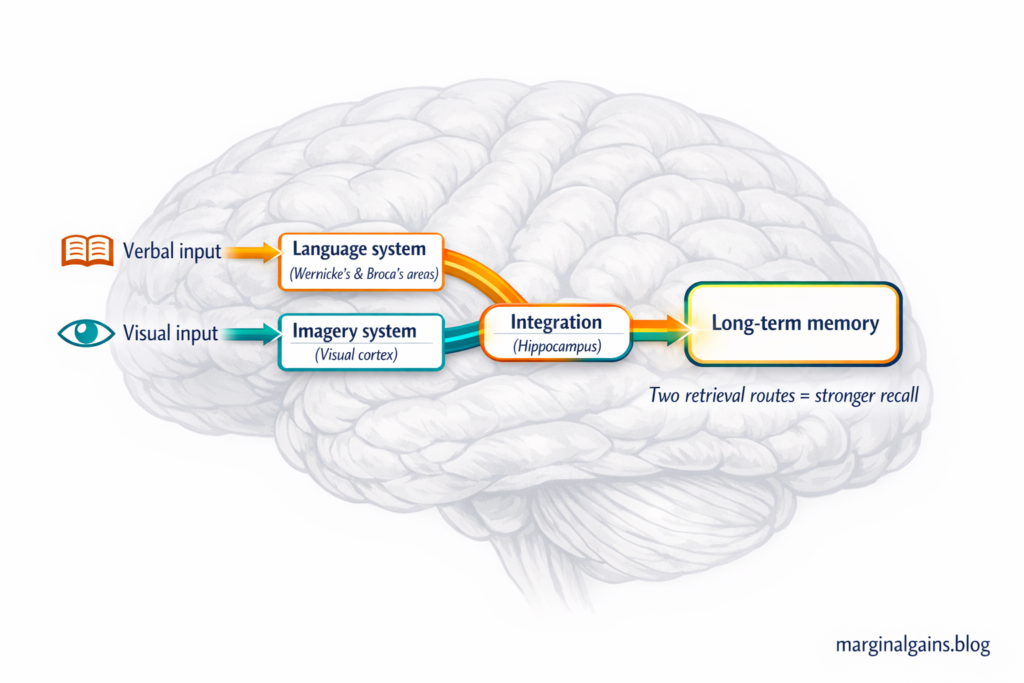
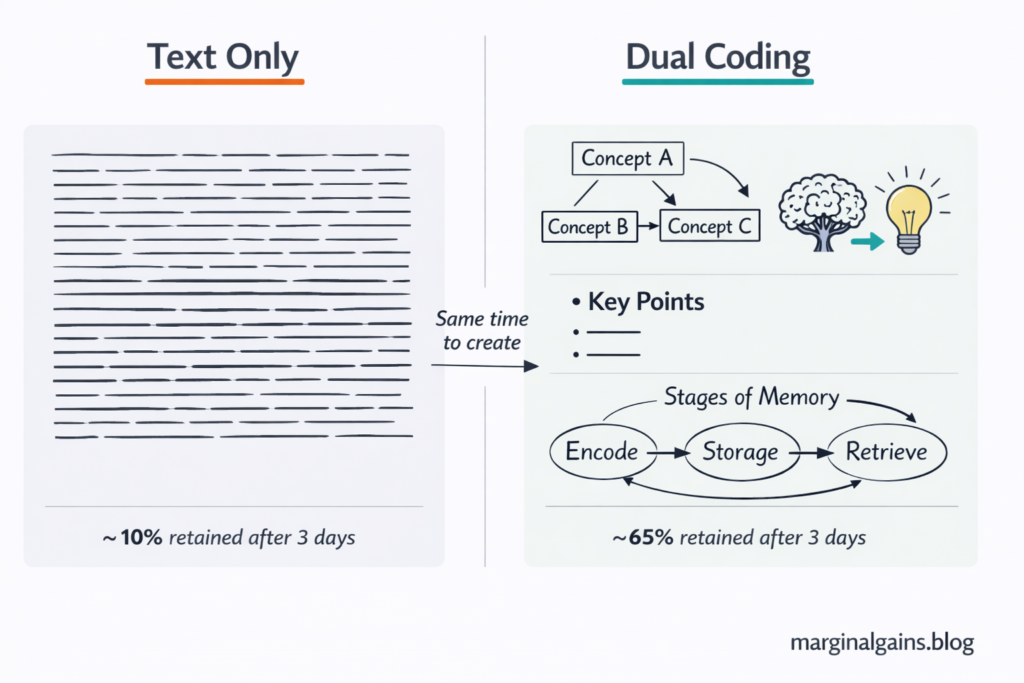
Research consistently demonstrates that dual coding produces superior memory compared to either verbal or visual encoding alone. In one classic study, participants who combined written notes with simple drawings remembered approximately 65% of information after three days, compared to just 10% for those who used words alone. This picture superiority effect has been replicated numerous times across different types of material.
This isn’t about having a “visual learning style.” Learning styles as traditionally conceived lack scientific support. Rather, dual coding works because everyone’s brain has these two processing systems, and using both simultaneously creates redundant, reinforcing memory traces.
The effect is particularly powerful for concrete concepts that can be easily visualised. Abstract ideas benefit too, though they require more creative visual representation. The key is that the act of creating a visual representation — whether a sketch, diagram, or mental image — forces deeper processing of the material.
How to Remember What You Read Using Dual Coding
Understanding the theory is one thing. Applying it requires specific, practical techniques. Here’s how to use dual coding to remember what you read.
The fundamental principle is simple: never rely on words alone. As you read, continually translate verbal information into visual form. This doesn’t mean creating elaborate artwork. Simple sketches, diagrams, symbols, or even vivid mental imagery all engage your visual processing system.
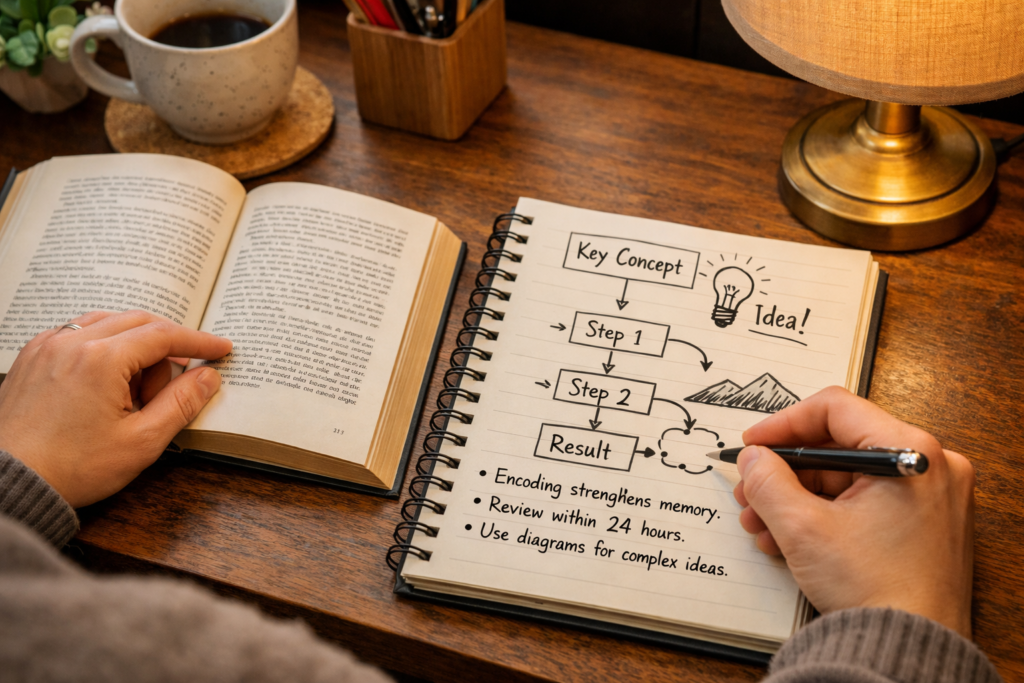
Start by reading actively with a pen or pencil in hand. When you encounter a key concept, pause and create a quick visual representation in the margin or on a separate notepad. If you’re reading about a process with sequential steps, draw a simple flowchart. For hierarchical information, sketch a tree diagram. For relationships between concepts, use a network or web of connections.
These visuals don’t need artistic merit. Stick figures, basic shapes, arrows, and simple symbols work perfectly. The goal isn’t to create something beautiful; it’s to engage your visual processing system while reinforcing the verbal content.
I’ve used this approach throughout my postgraduate studies and continue to use it when reading research for professional development. For a book on organisational psychology, I might draw a simple Venn diagram showing overlapping concepts, or a 2×2 matrix categorising different approaches. These crude sketches take seconds to create but dramatically improve my retention and understanding.
QUICK WIN:
Pick up whatever you’re currently reading and turn to the last page you read. In the margin or on a notepad, sketch a simple visual representation of the main idea — a diagram, flowchart, or even a rough symbol. Don’t overthink it; a box with an arrow takes ten seconds. That single act of visual encoding will make the content significantly more retrievable tomorrow than re-reading the page three times would.
Visual Note-Taking Strategies
One of the most practical applications of dual coding is visual note-taking. Rather than writing linear notes that simply transcribe the text, create notes that combine words and visual elements.
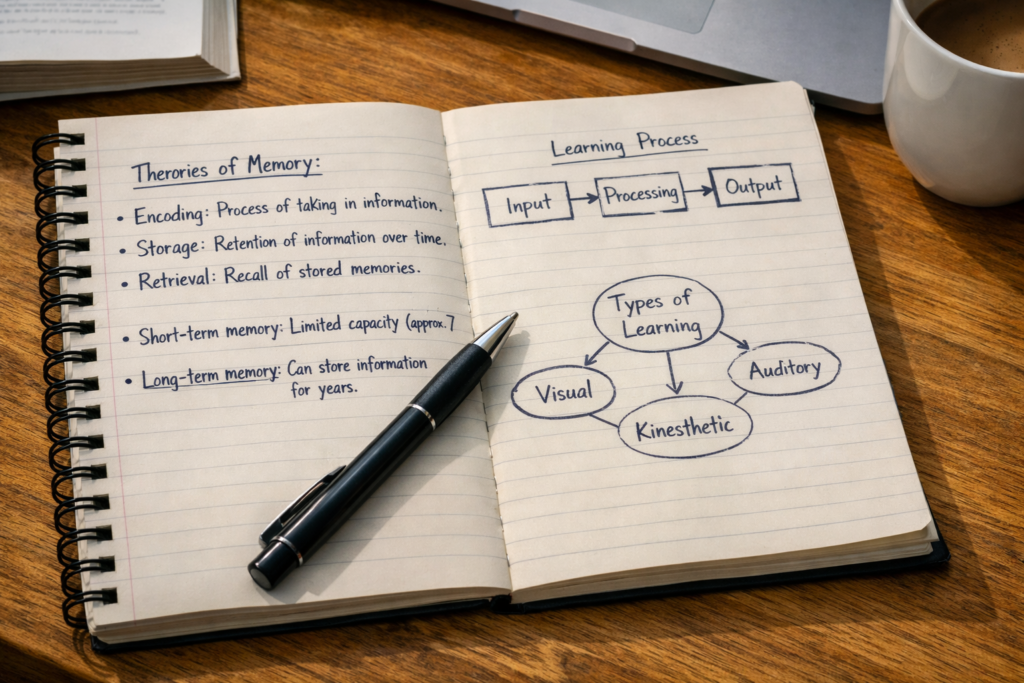
Mind mapping is a powerful dual coding technique. Place the main topic at the centre of the page, then branch out with related concepts, using different colours, shapes, and spatial arrangement to show relationships. The visual-spatial structure helps you see connections between ideas while the words provide specific content. When you later recall the mind map, you’re retrieving both the visual layout and the verbal content.
Sketchnoting offers another approach. As you read, create a combination of words, simple drawings, diagrams, and visual metaphors on a page. You’re not trying to capture everything; you’re creating a visual-verbal summary of key points. The act of deciding what to include and how to represent it visually forces deep processing.
For textbooks or technical material, consider the Cornell note-taking method enhanced with visuals. Divide your page into three sections: notes, cues, and summary. In the notes section, combine written information with diagrams and sketches. In the cues section, use visual symbols or tiny sketches as retrieval prompts. In the summary section at the bottom, include both a written summary and a simple visual representation of the main concept.
Even if you prefer digital note-taking, you can apply dual coding. Many note apps support drawing or inserting images. Create simple diagrams using drawing tools, or photograph your hand-drawn sketches and embed them in your digital notes. The key is combining modalities, not the specific medium.
Creating Mental Images While Reading
Not every reading situation allows for physical note-taking. When reading on your commute, before bed, or during a lunch break, you might not have paper and pen readily available. This is where the practice of creating deliberate mental imagery becomes valuable.
As you read, actively visualise what you’re reading about. If you’re reading about a historical event, picture the scene in your mind. For a business concept, imagine a concrete example of it in action. For abstract ideas, create metaphorical images that represent the concept.
The key word here is “actively.” Simply allowing vague images to drift through your mind while reading isn’t enough. Deliberately construct detailed mental pictures. What do the people look like? What’s the setting? What specific actions are happening? The more elaborate and unusual you make the mental image, the more memorable it becomes.
Research on visual imagery shows that the bizarreness effect enhances memory. Unusual, exaggerated, or humorous images are more memorable than ordinary ones. If you’re reading about customer retention strategies, don’t just imagine a happy customer; imagine a customer so delighted they’re literally jumping for joy or hugging the product. The exaggeration makes it stick. This same principle applies when you’re trying to remember names and faces — vivid, unusual associations work better than ordinary ones.
This technique requires practice. Most of us aren’t accustomed to deliberately creating mental imagery while reading. Start by pausing every few paragraphs to create one clear mental image of what you’ve just read. As this becomes more natural, you’ll find yourself spontaneously generating images as you read, which accelerates your reading while simultaneously improving retention.
QUICK WIN:
Next time you’re reading without pen and paper — on a commute, before bed, or during a break — pause after every three or four paragraphs and deliberately construct a mental image of what you just read. Make it specific and slightly unusual: real people, a concrete setting, an exaggerated action. Hold the image for five seconds before reading on. That brief pause costs almost no time but substantially improves how much you’ll remember the following day.
Applying Dual Coding to Different Types of Reading
The specific application of dual coding varies depending on what you’re reading and why you’re reading it. Here’s how to adapt the technique for different contexts.
For non-fiction books you’re reading to learn and remember, combine margin sketches with a separate visual summary page. After each chapter, create a single-page visual summary that combines the key points with simple diagrams or illustrations. This chapter summary becomes your review material. Instead of rereading the chapter, you review your visual summary, which triggers recall of the fuller content.
For academic reading or professional development materials, create concept maps that show relationships between ideas across multiple sources. As you read different articles or chapters, add to an evolving diagram that connects concepts from various readings. This not only aids retention but helps you see patterns and connections you’d miss with text-only notes. For more on this, see our guide to how to take better notes.
For practical how-to books, sketch the process or technique being described. If you’re reading about a productivity system, draw the workflow. For a cooking technique, sketch the steps. For fitness advice, draw stick figures demonstrating the movements. These visual representations serve as quick reference guides you can return to without rereading the entire text.
Even for narrative non-fiction or biographies, visual elements help. Create a timeline of events with small illustrations or symbols marking key moments. Draw a simple map showing geographical locations mentioned in the narrative. Sketch the main characters or subjects. These visual anchors help you retain the story structure and key information.
Overcoming Common Obstacles
When people first learn about dual coding, they often raise similar concerns. Understanding these obstacles helps you overcome them.
The most common objection is “I can’t draw.” This misses the point entirely. Dual coding doesn’t require artistic skill. A circle with a smiley face is sufficient to represent a person. A box with an arrow is enough for a process. Simple geometric shapes, stick figures, and basic symbols engage your visual processing system just as effectively as sophisticated artwork. The goal is encoding information visually, not creating gallery-worthy illustrations.
Another concern is that creating visuals takes extra time. Initially, it does slow your reading slightly. However, this is time well invested. The small additional time during reading eliminates hours of rereading later because you actually remember what you read the first time. Moreover, as dual coding becomes habitual, your speed increases. You learn to create quick visual representations almost automatically.
Some worry about reading digital content where adding sketches is less convenient. Digital annotation tools increasingly support drawing and image insertion. Alternatively, keep a notebook beside you when reading on a screen and create visual notes there. You can even photograph your sketches and link them to your digital highlights.
For those who genuinely struggle with visual representation, start with pre-made visual frameworks. Use templates like Venn diagrams, flowcharts, timelines, or matrices, and fill them with content from your reading. This structured approach to visual representation is easier than free-form sketching while still engaging dual coding.
QUICK WIN:
If free-form sketching feels daunting, start with a single pre-made framework. Draw a simple 2×2 matrix on a blank page before you start reading your next chapter — four boxes with labels like “Key ideas”, “Examples”, “Connections”, “Questions”. Fill it as you read rather than taking linear notes. You’re still dual coding — the spatial layout of the grid is a visual structure that aids retrieval — and you don’t need to draw a single illustration.
Reinforcing Memory Through Spaced Review
Dual coding improves encoding — getting information into long-term memory. To maintain that information over time, combine dual coding with spaced review, another evidence-based memory technique.
After reading and creating dual-coded notes, review them at strategic intervals. Review once shortly after finishing — perhaps the same evening. Review again after a few days. Then again after a week, two weeks, and a month. These spaced reviews strengthen the memory traces created through dual coding.
During review sessions, cover the verbal part of your notes and test yourself using only the visual elements. Can you explain the concepts by looking at your diagrams alone? Then reverse it: cover the visuals and see if you can mentally recreate them from the text. This active retrieval practice further strengthens both the verbal and visual memory representations.
The combination of dual coding and spaced review is particularly powerful. Dual coding creates strong initial encoding through multiple pathways. Spaced review prevents forgetting by repeatedly reactivating those memory traces at optimal intervals. Together, they transform reading from passive consumption into active learning with lasting retention.
Practical Examples of Dual Coding in Action
To make this concrete, let’s look at how dual coding applies to specific reading scenarios you might encounter.
Imagine you’re reading a chapter on time management that introduces the Eisenhower Matrix — a framework for prioritising tasks by urgency and importance. Traditional reading might involve highlighting the text description. Dual coding means you quickly sketch a 2×2 grid, label the quadrants (urgent-important, urgent-not important, etc.), and perhaps add a small symbol or example in each quadrant. This visual representation takes thirty seconds but makes the framework infinitely more memorable than the verbal description alone.
Or suppose you’re reading about the stages of behaviour change. Rather than just reading about precontemplation, contemplation, preparation, action, and maintenance, you draw a simple arrow or cycle diagram showing progression through these stages, perhaps with stick figures showing different levels of engagement at each stage. The visual progression makes the sequence much easier to recall than a list of terms.
For more abstract concepts, get creative with visual metaphors. Reading about cognitive load theory? Draw a bucket (representing working memory) being filled with water (representing information), with some water overflowing when too much is added. This visual metaphor makes the abstract concept concrete and memorable.
In my professional work, I regularly read research papers. A typical paper might describe a study’s methodology, results, and implications. My dual-coded notes might include a simple flowchart showing the study design, a quick bar chart sketching the main results (even though the paper has proper graphs), and a Venn diagram showing how this study’s findings relate to previous research. These crude visuals take minutes to create but make the paper’s content accessible weeks later without rereading.
Building the Dual Coding Habit
Like any skill, dual coding becomes more effective and efficient with practice. Your first attempts will feel awkward and time-consuming. This is normal. As the technique becomes habitual, you’ll find yourself automatically thinking about how to represent ideas visually as you read — which is precisely how to remember what you read with minimal additional effort.
Start with material that’s naturally visual. Books about processes, systems, or anything with clear structure are easier to dual-code than highly abstract philosophy or theory. Once you’re comfortable with straightforward content, move to more challenging material.
Consider dedicating specific reading sessions to practising dual coding rather than trying to dual-code everything you read immediately. Choose a chapter or article, read it with the explicit goal of creating visual representations, and evaluate how well the technique worked for that material. This focused practice accelerates skill development. Alongside retrieval practice, mnemonic devices work particularly well for arbitrary facts and vocabulary that don’t have inherent logic to anchor them.
Over time, you’ll develop your personal visual vocabulary — symbols, shapes, and representations that you use repeatedly. An arrow might always mean “leads to” or “causes.” A light bulb might consistently represent a key insight. A caution symbol might mark limitations or concerns. This personal visual shorthand makes dual coding faster while maintaining its memory benefits.
The goal isn’t to dual-code every word you read. Some reading is purely for enjoyment and doesn’t require retention strategies. But for material you’re reading to learn, understand, and remember — whether that’s professional development, academic study, or practical how-to content — dual coding transforms reading from a passive activity into an active learning process with significantly improved outcomes.
Measuring Your Improvement
How do you know if dual coding is working for you? Simple: test yourself. After reading something using dual coding, wait a few days, then see how much you can recall without looking at your notes. Write a summary from memory, explain the concepts to someone else, or answer questions about the material.
Compare this to your retention from material you read using your previous approach. Most people find the difference striking. Information dual-coded stays accessible far longer than information read traditionally.
Another indicator is whether you actually use what you read. The whole point of reading non-fiction is to gain knowledge or skills you can apply. If you find yourself implementing ideas from books you read weeks or months ago, your retention has genuinely improved. If books create momentary enthusiasm that fades without lasting impact, you’re not retaining enough to make the reading worthwhile.
The ultimate test is whether you can teach what you’ve read to others. Teaching requires not just recall but deep understanding and the ability to explain concepts in your own words. If you can teach something you read using your visual notes as a guide, you’ve successfully encoded and retained that information.
Remembering what you read is also an application of broader learning science — our pillar guide on how to learn faster covers the full range of evidence-based techniques for encoding and retaining information.
Making Reading More Rewarding
Beyond the practical benefits of improved retention, dual coding makes reading more engaging. The active process of creating visual representations keeps your mind focused on the material. You can’t dual-code while mentally drifting — it requires sustained attention.
This focused engagement makes reading sessions more productive. Instead of reading passively for an hour and retaining little, thirty minutes of dual-coded reading produces better comprehension and retention. The quality of reading improves even as the quantity potentially decreases.
There’s also something satisfying about creating visual-verbal notes. Looking back at a page filled with diagrams, sketches, and written insights creates a sense of accomplishment. You’ve not just consumed information; you’ve processed and transformed it into a form that serves your memory and understanding.
For those who enjoy reading but feel frustrated by poor retention, dual coding restores the sense that reading is worthwhile. When you can recall and use what you’ve read weeks or months later, the time invested in reading feels justified. Books become tools for genuine growth rather than temporary entertainment that leaves little lasting impact.
The dual coding method doesn’t work through magic. It works because it aligns with how your memory systems actually function. By engaging both verbal and visual processing, you create multiple pathways to information. When you combine this with other evidence-based techniques like active recall and spaced review, you transform reading from a passive consumption of words into an active process of building lasting knowledge that genuinely serves your personal and professional development.
RESOURCES:
I only recommend resources that I either use personally or have researched and feel are genuinely helpful for my readers. Resources sometimes contain affiliate links; if you purchase through these, I may earn a small commission at no extra cost to you.
Recommended Reading:
Make It Stick: The Science of Successful Learning by Peter Brown — The most accessible guide to what the research actually says about effective learning, including why passive reading fails and what to do instead. Paperback
How to Take Smart Notes by Sönke Ahrens — The practical guide to building a connected knowledge system from your reading, structured around the Zettelkasten method. Pairs exceptionally well with dual coding. Paperback
Moonwalking with Einstein: The Art and Science of Remembering Everything by Joshua Foer — A compelling account of how visual memory works and why combining imagery with verbal content is so powerful for retention. Paperback | Kindle | Audible
A Mind for Numbers: How to Excel at Maths and Science by Barbara Oakley — Despite the title, a practical guide to learning anything effectively, with strong coverage of visual thinking and chunking. Paperback | Kindle | Audible
Related Articles from Marginal Gains:
How to Learn Faster and Make It Stick — The broader guide to evidence-based learning strategies that complement dual coding
How to Remember What You Study (Without Cramming) — Connection-based learning techniques that work alongside dual coding
Active Recall vs Passive Reading — Why testing yourself beats re-reading every time
How to Use Spaced Repetition — The scheduling system that makes your dual-coded notes even more effective over time
The Chunking Method — How grouping information into meaningful units works hand in hand with visual encoding
I'm Simon Shaw, a Chartered Occupational Psychologist with over 20 years of experience in workplace psychology, learning and development, coaching, and teaching. I write about applying psychological research to everyday challenges - from habits and productivity to memory and mental performance. The articles on this blog draw from established research in psychology and behavioural science, taking a marginal gains approach to help you make small, evidence-based changes that compound over time, allowing you to make meaningful progress in the areas you care about most.