
How to Improve Working Memory: 7 Practical Strategies

You walk into a room and immediately forget why you’re there. Someone tells you their phone number and it vanishes before you can write it down. You’re following a recipe but lose track of which step you’ve completed. If this sounds familiar, you’re not alone — and it’s not a sign of a failing brain. It’s your working memory reaching its natural limits.
Knowing how to improve working memory is one of the most practically useful things you can do for your cognitive performance. Think of working memory as your mind’s sketch pad: a temporary workspace where you hold and manipulate information whilst completing tasks. When it’s functioning well, you can juggle conversations, follow instructions, and solve problems with ease. When it’s overloaded, even simple tasks feel frustratingly difficult.
The good news? Working memory isn’t fixed. Research shows you can strengthen it through specific strategies and practices. This article explores seven evidence-based approaches, drawing from cognitive psychology and learning science to give you practical techniques that actually work in everyday life.
Understanding Working Memory (And Why It Matters)
Before diving into how to improve working memory, it helps to understand what it actually is — and why it’s so crucial to nearly everything you do.
Working memory is the cognitive system that allows you to temporarily hold and process information. Unlike long-term memory, which stores information for extended periods, working memory is fleeting — typically lasting only 10–20 seconds unless you actively maintain it through rehearsal or attention.
Most people can hold about 3–5 “chunks” of information in working memory at once. That’s why phone numbers are grouped into sections, why to-do lists become overwhelming beyond a certain length, and why multitasking often backfires spectacularly. You’re not necessarily distracted or disorganised — you’re simply bumping up against the biological limits of your working memory capacity. In my lecturing days, textbooks contained the older estimate that we can hold 7 items (plus or minus 2) in memory, proposed by George Miller in 1956. This figure became widely quoted but was later challenged by research showing that Miller’s original studies conflated chunking (see below) with raw working memory capacity. More recent work, including research by Nelson Cowan, suggests the true limit for unrelated items is closer to four chunks, though the exact number varies depending on the complexity of the information and individual differences.
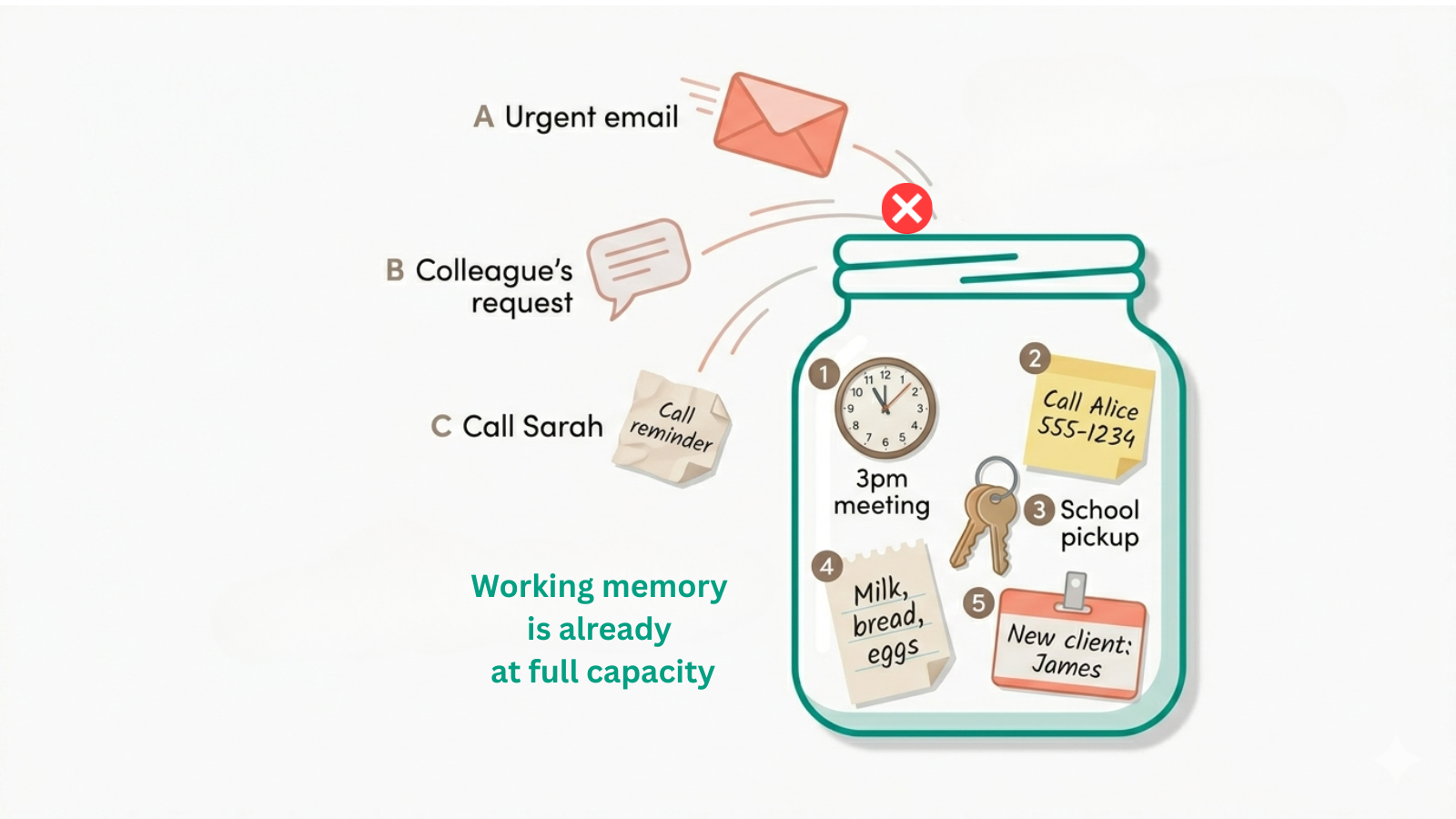
Working memory underpins nearly every cognitive activity: reading comprehension, mental arithmetic, following instructions, problem-solving, and decision-making. The distinction between working memory and long-term memory matters because the strategies for improving each are quite different. Chunking information helps working memory, whilst spaced repetition strengthens long-term memory. Understanding this difference allows you to apply the right technique for the right situation.
1. Improve Working Memory Through External Systems
The single most effective way to improve working memory performance isn’t to make your brain stronger — it’s to make it work less hard.
My work as a teacher confirmed that even the brightest minds struggle when they’re trying to hold too much information at once. The smartest strategy isn’t heroic mental effort; it’s building external systems that capture and organise information for you.
Write everything down. Maintain running lists for tasks, ideas, and commitments. The act of writing doesn’t just record information — it also reduces the mental load of trying to remember it. Use a dedicated notebook, app, or planner that becomes your external memory system.
Create visual cues. Place objects where you’ll need them: leave your gym bag by the door, put bills to pay near your keys, position books you’re reading on your pillow. These environmental reminders eliminate the need to remember tasks through pure mental effort.
Establish consistent routines. When actions become habitual, they require far less working memory to execute. Morning and evening routines, standardised workflows, and regular schedules all reduce the mental load of deciding and remembering what to do next.
Use technology strategically. Calendar reminders, to-do list apps, and note-taking systems aren’t signs of weakness — they’re cognitive tools that let you redirect mental energy towards creative and analytical thinking rather than mere remembering.
The goal isn’t to memorise everything. The goal is to preserve your limited working memory capacity for tasks that truly require active mental processing.
QUICK WIN:
Right now, identify one thing you’re currently trying to hold in your head — a task, a commitment, an idea. Write it down somewhere you’ll actually see it. That’s working memory freed up immediately. The most effective external system is the one you’ll actually use consistently, so start simple.
2. Practice Chunking to Improve Working Memory Capacity
Chunking is the cognitive technique of grouping individual pieces of information into larger, meaningful units. It’s why you remember phone numbers as “07700 900982” rather than “0-7-7-0-0-9-0-0-9-8-2”, and why acronyms like NASA or FBI are easier to recall than the full organisation names.
When you chunk information, you’re essentially compressing it — fitting more into your working memory’s limited capacity by treating multiple items as a single unit.
Group shopping list items by category. Rather than remembering “milk, bread, apples, cheese, chicken, bananas”, think “dairy, bakery, fruit, meat”. You’ve reduced six items to four categories, making the list easier to hold in mind whilst shopping.
Break complex instructions into phases. When learning a new skill or following complicated directions, identify the major steps first, then fill in the details. A recipe becomes “prep, cook, serve” before you worry about specific temperatures and times.
Create meaningful patterns. Look for connections, sequences, or logical relationships that bind separate items together. When someone gives you directions, visualise the route as a story: “left at the red building, straight past the park, right at the roundabout”. The narrative structure chunks the individual turns into a single mental map.
Chunking works because it leverages your existing knowledge to create shortcuts. The more expertise you develop in a domain, the more efficiently you can chunk information within that field.
3. Strengthen Working Memory Through Targeted Exercise
Whilst general “brain training” apps have mixed evidence for improving working memory, specific types of mental exercises do show genuine benefits when chosen carefully.
Dual n-back training. This exercise presents you with a sequence of items and asks you to identify when the current item matches one from a set number of steps back. Research published in Scientific Reports found that dual n-back training showed superior transfer effects compared to other memory training techniques — though it’s worth noting that results in healthy adults vary and some studies find more modest benefits. If you want to try it, free versions are available online and worth experimenting with for 10–15 minutes several times weekly. Dual N-Back Training — dualnback.com offers free unlimited sessions using the same protocol as the original research studies. Start at 2-back and aim for 20 minutes per session.
Mental arithmetic. Solving maths problems in your head — without paper or calculator — exercises working memory as you hold intermediate results whilst performing additional operations. Start with simple calculations and gradually increase complexity.
Working backwards tasks. Recite sequences in reverse order: spell words backwards, count down from 100 by sevens, recall lists in reverse. This requires you to hold information in mind whilst simultaneously manipulating it — exactly the dual task that defines working memory.
Complex card or strategy games. Chess, bridge, and strategic card games challenge you to remember multiple pieces of information whilst simultaneously planning several moves ahead. Unlike passive puzzles, these games demand active working memory throughout play.
The critical factor isn’t the specific exercise — it’s the cognitive demand. Choose activities that feel challenging but not overwhelming, and practise regularly. Even 10–15 minutes of focused mental exercise several times weekly can produce measurable improvements over time.
4. Leverage Dual Coding and Visualisation
Your working memory processes verbal and visual information through partially separate channels. When you engage both simultaneously, you effectively expand your working memory capacity.
This principle, known as dual coding, explains why diagrams often help more than text alone, and why visualising what someone tells you improves retention. You’re not just doubling the information — you’re creating richer mental representations that occupy both your verbal and visual-spatial working memory stores.
Convert abstract information into mental images. When someone explains a concept, actively picture it. If you’re learning about a process with multiple steps, visualise each stage as a scene. If you’re reading text, illustrate the content by making notes with images. The more vivid and detailed your mental image, the more effectively it anchors the information in working memory. Research suggests that combining text with visual elements can dramatically increase retention — with some studies showing figures as high as 65% after three days compared to around 10% for text alone.” That preserves the impact while being more epistemically honest.
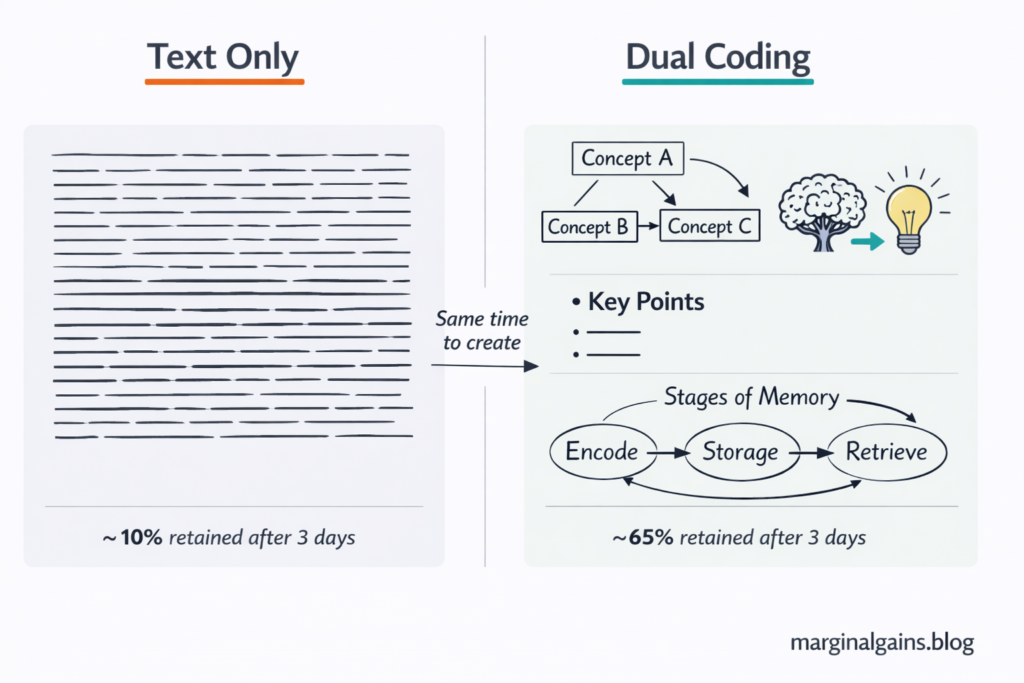
Draw diagrams and mind maps. Physically sketching information engages both visual-spatial and motor memory whilst also creating an external representation that reduces cognitive load. Even crude sketches help — the act of translating verbal information into visual form strengthens your mental representation.
Use the memory palace technique for sequences. This ancient method leverages your excellent spatial memory to remember lists and sequences by placing them in imagined locations along a familiar route. Because it engages visual-spatial working memory for verbal information, it dramatically expands what you can hold in mind.
Narrate visual information verbally. When looking at charts, graphs, or diagrams, describe aloud what you’re seeing. This dual encoding — visual input plus verbal processing — creates stronger working memory traces than either channel alone.
QUICK WIN:
Next time someone explains something complex, resist the urge to just listen. Actively picture it as they speak — visualise the people, places, or processes involved. Then describe what you’ve imagined back to them. You’ve just used dual coding to double the strength of your working memory trace.
5. Manage Cognitive Fatigue and Stress
Working memory is remarkably sensitive to fatigue, stress, and emotional state — which means managing these is as important as any direct technique for how to improve working memory.
This isn’t weakness — it’s biology. Working memory relies on executive control processes in the prefrontal cortex, one of the brain regions most vulnerable to stress and fatigue. When you’re tired, stressed, or emotionally overwhelmed, these systems simply function less efficiently.
Prioritise adequate sleep. Sleep deprivation dramatically impairs working memory performance. Just one night of poor sleep can reduce your effective working memory capacity by 30–40%. During sleep, your brain consolidates memories and clears metabolic waste products that accumulate during waking hours. Seven to nine hours of quality sleep isn’t a luxury — it’s a cognitive necessity. For more on this, see our article on how sleep affects memory.
Take strategic breaks. Working memory fatigues with sustained use. After 60–90 minutes of concentrated mental work, your performance degrades noticeably. Brief breaks — even five minutes of rest or light physical activity — allow working memory systems to recover.
Manage stress through proven techniques. Chronic stress floods your system with cortisol, which directly impairs prefrontal cortex function and working memory. Mindfulness meditation, regular exercise, and stress-reduction practices aren’t just good for general wellbeing — they specifically protect working memory from stress-related degradation. Research shows that even brief mindfulness exercises can improve working memory capacity within weeks.
Address environmental distractions. Background noise, visual clutter, and interruptions all consume working memory resources as your brain filters irrelevant stimuli. Create a workspace that minimises these demands: use noise-cancelling headphones, clear your desk of unnecessary items, and batch notifications rather than allowing constant interruptions.
6. Enhance How to Improve Working Memory Through Physical Exercise
The connection between physical activity and cognitive function might seem surprising, but the evidence is remarkably strong: regular exercise significantly improves working memory performance.
Aerobic exercise increases blood flow to the brain, promoting the growth of new neurons and strengthening connections between brain cells. It also triggers the release of brain-derived neurotrophic factor (BDNF) — a protein that supports neuron health and enhances cognitive function, particularly in regions critical for memory and executive function. You don’t need to become an athlete to experience these benefits. Moderate physical activity — even brisk walking for 30 minutes several times weekly — produces measurable improvements in working memory within weeks.
Incorporate regular aerobic exercise. Activities that elevate your heart rate — walking, cycling, swimming, dancing — show the strongest evidence for cognitive benefits. Aim for at least 150 minutes of moderate-intensity aerobic activity weekly.
Try acute exercise before cognitively demanding tasks. Even a single bout of exercise can temporarily boost working memory. A 20-minute walk or brief workout before an important meeting, exam, or complex project can enhance your mental clarity and focus for the subsequent hours. For more on this, see our article on the best exercise for brain health.
Break up sedentary periods with movement. Extended sitting impairs both physical and cognitive health. Brief movement breaks every hour — a quick walk, some stretching, or light calisthenics — help maintain working memory performance throughout the day.
Consider combining cognitive and physical challenges. Activities that require both mental and physical coordination — dance, martial arts, team sports — may provide additional cognitive benefits by simultaneously engaging motor learning and working memory systems.
7. Improve Working Memory Through Active Learning
How you engage with new information dramatically affects how to improve working memory over time. Passive approaches — simply reading or listening — place minimal demands on working memory and lead to minimal retention. Active learning strategies force deeper processing and strengthen working memory in the process.
Use active recall rather than passive review. Instead of rereading notes, close the material and attempt to recall the key points from memory. This retrieval practice strengthens both working memory (as you hold and manipulate information) and long-term memory (as you practise retrieval).
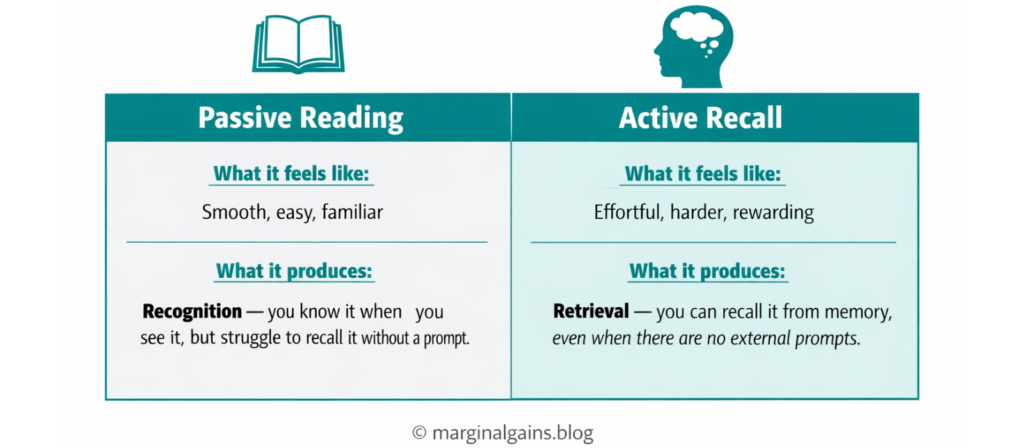
Explain concepts aloud. The act of teaching material to yourself or others requires you to hold information in working memory whilst organising it coherently. This elaborative processing creates stronger mental representations than passive review.
Ask questions and make connections. As you learn new material, actively question how it relates to what you already know. Making these connections engages working memory as you hold both new and existing knowledge simultaneously, strengthening understanding and retention.
Practise distributed learning. Spacing study sessions over time rather than cramming forces your working memory to retrieve information repeatedly, strengthening the neural pathways. This approach aligns with how working memory naturally functions — through repeated activation and consolidation.
The Long-Term Perspective: Building Cognitive Reserve
Whilst the strategies above can improve working memory within weeks, the most profound benefits come from sustained practice over months and years. Think of working memory improvement not as a quick fix but as an ongoing investment in cognitive health.
As a Chartered Occupational Psychologist with over 20 years of experience in cognitive assessment, I’ve observed that lasting transformation rarely comes from a single technique. It emerges from combining approaches: external systems reduce cognitive load, freeing working memory for more important processing. Chunking makes efficient use of limited capacity. Mental exercises strengthen the underlying systems. Dual coding expands functional capacity. Managing stress and fatigue protects performance. Physical exercise supports brain health. Active learning trains more efficient processing.
Together, these approaches create a comprehensive framework for how to improve working memory in everyday life. Start with the strategies that feel most accessible and relevant to your daily life. Build consistency before adding complexity. Small improvements in working memory can cascade into better focus, clearer thinking, and enhanced performance across every domain of life.
Your working memory isn’t fixed. With deliberate practice and the right strategies, you can strengthen this crucial cognitive system and experience the benefits in everything you do.
QUICK WIN:
Choose one strategy from this article that you haven’t tried before. Commit to using it for one week — just seven days. Working memory responds to consistent practice, and one week is long enough to notice a difference. The easiest starting point for most people is the external systems approach: simply write down everything you’re currently trying to hold in your head.
RESOURCES:
I only recommend resources that I either use personally or have researched and feel are genuinely helpful for my readers. Resources sometimes contain affiliate links; if you purchase through these, I may earn a small commission at no extra cost to you.
Recommended Reading
Make It Stick: The Science of Successful Learning by Brown, Roediger and McDaniel — the most practical evidence-based guide to learning and memory, covering many of the strategies that directly support working memory improvement. Hardback
The Organized Mind by Daniel Levitin — a fascinating exploration of how to manage cognitive load and information overload in the modern world, with directly applicable strategies for working memory. Paperback
Brain Training
Dual N-Back Training — dualnback.com offers free unlimited sessions using the same protocol as the original research studies. Start at 2-back and aim for 20 minutes per session.
Related Articles from the Marginal Gains Blog:
The Chunking Method — how to compress information to fit more into working memory
The Memory Palace Technique — using spatial memory to dramatically expand what you can hold in mind
Active Recall vs Passive Reading — why retrieval practice strengthens both working and long-term memory
How Does Sleep Affect Memory — the neuroscience of sleep and memory consolidation
Best Exercise for Brain Health — the physical activities with the strongest cognitive benefits
How to Learn Faster — evidence-based strategies for accelerating skill and knowledge acquisition
I'm Simon Shaw, a Chartered Occupational Psychologist with over 20 years of experience in workplace psychology, learning and development, coaching, and teaching. I write about applying psychological research to everyday challenges - from habits and productivity to memory and mental performance. The articles on this blog draw from established research in psychology and behavioural science, taking a marginal gains approach to help you make small, evidence-based changes that compound over time, allowing you to make meaningful progress in the areas you care about most.