How to Learn Any Skill Fast: The Deliberate Practice Method

You want to learn guitar, speak conversational Spanish, or master data visualisation for work. The thought of dedicating years to become competent feels overwhelming, so you never start. Meanwhile, you watch others seemingly pick up new skills with ease whilst you remain stuck in place. If you’ve ever wondered how to learn any skill fast — not just grind for years hoping something sticks — the answer lies in how you practise, not how long.
The difference between people who can learn any skill fast and those who struggle isn’t natural talent — it’s method. Research in skill acquisition reveals that the traditional “just practise more” approach wastes enormous amounts of time on activities that don’t actually improve performance. The secret isn’t practising harder; it’s practising smarter through a process called deliberate practice.
This article explores evidence-based strategies to learn any skill fast, drawing from cognitive psychology and expertise research to show you exactly how to compress years of mediocre practice into months of focused improvement. Whether you’re learning for career advancement, personal development, or pure enjoyment, these principles will accelerate your progress dramatically.
The 20-Hour Rule: The Key to How to Learn Any Skill Fast
Malcolm Gladwell popularised the idea that expertise requires 10,000 hours of practice. Whilst there’s truth to this for world-class mastery, it’s also deeply misleading for most learning goals. (Unless your ambition is to become an Olympic athlete or concert pianist, you probably don’t have 10,000 hours to spare. That’s five years of full-time work, which rather limits your hobby options.) Author and researcher Josh Kaufman demonstrated a more practical reality: you can reach functional competence in most skills within approximately 20 hours of focused practice.
The 20-hour threshold isn’t about becoming an expert — it’s about moving from complete novice to reasonably capable. To learn any skill fast, twenty hours is enough to hold a basic conversation in a foreign language, play simple songs on an instrument, or execute fundamental techniques in a new sport. It’s the difference between “I have no idea what I’m doing” and “I can actually do this.”
This compressed timeline depends entirely on how you spend those 20 hours. Random practice produces random results. Deliberate, structured practice following evidence-based principles produces rapid improvement. The question isn’t whether you have time to learn something new — it’s whether you’re willing to invest those hours intelligently.
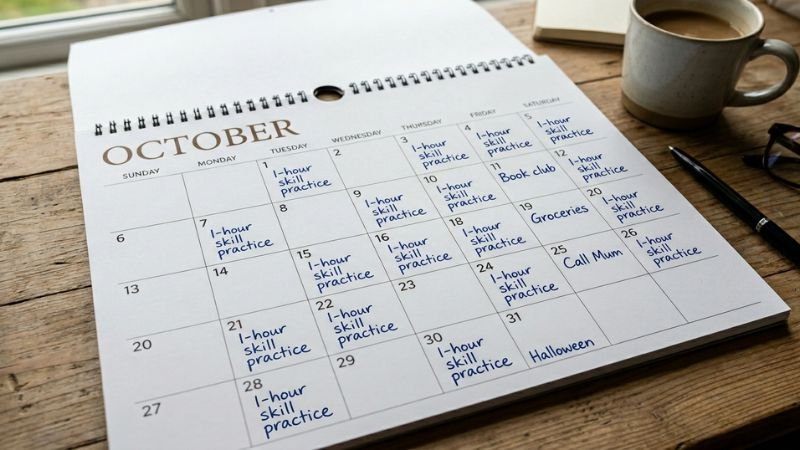
Twenty hours breaks down to just 45 minutes daily for a month, or four hours weekly over five weeks. That’s achievable for virtually anyone genuinely motivated to acquire a new skill. The barrier isn’t time — it’s knowing how to use that time effectively.
Deconstruct the Skill Into Learnable Components
Most skills appear monolithic when viewed from the outside. “Play guitar” or “speak French” seem like single, massive challenges. They’re not. Every complex skill comprises dozens of smaller sub-skills that can be learned individually and combined progressively.
The first step if you want to learn any skill fast is breaking down your target skill into its component parts. This deconstruction serves two purposes: it makes the learning process less overwhelming, and it allows you to prioritise the most impactful elements.
Consider learning guitar. The full skill includes: chord shapes, strumming patterns, fingerpicking, rhythm, music theory, reading tablature, changing chords smoothly, and dozens of other elements. Attempting to learn everything simultaneously guarantees slow progress and frustration.
Instead, deconstruct and prioritise. If your goal is to play popular songs around a campfire, you need perhaps five to seven basic chord shapes and three strumming patterns. That’s it. Those core elements give you access to hundreds of songs. Music theory and complex fingerpicking can wait — they’re not on the critical path to your specific goal.
The same principle applies to any skill. Want to hold basic conversations in Spanish? Research shows that the 1,500 most common words provide approximately 80% coverage of everyday conversation. Learn those first, not comprehensive grammar rules or obscure vocabulary.
Through two decades of learning and development work, I’ve consistently observed that people who deconstruct skills before practising progress three to five times faster than those who approach learning as an undifferentiated whole. The sub-skills that provide the highest return on invested time become immediately obvious once you break things down — but they’re invisible if you don’t.
Practical deconstruction process:
Research the skill thoroughly. Watch expert demonstrations, read introductory guides, study instructional materials. Your goal isn’t to learn yet — it’s to understand the skill’s structure and identify its major components.
List the sub-skills. Write down every distinct element you’ve identified. For public speaking, this might include voice projection, body language, slide design, storytelling structure, handling questions, managing nerves, and opening techniques.
Prioritise ruthlessly. Which sub-skills provide the fastest path to your specific goal? Which are prerequisites for others? Focus on high-leverage fundamentals that unlock broader capabilities.
Sequence your learning. Some sub-skills must precede others. In cooking, knife skills come before complex recipes. In coding, basic syntax precedes building applications. Create a logical progression rather than jumping randomly between elements.
Use Deliberate Practice, Not Mindless Repetition
The quality of practice matters infinitely more than quantity. You can spend 10,000 hours playing tennis casually with friends and never improve beyond recreational competence. Or you can spend 100 hours in deliberate practice and reach an intermediate competitive level.
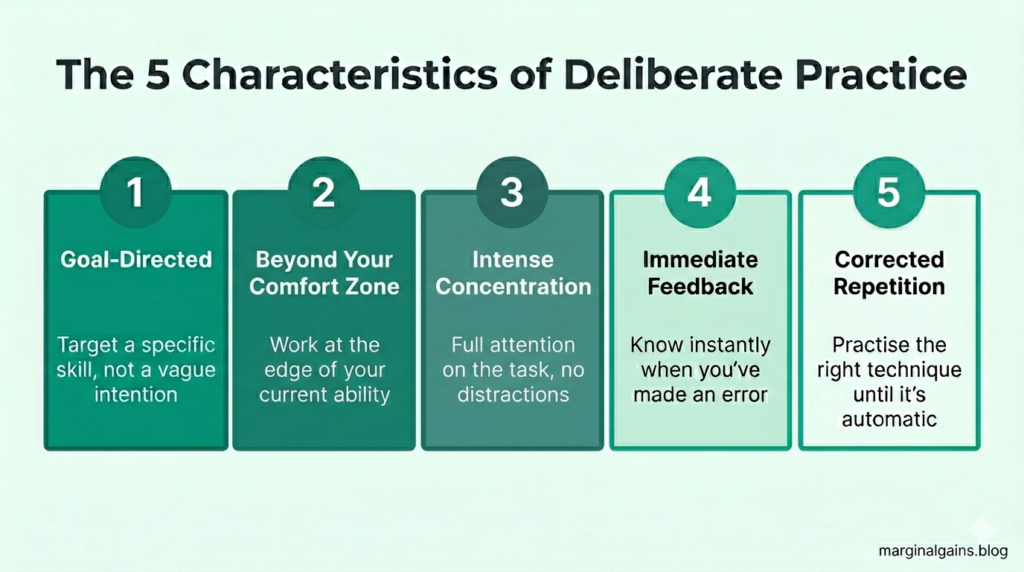
Deliberate practice — coined by Anders Ericsson — forms the foundation of how to learn any skill fast, and has specific characteristics that distinguish it from mere repetition. It’s the methodology that separates experts from enthusiastic amateurs.
Deliberate practice is goal-directed. Each session targets a specific, defined aspect of performance — not a vague intention to “get better.” Before practising, experts identify exactly what they’re working to improve: not “practise guitar” but “nail the transition from G to C chord at 80 beats per minute.” This precision is what makes deliberate practice so efficient. If you’ve ever worked with a coach to set performance goals, you’ll recognise this principle immediately — the same specificity that makes goal-setting effective in professional development applies equally to skill acquisition.
Deliberate practice operates just beyond your current ability. If a task feels comfortable, you’re not improving — you’re just reinforcing existing patterns. Effective practice constantly pushes you slightly past your competence edge, where mistakes are frequent but learning is maximal.
This explains why playing songs you already know doesn’t improve your guitar skills, why typing emails doesn’t make you a better writer, and why having conversations in your native language doesn’t expand your vocabulary. Comfort is the enemy of growth.
Deliberate practice requires intense concentration. You can’t improve whilst watching television or chatting with others. Genuine practice demands full attention directed at the specific element you’re trying to improve. This cognitive intensity is why even professionals rarely manage more than four to five hours of deliberate practice daily — it’s mentally exhausting.
This also explains why “practice time” is misleading. Someone noodling on piano for three hours whilst half-watching YouTube isn’t practising — they’re entertaining themselves. (Enjoyable? Certainly. Improving their piano skills? Not remotely.) Twenty minutes of focused work on a specific technical challenge produces more improvement.
Deliberate practice includes immediate feedback. You need to know instantly when you’ve made an error and how to correct it. This feedback can come from a coach, from technology (programming code either works or doesn’t), from video recording yourself, or from comparing your output against expert examples. The principle mirrors active recall in learning — testing yourself immediately reveals gaps that passive review conceals.
Without feedback, you simply reinforce whatever you’re currently doing — good or bad. This is why self-taught skills often plateau: learners repeat the same mistakes thousands of times because no mechanism exists to identify and correct errors.
Deliberate practice involves repetition of corrected behaviour. Once you’ve identified an error and understand the correction, you must practise the correct technique repeatedly until it becomes automatic. This is where most people give up prematurely — correction requires persisting through the awkward phase where the new technique feels unnatural.
The good news? Deliberate practice is significantly faster than casual practice. The bad news? It’s significantly harder. Most people avoid it because it’s uncomfortable. They’d rather spend hours in pleasant, unchallenging practice than 30 minutes of focused discomfort. This is precisely why most people remain perpetual beginners.
Embrace the Learning Dip (And Push Through It)
Every skill follows a predictable learning curve. Initial progress feels rapid and exciting — you go from knowing nothing to executing basic techniques within days. This early phase is thrilling. Then you hit the dip.
The learning dip is the extended period where improvement slows dramatically. You’re no longer a complete beginner, but you’re still far from competent. Progress becomes incremental and hard-won. This is where most people quit.
Author Seth Godin describes the dip as a critical filter that separates those who eventually succeed from those who give up. The dip exists precisely because persistence through difficulty creates competitive advantage. If learning remained easy throughout, everyone would master everything.
Understanding that the dip is inevitable — not a sign that you lack talent or chose the wrong skill — fundamentally changes how you navigate it. The dip isn’t failure; it’s the middle of the process. If you want to learn any skill fast, pushing through this phase is non-negotiable. (Admittedly, knowing this intellectually doesn’t make the dip feel any less frustrating when you’re stuck in it. The third time you completely mess up that chord progression, you question why you ever picked up a guitar. But that’s exactly the moment when quitting guarantees you’ll never progress.)
Several strategies help you persist through the dip:
Set process goals, not just outcome goals. Don’t focus solely on “play this song perfectly.” Instead, commit to “practise this specific technique for 20 minutes daily.” You can always control the process; you can’t always control immediate results. Meeting process goals maintains motivation even when outcomes lag.
Track micro-improvements. Progress during the dip is incremental but real. Keep a practice journal documenting small wins: “Transitioned between C and G chord 10% faster today” or “Pronounced the rolled R correctly three times.” These micro-victories sustain motivation when macro-progress feels absent.
Vary practice methods. Grinding the same exercise repeatedly breeds frustration. Maintain the focus on your target sub-skill but approach it from different angles. If chord transitions feel impossible, practise them in a different song, at a different tempo, or in a different key. Variation maintains engagement whilst still addressing the core challenge.
Remember why you started. Reconnect with your original motivation. Are you learning this skill for career advancement, personal satisfaction, social connection? The dip is temporary; the benefits of competence are permanent. Your future self will thank you for persisting.
Learn From Examples, Not Just Instruction
Traditional education emphasises explicit instruction: read the rules, understand the theory, then apply it. Expertise research reveals that observing expert examples often teaches more effectively than studying abstract principles.
This phenomenon, called perceptual learning, explains why young musicians improve dramatically by listening extensively to great performers, why photographers develop better composition by studying excellent photographs rather than just learning rules, and why writers improve by reading exceptional prose.
Your brain is a pattern-matching machine. When you observe high-quality examples repeatedly, your brain extracts underlying patterns even without conscious awareness of exactly what makes them effective. This implicit learning complements explicit instruction powerfully.
To leverage perceptual learning:
Study expert performances actively. Don’t just passively watch or listen — analyse what makes them effective. What specific techniques are they using? How do they structure their approach? What would you need to change about your current performance to move closer to theirs? For example, if you want to improve your ability to give a presentation without notes, review your favourite TED talks and study how your favourite speakers structure their ideas to create an easy-to-remember narrative.
Compare good and bad examples. Seeing contrasts clarifies what differentiates quality from mediocrity. If you’re learning presentation skills, watch both excellent and poor presentations, analysing the specific differences in structure, delivery, and visual design.
Imitate deliberately before innovating. Many learners resist copying others, viewing it as uncreative. This is backwards. Experts across every domain — from painters to jazz musicians to martial artists — spent years imitating masters before developing personal style. Imitation isn’t the enemy of creativity; it’s the foundation. (This applies even to memory techniques — the memory palace method has remained essentially unchanged for 2,500 years because the fundamentals simply work.)
Copy expert techniques precisely in practice. Once they become automatic, your personal variations will emerge naturally. But you can’t innovate on fundamentals you haven’t mastered.
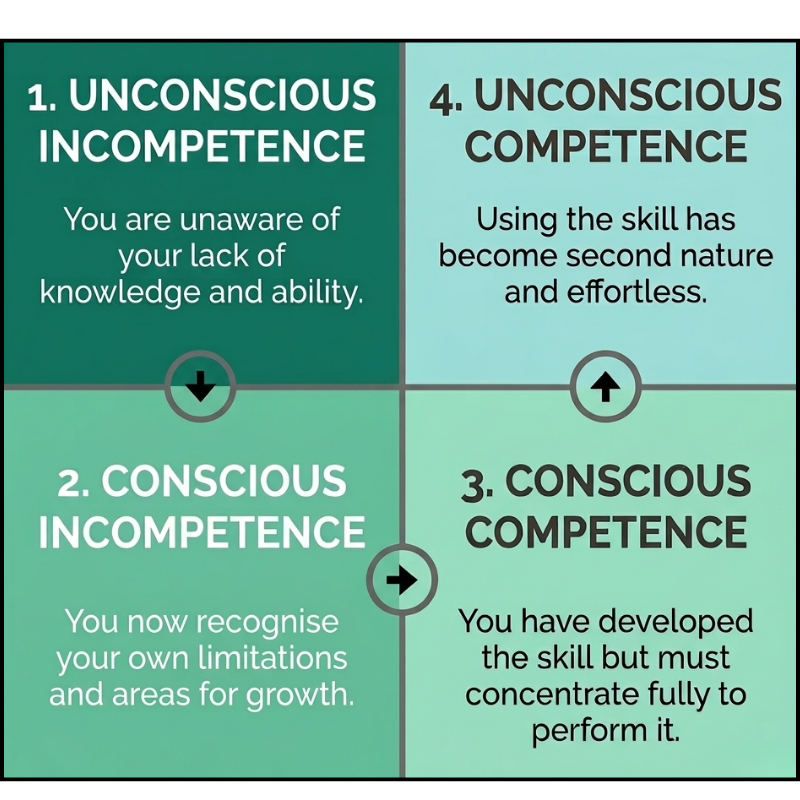
Educational trainer Noel Burch’s four stages of competence model maps this journey well. We begin at unconscious incompetence — unaware of what we don’t know. Deliberate imitation moves us to conscious incompetence, where we can see the gap between our performance and the expert’s. Sustained copying of correct technique then drives us through conscious competence — able to execute well, but only with focused effort. Finally, repeated practice embeds the skill so deeply it becomes unconscious competence: automatic, effortless, and truly yours. Imitating experts doesn’t keep you dependent on them — it accelerates your passage through every stage.
Interleave Practice for Better Retention
Common sense suggests that mastering one sub-skill completely before moving to the next produces fastest progress. Research reveals the opposite: interleaving practice across multiple related sub-skills accelerates learning and improves retention.
Interleaving means mixing different types of practice within a single session rather than blocking identical repetitions together. Instead of practising chord transitions for 30 minutes straight, you might practise chord transitions for 10 minutes, strumming patterns for 10 minutes, and rhythm exercises for 10 minutes.
This feels less efficient because interleaving creates more errors during practice — you’re constantly switching between tasks before achieving smooth performance in any single one. But this increased difficulty during practice produces superior long-term learning and transfer to real-world application.
The mechanism appears to be that interleaving forces your brain to repeatedly retrieve and apply different skills, strengthening the neural pathways more effectively, because each repetition requires retrieving the skill from long-term memory, which strengthens retention.
Interleaving also mirrors real-world application more accurately. You rarely use skills in isolation. Musicians must integrate rhythm, melody, and technique simultaneously. Athletes combine footwork, strategy, and technique fluidly. Interleaved practice prepares you for this integrated performance in ways blocked practice cannot.
Create Immediate Feedback Loops
The speed at which you receive and act on feedback directly determines your learning rate. Immediate correction prevents errors from becoming ingrained habits. Delayed feedback allows mistakes to compound.
Different skills offer different natural feedback mechanisms:
Instant feedback skills. Programming provides immediate feedback — code either executes correctly or produces errors. Mathematics problems have right or wrong answers. These skills enable rapid iteration because errors are instantly obvious.
Delayed feedback skills. Writing, public speaking, and interpersonal skills often lack immediate objective feedback. You can’t instantly know if your email was persuasive or your presentation landed effectively. These skills require deliberately creating feedback systems.
Strategies for building feedback loops:
Record yourself. Video or audio recording reveals aspects of your performance invisible to you whilst executing. Watch recordings with specific evaluation criteria: pace, clarity, body language, technical execution.
Seek expert evaluation. Coaches, teachers, and experienced practitioners can identify errors you can’t see yourself. Even occasional expert feedback dramatically accelerates progress compared to pure self-direction.
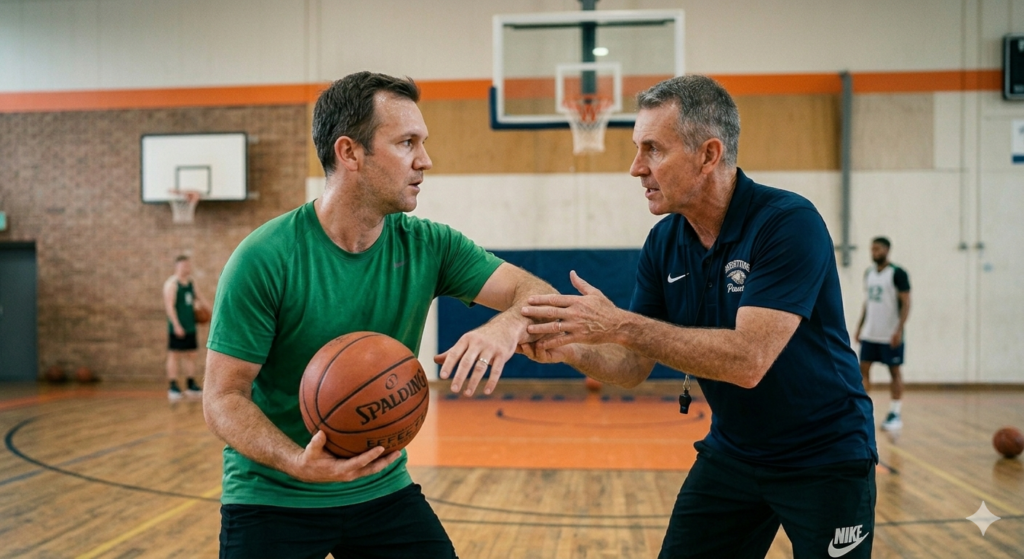
Use technology. Language apps provide instant pronunciation feedback. Fitness trackers quantify workout performance. Golf swing analysers measure club speed and angle. Leverage available technology to objectify subjective assessments.
Practise in public. Share your work, perform for others, apply skills in real contexts. Real-world application provides feedback that practice alone cannot. The vulnerability feels uncomfortable, but the learning is invaluable.
Space Practice Sessions for Maximum Retention
Cramming practice into marathon sessions feels productive but wastes time compared to distributed practice spread across multiple days.
The spacing effect demonstrates that information and skills practised across multiple shorter sessions are retained far better than equivalent material crammed into fewer, longer sessions. Thirty minutes of practice across six days produces superior results to three hours practised in a single session.
This occurs because memory consolidation — the process of converting short-term practice gains into stable long-term skills — happens primarily during rest periods between sessions, particularly during sleep. When you cram, you’re overwhelming your brain’s capacity to process and retain what you’ve practised. When you space out your practice, you’re providing multiple consolidation opportunities. Spaced repetition techniques have been shown to aid retention better than cramming.
The optimal spacing depends on the skill and your goals, but research suggests:
Daily practice sessions of 20–45 minutes work well for most skills during initial learning. This duration maintains concentration quality whilst allowing daily consolidation.
Gradually increase spacing as competence grows. Once basics are established, practising three to four times weekly maintains and advances skills without requiring daily commitment.
Never skip more than two days during initial acquisition. Skills decay rapidly when practice is too infrequent, requiring you to spend each session re-learning rather than advancing.
Spacing practice requires patience and planning — traits that feel at odds with wanting to learn any skill fast. But counterintuitively, spaced practice is faster than massed practice when measured by actual long-term competence rather than temporary performance during practice sessions.
Apply Skills in Realistic Contexts Early
Many learners wait until they feel “ready” before applying skills in real situations. This perfectionism slows learning dramatically. Early application, even when you’re objectively not ready, accelerates improvement in ways isolated practice cannot.
Learning a language? Start speaking with native speakers within the first few weeks, even though you’ll make countless errors. The feedback, emotional engagement, and practical communication demands teach elements that textbook study never can. (The same principle applies to remembering names — you improve far faster through actual social interaction than through isolated practice.)
Learning to code? Build a simple project immediately rather than completing every tutorial first. The challenges you encounter whilst building something real teach problem-solving and integration in ways sequential lessons don’t address.
Early real-world application serves multiple functions:
It reveals knowledge gaps. You discover exactly what you don’t know, making subsequent practice far more targeted. Theoretical learning often creates illusory competence — you think you understand until you try to apply it.
It provides motivation. Seeing your emerging skills create actual results sustains motivation through difficult learning phases. Abstract practice divorced from application feels pointless; applied practice feels meaningful.
It teaches integration. Real contexts require combining multiple sub-skills simultaneously under realistic constraints. This integration practice is qualitatively different from isolated skill practice.
The key is building in appropriate safety nets. Practise customer service techniques with friends before applying them in high-stakes client interactions. Cook for yourself before hosting a dinner party. Write blog posts before submitting articles to publications. Progressive exposure to increasingly demanding real-world contexts builds both skill and confidence systematically.
The Compounding Returns of Skill Acquisition
Learning one skill well makes learning related skills dramatically faster. The cognitive abilities, practice strategies, and domain knowledge developed whilst acquiring initial skills transfer to subsequent learning.
This is why learning your first programming language takes months whilst learning the third takes weeks. Why your second foreign language requires half the time of your first. Why intermediate musicians pick up new instruments far faster than complete novices.
You’re not just learning the skill itself — you’re learning how to learn that type of skill. This meta-skill compounds powerfully across your lifetime.
The implication? The hardest skill to learn is your first one in any domain. Each subsequent skill becomes progressively easier. The ability to learn any skill fast compounds — initial investment in learning how to learn effectively pays dividends across every future learning endeavour.
Start small if necessary. Master one skill thoroughly using deliberate practice principles. The confidence, capability, and methodology you develop transfer directly to the next challenge. Before long, you’ll have built a portfolio of competencies that individually seemed impossibly time-consuming to acquire.
The question isn’t whether you can learn any skill fast — the research conclusively demonstrates you can. The question is whether you’re willing to practise deliberately rather than casually, to persist through the inevitable dip, and to apply evidence-based learning strategies rather than relying on intuition alone.
Twenty focused hours can transform you from complete novice to functional competence in virtually any skill. That’s less than a month of consistent daily practice. The barrier to learn any skill fast isn’t time, talent, or opportunity. It’s method. Learn deliberately, and you can learn anything.
RESOURCES:
I only recommend resources that I either use personally or have researched and feel are genuinely helpful for my readers. Resources sometimes contain affiliate links; if you purchase through these, I may earn a small commission at no extra cost to you.
Recommended Reading:
The First 20 Hours: How to Learn Anything Fast by Josh Kaufman — The practical guide to rapid skill acquisition referenced throughout this article. A must-read if you want a step-by-step system for getting to functional competence quickly. Paperback | Kindle | Audible
Peak: Secrets from the New Science of Expertise by Anders Ericsson — The definitive book on deliberate practice from the researcher who coined the term. Essential reading for anyone serious about skill development. Paperback | Audible
The Talent Code: Greatness Isn’t Born. It’s Grown. by Daniel Coyle — Explores the neuroscience behind skill acquisition, including how myelin development underpins deep practice. Reads like a thriller and will change how you think about talent. Paperback | Kindle | Audible
The Inner Game of Tennis: The Classic Guide to the Mental Side of Peak Performance by W. Timothy Gallwey — The original inner game book, whose principles Gallwey later extended to music (The Inner Game of Music) and work (The Inner Game of Work). Essential reading for understanding the mental interference that blocks skill development. Paperback | Kindle | Audible
Make It Stick: The Science of Successful Learning by Peter Brown — The research behind spaced practice, interleaving, and retrieval — the core techniques covered in this article. Paperback | Kindle
Related Articles from Marginal Gains:
Learn Faster, Remember Longer — The broader guide to evidence-based learning strategies that complement the skill acquisition techniques here
Active Recall vs Passive Reading — Why testing yourself beats re-reading every time
How to Use Spaced Repetition — The scheduling system that makes distributed practice automatic
The Memory Palace Technique — A powerful memorisation method for knowledge-heavy skills
I'm Simon Shaw, a Chartered Occupational Psychologist with over 20 years of experience in workplace psychology, learning and development, coaching, and teaching. I write about applying psychological research to everyday challenges - from habits and productivity to memory and mental performance. The articles on this blog draw from established research in psychology and behavioural science, taking a marginal gains approach to help you make small, evidence-based changes that compound over time, allowing you to make meaningful progress in the areas you care about most.