
Social Connection and Brain Health: Why Your Brain Needs People

I’ll be honest — as someone who describes themselves as a “raging introvert,” writing this article has been uncomfortable. The research on social connection and brain health is unequivocal: your brain literally needs other people to function at its best. This isn’t feel-good philosophy or pop psychology. It’s neuroscience.
Social connection isn’t just pleasant — it’s a biological necessity for optimal brain function. Research from the 2020 Lancet Commission on dementia shows that tackling social isolation could prevent 4% of dementia cases worldwide. That’s roughly as many cases as you’d prevent by addressing hearing loss or hypertension.
Your brain evolved in social groups. It expects social interaction the way it expects food, water, and sleep. When you deprive it of meaningful connection, measurable changes occur in brain structure, function, and cognitive performance.
This matters for everyone, but particularly for those of us who work in cognitively demanding roles. You can optimise your workspace, perfect your sleep, and maintain excellent exercise habits — but if you’re socially isolated, you’re leaving significant cognitive performance on the table.
Social Connection and Brain Health: Why Your Brain Is Fundamentally Social
Human brains aren’t optimised for solitary existence. They’re optimised for navigating complex social worlds — tracking relationships, reading intentions, coordinating with others, and managing group dynamics.
During conversation, your brain performs an astonishing number of simultaneous tasks. You’re reading facial expressions and interpreting tone. You’re predicting what someone will say next and formulating your response. You’re managing your own emotional reactions whilst trying to understand theirs. You’re retrieving relevant memories and suppressing irrelevant ones.
This cognitive workout engages multiple brain systems simultaneously: working memory, attention, language processing, emotional regulation, and executive function. It’s comprehensive brain training that happens naturally during social interaction.
Research from Oregon Health and Science University found that 30 minutes of regular conversation significantly improved executive function in socially isolated older adults — the cognitive skills that determine how effectively you plan, organise, and complete tasks.
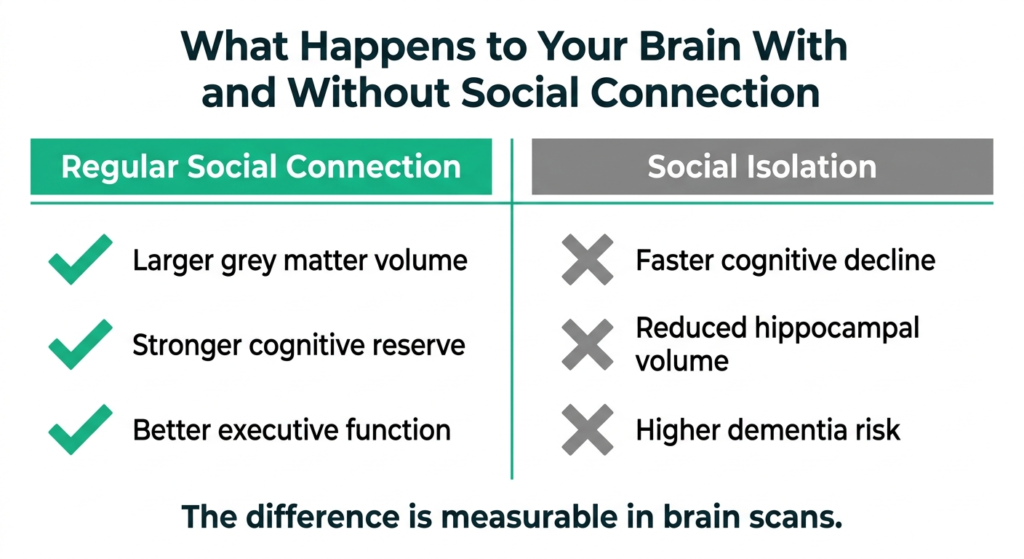
Think about that. A brief chat provides similar cognitive benefits to a crossword puzzle, but it’s infinitely more enjoyable and comes with emotional benefits as well.
QUICK WIN:
Schedule one 15-minute coffee or phone catch-up with a friend or colleague this week. Put it in your calendar like any other appointment. Notice how your thinking feels in the hour afterwards — most people find that genuine conversation provides a cognitive reset that no amount of solo breaks can replicate.
The Cognitive Reserve Hypothesis: Social Connection and Brain Health as Insurance
Cognitive reserve is your brain’s resilience against damage and ageing. It’s the buffer that determines whether brain pathology translates into noticeable cognitive symptoms.
Researchers discovered this in the late 1980s when they found people whose brains showed significant Alzheimer’s pathology but who never developed clinical symptoms. Their brains had enough reserve capacity to compensate for the damage.
Social connection builds this reserve through two mechanisms. First, it makes neural networks more efficient — greater capacity and flexibility to cope with disruption. Second, it develops alternative processing pathways. When disease damages standard neural networks, the brain recruits different structures that typically aren’t used for those tasks.
A meta-analysis of 13 global cohort studies — covering North America, South America, Europe, Africa, Asia, and Australia — found that people with strong social connections had slower rates of cognitive decline across memory, language, and executive function. The effect was strongest for social engagement and social activities rather than just having social support available.
The distinction matters. It’s not enough to have people you could call if needed. Regular, meaningful interaction is what builds cognitive reserve. Your brain needs active engagement, not passive availability.
Social Isolation Versus Loneliness: A Critical Distinction for Brain Health
Social isolation and loneliness aren’t the same thing, and research shows they affect your brain through different pathways — but both carry real consequences.
Social isolation is objective — fewer relationships, limited interaction, reduced participation in social life. Loneliness is subjective — the painful feeling of lacking connection, which can occur even when surrounded by people. Many socially isolated people don’t feel lonely, and many lonely people aren’t objectively isolated.
A comprehensive study tracking older adults for over a decade found that objective social isolation predicted faster cognitive decline — the direct result of the brain being deprived of the cognitive workout that social interaction provides. The “use it or lose it” principle applies here: social cognition systems weaken without regular use, regardless of how you feel about being alone.
Loneliness operates differently. Rather than directly impairing cognition through lack of stimulation, it works through the body’s stress systems. Chronic loneliness elevates cortisol, triggers inflammation, disrupts sleep, and over time produces structural brain changes — including reduced grey matter in regions critical for memory and emotional regulation. The damage accumulates more slowly, but it accumulates.
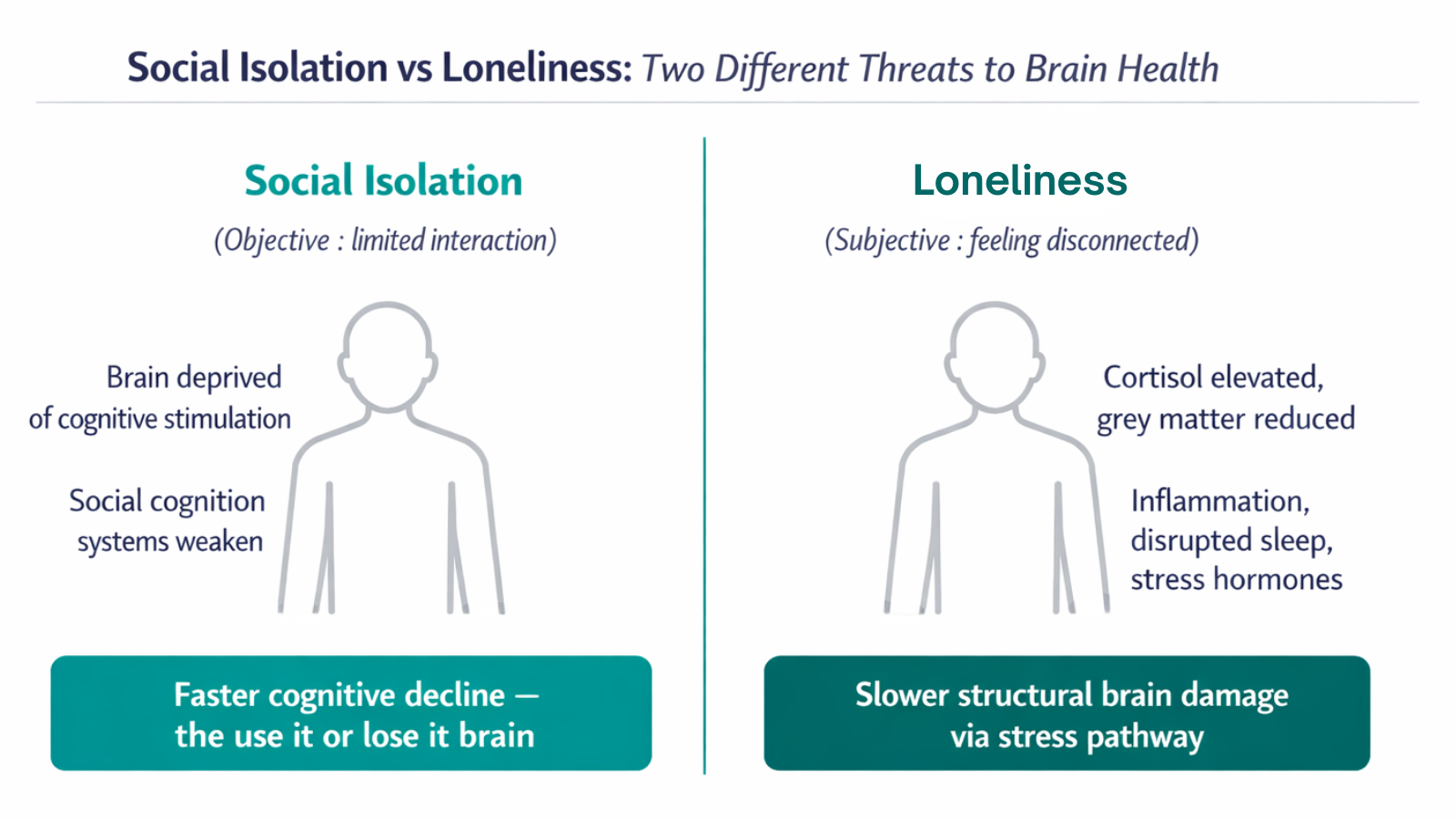
The practical implication is stark: you can feel perfectly content in your own company whilst your brain is quietly declining from lack of social stimulation. And you can feel desperately lonely in a crowded room and be accumulating a different kind of harm. What your brain needs isn’t the feeling of connection — it’s the actual engagement. You have to show up.
The scale of the problem has prompted government action. The UK and Japan have both established ministries specifically addressing loneliness. The US Surgeon General declared it a public health epidemic, comparing chronic isolation’s mortality risk to smoking 15 cigarettes daily.
What Social Connection Does to Your Brain Structure
Social connection and brain health are linked at the structural level. Larger social networks correlate with larger amygdala volume — the brain region processing social and emotional information. People with more social contacts show greater grey matter in regions relevant to social cognition including the prefrontal cortex, insula, and posterior superior temporal cortex.
The relationship appears bidirectional. Social connection promotes cognitive skills, and cognitive skills facilitate social connection. Strong social ties protect against decline, whilst declining cognition can limit social participation, creating a potentially vicious cycle.
Conversely, chronic social isolation causes measurable brain damage. Research shows reduced volume in the prefrontal cortex, hippocampus, amygdala, and insula. There’s also evidence of myelin damage — the insulating layer on nerve fibres that allows rapid communication between brain regions.
This myelin disruption particularly affects emotion regulation and executive function circuits. It may explain why socially isolated individuals show higher rates of depression, anxiety, and cognitive difficulties.
The good news? The brain maintains plasticity. Damage from isolation can be repaired when meaningful social connection is restored. Your brain adapts to both isolation and reconnection.
Quality Trumps Quantity: The Type of Social Connection That Benefits Brain Health
Having 500 social media followers doesn’t provide the same cognitive benefits as three close friends you see regularly.
Research consistently shows that quality of relationships matters more than quantity. A few close, meaningful relationships appear more beneficial than many superficial connections. Depth trumps breadth.
What constitutes “quality” connection? Research points to several factors: relationships involving genuine emotional intimacy and mutual support; interactions requiring substantive conversation rather than superficial pleasantries; activities done together that require coordination and communication; relationships characterised by trust, reciprocity, and genuine interest in each other’s lives.
Interestingly, different types of social ties serve different cognitive functions. Research distinguishes between “bridging” ties (loose connections providing cognitive stimulation through novel information and perspectives) and “bonding” ties (close relationships providing emotional support and frequent interaction). Both contribute to cognitive health, but in different ways.
For workplace cognitive performance, this has practical implications. The colleague you chat with about projects provides different cognitive benefits than the close friend you confide in about personal matters. Ideally, you want both types of connection.
QUICK WIN:
Audit your social connections this week. Write down the three people you have the most substantive conversations with. If the list is short or the conversations are mostly transactional, that’s useful information. You don’t need a large network — you need a few people you genuinely talk with.
The Stress Connection: How Social Bonds Protect Brain Health
Chronic stress damages brain structures — particularly the hippocampus, critical for memory formation. Social connection buffers against this damage through multiple mechanisms.
When you feel supported, your hypothalamic-pituitary-adrenal axis (the stress response system) functions more healthily. Cortisol levels remain within optimal ranges rather than chronically elevated. This protects the hippocampus from stress-related atrophy.
Social connection also promotes oxytocin release, which directly counters stress responses and fosters positive emotion. People with strong social ties show lower inflammatory markers and better immune function.
After particularly stressful work periods, proper conversations with family or friends provide genuine cognitive reset. Those “interruptions” aren’t actually interruptions — they’re necessary maintenance for optimal brain function.

For more on managing stress for peak mental performance, see my guide to stress management techniques that complement strong social connections.
Social withdrawal is also one of the earliest signs of developing burnout — and one of the things that makes it worse. For a full recovery framework, see our guide on how to recover from mental burnout.
Age and Social Connection: Why Brain Health Requires More Effort Over Time
The cognitive benefits of social connection and brain health become increasingly important with age.
The Framingham Heart Study, which has tracked thousands of people for decades, has produced consistent evidence that regularly interacting with family, friends, and others helps protect cognitive function with age.
Chronic loneliness and social isolation increase dementia risk in older adults by approximately 40–50%, depending on the study. This remains significant even after controlling for demographics, health behaviours, and other risk factors.
The mechanisms appear related to both cognitive reserve (built up through years of social engagement) and ongoing cognitive stimulation. Older adults who maintain active social lives continue exercising the complex cognitive skills required for social interaction.
However, ageing can disrupt social connection through multiple pathways. Retirement removes workplace social networks. Mobility limitations restrict participation in activities. Friends and family members die or move away. Health conditions and hearing loss make socialising more difficult.
This creates particular vulnerability. Just when social connection becomes most important for maintaining cognitive function, it often becomes harder to maintain. Addressing this requires intentional effort rather than assuming social engagement will happen naturally.
Practical Applications: Building Brain-Healthy Social Connection
Understanding the neuroscience is one thing. Actually building and maintaining meaningful social connections is another, particularly for those of us who find it cognitively draining.
Prioritise face-to-face interaction. Whilst digital communication maintains relationships, face-to-face conversation provides richer cognitive stimulation through reading body language, managing real-time interaction dynamics, and responding to subtle social cues. Video calls are better than text-only but still inferior to in-person interaction.
Schedule rather than hope. Put coffee with a friend in your calendar like any other meeting. Treat it as essential maintenance, not optional leisure. Social connection and brain health require the same deliberate attention as sleep or exercise — they don’t happen automatically.
Focus on activities that require genuine interaction. Watching television together provides less cognitive benefit than playing games, cooking together, or working on projects. The conversation and coordination matter more than simply being in the same space.
Join groups aligned with your interests. Book clubs, sports teams, community organisations, or hobby groups provide both regular social contact and shared purpose. The combination appears particularly beneficial for cognitive health.
Develop intergenerational connections. Research on programmes connecting older and younger adults shows cognitive benefits for both groups. Different perspectives and experiences provide novel cognitive stimulation.
For introverts (like me), quality over quantity becomes even more important. A few deep conversations are genuinely more beneficial than many superficial interactions. Don’t force yourself into large group settings if they’re genuinely exhausting. Find social formats that work for your temperament whilst still providing substantive interaction. The goal isn’t becoming someone you’re not — it’s ensuring your brain gets the social stimulation it needs for optimal function.
For a broader view of where social connection sits relative to your other cognitive habits, take our Mental Performance Checklist, which allows you to reflect on how you’re doing in ten areas of mental performance.
When Work Is Your Main Social Context
Many knowledge workers spend most waking hours at work. This makes workplace social connections particularly important for brain health.
Research suggests that meaningful work relationships — colleagues you genuinely talk with rather than just coordinate with — contribute to cognitive resilience. Water cooler conversations aren’t wasted time. They’re cognitive maintenance.
Remote work complicates this. Video calls for work tasks don’t provide the same informal interaction as office environments. You need to be more intentional about maintaining workplace social connections when working remotely. Schedule virtual coffee chats. Join online communities related to your field. Participate in collaborative projects that require genuine back-and-forth discussion.
However, work relationships alone aren’t sufficient. You need social connections outside your professional identity. When work is your only source of social interaction, you’re cognitively vulnerable to work disruptions like redundancy or retirement.
The Dark Side: When Social Connection Becomes Cognitive Drain
Not all social interaction benefits your brain. Toxic relationships, constant conflict, and obligation-based socialising without genuine connection can be cognitively draining rather than restorative.
Research distinguishes between “enriching” and “straining” social ties. Relationships characterised by criticism, demands, and disappointment activate stress responses rather than providing cognitive benefits.
You don’t need to maintain every relationship for brain health. Quality genuinely matters more than quantity. A few nourishing relationships outperform many draining ones. Listen to your own patterns — notice which interactions leave you energised versus which leave you genuinely depleted. Build your social life around the former whilst minimising the latter.
Social Connection, Brain Health, and Other Mental Performance Strategies
Social connection and brain health don’t exist in isolation from other factors affecting cognitive performance.
Poor sleep quality makes social interaction more difficult and less rewarding. Social withdrawal can be an early sign of inadequate rest. Prioritise sleep to maintain the energy for meaningful social engagement.
Regular physical exercise provides both direct cognitive benefits and opportunities for social connection through group activities. Walking groups, sports teams, or exercise classes combine both benefits.
Chronic stress makes you withdraw from social contact precisely when you need it most. Managing stress through other techniques — mindfulness, exercise, time management — preserves your capacity for social engagement.
Think of social connection as one component of comprehensive brain health rather than an isolated factor. It interacts with sleep, exercise, nutrition, and stress management to determine your overall cognitive performance.
QUICK WIN:
Pick one group activity — a class, club, walking group, or community event — that you’ve been meaning to try and book it this week. The combination of social interaction and shared purpose is one of the most cognitively beneficial combinations the research identifies. You don’t have to love it. Just go once and see.
Conclusion: Your Brain Needs People (Even If You Don’t Always Want Them)
Writing this article has forced me to confront my own patterns. I’m naturally inclined toward solitary work. Deep focus comes easily when I’m alone. Social interaction, even enjoyable conversation, requires effort.
But the research on social connection and brain health is unambiguous. My brain needs people, whether I always want them or not. Meaningful social connection isn’t optional for optimal cognitive function — it’s essential.
The good news is that “meaningful connection” can be achieved through formats that work for different temperaments. You don’t need constant socialising or large friend groups. A few quality relationships with regular interaction provide substantial cognitive benefits.
The challenge is treating social connection as seriously as you treat sleep, exercise, and nutrition. It’s not a luxury or optional extra. It’s fundamental brain maintenance.
If you’re like me — someone who finds social interaction effortful despite understanding its importance — start small. Schedule one 15-minute coffee chat with a friend or colleague this week. Put it in your calendar like any other appointment. Notice how your thinking feels afterwards.
Your brain will thank you. Even if you need to go be alone afterwards to recover, that brief interaction provided cognitive benefits you simply cannot get any other way. People aren’t just pleasant company. They’re necessary for your brain to function at its best. That’s not philosophy — that’s neuroscience.
For more evidence-based strategies to optimise cognitive performance, see my comprehensive guide on how to improve mental performance.
RESOURCES:
I only recommend resources that I either use personally or have researched and feel are genuinely helpful for my readers. Resources sometimes contain affiliate links; if you purchase through these, I may earn a small commission at no extra cost to you.
Recommended reading
The Village Effect: Why Face-to-Face Contact Is Good for Our Health, Happiness, Learning and Longevity — Susan Pinker. The most accessible and evidence-rich account of why in-person social connection matters more than digital alternatives — directly relevant to every section of this article. Paperback
The Loneliness Epidemic: Why So Many of Us Feel Alone — And How Leaders Can Respond — Susan McPherson. Covers the public health dimension of social isolation and practical responses — useful context for understanding why governments are treating this as a crisis. Paperback
Related Articles
How to Improve Mental Performance — The complete framework for optimising your cognitive output.
Stress Management for Mental Performance — How chronic stress interacts with social isolation to compound cognitive damage.
Sleep and Cognitive Function — Poor sleep and social withdrawal reinforce each other — understand the connection.
Mindfulness for Focus — Attentional training that complements the cognitive benefits of social engagement.
Maintain Mental Energy — How to protect cognitive resources so you have the capacity for meaningful social interaction.
I'm Simon Shaw, a Chartered Occupational Psychologist with over 20 years of experience in workplace psychology, learning and development, coaching, and teaching. I write about applying psychological research to everyday challenges - from habits and productivity to memory and mental performance. The articles on this blog draw from established research in psychology and behavioural science, taking a marginal gains approach to help you make small, evidence-based changes that compound over time, allowing you to make meaningful progress in the areas you care about most.