
The GROW Coaching Model: How to Coach Yourself
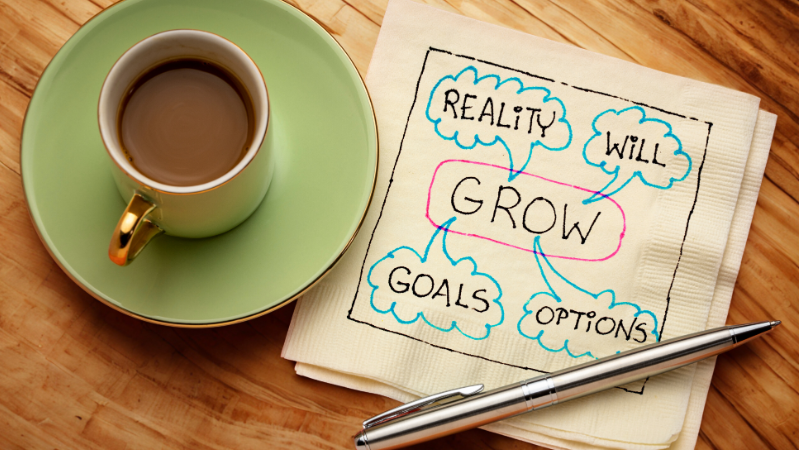
Most of us have areas of our lives we’d like to change — a career that feels stuck, a fitness goal we keep putting off, a relationship that could be better. The frustrating part isn’t usually a lack of motivation. It’s not knowing where to start, or getting tangled up in thoughts that go nowhere.
That’s exactly the problem the GROW coaching model was designed to solve. Originally developed as a professional coaching framework, the GROW model turns out to be just as powerful when you use it on yourself. No coach required, no expensive programme to sign up for — just a structured way of thinking that helps you move from “I know something needs to change” to “here’s what I’m going to do about it.”
In this article, I’ll walk you through the GROW coaching model step by step, with practical questions and a real-life example to show how it works. By the end, you’ll have everything you need to run your own self-coaching session.
What Is the GROW Coaching Model?
The GROW coaching model is a framework developed in the 1980s by Sir John Whitmore and colleagues Graham Alexander and Alan Fine. Whitmore popularised it through his influential book Coaching for Performance, and it has since become the most widely used coaching framework in the world — used by everything from FTSE 100 companies to the NHS.
GROW is an acronym for the four stages of the model: Goal, Reality, Options and Will (sometimes called Way Forward). Each stage asks a different type of question, and together they move you from a vague sense of dissatisfaction to a clear, committed plan of action.
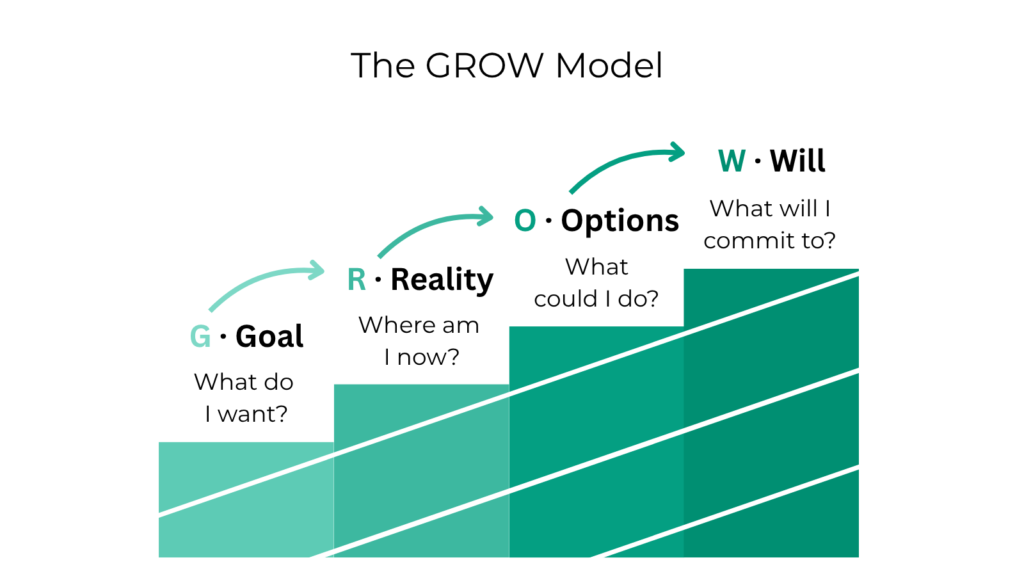
What makes the GROW coaching model particularly useful for self-coaching is its underlying philosophy: you already have more answers than you think. The model doesn’t tell you what to do — it creates the conditions for you to figure it out yourself. As Whitmore himself put it, the goal of coaching is to help people find their own way forward, not to hand them someone else’s solutions.
That principle holds whether you’re working with a professional coach or sitting quietly with a notebook on a Sunday afternoon.
Why Use a Coaching Model on Yourself?
When most people try to think through a problem, they end up going in circles. The same thoughts surface, the same objections arise, and nothing much changes. This isn’t a failure of intelligence — it’s what happens when thinking lacks structure.
The GROW coaching model provides that structure. It stops you from jumping straight to solutions before you’ve properly understood the problem. It prompts you to consider options you might not have thought of. And crucially, it moves you towards a concrete commitment rather than leaving things as vague intentions.
As a Chartered Occupational Psychologist, I’ve used coaching frameworks with clients for over two decades. The single most consistent observation I can share is this: the quality of the questions you ask yourself determines the quality of the insights you get. The GROW coaching model gives you better questions.
QUICK WIN:
Before you read on, think of one area of your life you’d like to improve — something specific, not just “be happier” or “get fitter.” Write it down in a single sentence. That’s your starting point for your first GROW coaching model session.
Before You Start: Choose Your Coaching Topic
A self-coaching session works best when you have a specific focus. If you try to work on “my life in general,” you’ll end up running in circles. Pick one area — a career decision, a health goal, a relationship challenge, a habit you want to build — and hold that in mind throughout.
A useful way to identify your topic is to ask: “Which area of my life, if I improved it, would make the biggest difference to how I feel?” Write your answer down in one or two sentences. Being specific about what you’re bringing to the session makes everything that follows easier and more productive.
G — Goal: What Do You Actually Want?
The first stage of the GROW coaching model asks you to get clear on what you want. This sounds straightforward, but most people find it harder than expected. We’re often much clearer about what we don’t want (“I don’t want to feel this stressed”, “I don’t want to stay in this job”) than what we actually do want.
The Goal stage asks you to flip that around: rather than remaining rooted in what you want to move away from, you’re stating what you’re moving towards.
Three Types of Goal
One of the most useful distinctions in coaching is between your end goal, your journey goals, and your session goal. Understanding the difference helps you avoid the common trap of setting goals that are either too vague to act on or so overwhelming they cause you to freeze.
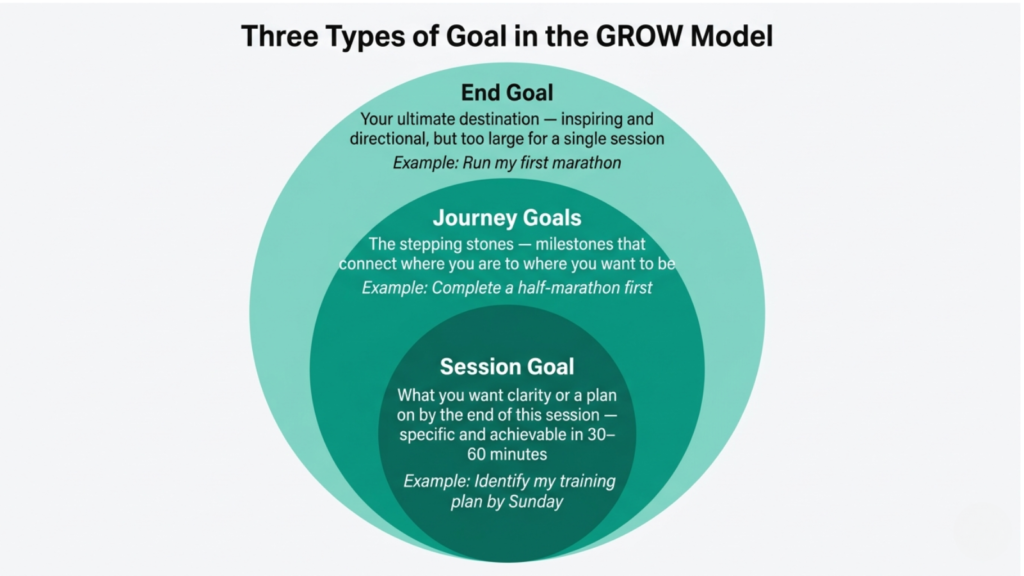
Your end goal is your ultimate destination — the big picture of what you want to achieve. “Run my first marathon.” “Move into a leadership role.” “Build a relationship where I feel genuinely heard.” End goals are inspiring and directional, but they’re too large to tackle in a single session.
Your journey goals are the stepping stones between where you are now and where you want to be. If your end goal is to run a marathon, your journey goals might include finding a training plan, building up to running five times a week, and completing a half-marathon first.
Your session goal is what you want to have clarity, a decision, or a plan on by the end of this specific self-coaching session — something concrete and achievable within 30 to 60 minutes of focused thinking. “By the end of this session, I want to know which three roles I’m going to apply for.” Starting with a session goal keeps the GROW coaching model manageable and means you’ll finish with something useful, rather than a vague sense of having thought about things.
Questions to Ask Yourself in the Goal Stage
(Use as many of these as are helpful in defining your goal).
- What do I want in this area of my life?
- What would be the most helpful thing I can take away from this session?
- What would a 10 out of 10 look like here?
- What would I like to have achieved by the end of this session?
- How will I know when I’ve reached my goal?
- Is this goal something I genuinely want, or something I feel I should want?
That last question matters more than it might seem. Goals that belong to someone else — a parent’s ambition, a partner’s expectation, society’s definition of success — tend not to sustain motivation when things get difficult. The best goals are genuinely yours.
For more on ensuring that your goals that are truly motivating, see our article how to set goals you’ll actually keep.
R — Reality: Where Are You Now?
Once you have a clear goal, the Reality stage of the GROW coaching model asks you to take an honest look at where you currently are. The purpose isn’t to dwell on problems — it’s to build an accurate picture of your starting point, because without that, any plan you make will be built on assumptions rather than facts.
This is the stage most people rush through, and that’s a mistake. The more honestly you explore your current reality, the more clearly you can see what needs to change and what resources you already have to work with.
Questions to Ask Yourself in the Reality Stage
- What’s the current situation in this area of my life?
- What’s already working, even partially?
- What have I already tried, and what happened?
- On a scale of 1 to 10, how satisfied am I with this area right now?
- What’s really stopping me from making progress?
- What am I contributing to this situation — even if I’d rather not admit it?
That final question is worth sitting with. It’s not about blame — it’s about agency. If you can identify ways in which you’re contributing to your current situation, you can also identify ways in which you have the power to change it. Our article on challenging self-limiting beliefs explores this further.
A useful tool at this stage is a simple 1–10 satisfaction rating. If you rate your current situation as a 4, ask yourself: what would make it a 5? Not a 10 — just one step better. This tends to surface practical, achievable insights rather than abstract ideals.
QUICK WIN:
Take the topic you identified at the start of this article. Write three honest answers to this question: “What’s really stopping me from making progress here?” Don’t filter or self-censor — write whatever comes to mind. The third answer is usually the most revealing. That’s your Reality stage in action.
O — Options: What Could You Do?
This is the creative stage of the GROW coaching model, and it’s often the most energising. Having looked honestly at where you are and where you want to be, you now generate as many possible ways forward as you can think of.
The key word is generate. The Options stage is not the time to evaluate, filter, or immediately dismiss ideas as impractical. That comes later. Right now, you want quantity over quality — because the best option is often not the first one that comes to mind.
A useful technique here is to ask yourself: “What would I do if I knew I couldn’t fail?” or “What would I do if I had unlimited time and resources?” These questions aren’t meant to produce realistic plans — they’re designed to loosen up thinking that has become constrained by habit or fear. The practical version of an impossible idea is often a perfectly good one.
Questions to Ask Yourself in the Options Stage
- What could I do to move closer to my goal?
- What else could I do? (Ask this a few times until you’ve really exhausted the possibilities.)
- What would I do if the usual obstacles weren’t there?
- What would someone I admire do in this situation?
- What’s the smallest possible action that would still move things forward?
- What’s the easiest / quickest / most energising thing I could do?
- What have I not tried yet because I’ve assumed it wouldn’t work?
Once you have a reasonable list — aim for at least five options — you can start to evaluate them. For each one, ask: how much control do I have over this? How practical is it, given my actual circumstances? How closely does it align with my goal? You’re looking for options that sit in the sweet spot of impactful and achievable.
One thing worth noting: the best action isn’t always the boldest one. Small, consistent steps tend to outperform dramatic gestures in almost every domain of personal development. If you’re interested in how that principle applies more broadly, our articles on the science of habit formation and the two-minute habit rule are worth exploring alongside your GROW coaching model work.
W — Will: What Are You Going to Do?
The final stage of the GROW coaching model is where self-coaching separates itself from ordinary thinking. The Will stage turns your best options into a genuine commitment — specific actions, with timescales, that you actually intend to carry out.
This is where most self-improvement efforts fall down. People think carefully about what they want and what they could do, then leave with a vague intention to “work on it.” The Will stage closes that gap by asking you to be precise about what happens next.
Questions to Ask Yourself in the Will Stage
- Which of my options am I going to act on?
- What specifically will I do, and by when?
- On a scale of 1 to 10, how committed am I to doing this?
- What might get in the way, and how will I handle it?
- Who else might be affected by my plans, and do I need to involve them?
- What could stop me from taking action, and what will I do to ensure this doesn’t happen?
The commitment scale question — “how committed am I on a scale of 1 to 10?” — is borrowed directly from professional coaching practice, and it’s remarkably useful. If your answer is 7 or below, your action plan probably needs adjusting. Either the action is too ambitious, the timing is wrong, or there’s an obstacle you haven’t properly addressed yet. A score of 8 or above is a much more reliable predictor of follow-through.
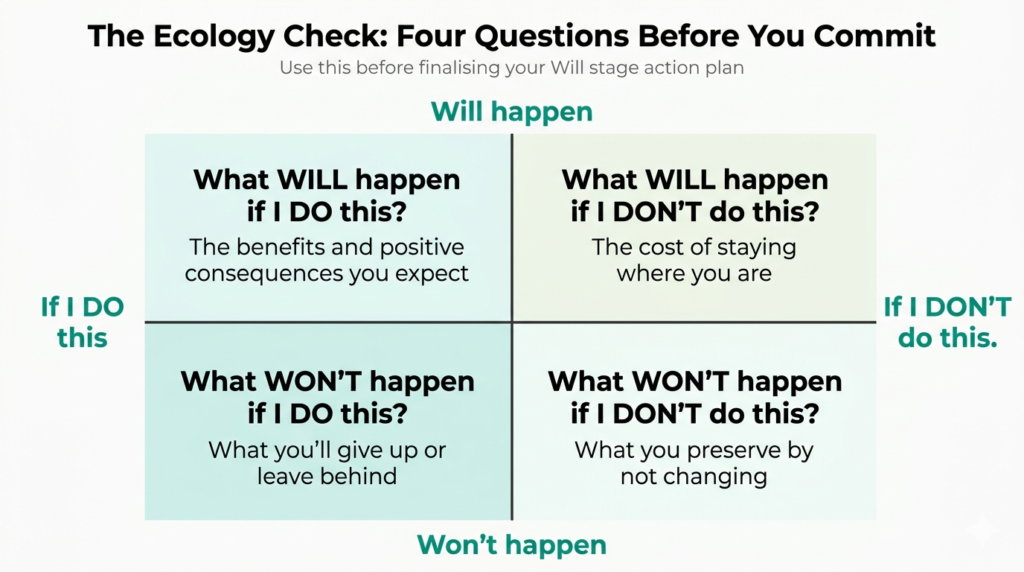
The question about who else might be affected is sometimes called an ‘ecology check in coaching’. It’s a prompt to think about the wider impact of your plans — not to talk yourself out of change, but to anticipate any complications early.
Before you finalise your action plan, it’s worth running a quick ecology check — a simple four-question exercise borrowed from professional coaching practice. The idea is to stress-test your chosen action by examining it from four angles: what happens if you do it, what happens if you don’t, what won’t happen if you do it, and what won’t happen if you don’t. This last question is the most subtle — it surfaces what you’re preserving by staying put, which is often the real source of resistance. Work through the four quadrants in the diagram below with your chosen action in mind. If your answers feel balanced and you’re still committed, you’re ready to act. If a quadrant surfaces a significant concern you hadn’t considered, go back into the Options stage and explore further before committing.
You can also use the WOOP model to strengthen at the Will stage. Where GROW asks “What will you do?”, WOOP asks “What will get in your way, and how will you respond?” The two work beautifully together: use GROW to define your goal and options, then run a WOOP to prepare yourself for following through.
The GROW Coaching Model in Practice: A Worked Example
To see how the GROW coaching model works in real life, here’s a brief example of someone using it to coach themselves through a common situation — feeling stuck in a career that no longer feels right.
Goal: My end goal is to move into a role that uses my skills more creatively. For this session, I want to identify three specific job types I could realistically move into within the next 12 months.
Reality: I’ve been in my current role for four years. I’m competent but bored, and I’ve been putting off doing anything about it because I’m not sure what I want. My current satisfaction with my career is about a 3 out of 10. I haven’t spoken to anyone about it, and I haven’t updated my CV in three years. I’m contributing to the situation by staying passive.
Options: I could speak to a career coach; research job boards to see what’s out there; ask colleagues in roles I’m curious about what their day-to-day looks like; take an online skills assessment; update my LinkedIn profile; reach out to my professional network; sign up for a short course to build a new skill; apply for an internal transfer.
Will: I’m going to research three job categories on two job boards this weekend, and I’ll reach out to two contacts in different fields to ask for a 20-minute conversation. I’ll do this by Sunday evening. Commitment: 9 out of 10. The main obstacle is finding time — I’ll block two hours on Saturday morning to make sure it happens.
Notice that the output isn’t a grand life plan. It’s two specific, time-bound actions with a concrete deadline. That’s exactly what the Will stage of the GROW coaching model is designed to produce.
Tips for Getting the Most Out of the GROW Coaching Model
A few practical observations from coaching experience that will make your GROW sessions more productive.
Write things down. There is a significant difference between thinking through the GROW questions in your head and writing your answers on paper. Writing slows down your thinking, forces you to be more precise, and creates a record you can return to. A notebook works perfectly well — you don’t need an app or a template.
Don’t rush the Reality stage. The urge to jump straight to solutions is almost universal, and almost always counterproductive. The more honestly you examine your current situation, the better your options will be. Give yourself at least as much time on Reality as you do on Options.
Revisit your goal as you go. It’s normal to find that your goal changes slightly as you work through the GROW coaching model. Sometimes exploring Reality reveals that what you thought you wanted isn’t quite right. That’s not a problem — it’s the model working as intended. Adjust your goal and continue.
Be honest about commitment in the Will stage. A commitment score below 8 is useful information, not a failure. It tells you that something in your plan needs to change before you act. Take that seriously rather than pushing forward on a shaky foundation, otherwise you run the risk of self-sabotaging your goal.
Build in accountability. One of the advantages of working with a professional coach is that someone else knows what you’ve committed to. You can replicate this to some extent by telling a trusted friend or colleague what you’re planning to do and by when. The psychological research on commitment and follow-through consistently shows that making intentions known to others increases the likelihood of acting on them.
If you find the GROW coaching model helpful but want to go deeper, it connects naturally with other areas of personal development. Understanding your core values, for example, makes the Goal stage considerably more powerful — goals that align with what you genuinely care about are far more motivating than those that don’t. And if you find that the same obstacles keep appearing in your Reality stage, it may be worth exploring whether patterns of overthinking are getting in the way of clear thinking.
QUICK WIN:
Set aside 30 minutes this week for your first GROW coaching model session. Block it in your calendar now, treat it like any other appointment, and bring a notebook. Work through all four stages on the topic you identified at the start of this article. The structure does the heavy lifting — you just need to show up and answer the questions honestly.
The GROW Coaching Model and Professional Coaching
Self-coaching with the GROW coaching model is genuinely effective for most everyday goals and decisions. There are situations, however, where working with a professional coach adds significant value — complex career transitions, deeply entrenched patterns of behaviour, or goals where the emotional stakes are high enough that objectivity is hard to maintain on your own.
A professional coach brings something that self-coaching can’t fully replicate: the experience of being truly heard by another person, challenged by someone who isn’t emotionally invested in your situation, and held accountable in a way that most of us find more motivating than self-accountability alone. Research consistently shows that coaching interventions improve goal attainment, resilience and wellbeing across professional and personal contexts.
That said, the GROW coaching model itself doesn’t require a professional coach to be useful. The framework is solid, the questions work, and the discipline of working through all four stages — rather than just the first two — makes a real difference to outcomes. Start with self-coaching and see where it takes you.
A Final Thought
The GROW coaching model has been around for over 40 years because it reflects something true about how change actually happens: clarity comes before action, and commitment matters more than enthusiasm. Most people skip the first two stages and go straight to deciding what they’ll do, which is why so many plans fail to survive first contact with reality.
Working through Goal, Reality, Options and Will in sequence — even just once, even informally — tends to produce better decisions and more follow-through than unstructured thinking, no matter how motivated you feel at the start. Give it a try on something that matters to you. The GROW coaching model is simple. The insight it generates often isn’t.
If you found this useful, a useful next step could be for you to learn more about the common mistakes people make when forming new habits when embedding new habits — because even the best coaching framework needs consistent follow-through to produce lasting results.
QUICK WIN:
The GROW coaching model works best on paper, not just in your head. Open a notebook to a blank page right now. Write the four headings — Goal, Reality, Options, Will — with space between each. Then answer just the first question under Goal: “What do I want in this area of my life?” That single sentence is enough to start. The rest follows naturally.
RESOURCES:
I only recommend resources that I either use personally or have researched and feel are genuinely helpful for my readers. Resources sometimes contain affiliate links; if you purchase through these, I may earn a small commission at no extra cost to you.
Recommended Reading
Coaching for Performance by Sir John Whitmore — The original book that introduced the GROW coaching model to a mainstream audience. Still the best single introduction to coaching philosophy and practice. Paperback
The Coaching Manual by Julie Starr — A practical and accessible guide to coaching skills that works equally well for self-coaching and for anyone who coaches others. Paperback
Related reading on Marginal Gains:
Why Habits Fail: 12 Common Mistakes and How to Avoid Them — Understanding the obstacles that can undermine the commitments you make in the Will stage
The Two-Minute Rule for Habits — Turning GROW model commitments into lasting behaviour change
Willpower and Habit Formation — The psychology of commitment and follow-through
How to Stop Overthinking — Clearing the mental clutter that blocks clear thinking in the Reality stage
Habit Formation Guide — The complete guide to turning Will stage commitments into automatic behaviours
How to Maintain Mental Energy — Protecting the cognitive resources you need for effective self-coaching
I'm Simon Shaw, a Chartered Occupational Psychologist with over 20 years of experience in workplace psychology, learning and development, coaching, and teaching. I write about applying psychological research to everyday challenges - from habits and productivity to memory and mental performance. The articles on this blog draw from established research in psychology and behavioural science, taking a marginal gains approach to help you make small, evidence-based changes that compound over time, allowing you to make meaningful progress in the areas you care about most.